惠氏启赋

Search documents
雀巢CEO深夜出镜道歉,损失到底是“0.5%”还是104亿?
Sou Hu Cai Jing· 2026-01-15 02:25
Core Viewpoint - A global recall of infant formula has led to a trust crisis for Nestlé, with the new CEO publicly apologizing and emphasizing food safety as a core value, yet revealing vulnerabilities in supply chain management [1][3]. Group 1: Recall Incident - The recall was triggered by a batch of oil containing ARA that may have been contaminated with Bacillus cereus toxin, causing alarm among parents worldwide [3]. - The recall list includes products like Nestlé NAN, BEBA, and Wyeth Illuma, with Nestlé claiming it is a "preventive measure" and reporting "zero confirmed cases," but parents' anxiety has escalated [5]. Group 2: Communication and Response - There are criticisms regarding the delayed global notification after the issue was discovered in December, with Nestlé stating it needed to coordinate with regulators, but this was perceived as a slow response in the age of rapid information dissemination [5][6]. - The CEO's video apology was seen as a rare move for Nestlé, but it was pre-recorded and lacked interactive engagement, leading to perceptions of it being a "one-way apology" [6]. Group 3: Supply Chain Vulnerabilities - The incident highlights the fragility of multinational supply chains, with the identity of the raw material supplier remaining undisclosed, raising concerns about the reliance on a few suppliers for high-end additives like ARA [6][8]. - Jefferies estimates the potential loss could reach 1.2 billion Swiss francs, significantly higher than Nestlé's own estimate of a 0.5% sales impact, particularly affecting the sensitive Chinese market [8]. Group 4: Future Implications - The CEO's commitment to "restore supply around the clock" is viewed as a gamble, with challenges in production line changes, supply chain audits, and rebuilding market confidence ahead [8][9]. - Nestlé is attempting to turn the crisis into an opportunity for quality upgrades by initiating a thorough review of suppliers, which could potentially attract cautious parents if executed transparently [9]. Group 5: Industry Landscape - The incident underscores a harsh reality in the infant formula industry where safety is paramount, and any lapse in raw material quality can lead to catastrophic consequences for brands [10]. - With regulatory bodies intensifying scrutiny, the infant formula sector may undergo significant cleansing, making the forthcoming quality control measures and supplier transparency critical for Nestlé's recovery [10][12].


波及31国!雀巢CEO就“奶粉召回事件”致歉
Guo Ji Jin Rong Bao· 2026-01-14 15:17
Core Viewpoint - Nestlé's CEO, Philipp Navratil, publicly apologized for a recent infant formula recall, emphasizing the company's commitment to food safety and consumer trust [6][11]. Group 1: Recall Details - The recall was initiated due to quality issues found in an ingredient supplied to a Nestlé factory in the Netherlands, which may contain a harmful toxin [7]. - The recall affects specific batches of infant formula sold in 31 countries, including brands like Nestlé BEBA and Wyeth [7][8]. - In China, 71 batches of infant formula are being recalled, including products sold through cross-border e-commerce [8]. Group 2: Regulatory Response - The Chinese government has expressed significant concern over the recall, urging Nestlé to take responsibility and protect consumer rights [9]. Group 3: Financial Impact - The recalled products account for less than 0.5% of Nestlé's total sales, indicating that the overall financial impact may not be substantial [12]. - However, Jefferies estimates potential sales losses of approximately 1.2 billion Swiss francs, representing about 1.3% of the company's annual sales [12]. Group 4: Market Context - Nestlé faces growth challenges, particularly in the Greater China region, where the infant nutrition segment is one of the few growth drivers [13]. - The competitive landscape in China's infant formula market is intensifying, with local brands increasing their market presence [13].
雀巢“渡劫”?惠氏中国员工批量“毕业”震荡未平,婴配粉又陷全球召回危机
3 6 Ke· 2026-01-08 04:17
Core Viewpoint - Nestlé is currently facing a dual crisis involving a global recall of infant formula products due to quality issues with raw materials and internal restructuring challenges following the merger of its Wyeth and infant nutrition businesses in China [1][10][16]. Internal Challenges - The merger of Wyeth and Nestlé's infant nutrition business in China has led to significant personnel optimization, with reports of a 30%-50% reduction in frontline staff across various provinces [3][4]. - Employees who remain are experiencing management voids and unclear operational processes, leading to difficulties in executing their roles effectively [4][6]. - The restructuring has resulted in a lack of support for sales activities, with many products experiencing price increases and reduced promotional activities, further complicating sales efforts for remaining staff [6][12]. External Crisis - Nestlé has initiated a global recall of multiple batches of infant formula due to potential contamination with a toxin from a supplier's raw material, which poses health risks to infants [10][12]. - The recall has expanded to include products sold through cross-border e-commerce channels in China, with significant consumer concern leading to the formation of advocacy groups for product returns [10][11]. - Despite the recall being labeled as a preventive measure, the potential impact on brand trust, especially in the sensitive infant nutrition market, is significant [12][16]. Market Context - The merger and subsequent challenges come at a time when Nestlé's performance in the Greater China region has been under pressure, with an organic growth rate of -6.1% reported for the first three quarters of 2025 [16]. - The global strategy includes a plan to lay off approximately 16,000 employees, representing 6% of the workforce, aimed at optimizing cost structures and accelerating transformation [16].
雀巢在欧洲多国召回婴儿奶粉 雀巢中国回应:少数产品或受影响 已回收特定批次奶粉
Xin Lang Cai Jing· 2026-01-07 05:13
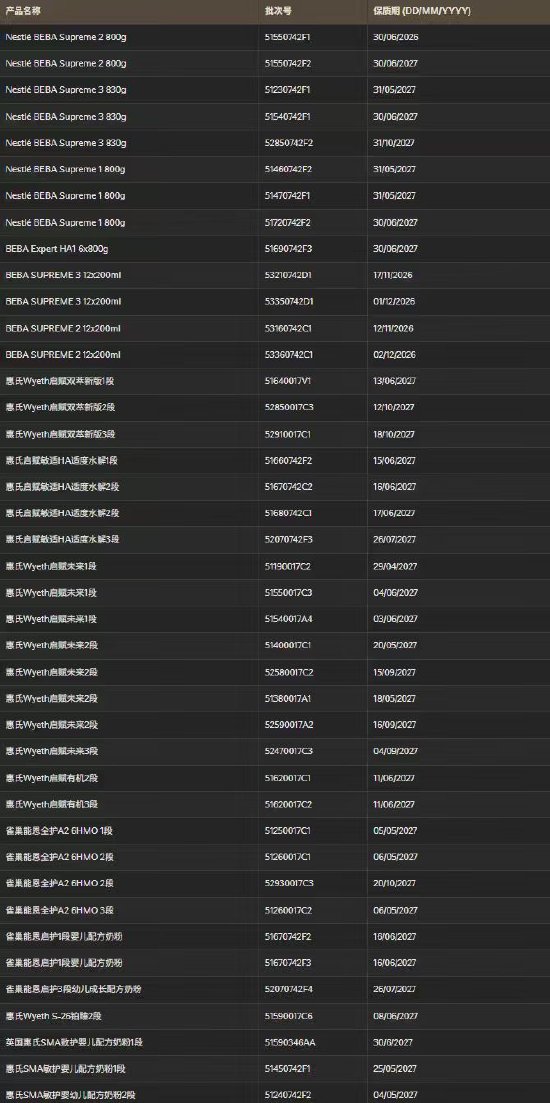
Core Viewpoint - Nestlé has announced a precautionary recall of infant formula in several European countries due to quality issues with a specific ingredient provided by a supplier, although no adverse health reports have been received so far [1][6]. Group 1: Recall Details - The recall affects infant formula products in Germany, Austria, Denmark, Italy, and Sweden [1]. - Nestlé has conducted tests on potentially affected products, specifically focusing on arachidonic acid (ARA) oils and related mixtures [6]. - The company has communicated with relevant authorities in the affected countries to implement necessary measures [6]. Group 2: Response in China - Nestlé China has emphasized that food safety and quality are top priorities, stating that a few products in the Chinese market may be affected [7]. - As a precautionary measure, specific batches of infant formula have been recalled in China, but no adverse health reports have been received related to these products [7]. - All registered and sold special medical purpose infant formula products in mainland China, such as "超启能恩," "启赋," and "S26铂臻," are not affected by the recall [7]. Group 3: Product Information - The company has released images and batch numbers of the recalled products, which have different names in various countries [2][6]. - A detailed list of affected products includes various formulations of "BEBA Supreme" and "Wyeth" brands, with specific batch numbers and expiration dates provided [3][8][9].
达能周志刚或升职:爱他美们与医学营养品一起管
2 1 Shi Ji Jing Ji Bao Dao· 2025-12-10 03:03
Group 1 - Danone is restructuring its leadership in China, appointing Zhou Zhigang to lead its specialized nutrition business starting January 1, 2026, as part of its "Revitalizing Danone" strategy [1][2] - The restructuring aims to create a more streamlined leadership structure to accelerate transformation and enhance focus and agility in operations [1] - Danone's CEO has identified medical nutrition as a significant long-term growth opportunity, with adult medical nutrition in China experiencing double-digit growth annually for over a decade [2] Group 2 - Nestlé is also merging its Wyeth Nutrition and Nestlé infant nutrition businesses into a single unit, effective January 1, 2026, with Joel Seah as the head [3] - The infant formula market is under pressure, with Nielsen IQ reporting a growth rate of only 0.6% in the second quarter of 2025, and a decline in marriage registrations in China by over 20% in 2024 [4] - Despite foreign brands maintaining a brand advantage, domestic brands like Feihe and Yili have surpassed foreign companies in market share as of 2022 [4][5]
达能周志刚或升职:爱他美们与医学营养品一起管丨消费参考
2 1 Shi Ji Jing Ji Bao Dao· 2025-12-10 02:41
Group 1 - Foreign companies are streamlining their operations in China, with Danone appointing Zhou Zhigang as the head of its specialized nutrition business starting January 1, 2026 [1][2] - Danone's organizational restructuring aims to accelerate transformation and enhance focus and agility, aligning with its "Revitalizing Danone" strategy [2][3] - Danone's CEO highlighted medical nutrition as a significant long-term growth opportunity, with adult medical nutrition in China experiencing double-digit growth annually for over a decade [3] Group 2 - Nestlé is also merging its Wyeth Nutrition and Nestlé Infant Nutrition businesses into a single unit, effective January 1, 2026, with Joel Seah as the head [4] - The baby formula market is under pressure, with Nielsen IQ reporting a growth rate of only 0.6% in Q2 2025, and a decline in marriage registrations by over 20% in 2024 [5] - Despite foreign brands maintaining a competitive edge, domestic brands like Feihe and Yili have surpassed foreign companies in market share [5][6]

雀巢婴儿营养与惠氏营养品在华合并,意在重拾增长势头
Xin Jing Bao· 2025-12-03 09:43
Core Viewpoint - Nestlé's Greater China region will establish a new nutrition business unit starting January 1, 2026, merging its infant nutrition business with Wyeth, aiming to enhance organizational efficiency and regain growth momentum in the competitive market [1][2]. Group 1: Business Merger Announcement - Nestlé confirmed the merger of its infant nutrition and Wyeth nutrition units on December 1, 2023, with the new unit set to launch in 2026 [2]. - The merger aims to combine the brand influence of Wyeth's products with Nestlé's industry and channel advantages for sustainable development in a competitive market [2][3]. - The integration will not disrupt existing operations, as Wyeth will continue to operate independently during the transition [2]. Group 2: Historical Context and Market Position - Wyeth has operated independently since its acquisition by Nestlé for $11.85 billion in 2012, which was intended to enhance Nestlé's infant nutrition portfolio [2][3]. - In 2019, Nestlé and Wyeth together held a 17% market share in China's infant formula market, making them the leading company at that time [3]. - The market dynamics have shifted due to declining birth rates and the rise of domestic brands, impacting Wyeth's sales and market position [4][5]. Group 3: Recent Performance and Market Trends - After a decline in sales from 2019 to 2021, Nestlé's infant nutrition business showed signs of recovery in 2022 and 2023, although it faced another downturn in 2024 [6][7]. - As of 2024, Nestlé and Wyeth's combined market share in China's infant formula market is approximately 9.3%, ranking them behind leading brands like Feihe and Danone [7]. - The merger is expected to consolidate their market presence and improve competitive strength amid a challenging environment characterized by high market concentration and strategic competition among brands [7].
新帅在华“动刀”:雀巢、惠氏营养品合并
2 1 Shi Ji Jing Ji Bao Dao· 2025-12-02 23:08
Core Viewpoint - Nestlé is undergoing a significant top-down reform, merging its Wyeth Nutrition and Nestlé Infant Nutrition business units into a single Nestlé Nutrition business starting January 1, 2026, to enhance growth and consolidate its leadership in the Chinese infant nutrition market [1][2]. Group 1: Business Strategy and Market Position - The merger aims to leverage the strong brand influence of Wyeth and S-26 with Nestlé's industry and channel advantages to achieve sustainable growth in a competitive market [5]. - The infant formula market in China is transitioning to a mature phase, with a reported growth rate of only 0.6% in Q2 2025, as the new baby boom is expected to decline [3]. - The ultra-premium segment is becoming mainstream, with a 13.3% year-on-year growth in the ultra-premium+ market, while other segments are experiencing declines [4]. Group 2: Competitive Landscape - The competition in the ultra-premium market is intensifying, as evidenced by Feihe's revenue decline of 9.36% to 9.151 billion yuan in the first half of the year, highlighting the challenges faced by brands in this segment [5]. - Domestic brands like Feihe and Yili have surpassed foreign brands in market share, indicating a shift in the competitive landscape of the infant formula market [5]. Group 3: Organizational Changes and Leadership - Nestlé has recently undergone significant leadership changes, with a new CEO, Frits van Paasschen, appointed in September 2025, emphasizing a performance-driven culture and a focus on growth [7][8]. - The restructuring in Nestlé China, led by CEO Mark Schneider, includes key personnel changes in the coffee and finance sectors, indicating a strategic shift towards more agile management [10]. - The new head of the infant nutrition business, Joel Seah, has a background in the Southeast Asian market, suggesting a strategic inclination towards leveraging regional expertise [11][12].
雀巢,联合作战
Sou Hu Cai Jing· 2025-12-02 17:07
Core Insights - Nestlé is restructuring its operations in the Greater China market by merging its Wyeth Nutrition and Nestlé Infant Nutrition businesses, effective January 1, 2026, with Joel Seah appointed as the head of the new unit [1][10] - This merger is seen as a strategic response to the changing dynamics of the Chinese market, aiming to enhance competitiveness and drive sustainable growth [3][7] - The integration is expected to create significant synergies, leveraging brand strength, product development, and channel resources to capture growth opportunities [12][9] Company Strategy - The merger aligns with Nestlé's broader strategy to simplify its organizational structure and respond more flexibly to market competition, as emphasized by the new CEO, Phil Navratil [3][9] - The integration aims to combine the strong brand influence of Wyeth in the mid-to-high-end market with Nestlé's penetration in the mass market, allowing for comprehensive coverage across different consumer segments [12][10] - Nestlé plans to continue investing in brand and channel development to regain growth momentum and maintain its leadership position in the infant nutrition market in China [10][12] Market Context - The infant formula market in China is undergoing structural adjustments due to declining birth rates and rising costs, with market growth slowing to 0.6% by Q2 2025 [7][9] - The competitive landscape is shifting from "incremental sharing" to "market share acquisition," making resource integration essential for enhancing competitiveness [7][9] - Analysts suggest that the merger will consolidate resources, allowing for more effective competition against other brands in a highly concentrated market [9][12] Leadership and Execution - Joel Seah, with over 20 years of experience in the fast-moving consumer goods sector, is seen as a key figure in ensuring a smooth transition and maximizing the merger's potential [5][14] - The successful integration will depend on addressing cultural differences and ensuring talent retention while fostering innovation tailored to local market needs [14][12] - The new unit is expected to focus on developing customized products that cater to the specific needs of Chinese consumers, enhancing collaboration with local supply chains to reduce costs [14][12]
雀巢、惠氏营养品将被合并
21世纪经济报道· 2025-12-02 09:45
Core Viewpoint - Nestlé is undergoing a significant top-down reform, merging its Wyeth Nutrition and Nestlé Infant Nutrition business units to form a new Nestlé Nutrition business starting January 1, 2026, aiming to strengthen its leadership in the infant nutrition market in China [1][4]. Group 1: Business Strategy and Market Position - The merger is intended to enhance growth momentum and consolidate Nestlé's leadership in the infant nutrition market, which is facing a slowdown due to declining birth rates and market saturation [4]. - The infant formula market in China is experiencing a growth rate of only 0.6% as of Q2 2025, with a significant drop in marriage registrations by over 20% in 2024, indicating a diminishing new-born demographic [4]. - The ultra-premium segment of the market is becoming mainstream, with a year-on-year growth of 13.3% for ultra-premium products, while other segments are experiencing declines [4]. Group 2: Competitive Landscape - The competition in the infant formula market is intensifying, with leading brands like Yili and Feihe expanding their market share, while Nestlé and FrieslandCampina maintain brand advantages [5]. - Feihe reported a revenue decline of 9.36% to 9.151 billion yuan in the first half of the year, highlighting the competitive pressures in the market [5]. - Domestic brands have gained a dominant position in the market, surpassing foreign brands like Nestlé and Friesland in 2022 [5]. Group 3: Financial Performance - Nestlé's organic growth rate in the Greater China region was -10.4% in Q3, continuing a downward trend from Q2, which emphasizes the need for a strategic focus on the infant formula business [6]. - The sales figures for the first nine months of 2025 show a slight decline in total sales compared to the same period in 2024, indicating challenges in maintaining growth [2]. Group 4: Corporate Governance and Leadership Changes - Recent leadership changes at Nestlé include the appointment of a new CEO, who emphasizes a performance-driven culture and a focus on growth opportunities [8][10]. - The restructuring of key positions within the Greater China region, including the appointment of new leaders for the coffee and finance sectors, reflects a strategic shift under the new management [10].