慧播星数字人

Search documents
百度发布最新财报:2025年营收1291亿元 四季度AI业务收入占比43%
Zhong Guo Jing Ji Wang· 2026-02-27 07:44
Core Insights - In 2025, Baidu's total revenue reached 129.1 billion yuan, with AI business revenue at 40 billion yuan, exceeding market expectations [1] - The year 2025 is highlighted as a pivotal year for AI to become Baidu's new core, with strong momentum in AI cloud services [1] - Baidu's AI-native marketing services saw a significant revenue increase of 301% in 2025 [2] Group 1: Financial Performance - Baidu's total revenue for Q4 was 32.7 billion yuan, with AI business revenue accounting for 43% of general business revenue [1] - AI cloud revenue for the full year 2025 grew by 34% year-on-year, with Q4 AI high-performance computing subscription revenue increasing by 143% [1] - The number and amount of winning bids for large models in Baidu's intelligent cloud reached first place for two consecutive years [1] Group 2: User Engagement and AI Applications - Monthly active users of the Baidu App reached 679 million, while Wenxin Assistant had 202 million monthly active users, with a fourfold increase since the launch of the Spring Festival red envelope activity [2] - AI applications surpassed 10 billion yuan in revenue for the year 2025, with the no-code generation platform outperforming in functionality and application quality [2] - The "Luo Bo Kua Pao" service recorded 3.4 million global autonomous driving service instances in Q4, with a year-on-year growth of over 200% [2] Group 3: Technological Advancements - The official version of Wenxin 5.0 was launched, featuring 2.4 trillion parameters and supporting multiple information types [3] - Baidu's ESG performance has shown further improvement, as noted in the S&P Global Sustainability Yearbook 2026 [3]

向市场亮剑,百度2025年Q4 AI业务增长为行业注入信心
Sou Hu Cai Jing· 2026-02-26 22:33
Core Insights - The AI industry experienced significant growth in 2025, with Baidu emerging as a leading player and a benchmark for the sector [1][3] - Baidu's total revenue for 2025 reached 129.1 billion RMB, with AI business revenue accounting for 40 billion RMB, representing 43% of its general business revenue [1][4] Financial Performance - In Q4 2025, Baidu's total revenue was 32.7 billion RMB, showing a year-on-year growth of 5% [2] - AI-related business segments demonstrated robust growth, with AI cloud revenue increasing by 34% year-on-year, and AI high-performance computing subscription revenue soaring by 143% in Q4 [4][5] Strategic Positioning - Baidu's AI business is transitioning from a cost center to a profit center, indicating a shift towards quantifiable revenue streams [4][8] - The company has positioned itself as a leading AI firm with a strong internet foundation, as evidenced by its strategic focus on AI commercialization [5][8] Market Impact - Baidu's AI applications have shown significant commercial value, with AI application revenue surpassing 10 billion RMB in 2025 [4][9] - The launch of "Robotaxi" services has expanded Baidu's market presence, with over 3.4 million rides in Q4 2025, marking a growth of over 200% [16][18] Future Outlook - Baidu announced a new stock buyback plan of $5 billion and introduced a dividend policy for 2026, signaling confidence in its AI profitability and market valuation [19][21] - The potential spin-off of Baidu's Kunlun chip business is expected to unlock further value and enhance the company's growth trajectory [21][22]

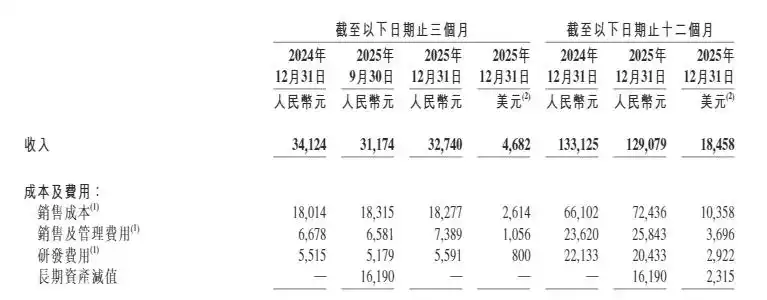
百度去年四季度AI业务收入占比43%
Guang Zhou Ri Bao· 2026-02-26 14:18
Core Insights - Baidu's total revenue for 2025 reached 129.1 billion RMB, a year-on-year decrease of 3.0%, while AI business revenue amounted to 40 billion RMB [1] - In Q4 2025, Baidu's total revenue was 32.7 billion RMB, with AI business revenue accounting for 43% of Baidu's general business revenue, exceeding market expectations [1] - Baidu's founder, Li Yanhong, emphasized that 2025 is a pivotal year for AI to become the new core of Baidu, expressing confidence in creating lasting value in the AI era [1] AI Business Performance - Baidu's core AI new business revenue reached 40 billion RMB in 2025, representing a 48% year-on-year growth [2] - The breakdown of AI new business revenue includes: - Intelligent cloud infrastructure: 19.8 billion RMB, up 34% - AI applications: 10.2 billion RMB, up 5% - AI native marketing services: 9.8 billion RMB, up 301% [2] AI Cloud and Marketing Services - AI cloud revenue for 2025 was 19.8 billion RMB, a 34% increase year-on-year, with Q4 subscription revenue for AI high-performance computing facilities growing by 143% [3] - AI native marketing services generated 9.8 billion RMB in 2025, marking a significant growth of 301% [3] User Engagement and Expansion - Baidu App's monthly active users reached 679 million, while Wenxin Assistant's monthly active users hit 202 million, with a fourfold increase since the launch of the Spring Festival red envelope activity [3] - The "LuoBo Kuaipao" autonomous driving service recorded 3.4 million service instances in Q4 2025, a year-on-year increase of over 200%, with a peak of over 300,000 weekly trips [4] - As of February 2026, "LuoBo Kuaipao" has provided over 20 million global service instances, covering 26 cities worldwide [4][5]
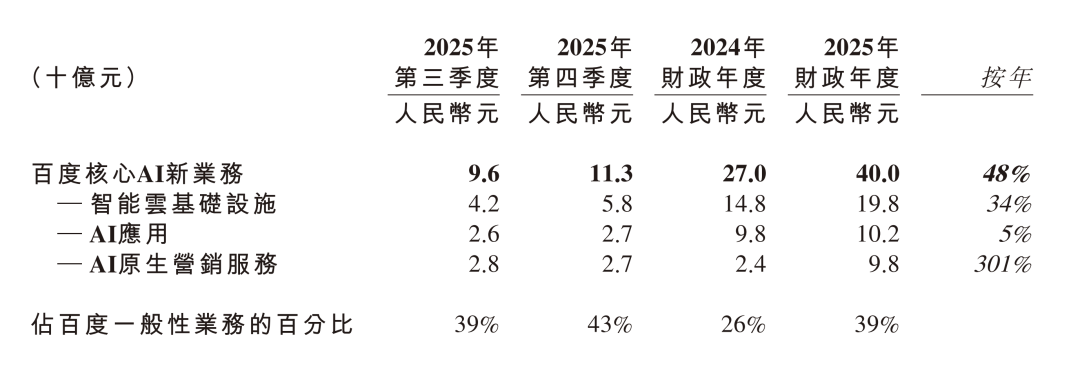
百度2025年营收达1291亿元 第四季度AI业务收入占比43%
Zheng Quan Ri Bao Wang· 2026-02-26 13:05
Core Insights - Baidu's total revenue for 2025 reached 129.1 billion yuan, with AI business revenue accounting for 40 billion yuan, indicating a significant shift towards AI as a core business driver [1] - The company reported that AI-related services are expanding rapidly, with AI cloud revenue growing by 34% year-on-year and AI native marketing services increasing by 301% in 2025 [2][3] Group 1: Financial Performance - In Q4 2025, Baidu's total revenue was 32.7 billion yuan, with AI business revenue constituting 43% of general business income [1] - AI cloud's subscription revenue surged by 143% year-on-year in Q4, reflecting strong demand for high-performance computing [1] - AI native marketing services revenue reached 2.7 billion yuan in Q4, marking a 110% year-on-year increase [2] Group 2: User Engagement and Application Growth - Baidu App's monthly active users reached 679 million, while Wenxin Assistant's monthly active users hit 202 million, showcasing strong user engagement [2] - The launch of the Wenxin Assistant during the Spring Festival led to a fourfold increase in active users [2] - Baidu's AI applications generated over 10 billion yuan in revenue for the year, with significant growth in various sectors [2] Group 3: Autonomous Driving and Market Expansion - In Q4 2025, Baidu's autonomous driving service, "Luobo Kuaipao," recorded over 3.4 million rides, a year-on-year increase of over 200% [3] - The service has expanded to 26 cities globally, with a total of over 20 million rides provided [3] - Baidu's autonomous driving technology has accumulated over 300 million kilometers of total driving distance, with over 190 million kilometers being fully autonomous [3] Group 4: Capitalization and Strategic Moves - Baidu's subsidiary Kunlun Chip has submitted a listing application to the Hong Kong Stock Exchange, indicating a strategic move to capitalize on its AI chip business [4] - The company announced a share buyback plan of up to 5 billion USD and plans to declare its first dividend in 2026, enhancing shareholder returns [4] - These initiatives are expected to optimize Baidu's valuation structure and open financing channels for long-term technological investments [5]
百度发布最新财报!
Zhong Guo Ji Jin Bao· 2026-02-26 11:37
Core Insights - Baidu's total revenue for 2025 reached 129.1 billion yuan, with AI business revenue accounting for 40 billion yuan, indicating a strong performance in AI-related sectors [1] - In Q4 2025, total revenue was 32.7 billion yuan, with AI business revenue making up 43% of general business income, surpassing market expectations [1] - The company emphasizes that 2025 is a pivotal year for AI to become the new core of Baidu's operations, with a focus on expanding AI applications to meet diverse needs [1] AI Business Performance - AI revenue grew by 34% year-on-year, with Q4 subscription revenue from high-performance computing facilities increasing by 143%, accelerating from 128% in Q3 [1] - AI-native marketing services saw a remarkable 301% year-on-year revenue growth, with AI applications generating over 10 billion yuan in total revenue for the year [2] - Monthly active users for Baidu App reached 679 million, while Wenxin Assistant's monthly active users hit 202 million, with a fourfold increase since the launch of the Spring Festival red envelope activity [2] Autonomous Driving Expansion - The autonomous driving service "Luobo Kuaipao" recorded over 3.4 million service instances in Q4, marking a year-on-year growth of over 200% [3] - As of February 2026, Luobo Kuaipao has provided over 20 million service instances globally, covering 26 cities [3] - The total mileage for autonomous driving has exceeded 300 million kilometers, with fully autonomous driving mileage surpassing 190 million kilometers [3] Technological Advancements - The official version of Wenxin 5.0 was launched, featuring 2.4 trillion parameters and supporting multi-modal input and output [3] - Wenxin 5.0 has achieved top rankings in domestic text and visual understanding benchmarks, outperforming several mainstream models [3] - Kunlun Chip has submitted an application for a mainboard listing on the Hong Kong Stock Exchange [3]
百度最新财报:2025年营收1291亿元 四季度AI业务收入占比43%
市值风云· 2026-02-26 10:12
Core Insights - Baidu's total revenue for 2025 reached 129.1 billion yuan, with AI business revenue accounting for 40 billion yuan, exceeding market expectations [1] - The year 2025 is identified as a pivotal year for AI to become Baidu's new core, with strong momentum in AI cloud services and a growing portfolio of AI applications [1] - AI cloud revenue grew by 34% year-on-year in 2025, with high-performance computing subscription revenue increasing by 143% in Q4 [1] Group 1: AI Business Performance - AI native marketing services revenue increased by 301% year-on-year in 2025 [2] - Monthly active users of Baidu App reached 679 million, while Wenxin Assistant's monthly active users reached 202 million, with a fourfold increase since the launch of the Spring Festival red envelope activity [2] - The revenue from AI applications surpassed 10 billion yuan in 2025, indicating significant growth in this segment [2] Group 2: Autonomous Driving and AI Model Developments - The autonomous driving service "Luobo Kuaipao" recorded 3.4 million service instances in Q4, with a year-on-year growth of over 200% [2] - The total mileage for autonomous driving exceeded 300 million kilometers, with fully autonomous driving mileage surpassing 190 million kilometers [3] - The official version of Wenxin 5.0 was launched, featuring 2.4 trillion parameters and achieving top rankings in various AI model benchmarks [3] Group 3: Market Expansion and ESG Performance - Luobo Kuaipao is accelerating its expansion into global markets, having provided over 20 million service instances across 26 cities by February 2026 [2] - Baidu has made further improvements in ESG performance, as noted in the S&P Global Sustainability Yearbook 2026 [3]
百度最新财报:2025年营收1291亿元 四季度AI业务收入占比43%
Qi Lu Wan Bao· 2026-02-26 09:23
Core Insights - Baidu's total revenue for 2025 reached 129.1 billion yuan, with AI business revenue accounting for 40 billion yuan, exceeding market expectations [1] - The company emphasizes that 2025 is a pivotal year for AI to become its new core, with strong momentum in AI cloud services and a growing portfolio of AI applications [1] - AI cloud revenue grew by 34% year-on-year, with high-performance computing subscription revenue increasing by 143% in Q4 [1] Group 1: Financial Performance - In Q4, Baidu's total revenue was 32.7 billion yuan, with AI business revenue constituting 43% of its general business revenue [1] - AI-native marketing services saw a revenue increase of 301% for the entire year of 2025 [2] - The total revenue from AI applications surpassed 10 billion yuan in 2025 [2] Group 2: User Engagement and Market Expansion - As of December 2025, Baidu App had 679 million monthly active users, while Wenxin Assistant reached 202 million monthly active users, with a fourfold increase since the launch of the Spring Festival red envelope activity [2] - The autonomous driving service, "Luobo Kuaipao," recorded 3.4 million service instances in Q4, marking a year-on-year growth of over 200% [2] - Luobo Kuaipao has expanded its global reach, providing over 20 million service instances across 26 cities by February 2026 [2] Group 3: Technological Advancements - The official version of Wenxin 5.0 was launched, featuring 2.4 trillion parameters and supporting multiple forms of input and output [3] - Wenxin 5.0 has achieved top rankings in various domestic benchmarks, surpassing several mainstream models [3] - Baidu's ESG performance has improved, as noted in the 2026 Global Edition of the S&P Global Sustainability Yearbook [3]
中金:维持百度集团-SW跑赢行业评级 目标价196港元
Zhi Tong Cai Jing· 2026-01-21 02:08
Group 1 - The core viewpoint of the report maintains Baidu Group's revenue and non-GAAP profit forecasts for 2025, 2026, and 2027, with an "outperform" rating and a target price of HKD 196, indicating a 33% upside potential compared to the current market valuation [1] - The expected non-GAAP net profit for Baidu in Q4 2025 is projected to be CNY 3 billion, with the core business also contributing CNY 3 billion [1] Group 2 - Baidu AI Cloud is expected to maintain a year-on-year growth rate exceeding 30% in Q4, driven by strong AI demand from enterprise clients and the company's differentiated self-developed infrastructure [2] Group 3 - The "萝卜快跑" (LuoBo Kuaipao) initiative has achieved significant milestones in its global expansion, launching commercial operations in Abu Dhabi and planning to deploy hundreds of vehicles for a large-scale fleet by January 2026 [3] - The company has received full autonomous testing permits in Dubai and is preparing to initiate autonomous driving tests in London in collaboration with Uber and Lyft, adapting to local traffic regulations [3] Group 4 - Multiple models from Baidu's Wenxin have ranked highly, with ERNIE-5.0-0110 and ERNIE-5.0-Preview-1203 achieving notable results in text and visual understanding categories, respectively [4] - The AI application landscape is rapidly evolving, with the "秒哒" (MiaoDa) no-code platform generating over 500,000 commercial applications and experiencing a daily growth rate of over 150%, while its overseas version MeDo topped the Product Hunt global product list [4] - The "慧播星" (HuiBoXing) digital human initiative is expanding into markets like Brazil, Thailand, and Vietnam, while the GenFlow intelligent agent's overseas version Oreate has gained millions of users [4]
中金:维持百度集团-SW(09888)跑赢行业评级 目标价196港元
智通财经网· 2026-01-21 02:04
Group 1 - The core viewpoint of the report maintains Baidu Group's revenue and non-GAAP profit forecasts for 2025, 2026, and 2027, with a target price of HKD 196, indicating a 33% upside potential compared to the current market valuation [1] - The expected non-GAAP net profit for Baidu in Q4 2025 is projected to be CNY 3 billion, with the core non-GAAP net profit also at CNY 3 billion [1] Group 2 - Baidu AI Cloud is expected to maintain a year-on-year growth rate exceeding 30% in Q4, driven by strong AI demand from enterprise clients and the company's differentiated self-developed infrastructure [2] Group 3 - The "萝卜快跑" (Roborace) has achieved significant milestones in its global expansion, launching fully autonomous commercial operations in Abu Dhabi and planning to deploy hundreds of vehicles by 2026 [3] - The company has received full autonomous testing permits in Dubai and is preparing to initiate autonomous driving tests in London in collaboration with Uber and Lyft [3] Group 4 - Multiple models from Baidu's Wenxin have ranked highly, with ERNIE-5.0-0110 and ERNIE-5.0-Preview-1203 achieving notable results in text and visual understanding categories [4] - The AI application landscape is rapidly evolving, with the "秒哒" no-code platform generating over 500,000 commercial applications and experiencing a daily growth rate of over 150% [4] - The overseas version of the GenFlow intelligent agent has gained millions of users, while the digital human "慧播星" is expanding into markets like Brazil, Thailand, and Vietnam [4]
百度集团副总裁平晓黎:慧播星数字人是AI时代的生产力新引擎
Xin Lang Cai Jing· 2026-01-15 10:18
Core Insights - The event "2025 Technology Wind and Cloud List" was held in Beijing, where Baidu's Vice President, Ping Xiaoli, highlighted the validation of digital human applications and technology over the years, leading to a consensus in the industry regarding digital humans as a new productive force [1][2] Group 1: Digital Human Applications - Baidu's Huibo Star digital human has been widely applied across over 30 industries, including e-commerce, automotive, marketing, finance, law, and education, with more than 100,000 clients globally in countries such as Brazil, Thailand, and Vietnam [1][2] Group 2: Technology and Capabilities - The high persuasive digital human from Baidu is characterized by multi-modal integration and a multi-agent system capable of thinking, decision-making, and execution [3][5] - The Huibo Star digital human utilizes scripts to achieve a high match of language, voice, and actions, supported by master-level scriptwriting capabilities that ensure engaging content and expressive performance [3][5] - The AI core can dynamically think and make decisions based on real-time signals from the live broadcast environment, coordinating multiple intelligent agents to execute specific tasks [3][5] Group 3: Market Growth - Huibo Star has become a comprehensive digital human platform, covering various formats such as digital human live streaming, videos, and intelligent agents, addressing the core needs of commercial clients and professional content creation institutions, experiencing explosive growth in 2025 [5]