
战略石油储备

Search documents
格林大华期货早盘提示:全球经济-20260316
格林大华期货· 2026-03-16 01:19
1. Report Industry Investment Rating - Not provided in the given content 2. Core Viewpoints of the Report - The US military's strike on Iran's oil - export hub and Iran's strong response lead to the long - term blockade of the Strait of Hormuz, and the supply gap in the oil market is huge, with high oil prices tending to be platform - based, which will impact the global economy [2][3] - The US private credit crisis is spreading to traditional banks, and the firewalls of traditional banks are facing severe tests [1][2] - The Iran war has broken the "buy - on - dips" habit of US retail investors, and the weekly purchase volume of retail investors has dropped by about 30% [1][2] - The Fed's uncertainty is expected to peak from July to November 2026, and there may be a trend of "fleeing from US assets" [2] - The US return to the Monroe Doctrine will have a profound and subversive impact on major asset classes [3] - The NASDAQ futures have broken through, and factors such as AI substitution and the Middle - East situation may trigger a new round of large - scale selling, and the decline of US stocks may have a significant negative impact on US consumption [3] - Due to the US's continuous wrong policies, the global economy has passed its peak in late 2025 and is running downward [3] 3. Summary by Relevant Catalogs Global Economic Logic - The US military strikes Iran's oil - export hub, and the Strait of Hormuz blockade tends to be long - term. The IEA releases 4 billion barrels of strategic oil reserves, but the actual global release speed may be only about 120,000 barrels per day, while the supply gap caused by the blocked Strait of Hormuz is 11 - 16 million barrels per day [2][3] - Iran will consider ending the war under two conditions: recovering all losses and the US leaving the Persian Gulf [1][2] - The US private credit crisis is spreading to traditional banks, with Deutsche Bank exposing about $30 billion in relevant risk exposures, and institutions such as BlackRock, Cliffwater, and Morgan Stanley having problems [1][2] - The Iran war has broken the "buy - on - dips" habit of US retail investors, and the weekly purchase volume of retail investors has dropped by about 30% [1][2] - The Fed's uncertainty is expected to peak from July to November 2026, and there may be a trend of "fleeing from US assets" [2] - The high asset prices and blind profit - seeking currently remind the JPMorgan CEO of the pre - 2008 financial crisis, and the reversal of the credit cycle may lead to an unexpected default wave [2] Impact of US Policy on Asset Classes - The US return to the Monroe Doctrine will have a subversive and far - reaching impact on major asset classes such as the global economy, US bonds, US stocks, the US dollar, precious metals, and industrial metals [3] Stock Market Situation - The NASDAQ futures have broken through. AI's subversive substitution of many industries and the Middle - East situation may trigger a new round of large - scale selling. The decline of US stocks may have a significant negative impact on US consumption [3] Global Economic Trend - Due to the US's continuous wrong policies, the global economy has passed its peak in late 2025 and is running downward [3]
格林期货早盘提示:全球经济-20260313
格林大华期货· 2026-03-13 01:16
Report Industry Investment Rating - The investment rating for the global economy in the macro and financial sector is "downward" [1] Core Viewpoints of the Report - The release of 400 million barrels of strategic petroleum reserves by the IEA may not effectively fill the supply gap caused by the obstruction of the Strait of Hormuz, and high oil prices will impact the global economy [1][2][3] - The geopolitical situation in the Middle East is tense, with no sign of a cease - fire negotiation, and the situation may further escalate [1] - The global financial market is under pressure. Hedge funds are suffering heavy losses, and there are risks of a systemic crisis in the insurance industry and an unexpected default wave in the credit cycle [2][1] - The global capital allocation logic is being re - structured, and there may be a trend of "fleeing from US assets" [2][1] - The US's return to the Monroe Doctrine will have a profound impact on major asset classes, and the global economy has been in a downward trend since the end of 2025 [3] Summary by Related Catalogs Global Economic Logic - The IEA's release of strategic petroleum reserves may not meet the supply gap. The end of the war in Iran depends on certain conditions. The private credit crisis in the insurance industry is severe, and there are risks of a systemic crisis. Hedge funds are selling US stocks rapidly, and there are warnings about a credit cycle reversal and a "capital war." There may be a trend of "fleeing from US assets" in the future, and consumer K - type differentiation is intensifying [2] Impact of US Policy and Market Situation - The US's return to the Monroe Doctrine will have a far - reaching impact on major asset classes. High oil prices will impact the global economy. The Nasdaq futures have broken through support levels, and the decline in US stocks may affect US consumption. The global economy has been in a downward trend since the end of 2025 [3] Important News - The IEA releases 400 million barrels of strategic petroleum reserves, with the US contributing 172 million barrels. The actual release speed may be slow, and the supply gap in the Strait of Hormuz is large [1][2][3] - Iran demands certain conditions for ending the war and refuses to negotiate as long as Israel exists [1] - The US will release strategic petroleum reserves over about 120 days, but its actual sustainable release capacity is limited [1] - Iran warns of a $200/barrel oil price and will implement a "serial strike" strategy [1] - The Trump administration's war against Iran lacks clear goals and exit strategies [1] - Global hedge funds are suffering heavy losses, and stock positions are more vulnerable [1] - Global fund managers are adopting a "avoiding the US" strategy, and global capital allocation is being re - structured [1]
冠通期货早盘速递-20260312
Guan Tong Qi Huo· 2026-03-12 05:33
1. Hot News - Trump said that there are "almost no targets left to strike" in Iran and the US military action against Iran is "coming to an end", but US and Israeli officials said they haven't received any internal instructions to stop the military action. The US Central Command warned of possible attacks on Iranian civilian ports, and an Iranian military spokesman said they would strike all ports and terminals in the region if their ports are threatened [2] - The International Energy Agency (IEA) agreed to release 400 million barrels of strategic oil reserves. The G7 energy ministers supported using strategic reserves to stabilize the energy market if necessary. Trump said the US will "slightly" cut its strategic oil reserves, Japan will release about 80 million barrels starting March 16, and Germany will release 2.4 million tons [2] - In February, China's auto sales were 1.805 million, a 15.2% year - on - year decrease. New energy vehicle sales were 765,000, a 14.2% year - on - year decrease, while auto exports were 672,000, a 52.4% year - on - year increase [2] - Iranian President Pezeshkian reiterated Iran's commitment to regional peace in calls with Russian and Pakistani leaders, stating that the "only way" to end the war is to recognize Iran's legitimate rights, pay war reparations, and have international guarantees against future aggression [3] - Starting from the settlement on March 16, 2026, the trading margin for apple futures contracts 2604 and 2605 will be adjusted to 15%, and the daily limit will be adjusted to 13% [3] 2. Sector Performance Key Focus - Urea, Shanghai copper, p - xylene, crude oil, PP [4] Night - session Performance - Non - metallic building materials rose 2.25%, precious metals rose 30.75%, energy rose 6.91%, chemicals rose 12.92%, grains rose 1.02%, agricultural and sideline products rose 2.64%, oilseeds and fats rose 8.32%, non - ferrous metals rose 23.99%, soft commodities rose 2.53%, and coal, coking, steel and minerals rose 8.68% [4][5] 3. Sector Positions - The document shows the changes in commodity futures sector positions in the past five days, including Wind agricultural and sideline products, Wind grains, Wind chemicals, Wind energy, Wind coal, coking, steel and minerals, Wind non - ferrous metals, Wind comprehensive commodities, Wind soft commodities, Wind oilseeds and fats, Wind precious metals, and Wind non - metallic building materials [6] 4. Performance of Major Asset Classes Equity - The Shanghai Composite Index rose 0.25% daily, - 0.71% monthly, and 4.15% annually; the Shanghai 50 rose 0.12% daily, - 1.78% monthly, and - 1.51% annually; the CSI 300 rose 0.64% daily, - 0.13% monthly, and 1.61% annually; the CSI 500 fell 0.08% daily, - 2.95% monthly, and rose 12.56% annually; the S&P 500 fell 0.08% daily, - 1.50% monthly, and - 1.02% annually; the Hang Seng Index fell 0.24% daily, - 2.75% monthly, and rose 1.05% annually; the German DAX fell 1.37% daily, - 6.50% monthly, and - 3.47% annually; the Nikkei 225 rose 1.43% daily, - 6.50% monthly, and 9.31% annually; the UK FTSE 100 fell 0.56% daily, - 5.10% monthly, and rose 4.25% annually [7] Fixed - income - The 10 - year Treasury bond futures fell 0.04% daily, - 0.12% monthly, and rose 0.37% annually; the 5 - year Treasury bond futures fell 0.03% daily, - 0.06% monthly, and rose 0.17% annually; the 2 - year Treasury bond futures fell 0.01% daily, - 0.01% monthly, and 0% annually [7] Commodities - The CRB commodity index rose 1.99% daily, 13.53% monthly, and 18.81% annually; WTI crude oil rose 6.52% daily, 32.22% monthly, and 54.59% annually; London spot gold fell 0.14% daily, - 1.81% monthly, and rose 20.02% annually; LME copper fell 0.69% daily, - 1.86% monthly, and rose 4.42% annually; the Wind commodity index fell 1.38% daily, - 4.64% monthly, and rose 15.81% annually [7] Others - The US dollar index rose 0.32% daily, 1.66% monthly, and 1.01% annually; the CBOE volatility index fell 2.81% daily, rose 22.00% monthly, and 62.07% annually [7] 5. Stock Market Risk Preference and Major Commodity Trends - The document shows the trends of the Baltic Dry Index (BDI), CRB spot index, WTI crude oil, London spot gold, London spot silver, LME 3 - month copper, gold - oil ratio, copper - gold ratio, risk premium, CBOT soybeans, CBOT corn, and Wind All - A (ex - financials and oil & petrochemicals) [8]
美能源部长:美政府“正在讨论”协调释放战略石油储备
中国能源报· 2026-03-10 02:41
Group 1 - The U.S. government is "discussing" the coordination of releasing strategic petroleum reserves to address the current energy market situation [1][3]


G7:暂不释放战略石油储备
财联社· 2026-03-09 23:44
Core Viewpoint - G7 finance ministers have reached a consensus to temporarily refrain from releasing strategic oil reserves despite rising oil prices due to the Iran conflict, indicating a need for further analysis before any action is taken [1][5]. Group 1: G7 Meeting and Decisions - G7 finance ministers held a conference call to discuss the impact of the Iran conflict on oil prices, which have surged significantly [2]. - The G7 countries, which include the US, Canada, Japan, Italy, the UK, Germany, and France, are prepared to take necessary measures to support global energy supply, including the potential release of oil reserves, but no decision has been made yet [3][4]. - An official noted that the timing of any decision regarding the release of strategic reserves is still under consideration, with further discussions planned among G7 energy ministers and leaders [5][6]. Group 2: Oil Price Impact and Economic Concerns - Following the escalation of the Iran conflict, Brent crude oil futures saw a significant spike, rising by 30% to $119.50 per barrel, the highest level since 2022, raising concerns about the impact on global oil production and transportation [6]. - The financial markets are particularly worried about how high oil prices could rise and how long they might remain elevated, which could exacerbate the burden on households already facing high inflation [7]. - There is a risk of stagflation, where economic growth stagnates while inflation remains high, as rising oil prices could lead to increased costs for businesses, affecting fuel, transportation, and energy expenses [8].

美国至11月28日当周EIA原油库存增加57.4万桶,前值增加277.4万桶
Mei Ri Jing Ji Xin Wen· 2025-12-03 21:22
Group 1 - The core point of the article is that U.S. crude oil inventories increased by 574,000 barrels for the week ending November 28, compared to an increase of 2.774 million barrels in the previous week [1] - The Strategic Petroleum Reserve saw an increase of 250,000 barrels, while the previous week's increase was 498,000 barrels [1]
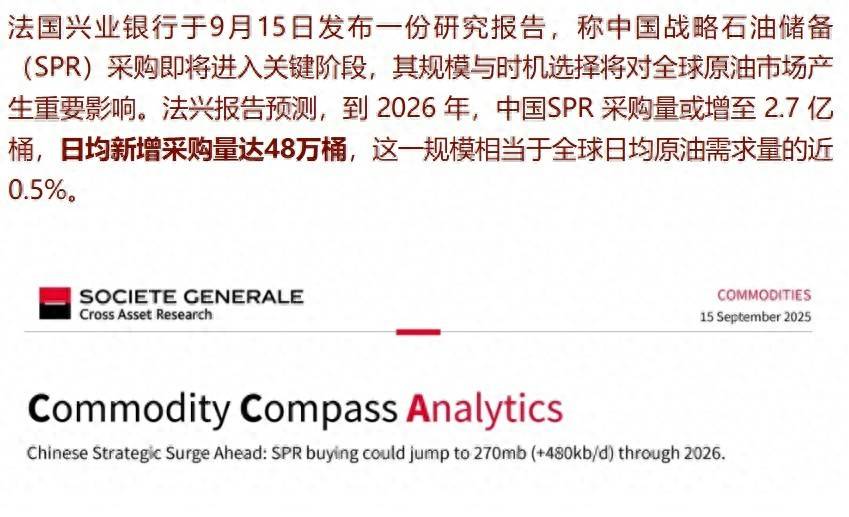
法兴银行报告,中国石油采购量惊人!在准备什么?存多少合适?
Sou Hu Cai Jing· 2025-09-24 10:41
Group 1 - The core viewpoint of the news is that China's strategic oil reserve procurement is entering a critical phase, with an expected increase in procurement volume due to favorable international oil prices [1][2] - According to the report, the procurement volume may rise to 270 million barrels next year, which translates to an average daily increase of 480,000 barrels, accounting for 0.5% of global daily crude oil demand [2] - The report indicates that China's strategic oil reserve capacity currently stands at 800 million barrels, which is sufficient to accommodate the increased procurement [4] Group 2 - China has established eight national-level oil reserve bases with a total storage capacity of 28.6 million cubic meters, equivalent to 26.1 million tons of crude oil [6] - The strategic oil reserve scale in China can cover over a month of consumption, while the U.S. reserves can cover 240 days, Japan 187 days, and France 116 days [6] - Recent reports suggest that the number of oil reserve bases in China has increased to nine, with total storage capacity exceeding 33 million tons [8] Group 3 - The strategic oil reserve is crucial for national energy security, as it ensures the operation of machinery, vehicles, and weapon systems in times of supply disruption [10][11] - The concept of strategic oil reserves emerged after the oil crisis in the 1970s, prompting major countries to establish their reserves to mitigate the impact of potential supply interruptions [14][16] - China's strategic oil reserve planning aims to establish reserves equivalent to at least 100 days of net crude oil imports, with ongoing construction of storage facilities across the country [20] Group 4 - The best long-term strategy for oil reserves is domestic production, as new discoveries of oil reserves continue to grow globally [27] - China's future oil import scale is expected to decrease as domestic production increases, enhancing energy security [29] - The overall importance of oil as a primary energy source is likely to persist unless significant advancements in alternative energy sources, such as nuclear fusion, are achieved [34][36]

美国至6月13日当周EIA战略石油储备库存 23万桶,前值23.7万桶。
news flash· 2025-06-18 14:32
Group 1 - The U.S. Strategic Petroleum Reserve inventory decreased by 230,000 barrels for the week ending June 13, compared to a previous value of 237,000 barrels [1]
美众议院委员会提议拨款15亿美元补充战略石油储备
news flash· 2025-05-12 16:01
Core Viewpoint - The U.S. House Committee proposed a budget plan to allocate over $1.5 billion for the restoration and maintenance of the Strategic Petroleum Reserve (SPR) [1] Group 1: Funding Allocation - The proposal includes $1.32 billion for purchasing oil to replenish the SPR, which is the world's largest emergency crude oil reserve [1] - An additional $218 million is allocated for facility maintenance [1] Group 2: Legislative Changes - The proposal cancels a previous directive to sell oil from the SPR and eliminates the congressional authorization to sell 7 million barrels of SPR in the fiscal year 2027 [1] Group 3: Current Status and Future Projections - The SPR currently holds approximately 399 million barrels of oil, with a total storage capacity of about 727 million barrels [1] - U.S. Energy Secretary estimated that fulfilling former President Trump's goal of filling the SPR would require $20 billion and several years, which would assist domestic energy producers when oil prices are relatively low [1]