
纳指期货

Search documents
格林大华期货早盘提示-20260401
Ge Lin Qi Huo· 2026-03-31 23:42
Report Industry Investment Rating - No information provided Core Viewpoints - The conflict in the Middle East, especially the situation in the Strait of Hormuz, has a significant impact on the global economy and financial markets. The potential closure of the Strait of Hormuz could lead to a sharp increase in oil prices, which in turn affects inflation, interest rates, and bond yields. The global economy is facing downward pressure due to factors such as high oil prices and the US's wrong policies [2][3]. Summary by Related Catalogs Global Economic Logic - Trump is willing to end the military action against Iran even if the Strait of Hormuz remains largely closed. Iran's parliament has passed a management plan for the Strait of Hormuz, giving the Iranian armed forces a control role [1][2]. - There is a 40% probability that the conflict will continue until June, and if so, oil prices may exceed $200 per barrel, and US gasoline may reach $7 per gallon [2]. - The IEA has announced the release of 400 million barrels of strategic oil reserves, but the actual global release speed is no more than 3 million barrels per day, while the supply gap caused by the obstruction of the Strait of Hormuz is 11 - 16 million barrels per day [2][3]. - Analysts from Nomura and Goldman Sachs have warned that traders face extremely high risks in the current environment [2]. Impact on Financial Markets - The Fed Chairman's statement that the Fed tends to keep interest rates unchanged in the context of an energy shock has alleviated market concerns about the Fed tightening monetary policy to curb inflation [1]. - High - end believes that the Fed will eventually cut interest rates, referring to the situation in 1990 when the Fed cut rates during an oil supply shock [1]. - The decoupling of bonds and oil has become a key signal, with the market logic shifting from inflation panic to recession concerns and fiscal stimulus expectations [1]. - Global central banks are selling US Treasuries at the fastest pace in more than a decade, and the yen is under pressure [1]. - The Nasdaq futures have broken through support levels, and the AI - induced industry substitution and the Middle East situation may trigger a new round of large - scale selling, which may have a significant negative impact on US consumption [3].

格林大华期货早盘提示-20260330
Ge Lin Qi Huo· 2026-03-30 00:08
1. Report Industry Investment Rating - The report gives a "downward" rating for the global economy in the macro and financial sector [1] 2. Core Viewpoints - The closure of the Strait of Hormuz by Iran and the escalating Middle - East conflict will have a significant impact on the global economy and financial markets [1][2][3] - There is a high probability that the conflict will continue until June, which may cause oil prices to soar and gasoline prices in the US to rise [1][2] - The release of strategic oil reserves by the IEA cannot fully compensate for the supply gap caused by the blocked Strait of Hormuz [2][3] - The continuous high - oil prices will impact the global economy, and the decline of the US stock market may have a negative impact on US consumption [3] 3. Summary by Related Content 3.1 Important Information - Iran's Islamic Revolutionary Guard Corps has closed the Strait of Hormuz, and any attempt to pass through will be severely punished. Ships to and from "ports of US - Israeli hostile allies and supporters" are prohibited [1] - Israel has attacked three nuclear facilities and weapon bases in Iran [1] - The Houthi armed forces have launched missiles at Israel, and the Yanbu Port and the Bab - el - Mandeb Strait, which are important for oil transportation, are within the missile range [1] - The Pentagon is formulating a "decisive blow" military plan against Iran, which may include using ground forces and large - scale bombing [1] - The conflict in the Middle - East is difficult to resolve in the short term, and the closure of the Strait of Hormuz has broken the market's optimistic expectation of "cease - fire means navigation" [1] - The blockade of the Strait of Hormuz is causing an oil shock, with Asian inventories approaching the limit and Africa and Europe facing pressure in April [1] - The probability of the conflict continuing until June is as high as 40%, and if this happens, oil prices may exceed $200, and US gasoline may reach $7 per gallon [1][2] - There has been a significant price fluctuation in Brent crude oil futures, and market liquidity is thinning [1] - The S&P 500 index has fallen for five consecutive weeks, the Goldman Sachs panic index is in the panic zone, and hedge funds have been net - selling [1] 3.2 Global Economic Logic - Iran has made it clear that it will not negotiate until all its cease - fire conditions are met [2] - The control of the Strait of Hormuz is crucial for the Middle - East "ultimate battle" and is related to the global energy lifeline and the US dollar's foundation [2][3] - The IEA's release of 400 million barrels of strategic oil reserves cannot fully cover the supply gap of 11 - 16 million barrels per day caused by the blocked Strait of Hormuz [2][3] - Analysts from multiple institutions warn that oil prices may rise significantly, and traders face high risks [2] 3.3 Impact on the Economy - High - oil prices will impact the global economy, and the decline of the US stock market may have a negative impact on US consumption [3] - Due to the US's wrong policies, the global economy has passed its peak in late 2025 and is in a downward trend [3]
格林大华期货早盘提示-20260326
Ge Lin Qi Huo· 2026-03-25 23:31
Group 1: Report Industry Investment Rating - Not provided Group 2: Core Viewpoints - The possibility of negotiations between the US and Iran is extremely low due to almost zero trust, and Iran believes the US request for negotiation is a deception [1][2] - The control of the Strait of Hormuz is crucial for the "ultimate battle" in the Middle East, and losing it could lead to the decline of empires and shake the US dollar's foundation [2][3] - The release of 400 million barrels of strategic oil reserves by IEA cannot cover the supply gap caused by the obstruction of the Strait of Hormuz, and high - oil prices may impact the global economy [2][3] - The market is at a dangerous critical point. If the geopolitical situation doesn't improve in two weeks, the stock market may experience a crash - like decline [2] - The global economy has passed its peak in late 2025 and is on a downward trend due to the US's wrong policies [3] Group 3: Summaries by Relevant Catalogs Global Economy and Finance - The US President claims to be in negotiations with Iran for a cease - fire and a 15 - point agreement, but Iran denies and refuses to accept the cease - fire and negotiation [1] - Retail investors had their first net sell - off on Monday since November 2023, selling about $20.6 million in stocks [1] - Foreign official accounts' US Treasury holdings at the New York Fed dropped by $75 billion in four weeks, with a net sell - off of about $60 billion [1] - The auction of $69 billion in two - year US Treasury bonds was cold, reflecting market concerns about high inflation and interest - rate hikes [1] - The Nasdaq futures have broken through support levels, and the AI - related situation and Middle East tensions may trigger a new round of large - scale selling [3] - The decline in US stocks may have a significant negative impact on US consumption [3]
格林大华期货早盘提示-20260324
Ge Lin Qi Huo· 2026-03-23 23:30
Report Industry Investment Rating - There is no mention of the report industry investment rating in the provided content. Core Viewpoints - The geopolitical situation between the US and Iran is tense, with conflicting statements from both sides. The control of the Strait of Hormuz is crucial for the global economy and the US hegemony. High oil prices and supply shortages may lead to a global economic downturn, and the stock market is at a dangerous critical point [1][2][3]. - The price of Brent crude oil may increase significantly if the Strait of Hormuz is blocked for an extended period. The stock market may face a crash - like decline if the geopolitical situation does not improve in two weeks [1][2]. - The global economic situation is deteriorating, with the US economy facing challenges due to wrong policies and the potential negative impact of the stock market decline on consumption [3]. Summaries by Related Catalogs Global Economic and Geopolitical Situation - The US President shows an intention to reach an agreement with Iran, but Iran's "senior leadership" denies the existence of negotiations, stating that the US President's statement aims to lower energy prices and gain time for military plans [1]. - The US Treasury Secretary mentions destroying Iranian facilities and that "all options are on the table", including seizing Kharg Island. Iran warns that US military bases and financial institutions supporting US military spending are "legitimate targets" [1]. - Yemen's Houthi rebels may block the Bab - el - Mandeb Strait to support Iran. Bridgewater's Dalio believes that the "ultimate battle" in the Middle East depends on who controls the Strait of Hormuz, which is crucial for global energy and the US dollar's foundation [2]. - The IEA releases 400 million barrels of strategic oil reserves, but the actual global release rate is no more than 3 million barrels per day, while the supply gap caused by the blockage of the Strait of Hormuz is 11 - 16 million barrels per day [2][3]. Market and Asset Performance - Goldman Sachs extends the duration of a "5% flow" in the Strait of Hormuz from 3 weeks to 6 weeks, introduces a higher structural safety premium, and raises the average price of Brent in March - April to $110. If the blockage lasts for 10 weeks, the Brent crude oil price may exceed the 2008 record of $147 [1]. - The NASDAQ futures have broken through support levels. AI's disruptive substitution in many industries and the Middle East situation may trigger a new round of large - scale selling in the US stock market, and the decline in the US stock market may have a significant negative impact on US consumption [3]. - The call volume of domestic large - scale models has exceeded that of US models for three consecutive weeks, with a 56.9% increase from the previous week [1]. - Gold has unexpectedly underperformed risk assets in the short term, but its long - term allocation value remains solid due to the de - dollarization logic [1].
格林大华期货早盘提示-20260323
Ge Lin Qi Huo· 2026-03-22 23:31
1. Report Industry Investment Rating - Not provided in the given content 2. Core Viewpoints - The geopolitical situation in the Middle East is tense. The US has issued an ultimatum to Iran, and Iran has threatened counter - attacks. Yemen's Houthi rebels may block the Mandeb Strait. The control of the Strait of Hormuz is crucial for the US and the global energy market [1][2][3] - There is a huge supply gap in the oil market due to the obstruction of the Strait of Hormuz. Although the IEA has released a large - scale strategic oil reserve, it cannot fully cover the gap. High oil prices may reach historical highs and impact the global economy [2][3] - The market has shifted to price "indefinite uncertainty". Investors are short - selling low - quality stocks and European assets. The US stock market is at risk, especially with high AI positions and momentum long - term exposure [1][2] - The global economy has passed its peak in late 2025 and is on a downward trend due to the US's wrong policies [3] 3. Summary by Related Catalogs Geopolitical Tensions - The US President demands that Iran open the Strait of Hormuz within 48 hours, otherwise, the US will attack Iranian power plants. Iran warns that it will counter - attack US and its allies' energy facilities, information systems, and desalination plants in the Gulf [1][2] - The US amphibious assault fleet may land in the Strait of Hormuz, and the war duration may exceed expectations. Yemen's Houthi rebels may block the Mandeb Strait to support Iran [1][2] - Bridgewater's Ray Dalio believes that the "ultimate battle" in the Middle East depends on who controls the Strait of Hormuz, which is related to the global energy lifeline and the US hegemony [2][3] Oil Market Situation - The US may lift sanctions on Iranian oil at sea in the next few days, with a reserve of about 140 million barrels [1] - The IEA has released 400 million barrels of strategic oil reserves, but the actual global release speed is no more than 3 million barrels per day, while the supply gap caused by the obstruction of the Strait of Hormuz is 11 - 16 million barrels per day [2][3] - Goldman Sachs warns that under the background of the continuous obstruction of the Strait of Hormuz, Brent crude oil may break through the 2008 historical high of $147.50 per barrel, and oil prices may remain at a high level of $100 for a long time [1][2] - Oman crude oil spot has soared to $173, with a serious disconnection between futures and spot [1] Market Reactions - Asian steam cracking plants using naphtha as raw materials have entered a large - scale shutdown wave, with some operating loads dropping to 60% [1] - The market has shifted to price "indefinite uncertainty". Customers are short - selling low - quality stocks and European assets. The Fed's hawkish stance worsens the situation [1][2] - The risk - return of the US stock market tends to be symmetrical, but AI positions are at a historical peak, and momentum long - term exposure has reached a five - year high. Once it collapses, it may trigger tail risks [1][2] - If the geopolitical situation does not improve within two weeks, the stock market will face a crash - like decline [2] - The Nasdaq futures have broken through support levels. AI's disruptive substitution and the Middle East situation may trigger a new round of large - scale selling in the US stock market, which may have a significant negative impact on US consumption [3]
格林期货早盘提示:全球经济-20260313
格林大华期货· 2026-03-13 01:16
Report Industry Investment Rating - The investment rating for the global economy in the macro and financial sector is "downward" [1] Core Viewpoints of the Report - The release of 400 million barrels of strategic petroleum reserves by the IEA may not effectively fill the supply gap caused by the obstruction of the Strait of Hormuz, and high oil prices will impact the global economy [1][2][3] - The geopolitical situation in the Middle East is tense, with no sign of a cease - fire negotiation, and the situation may further escalate [1] - The global financial market is under pressure. Hedge funds are suffering heavy losses, and there are risks of a systemic crisis in the insurance industry and an unexpected default wave in the credit cycle [2][1] - The global capital allocation logic is being re - structured, and there may be a trend of "fleeing from US assets" [2][1] - The US's return to the Monroe Doctrine will have a profound impact on major asset classes, and the global economy has been in a downward trend since the end of 2025 [3] Summary by Related Catalogs Global Economic Logic - The IEA's release of strategic petroleum reserves may not meet the supply gap. The end of the war in Iran depends on certain conditions. The private credit crisis in the insurance industry is severe, and there are risks of a systemic crisis. Hedge funds are selling US stocks rapidly, and there are warnings about a credit cycle reversal and a "capital war." There may be a trend of "fleeing from US assets" in the future, and consumer K - type differentiation is intensifying [2] Impact of US Policy and Market Situation - The US's return to the Monroe Doctrine will have a far - reaching impact on major asset classes. High oil prices will impact the global economy. The Nasdaq futures have broken through support levels, and the decline in US stocks may affect US consumption. The global economy has been in a downward trend since the end of 2025 [3] Important News - The IEA releases 400 million barrels of strategic petroleum reserves, with the US contributing 172 million barrels. The actual release speed may be slow, and the supply gap in the Strait of Hormuz is large [1][2][3] - Iran demands certain conditions for ending the war and refuses to negotiate as long as Israel exists [1] - The US will release strategic petroleum reserves over about 120 days, but its actual sustainable release capacity is limited [1] - Iran warns of a $200/barrel oil price and will implement a "serial strike" strategy [1] - The Trump administration's war against Iran lacks clear goals and exit strategies [1] - Global hedge funds are suffering heavy losses, and stock positions are more vulnerable [1] - Global fund managers are adopting a "avoiding the US" strategy, and global capital allocation is being re - structured [1]
格林大华期货早盘提示-20260311
Ge Lin Qi Huo· 2026-03-10 23:47
Report Industry Investment Rating - Goldman Sachs adjusted the stock rating for the next three months to tactical neutral and overweighted cash [1] Core Viewpoints - The global economy is facing multiple challenges including geopolitical conflicts, oil price fluctuations, and potential financial crises. The US's policy adjustments and the Fed's monetary policy changes have significant impacts on various asset classes [2][3] Summary by Related Catalogs Global Economy and Finance - Trump's statement caused the oil price to drop from nearly $120 to $85, reflecting the White House's anxiety about high - oil prices' impact on inflation and election prospects [1] - Iran's Islamic Revolutionary Guard Corps stated that in case of an attack, it will not allow "enemies and their allies" to export oil from the region [1] - Deutsche Bank warned that the oil - price trend is "strikingly similar" to the 1970s oil crisis, but current inflation expectations are stable and the economy is more resilient [1] - Goldman Sachs pointed out that if the oil flow through the Strait of Hormuz remains low in March, oil prices may exceed the peaks in 2008 and 2022 [1] - The risk of an energy shock similar to that in the 1970s is increasing due to the Middle - East conflict, which may put pressure on risk - preference and related assets [1] - The US Congress passed the War Powers Act in 1973, which regulates the military action time limit [1] - When the oil price breaks through $100, fund managers are re - allocating their portfolios to anti - inflation sectors, and options hedging is becoming more popular [1] - The sharp decline in oil prices cannot be solved by the US president's words. Iran's stance on oil export restrictions may further affect the oil market [2][3] - The private - credit crisis triggered by BlackRock's redemption limit has put pressure on the insurance industry, and there are concerns about a 2008 - style systemic risk [2] - Hedge funds have been net - selling US stocks at the fastest pace since March last year [2] - JPMorgan Chase CEO warned of a potential default wave due to the reversal of the credit cycle [2] - Bridgewater Associates' founder warned of a "capital war" due to geopolitical tensions and market volatility [2] - The expected policy of Fed nominee Wash will have a negative impact on global equity and commodity assets [2] - Nomura expects the Fed's uncertainty to peak from July to November 2026, which may lead to a "flight from US assets" [2] - The Fed's Beige Book shows a K - shaped consumption pattern among US consumers [2] - The US's return to the Monroe Doctrine will have a profound impact on major asset classes [3] - Wash's combination of interest - rate cuts and balance - sheet reduction indicates a major shift in Fed's monetary policy, which will lead to a liquidity - contraction expectation for equity assets [3] - The NASDAQ futures have broken through support levels, and AI substitution and the Middle - East situation may trigger a new round of large - scale selling of US stocks [3] - The global economy has passed its peak in late 2025 and is on a downward trend due to the US's wrong policies [3]
格林期货早盘提示:全球经济-20260310
Ge Lin Qi Huo· 2026-03-10 00:59
Report Industry Investment Rating - Not provided Core Viewpoints - The escalation of the Iran situation has led to a sharp rise in oil prices, with the price breaking through $100 on March 9 and reaching nearly $120, causing panic in the global market and a classic scenario of rising oil and the US dollar while other assets decline [1][2] - The private credit crisis triggered by BlackRock's redemption restrictions has put pressure on the insurance industry, and there are concerns about a 2008 - style systemic risk [1][2] - The US's return to the Monroe Doctrine and the Fed's potential policy shift will have a profound impact on various asset classes [3] - The US - Israel attack on Iran and the closure of the Strait of Hormuz will shock the global economy, and the decline of US stocks may negatively affect US consumption [4] Summary by Related Catalogs Global Economic and Financial Situation - On March 9, due to the escalation of the Iran situation, the oil price opened above $100 and reached nearly $120, and the financial market showed a pattern of rising oil and the US dollar while other assets fell [1][2] - BlackRock's redemption restrictions have triggered a private credit crisis, and the insurance industry, which has about one - third of its investments in this area, is under pressure. The insurance bond spread has widened significantly, and there are fears of a systemic risk [1][2] - Hedge funds have been net - selling US stocks at the fastest pace since March last year, and warnings from financial figures such as JPMorgan's CEO and Bridgewater's founder indicate concerns about the market [2] - The Fed's potential policy shift, including the expected policy of the Fed's nominee chair Wash, will have a negative impact on global equity and commodity assets, and there may be a "flight from US assets" trend from July to November 2026 [2] Geopolitical Impact on Oil - The attack on Iran's energy facilities, including a refinery in southern Tehran and oil depots, and the potential disruption of the Kharg Island could lead to a significant reduction in oil supply, with a total loss of at least 5 million barrels per day and over 8 million barrels per day including refined products [1] - Saudi Arabia has redirected some oil exports to the Yanbu port, but the increase in net flow is far below the theoretical limit [1] Impact on the US and Global Economy - The US's return to the Monroe Doctrine will have a profound impact on global economic and various asset classes [3] - The US - Israel attack on Iran and the closure of the Strait of Hormuz will shock the global economy, and the decline of US stocks may have a negative impact on US consumption [4] - The global economy has passed its peak in late 2025 and is on a downward trend due to the US's wrong policies [4]
突然,金银、股市全线跳水!
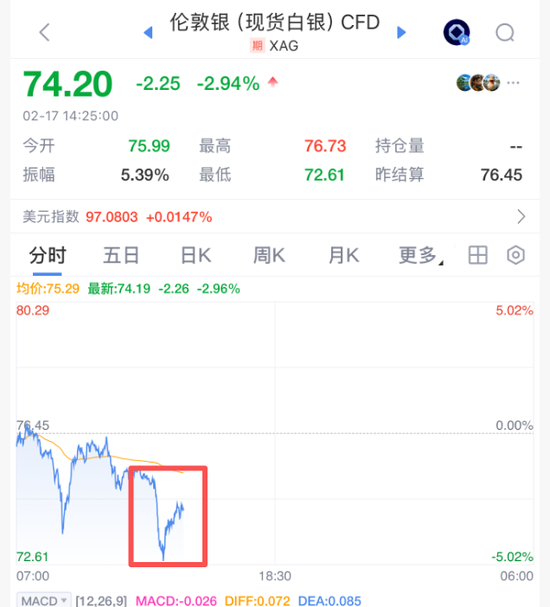
Xin Lang Cai Jing· 2026-02-17 07:12
Core Viewpoint - The market experienced a significant downturn on February 17, with both precious metals and major stock indices declining sharply, indicating a cautious sentiment among investors amid geopolitical tensions and market holidays [1][3][4]. Group 1: Precious Metals - Spot gold prices fell below $4,900 per ounce, while silver prices dropped approximately 5% before recovering slightly [1][5]. - The decline in precious metals prices suggests lingering psychological effects from the market crash in late January, where gold and silver plummeted alongside stock markets [4][9]. Group 2: Stock Indices - Major U.S. stock index futures, including the Nasdaq, fell by 0.8%, the Nikkei 225 by 0.5%, and the FTSE China A50 by over 0.7% [3][8]. - The overall market showed a defensive posture due to a lack of positive catalysts and the impact of multiple market holidays, leading to reduced liquidity [4][9]. Group 3: Geopolitical Factors - Analysts are closely monitoring developments between the U.S. and Iran, particularly following recent military exercises by Iran, which are dampening market risk appetite [4][9]. - The upcoming second round of nuclear negotiations between Iran and the U.S. adds to the uncertainty, as previous threats from the U.S. regarding Iran's nuclear program loom large [4][9].

美国非农数据公布后 美元指数走高
Xin Lang Cai Jing· 2026-02-11 13:44
Core Viewpoint - The release of January's non-farm payroll data in the U.S. has led to an increase in the U.S. dollar index, which rose to 97.16 [1] Market Reactions - U.S. stock futures experienced a short-term rally, with the Nasdaq futures increasing by 0.35%, S&P 500 futures rising by 0.31%, and Dow futures up by 0.24% [1] - U.S. Treasury yields also saw a short-term increase, with the 10-year Treasury yield rising by 4 basis points to 4.192% [1] Commodity Market - Spot gold prices turned to a decline after previously rising over 1% [1] - The increase in spot silver prices narrowed from 6% to 4% [1]