
投顾服务

Search documents
九方智投否认被调查:千个账号圈粉超6千万 “诱惑信息”花样揽会员
Xin Jing Bao· 2026-01-31 21:36
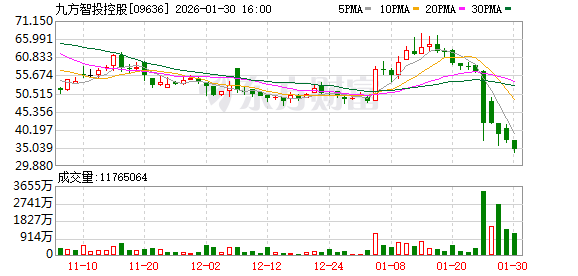
Core Viewpoint - The stock price of Jiufang Zhitu has been on a downward trend, dropping nearly 60% from its peak, primarily due to market rumors about regulatory investigations and subsequent clarifications from the company regarding its operational status [2][3]. Group 1: Stock Performance - On January 26, Jiufang Zhitu's stock price fell over 30% during trading, and despite a brief recovery of over 15% the next day, it continued to decline, reaching a price of 34.46 HKD by January 30, marking an 11-day consecutive drop [2]. - The stock has decreased from a high of 83.35 HKD in August 2025, representing a cumulative decline of nearly 60% [2]. Group 2: Regulatory Concerns - Market rumors suggested that Jiufang Zhitu was under investigation by regulators, which led to significant stock price volatility [2]. - On January 29, the company issued a clarification stating that it was not under investigation and that its operational conditions remained normal [2]. Group 3: Marketing and Customer Acquisition - Jiufang Zhitu has leveraged AI and short video platforms to expand its customer base, increasing its operational accounts to 994 with a total of 63.06 million followers by June 2025 [2][6]. - The company employs a marketing strategy that includes sending enticing messages about stock performance to attract clients, with a focus on creating a positive and engaging customer experience [3][5]. Group 4: Customer Complaints and Refund Issues - Jiufang Zhitu has faced numerous complaints from customers regarding misleading marketing practices and dissatisfaction with the services provided, with over 300 complaints recorded [8]. - The company has a high refund rate, which was 30.5% in the first half of 2024, dropping to 24.6% in the first half of 2025, indicating a correlation between market performance and customer satisfaction [9]. Group 5: Financial Performance and Costs - In the first half of 2025, Jiufang Zhitu's sales and marketing expenses reached 662 million CNY, up from 553 million CNY in the same period the previous year [7]. - The company’s revenue for 2022 was 1.85 billion CNY, with sales and marketing expenses accounting for nearly half of that amount [7].

证券经纪人8年减少超6.8万!投顾迎4年来最大扩容,专业取代流量
券商中国· 2026-01-25 02:01
Core Viewpoint - The article discusses the significant transformation in the securities brokerage industry, highlighting the reduction of traditional brokers and the rise of investment advisors as firms shift from sales-driven models to wealth management-focused strategies [2][5]. Group 1: Decline of Securities Brokers - The number of securities brokers has decreased by over 5,000 in the past year, reflecting a broader trend of industry contraction [2]. - From early 2018 to the end of 2025, the number of brokers in the industry dropped from over 90,000 to 22,400, a reduction of more than 68,000 brokers over eight years [3]. - Major firms like CICC and China Merchants Securities have seen drastic reductions in their broker counts, with CICC achieving a "zero" broker count and China Merchants reducing from over 800 to just 13, a decline of over 90% [4]. Group 2: Factors Driving Change - The shift from "transactional trading" to wealth management has led to a reevaluation of talent needs, with a focus on professional skills over sheer numbers [3][4]. - Increased market competition and the decline in commission rates have pressured traditional revenue streams, exacerbated by reforms in public fund fees [4]. - The advancement of financial technology has reduced the demand for traditional broker roles, as online services and automated tools take precedence [4]. Group 3: Rise of Investment Advisors - The number of investment advisors has surged, increasing from over 40,000 in 2018 to 86,000 by the end of 2025, with a notable addition of over 5,000 advisors in the past year [6]. - Leading firms are investing in expanding their advisory teams, with companies like Huatai Securities and CITIC Securities increasing their advisor counts significantly [6]. - Smaller firms are also adopting strategies to enhance their advisory capabilities, focusing on reducing interchangeable roles while boosting the quality and scale of their advisory teams [6]. Group 4: Transition from Brokers to Advisors - Many investment advisors are former brokers transitioning into advisory roles, with firms assessing potential candidates based on their qualifications and client service abilities [7]. - The core competitive advantage in advisory services lies in building a highly skilled team capable of providing tailored solutions and asset management [7]. - The industry faces challenges in bridging the gap between traditional sales roles and the more complex demands of asset management and client relationship building [7]. Group 5: Evolving Skill Requirements - The current market demands investment advisors to possess skills in asset allocation, client relationship management, and the use of digital tools [8]. - Firms are developing training programs to enhance advisor capabilities, focusing on both technical skills and client engagement strategies [8]. - Companies are implementing structured support systems to ensure consistent delivery of strategies and insights across their advisory teams [8].





国泰海通宋心磊谈AI:本质上是业务的延伸工具,不会改变金融行业本质
Xin Lang Cai Jing· 2026-01-15 09:44
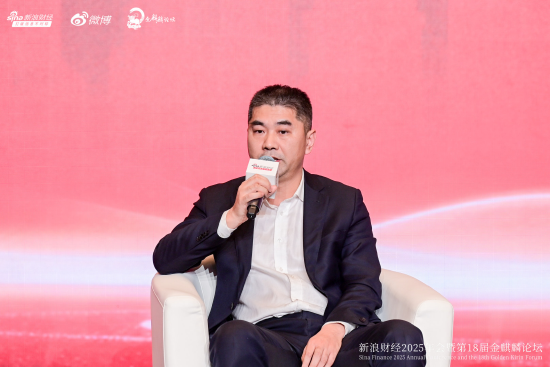
Core Viewpoint - The forum highlighted that AI remains a tool within the financial and securities industry, enhancing service efficiency but not altering the fundamental operational rules of the sector [1][5]. Group 1: AI in Financial Services - AI can improve service efficiency, particularly in investment advisory services, but it cannot surpass the collective capabilities of a team [3][7]. - The current phase of AI application emphasizes its role as a supportive tool rather than a replacement for human professionals [5][8]. Group 2: Wealth Management Transformation - The traditional brokerage business is characterized by "channel business," leading to significant homogenization in service quality and professional capabilities across institutions [3][7]. - Wealth management should focus on transforming uncertainty into certainty, which requires a shift towards integrated professional capabilities rather than merely selling products [3][7]. Group 3: Challenges and Future Directions - The transition towards a more systematic and valuable service model in wealth management is challenging, but essential for market participants to avoid merely enhancing transaction efficiency [4][8]. - Companies like Guotai Junan are actively working to develop a service model that embodies certainty, leveraging AI to enhance service delivery [4][8].

东海证券晨会纪要-20251230
Donghai Securities· 2025-12-30 05:15
Group 1: Securities Industry Investment Strategy - The report emphasizes the importance of wealth management and international business as key growth areas for securities firms, suggesting a differentiated development strategy to become a top-tier investment bank [5][6]. - The personal investable asset scale in China has surpassed 300 billion, with a notable increase in new account openings by 8% this year, indicating a growing enthusiasm among individual investors [5]. - The report highlights the potential for securities firms to leverage ETF sales and enhance their advisory services through a focus on professional, scenario-based, and ecological approaches, as well as digital transformation using AI [5][6]. Group 2: Banking Industry Investment Strategy - The banking sector is expected to experience a relief in core business pressures, with a focus on capturing cyclical elasticity amidst resilient dividends [7][9]. - Despite challenges, the report notes that bank dividend yields remain attractive compared to 10-year government bond yields, maintaining a relative advantage for asset allocation [7]. - The report anticipates a slight recovery in bank profit growth, particularly for smaller banks that maintain strong asset quality during the current credit risk cycle [10]. Group 3: Economic and Regulatory Updates - Starting January 1, 2026, China will adjust tariffs on 935 items to enhance domestic and international market synergy and support economic transformation [11][12]. - The market regulatory authority has outlined key tasks for 2026, focusing on fair competition, anti-monopoly enforcement, and improving market entry and exit systems [11][12]. Group 4: Market Performance Overview - The A-share market has shown slight fluctuations, with the Shanghai Composite Index closing at 3965 points, reflecting a marginal increase of 0.04% [13][14]. - The report indicates that the market is currently experiencing a mixed performance, with some sectors like chemical fibers showing gains while others like energy metals are declining [16]. Group 5: Market Data Insights - As of December 29, 2025, the financing balance in the market was 25,264 million, with a decrease of 20.38 million [18]. - The report provides various interest rates, including a 1-year LPR at 3% and a 5-year LPR at 3.5%, indicating the current monetary policy environment [18].
公募基金市场观察系列:财富管理新范式,ETF投顾展现巨大潜力
Yin He Zheng Quan· 2025-12-29 13:51
- The report introduces five ETF quantitative strategies: macro timing strategy, momentum selection strategy, low-volatility diffusion industry rotation strategy, fund flow strategy, and quantile regression strategy[41][43][52] - **Macro Timing Strategy**: This strategy uses Gaussian distribution-based Black-Litterman (B-L) and Copula distribution-based B-L models to calculate ETF allocation weights. It incorporates economic cycle segmentation to constrain asset allocation weights across different ETF categories. Representative ETFs include stock ETFs (e.g., CSI 300 ETF), bond ETFs (e.g., government bond ETF), commodity ETFs (e.g., gold ETF), and currency ETFs (e.g., Silver Day Profit A). The strategy achieved an annualized return of 9.43%, Sharpe ratio of 0.66, Calmar ratio of 0.52, and maximum drawdown of -13.21% since 2020[43][45][46] - **Momentum Selection Strategy**: This strategy utilizes XGBoost to predict ETF upward probability as a momentum indicator and historical quantile of fund shares as a crowding indicator. It selects ETFs with high momentum and low crowding within sectors, adjusting allocation weights based on crowding levels. The strategy achieved an annualized return of 13.93%, Sharpe ratio of 1.33, Calmar ratio of 1.21, and maximum drawdown of -23.14% since 2020[53][54][55] - **Low-Volatility Diffusion Industry Rotation Strategy**: This strategy applies industry diffusion index factors combined with volatility adjustments to design a low-volatility industry rotation model. It matches ETFs to industry indices based on correlation and selects top ETFs for monthly rebalancing. The strategy achieved an annualized return of 12.22%, relative excess return of 3.21%, Sharpe ratio of 0.91, and maximum drawdown of -21.43% since 2020[61][62][63] - **Fund Flow Strategy**: This strategy uses weighted fund flow indicators and risk metrics to rank industries, selects ETFs based on turnover rate and premium/discount rate, and optimizes allocation weights using second-order stochastic dominance. The strategy achieved an annualized return of 11.24%, Sharpe ratio of 1.12, Calmar ratio of 1.03, and maximum drawdown of -19.21% since 2020[64][67][68] - **Quantile Regression Strategy**: This strategy employs quantile random forest (QRF) to predict future distribution characteristics of technology sector indices, selects ETFs based on liquidity and scale, and adjusts positions using MACD and volatility metrics. The strategy achieved an annualized return of 15.62%, Sharpe ratio of 1.21, Calmar ratio of 1.15, and maximum drawdown of -21.43% since 2020[71][72][73]
以投顾业务为核心 破局券商财富管理转型
Zhong Guo Zheng Quan Bao - Zhong Zheng Wang· 2025-12-11 14:26
Core Insights - The securities industry is undergoing a profound transformation, facing challenges such as declining commission rates, compressed profits from product distribution, and intensified competition [1][2] - The consensus within the industry is shifting towards wealth management transformation centered on professional investment advisory services, as firms seek to address high customer acquisition costs and difficulties in activating existing clients [2][3] Industry Challenges - The brokerage business is under unprecedented pressure, with average commission rates dropping from 0.08% to below 0.02% over the past decade, and a decline in the proportion of channel business revenue [2] - The industry faces three common challenges: market environment volatility, traditional investor behavior misalignment with long-term investment logic, and internal constraints such as short-term revenue pressures and talent shortages [3] Strategic Measures - The company is focusing on four key initiatives to strengthen its investment advisory business: "total-part collaboration," "team building," "training empowerment," and "productization of services" [4] - A collaborative management model has been established to enhance operational efficiency and ensure compliance, addressing the company's limitations in client base and brand influence [4] Talent Development - The company emphasizes that the core asset of brokerage business is talent, and the success of the transformation relies on providing valuable professional services rather than merely selling products [4][5] - A three-tier training system has been developed to enhance the capabilities of investment advisors, covering various dimensions such as business knowledge, professional skills, and marketing techniques [5] Client Management and Service - The company aims to standardize investment advisory services and manage client expectations to reduce irrational behaviors during market fluctuations, which is crucial for establishing a competitive advantage [6] - Future plans include refining client segmentation and developing a targeted product service system to achieve personalized service for clients [7] Long-term Vision - The company is committed to the long-term development of its investment advisory business, focusing on client needs and striving for a win-win situation for client asset preservation and company growth [7][8] - The ongoing transformation towards a buyer-oriented advisory model is seen as a necessary evolution for the industry, moving from scale competition to value competition, ultimately benefiting clients, companies, and the industry as a whole [8]

爱建证券:AI驱动 开启IP财富新纪元
Zhong Zheng Wang· 2025-12-10 07:33
Core Viewpoint - In the increasingly competitive financial industry, customer service capability has become a crucial component of brokerage firms' core competitiveness, with Aijian Securities leveraging AI to enhance its service level and carve out a unique development path in the wealth management sector [1][2]. Group 1: Customer Engagement Strategies - Aijian Securities has established a comprehensive multimedia communication matrix that spans various social media platforms, including WeChat, Weibo, Douyin, and Kuaishou, as well as long video and podcast platforms, ensuring service availability in active customer scenarios [1]. - The company has implemented a regular live streaming operation, conducting over 20 live sessions weekly across major platforms, achieving a weekly viewership of over 200,000 and an average of 23,000 viewers per session, significantly exceeding the industry average of 12,000 [2]. - The interaction rate during live sessions peaked at over 20%, indicating high customer engagement and interest in the content provided [2]. Group 2: Performance Metrics - Within six months, Aijian Securities' advisory services reached a total asset scale exceeding 1.5 billion, with an average client asset of over 5 million, reflecting strong customer recognition of the company's professional services [2]. - The company publishes over 60 short videos weekly, with an average view count of over 400,000 per video, and peak views reaching 900,000, further expanding its service reach and influence [3]. Group 3: Differentiation and Value Creation - Aijian Securities utilizes AI technology for precise customer demand analysis, enabling personalized service offerings and converting potential users into actual clients, thereby enhancing market competitiveness at a low cost [3]. - The company actively collaborates with institutional resources and engages in deep dialogues with star fund managers to inject momentum into premium asset management products, thereby maintaining pricing power [3]. - Aijian Securities focuses on a differentiated approach by emphasizing product quality and combining high-quality asset management products with professional services to create greater value for clients [3].

新股民入市引爆投顾需求 券商深耕财富管理
Zhong Guo Jing Ying Bao· 2025-09-05 19:58
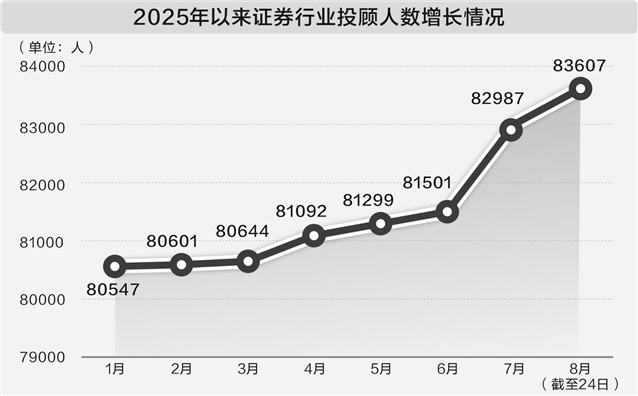
Group 1: Market Overview - The A-share market has seen a structural trend with a significant increase in trading activity and investor engagement, leading to a historic opportunity for investment advisory services [1][2] - In August, 2.65 million new accounts were opened in the A-share market, marking a 34.97% month-on-month increase and a 165% year-on-year increase, with a total of 17.21 million new accounts opened in the first eight months of the year [1] Group 2: Growth in Investment Advisory Services - The number of investment advisors has increased significantly, nearing 90,000, reflecting a strong demand for professional advisory services despite a decrease in overall industry personnel [1] - The brokerage industry has seen a 55% year-on-year increase in commission income from brokerage services, reaching 74.56 billion yuan in the first half of 2025 [2] Group 3: Investor Behavior and Demand - Investors are increasingly seeking professional investment guidance, with many new clients signing up for advisory services to optimize their asset allocation and portfolio structure [3][4] - There is a notable shift in investor inquiries, focusing on specific market conditions, valuation assessments, and investment strategies [3] Group 4: Performance of Wealth Management - The wealth management transformation among brokerages is showing positive results, with a significant increase in client engagement and service offerings [9][11] - The number of signed clients for investment advisory services at Guoxin Securities increased by 63% from the end of 2024 to August 2025, reflecting the growing demand for professional advisory services [7] Group 5: Technology and Client Engagement - Companies are enhancing client engagement through regular communication and interactive platforms, utilizing technology to provide tailored investment solutions [10][11] - The use of AI and technology in advisory services is being emphasized to improve service delivery and meet diverse client needs [11]



上证指数创下十年新高 券商多举措引客、留客、活客
Cai Jing Wang· 2025-08-25 03:30
Core Insights - The Shanghai Composite Index reached a ten-year high of 3,800 points on August 22, leading to increased demand for investment advisory services from investors [2] - Securities firms are responding to the market recovery by enhancing advisory services and launching promotional packages to attract and retain clients [2][6] - There is a notable increase in the signing of equity portfolio products, reflecting a significant recovery in investor confidence and enthusiasm for the equity market [3][5] Group 1: Demand for Advisory Services - The demand for investment advisory services has surged, with a marked increase in the signing of equity-related products [3] - The number of clients accessing advisory service programs has reached a recent high, indicating heightened interest in market conditions and personal investment strategies [3][6] - Several securities firms are actively conducting educational activities to guide new clients in rational investment practices [7] Group 2: Strategies by Securities Firms - Securities firms are implementing various strategies, including new client promotional packages and enhanced investor education initiatives [6] - New client packages often feature annualized returns exceeding 6%, along with AI-driven stock analysis and other advanced tools [6] - Firms are focusing on diversifying product offerings, including ETFs and private equity products, to meet evolving investor interests [6] Group 3: Market Environment - The current market environment is characterized by a new phase, with firms emphasizing the importance of balanced asset allocation to avoid irrational investment behaviors [7] - Despite the increased activity, the current level of engagement among securities firms is not as intense as during the previous year's market surge [7]
市场回暖带热投顾需求 券商多举措引客留客活客
Zheng Quan Shi Bao· 2025-08-24 22:14
Core Viewpoint - The recent surge in the Shanghai Composite Index, surpassing 3800 points, has led to a significant increase in demand for investment advisory services from brokerages, with both contract signings and revenue rising concurrently [1][2]. Group 1: Demand for Investment Advisory Services - There has been a notable increase in the signing of equity portfolio products, reflecting a resurgence in investor confidence and enthusiasm for the equity market [2]. - The number of clients resetting passwords for dormant accounts has surged significantly in August, indicating a revival in trading activity [2]. - The demand for advisory services is driven by investors' concerns about market valuations, the sustainability of capital inflows, and specific asset allocation strategies [2][3]. Group 2: Brokerages' Response Strategies - Brokerages are actively enhancing their advisory services and launching promotional activities, particularly during the "818 Financial Festival," to attract and retain clients [3][4]. - Various brokerages are offering new client incentives, including high-yield financial products and advanced trading tools, to encourage new account openings [4]. - Investment education initiatives are being implemented to guide new clients in rational investment strategies, focusing on risk tolerance and diversified asset allocation [5][6]. Group 3: Operational Enhancements - Brokerages are investing in operational support, including customer service and educational resources, to better meet client needs [5][6]. - Technological improvements, such as app enhancements and intelligent service features, are being introduced to facilitate a better trading experience for clients [6].

