数据产品和服务

Search documents
我国首次明确:培育三类数据流通服务机构
Sou Hu Cai Jing· 2026-02-09 07:00
Core Viewpoint - The recent joint release by the National Data Bureau, Ministry of Industry and Information Technology, Ministry of Public Security, and China Securities Regulatory Commission outlines the cultivation of three types of data circulation service institutions to accelerate the marketization and valuation of data elements in China [1][3]. Group 1: Types of Data Circulation Service Institutions - The three types of data circulation service institutions include data exchanges (centers), data circulation service platform enterprises, and data merchants, each with distinct roles [1][3]. - Data exchanges (centers) will focus on comprehensive service functions, while data circulation service platform enterprises will emphasize specialized development, and data merchants will enhance the development of data products and services [1][3]. Group 2: Policy Measures and Objectives - The opinion encourages diverse circulation and trading models, promoting data exchanges for data, orders, services, models, and scenarios, which is expected to enhance the value release of data elements [1][3]. - By the end of 2029, the capabilities of data circulation service institutions are expected to significantly improve, with more diverse trading forms and richer data products and services [4]. Group 3: Functional Positioning and Development - Data exchanges (centers) are encouraged to strengthen their comprehensive service functions, including compliance assurance and supply-demand matching, to enhance the efficiency of data product circulation [5][6]. - Data circulation service platform enterprises are supported to develop specialized services around industry chains and supply chains, promoting data utilization and value co-creation [6][7]. - Data merchants are encouraged to expand data acquisition channels and develop data products tailored to industry needs, exploring new trading models such as data-as-a-service [6][7]. Group 4: Enhancing Service Capabilities - The opinion emphasizes the need for data circulation service institutions to innovate trading models and increase the supply of high-quality data products and services [7][8]. - Institutions are encouraged to explore diverse trading modes, including data exchanges for various forms of data transactions, to lower transaction costs and promote broader data circulation [7][8]. Group 5: Implementation and Management - The National Data Bureau is tasked with coordinating the establishment of a management system for data circulation service institutions, ensuring clear responsibilities and efficient operations [12][13]. - There is a focus on strengthening supervision and management to prevent illegal activities and ensure compliance within data exchanges and circulation service institutions [12][13].
我国将培育三类数据流通服务机构
Xin Lang Cai Jing· 2026-02-08 11:21
Core Viewpoint - The recent issuance of the "Opinions" by various Chinese government agencies signals a commitment to cultivate three types of data circulation service institutions, aiming to enhance the market-oriented value of data elements and establish a unified national data market [1][2]. Group 1: Types of Data Circulation Service Institutions - The three types of data circulation service institutions include data exchanges (centers), data circulation service platform enterprises, and data merchants, each with distinct roles: data exchanges focus on comprehensive services, platform enterprises on specialized development, and data merchants on enhancing data product and service development [1][2]. - By December 2025, data exchanges are expected to serve as "explorers" of institutional rules and ecosystem cultivation, while platform enterprises will act as the "main force" in promoting industry data circulation and utilization, and data merchants will lead in developing data products and providing diverse services [1]. Group 2: Challenges in Data Element Marketization - The issuance of the "Opinions" aims to address issues such as market specificity, product supply-demand contradictions, and misalignment of service institution functions in the current data element market [2]. - There is a strong demand for data elements across various sectors, but existing data exchanges primarily offer static, one-time data sets, failing to meet the market's need for high-quality data products and services [2]. Group 3: Role and Positioning of Data Exchanges - Data exchanges (centers) have been established for several years, with the Guiyang Big Data Exchange reporting 2,187 market participants and 2,396 listed products by December 31, 2025 [3]. - However, data exchanges face challenges such as low transaction volumes, inefficient processes, and the absence of a robust bilateral market network effect [3][4]. Group 4: Future Directions for Data Exchanges - The "Opinions" clarify that data exchanges are just one part of the data circulation service ecosystem, with a need to enhance their comprehensive service capabilities and better define their market positioning [4]. - Data exchanges should focus on strengthening their service functions, including developing online trading platforms, compliance tools, and high-value data products, while also promoting the circulation of public data products [4][5].
四部门发文加快培育数据流通服务机构
Xin Hua She· 2026-02-07 06:14
Core Viewpoint - The recent policy document aims to clarify the role of data circulation service institutions, enhance transaction efficiency, and promote the marketization and valuation of data elements, ultimately fostering a vibrant data market ecosystem [1] Group 1: Policy Objectives - The document outlines the goal of significantly improving the capabilities of data circulation service institutions by the end of 2029, with a more diverse range of transaction forms and enriched data products and services [1] - It emphasizes the need for increased willingness among various entities to supply and utilize data, leading to a noticeable improvement in the overall level of data circulation and utilization in society [1] Group 2: Current Landscape - Data circulation service institutions, including data exchanges, service platform enterprises, and data vendors, are crucial for linking data supply and demand, facilitating transactions, and advancing the marketization of data elements [1] - Despite the positive contributions of these institutions in optimizing data resource allocation and expanding application scenarios, challenges remain, such as unclear functional positioning, service capability gaps, and the need for improved supervision and management [1]
数据交易所的发展定位及创新方向
Jin Rong Shi Bao· 2026-01-19 01:40
Core Insights - China's data technology development has entered a new phase of systematic layout and collaborative promotion, with efforts to cultivate various data circulation service institutions and accelerate the construction of an open, shared, and secure national integrated data market [1][5] Group 1: Data Market Development - The marketization and efficient utilization of data are core paths to activate the multiplier effect of the digital economy, with data exchanges playing a crucial role in connecting data supply and demand [2] - The National Data Bureau has categorized data circulation service institutions into three types, marking a new stage in the construction of the data factor market [2][3] - Data exchanges are essential components of the national integrated data market, and their future development should focus on "three deep integrations" to clarify their functional positioning and innovation direction [2][6] Group 2: Types of Data Circulation Service Institutions - Data circulation service institutions are evolving, with a need to include platform enterprises and data merchants in the research scope beyond just data exchanges [3] - Data exchanges are exploring the establishment of a full-chain service system for data circulation transactions, but their current role and transaction scale are still limited [3] - Industry data integration and utilization models are being accelerated by data circulation service platform enterprises, which focus on value co-creation through data sharing and exchange [4] Group 3: Role of Data Merchants - Data merchants, as key players in data production and operation, are actively gathering data resources and developing data governance and trading practices [5] - They are innovating in exploring new data circulation transaction models, such as high-quality data sets and data-as-a-service models [5] Group 4: Policy Recommendations for Data Exchanges - Data exchanges should deeply integrate with the development of the real economy, assisting enterprises in data utilization and assetization [7][8] - They should also support public data transactions by providing compliance review and valuation services [8][9] - The construction of data circulation infrastructure is crucial for enhancing the efficiency of data market operations [10][11] Group 5: Innovation and Regulation - Safety, regulation, and innovation are essential for the sustainable development of the data market, with data exchanges needing to establish norms and promote innovative practices [11][12] - A systematic policy framework is necessary to support the long-term development of data exchanges, focusing on capability building and ecosystem cultivation [13][14]
加快培育三类数据流通服务机构
Ren Min Ri Bao· 2026-01-12 20:23
Core Viewpoint - The recent national data work conference emphasizes the acceleration of building an open, shared, and secure national integrated data market by fostering three types of data circulation service institutions [1] Group 1: Types of Data Circulation Service Institutions - The three types of data circulation service institutions identified are data exchanges, data circulation service platform enterprises, and data merchants, which are crucial for promoting data circulation and trading [1] - Data exchanges act as "explorers" for institutional rules and ecosystem cultivation, playing a positive role in supply-demand matching, rule formulation, compliance services, and ecosystem aggregation [1] - Data circulation service platform enterprises serve as the main entities for conducting data circulation transactions, utilizing data infrastructure to promote industry data circulation and development [1] - Data merchants are companies that consider data as a key production factor, leading in developing data products and providing diverse services [1] Group 2: Focus Areas for Data Market Development - The conference highlights the need to prioritize the marketization and valuation of data elements, encouraging diverse entities to explore innovative data circulation trading models [1] - There is a call to increase the supply of high-quality data products and services while ensuring safe, compliant, and efficient data circulation and trading [1] - The focus is also on conducting research on the scale measurement and monitoring indicator system for data circulation trading, aiming to establish a scientific and reasonable monitoring system that reflects the current state of data circulation trading [1]
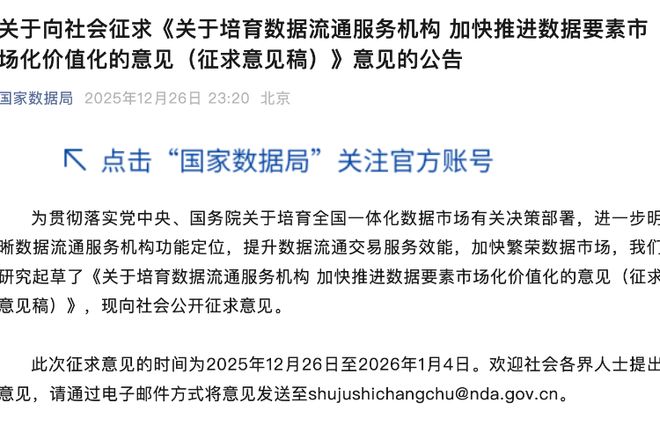
国家数据局:拓展适应AI发展的高质量数据集流通交易方式
Nan Fang Du Shi Bao· 2025-12-29 11:13
Core Viewpoint - The National Bureau of Statistics is seeking public opinion on a policy document aimed at clarifying the roles of data circulation service institutions and promoting the marketization and valuation of data elements [2][3]. Group 1: Function Positioning - The draft opinion proposes to guide data exchanges to enhance their comprehensive service functions, promote the specialized development of data circulation service platform enterprises, and support data vendors in expanding their data product and service development efforts [2]. - It emphasizes supporting data vendors to actively explore data acquisition channels and develop data products tailored to industry needs, including high-quality datasets and new transaction models like data-as-a-service [2]. Group 2: Service Capability Enhancement - The opinion aims to expand high-quality data circulation transaction methods that are suitable for artificial intelligence development, encouraging collaboration between data circulation service institutions and industry leaders [3]. - It supports data circulation service institutions in providing services such as data aggregation, governance, and model training, leveraging data infrastructure [3]. Group 3: Implementation and Regulation - The opinion proposes to strengthen the management of data exchanges, optimize their layout, and control their quantity while promoting integration and optimization [3]. - It calls for the establishment of a cross-departmental regulatory mechanism to combat illegal activities such as fictitious transactions and market manipulation, ensuring that data circulation service institutions adhere to regulatory standards [3]. Group 4: Development Goals - The opinion sets specific construction goals, aiming for significant improvements in the capabilities of data circulation service institutions by the end of 2029, with more diverse transaction forms and enriched data products and services [3].

积极融入和服务全国统一大市场
Jing Ji Ri Bao· 2025-12-17 23:32
Core Viewpoint - The article emphasizes the importance of building a unified national market in China, as directed by the central government, to strengthen domestic circulation and facilitate international trade [1]. Group 1: Implementation of National Market Integration - The Henan province has actively implemented the central government's directives by organizing conferences and formulating plans to integrate and serve the national unified market, establishing 150 annual tasks and focusing on ten key initiatives [1]. - The province has introduced a "Five Unifications and One Opening" policy to align national needs, provincial capabilities, and business expectations [1]. Group 2: Market Regulation and Fair Competition - Henan has enacted measures to enhance market fairness, including the establishment of a competitive review system and the investigation of 426 cases of unfair competition [2]. - The province has streamlined market entry processes, reducing the time for business relocations to six working days and enabling 2,398 companies to move freely [2]. - A unified public credit information directory has been created, resulting in a 52.3% increase in credit loans facilitated, totaling 166.88 billion yuan [2]. Group 3: Government Behavior and Procurement Regulation - The province has undertaken a comprehensive review of local government policies that hinder the unified market, amending or abolishing 160 policy documents [3]. - A new mechanism for investment attraction has been established to regulate local government behavior and prevent unfair practices [3]. Group 4: Business Environment Optimization - Henan has revised its business environment regulations, implementing actions to enhance the overall business climate and reduce administrative burdens by 81.5% [4]. - The province has conducted extensive outreach to businesses, visiting nearly 80,000 companies and resolving over 12,000 issues [4]. Group 5: Logistics and Infrastructure Development - The province is advancing the construction of a modern transportation system, with high-speed rail and highway expansions, achieving a total of 2,263 kilometers of high-speed rail [5][6]. - The logistics sector has seen a 20.2% increase in port throughput, reaching 60.68 million tons [6]. Group 6: Consumer and Trade Hub Development - Henan is focusing on expanding domestic demand through various promotional activities, resulting in a 5.8% increase in retail sales [7]. - The province is enhancing its commercial infrastructure to improve the efficiency of goods distribution [7]. Group 7: Resource Allocation and Market Reform - Efforts are being made to create a unified market for various resources, including land, labor, and capital, with a focus on facilitating efficient resource allocation [8]. - The province has seen a 63.7% increase in technology contract transactions, totaling 230.96 billion yuan [8]. Group 8: International Trade and Belt and Road Initiative - Henan is enhancing its role in the Belt and Road Initiative by expanding international air and rail routes, with a 24.6% increase in cargo throughput at Zhengzhou Airport [9]. - The province's total import and export value reached 840.24 billion yuan, growing by 13.5% [9].
多部门发文,事关消费者网购
Sou Hu Cai Jing· 2025-12-14 19:12
Core Viewpoint - The article discusses the issuance of guidelines by the State Administration for Market Regulation, in collaboration with other departments, aimed at enhancing the quality of products and services on online trading platforms, particularly focusing on the live-streaming e-commerce sector [1][2]. Group 1: Enhancing Product and Service Quality - The guidelines emphasize improving consumer satisfaction and safety, transitioning from quantity to quality in online transactions [1]. - A series of innovative measures are proposed, including supporting platforms to utilize data advantages for on-demand production and encouraging the establishment of Chief Quality Officer systems [2][4]. - Platforms are encouraged to develop customized data products and services, enhancing online sales channels for foreign trade products [4]. Group 2: Quality Management and Training - The guidelines call for improved online service quality management rules, promoting the use of technologies like 3D modeling and AR/VR for better product display [4]. - Platforms should establish a quality management training mechanism for live-streaming marketers, focusing on quality-centric selection processes [8]. - A "blacklist" system is to be implemented for operators and marketers who violate quality laws [8]. Group 3: Regulatory Measures and Compliance - The introduction of a "product digital passport" plan aims to enhance traceability and verification of product quality [2][13]. - The guidelines propose the establishment of a national industrial product quality safety monitoring and early warning platform using big data and AI for proactive regulation [2][13]. - Strict measures will be taken against false advertising and misleading marketing practices, particularly in high-risk sectors like food and pharmaceuticals [8][12]. Group 4: Consumer Protection and After-Sales Service - The guidelines advocate for a comprehensive after-sales service system, ensuring platforms provide efficient dispute resolution and consumer rights protection [12][14]. - Platforms are encouraged to simplify the process for consumers to report quality disputes and enhance the convenience of consumer rights protection [12][14]. - The establishment of a "one-click evidence submission" feature for consumer rights protection is also recommended [14].

市场监管总局等部门发布关于提升网络交易平台产品和服务质量的指导意见
Mei Ri Jing Ji Xin Wen· 2025-12-12 10:14
Core Viewpoint - The recent guidelines issued by the State Administration for Market Regulation aim to enhance the quality of products and services on online trading platforms, which is crucial for improving the online consumption environment and fostering the healthy development of the platform economy [1][2]. Group 1: Overall Requirements - The guidelines emphasize a people-centered development approach, aiming for significant improvements in product and service quality on platforms by 2030, with a focus on addressing key quality issues and enhancing consumer satisfaction [2]. Group 2: Enhancing Product and Service Quality - The initiative encourages innovation in online product quality, particularly in sectors like home appliances, electronics, and food, promoting standardized quality across online and offline sales [3]. - It supports the development of online service quality management rules, including the use of advanced technologies for better consumer interaction and service quality commitments [3]. - The guidelines advocate for the cultivation of trustworthy online business entities, emphasizing quality grading and the establishment of a credit evaluation mechanism for platform operators [3]. Group 3: Strengthening Comprehensive Quality Management - Platforms are encouraged to adopt comprehensive quality management systems, integrating international standards and enhancing their internal auditing processes [4]. - The guidelines stress the importance of improving the quality management capabilities of platform operators, including establishing a full-chain quality control system [5]. - There is a focus on enhancing the quality awareness of live-streaming e-commerce practitioners, promoting quality-centric selection mechanisms and training [5]. Group 4: Addressing Illegal Business Practices - The guidelines call for strict measures against fraudulent practices such as selling counterfeit products and misleading marketing, ensuring that platforms enforce compliance with product information disclosure [6]. - There is a strong emphasis on combating misleading advertising, particularly in sensitive sectors like food and healthcare, and ensuring accountability for false claims [6]. - The guidelines also address unfair competition and pricing violations, mandating transparency in pricing and discouraging predatory pricing practices [6]. Group 5: Strengthening Quality Supervision - The implementation of a "digital passport" for products is proposed to enhance traceability and verification of product quality [6]. - The guidelines advocate for the use of advanced technologies like big data and AI to improve regulatory capabilities and ensure effective monitoring of online transactions [6]. - There is a call for enhanced collaboration between regulatory bodies to ensure comprehensive oversight of online trading activities [6]. Group 6: Creating a Safe Online Consumption Environment - The guidelines promote transparency in information disclosure by platforms and operators, encouraging the public sharing of service agreements and quality information [6]. - They advocate for the establishment of a robust after-sales service system, ensuring consumer rights are protected and disputes are resolved efficiently [6]. - The guidelines aim to facilitate consumer rights protection, promoting mechanisms for quick resolution of quality disputes and enhancing consumer advocacy [6].
市场监管总局等部门:支持发展线上线下融合的即时零售新业态 鼓励平台加强差异化竞争
Zheng Quan Shi Bao Wang· 2025-12-12 10:09
Core Viewpoint - The article discusses the release of guidelines by the State Administration for Market Regulation and other departments aimed at enhancing the quality of products and services sold on online trading platforms, emphasizing innovation and quality improvement across various sectors [1] Group 1: Quality Improvement Initiatives - The guidelines propose promoting quality innovation for products sold online, particularly in sectors such as home appliances, home decoration, electronics, textiles, and food [1] - There is a focus on strengthening quality standards, inspection certification systems, and brand development for online products, ensuring that online and offline products meet the same quality standards [1] Group 2: Collaborative Efforts - The guidelines support collaboration among platforms, operators, manufacturers, industry associations, and research institutions to implement innovation-driven quality improvement plans [1] - There is encouragement for platforms to develop data products and services related to demand customization and risk management, fostering new manufacturing models such as on-demand production and personalized customization [1] Group 3: Manufacturing Quality Enhancement - The implementation of an excellent quality engineering initiative in the manufacturing sector is emphasized, urging platforms and operators to enhance the application of quality management capability evaluation results [1] - The guidelines advocate for the improvement of quality management capability levels among manufacturing enterprises [1] Group 4: New Retail Models and Trade Expansion - The guidelines support the development of new retail formats that integrate online and offline sales, encouraging platforms to strengthen differentiated competition [1] - There is a directive for platform enterprises to broaden and optimize online sales channels for foreign trade products, facilitating procurement, standardization, and certification connections to enrich consumer supply [1]