
文商旅综合体

Search documents
2025,中国旅游消费彻底变了!
3 6 Ke· 2026-01-06 03:21
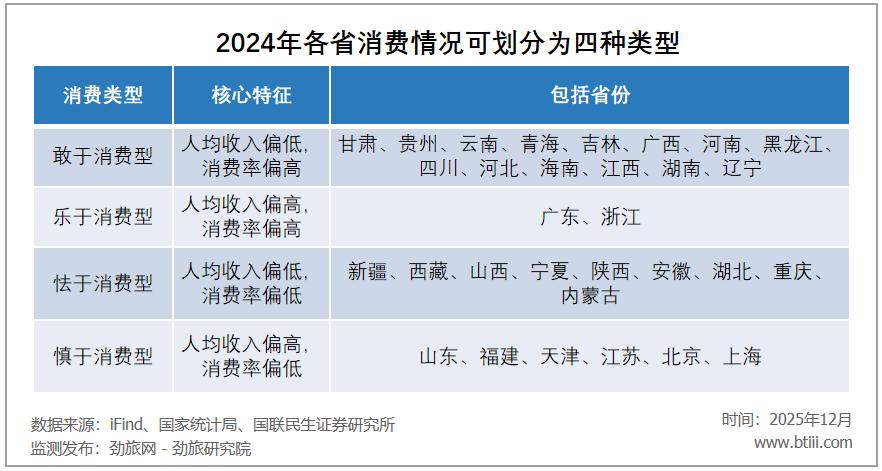
Core Insights - In 2025, domestic tourism consumption in China experienced an unexpected trend where major economic hubs like Beijing and Shanghai saw a decline in tourism spending, while economically lagging regions such as Northeast (Heilongjiang, Jilin, Liaoning), Northwest (Gansu, Qinghai), and Southwest (Yunnan, Guizhou) exhibited a surge in tourism spending [1][2][3] Group 1: Consumption Patterns - Beijing and Shanghai are categorized as "cautious consumption" regions, indicating that residents in these economically advanced cities are spending less on tourism compared to residents in less developed areas [1][2] - The report classifies provinces into four consumption types based on per capita income and consumption rates, revealing that lower-income regions are more willing to spend on tourism [1][2] Group 2: Economic Factors - High living costs and economic pressures in Beijing and Shanghai are leading residents to cut back on tourism budgets, despite a high demand for travel [2][3] - The economic restructuring in these cities has shifted resources towards new industries, resulting in a slower growth of local service industries, which negatively impacts tourism spending [3][4] Group 3: Tourism Trends - A notable trend in 2025 is the preference for camping over hotel stays, with tourists opting for high-cost performance experiences, indicating a shift towards value-driven consumption [9][10] - The K-shaped consumption differentiation highlights a divide where consumers seek either high emotional value experiences or high cost-performance options in tourism [9][10] Group 4: Policy Changes - Traditional tourism stimulus measures like free admission and consumption vouchers are losing effectiveness, prompting regions to explore new strategies such as school holidays and local cultural festivals to boost tourism [14][15] - The introduction of school autumn holidays in several cities has unexpectedly stimulated local tourism, demonstrating the potential of innovative holiday policies [15][19] Group 5: Cultural Influence - The rise of local intangible cultural heritage is becoming a significant driver of tourism consumption, with a notable increase in interest and participation in local cultural events and festivals [17][18] - The success of local cultural events indicates a shift in consumer interest towards unique, culturally rich experiences that enhance tourism spending [17][18]

2025,中国旅游消费彻底变了
虎嗅APP· 2026-01-02 13:24
Core Insights - In 2025, domestic tourism consumption in China experienced an unexpected trend where major economic hubs like Beijing and Shanghai saw a decline in tourism spending, while less developed regions such as Northeast (Heilongjiang, Jilin, Liaoning), Northwest (Gansu, Qinghai), and Southwest (Yunnan, Guizhou) exhibited a surge in tourism consumption [3][4][6]. - Traditional government measures to stimulate tourism, such as consumption vouchers and free admission, have become less effective, leading to the rise of new strategies like seasonal holidays and local intangible cultural heritage events to boost tourism [26][28][32]. Group 1: Consumption Patterns - A report categorized provinces into four consumption types based on per capita income and consumption rates, revealing that Beijing and Shanghai fall into the "cautious consumption" category, contrary to expectations [5][6]. - Residents in economically weaker regions like Northeast China are more willing to spend on tourism due to lower living costs and stable incomes, leading to increased tourism activity [11][12]. Group 2: Changing Consumer Behavior - The trend of tourists opting for camping over hotel stays during peak seasons highlights a shift towards seeking high cost-performance experiences in tourism [14][15]. - The K-shaped differentiation in tourism consumption indicates a split where some consumers prioritize high emotional value experiences, while others focus on high cost-performance, emphasizing value for money [16][18]. Group 3: New Stimulus Measures - The effectiveness of traditional tourism stimulus measures has diminished, prompting the introduction of new strategies such as school autumn breaks and government-led cultural festivals to stimulate local tourism [26][28]. - The introduction of school autumn breaks in cities like Sichuan and Guangdong has unexpectedly boosted local tourism, creating a new peak travel period [28][30]. Group 4: Future Opportunities - The shift in tourism consumption patterns presents new opportunities for businesses, particularly in less developed regions where tourism infrastructure is evolving [35][36]. - The anticipated rise of government-led cultural festivals and new public holidays is expected to further stimulate tourism consumption in 2026, with a focus on creative and low-barrier events [36][37].

2025,中国旅游消费彻底变了
Sou Hu Cai Jing· 2026-01-01 01:48
Core Insights - In 2025, domestic tourism consumption in China experienced an unexpected trend where major economic hubs like Beijing and Shanghai saw a decline in tourism spending, while less developed regions such as Northeast (Heilongjiang, Jilin, Liaoning), Northwest (Gansu, Qinghai), and Southwest (Yunnan, Guizhou) exhibited a surge in tourism activity [2][4][9]. Group 1: Consumption Patterns - Beijing and Shanghai have been categorized as "cautious consumers," indicating that residents in these economically advanced cities are spending less on tourism compared to their counterparts in less affluent regions [3][4]. - The decline in tourism spending in Beijing and Shanghai is attributed to high living costs and economic pressures, leading residents to reduce their travel budgets significantly [4][5]. - In contrast, residents in the Northeast, despite lower incomes, are more willing to spend on tourism due to lower living costs and stable incomes, resulting in a higher propensity for travel [10][11]. Group 2: Changing Consumer Behavior - A notable trend in 2025 is the shift towards camping and high-cost performance experiences, with many tourists opting to sleep in tents rather than expensive hotels during peak travel times [12][13]. - The concept of "high cost performance" has become crucial in influencing tourism consumption decisions, with consumers seeking value for money and unique experiences [14][19]. - The demand for high cost performance is not limited to tourism but reflects a broader global consumer trend towards purposeful spending [16][18]. Group 3: Ineffectiveness of Traditional Stimulus Measures - Traditional measures to stimulate tourism, such as free admission and consumption vouchers, have become less effective, prompting the need for new strategies [20][21]. - New initiatives, including the introduction of school autumn breaks and local cultural festivals, have emerged as effective means to boost tourism consumption [21][22]. - The rise of local intangible cultural heritage as a tourism draw has shown significant potential, with many regions successfully leveraging these cultural elements to attract visitors [24]. Group 4: Future Opportunities - The tourism industry is witnessing a shift in focus towards high-activity markets like Northeast China, with new tourism products and services being developed to meet changing consumer preferences [26][27]. - The introduction of new public holidays and school breaks is expected to further stimulate tourism consumption in the coming years, with predictions of increased government-led cultural and tourism festivals [27][28]. - The evolving landscape of tourism consumption presents opportunities for businesses that can adapt to the demand for high cost performance and unique experiences [28][29].
华侨城A涨2.82%,成交额2.86亿元,后市是否有机会?
Xin Lang Cai Jing· 2025-12-10 07:09
Core Viewpoint - The company, Shenzhen Overseas Chinese Town Holdings Co., Ltd. (华侨城A), has shown a significant increase in stock price and trading volume, indicating potential investor interest and market activity [1]. Group 1: Company Overview - As of the end of 2022, the company managed a total of 316 property projects, covering an area of 46.8 million square meters across 56 cities in China [2]. - The company is primarily engaged in tourism and real estate, with major products including theme parks, hotels, and cultural tourism projects [2][7]. - The company has a significant stake in the cultural tourism development sector, holding 60% of the shares in a subsidiary focused on cultural tourism and specialty town projects [2]. Group 2: Financial Performance - For the period from January to September 2025, the company reported a revenue of 17.025 billion yuan, a year-on-year decrease of 41.95%, and a net profit attributable to shareholders of -4.367 billion yuan, down 85.76% year-on-year [8]. - The company has distributed a total of 16.503 billion yuan in dividends since its listing, but has not paid any dividends in the last three years [9]. Group 3: Market Activity - The stock price increased by 2.82% on December 10, with a trading volume of 286 million yuan and a turnover rate of 1.63%, bringing the total market capitalization to 20.496 billion yuan [1]. - The main capital inflow for the stock today was 28.107 million yuan, accounting for 0.11% of the total, with no significant trends in capital movement observed [4][5].

华侨城A涨1.14%,成交额2.02亿元,近5日主力净流入-8083.19万
Xin Lang Cai Jing· 2025-11-28 07:07
Core Viewpoint - The company, Shenzhen Overseas Chinese Town Holdings Co., Ltd. (华侨城A), is experiencing fluctuations in its stock performance and has significant involvement in the tourism and real estate sectors, with a focus on cultural tourism and themed projects [1][7]. Company Overview - Shenzhen Overseas Chinese Town Holdings Co., Ltd. was established on September 2, 1997, and listed on September 10, 1997. The company primarily operates in tourism, real estate, and paper packaging, with tourism contributing 72.15% and real estate 27.18% to its revenue [7]. - As of November 20, 2023, the company had 108,200 shareholders, an increase of 5.43% from the previous period, with an average of 63,740 circulating shares per person, a decrease of 5.15% [8]. Financial Performance - For the period from January to September 2025, the company reported a revenue of 17.025 billion yuan, a year-on-year decrease of 41.95%, and a net profit attributable to shareholders of -4.367 billion yuan, down 85.76% year-on-year [8]. - The company has distributed a total of 16.503 billion yuan in dividends since its listing, but has not issued any dividends in the past three years [9]. Business Segments - The company manages 316 property projects with a total management area of 46.8 million square meters across 56 cities in China as of the end of 2022 [2]. - The main products include theme parks, hotels, cultural and commercial tourism complexes, natural and cultural scenic spots, travel services, and various community developments [3][7]. Recent Developments - The company has integrated indoor ice and snow venues into some of its theme parks, such as the "Alpine Snow World" at Shenzhen Window of the World, which was upgraded in 2020 [3][4]. - The company holds a 60% stake in Huachao City Zhuozhou Cultural Tourism Development Co., Ltd., which focuses on cultural tourism and themed town projects [2].
小商品城(600415):第七市场新程启航 业绩长期有保障
Xin Lang Cai Jing· 2025-11-17 00:24
Core Insights - The company successfully acquired the land use rights for a plot in Yiwu for 3.22 billion yuan, with an estimated construction period of 3-4 years, aiming for completion post-2028 [1] - The project will cover approximately 164,700 square meters of land, with a total construction area of about 660,000 square meters, including various commercial and office spaces [1] - The total estimated investment for the project is 7.863 billion yuan, funded through the company's own resources and some bank loans [1] Project Objectives - The project aims to create a comprehensive international trade smart ecosystem, focusing on upgrading the "world supermarket" concept and leveraging new national trade reform policies [1] - It will establish three core centers: a "trade integration" center, a "trade and industry city" service center, and a "cultural and commercial tourism" experience center [1] - The development will extend the Yiwu International Trade City, providing physical space to support the innovative growth of import trade [1] Regional Impact - The construction and operation of the project are expected to enhance Yiwu's commercial and tourism development opportunities, optimizing the 4A-level international trade shopping area [1] - The project aims to establish a new landmark for commerce and tourism in Yiwu, thereby increasing the region's influence [1] Investment Outlook - The acquisition of land use rights is anticipated to bolster the company's competitiveness in the import industry chain, aligning with the new round of national trade reforms [2] - The projected net profits for the company from 2025 to 2027 are estimated at 4.51 billion, 5.69 billion, and 6.82 billion yuan, with corresponding price-to-earnings ratios of 20.0, 15.9, and 13.3 [2]

深圳华侨城股份有限公司 2025年10月主要业务经营情况公告
Zhong Guo Zheng Quan Bao - Zhong Zheng Wang· 2025-11-13 23:20
Group 1: Real Estate Sales - In October 2025, the company achieved a contracted sales area of 91,000 square meters, a year-on-year decrease of 62%, but a month-on-month increase of 16% compared to September [2] - The contracted sales amount for October 2025 was 1.3 billion yuan, a year-on-year decrease of 57%, while it increased by 20% month-on-month from September [2] - From January to October 2025, the cumulative contracted sales area was 984,000 square meters, a year-on-year decrease of 26%, and the total contracted sales amount was 14.55 billion yuan, a year-on-year decrease of 27% [2] Group 2: Land Acquisition - In October 2025, the company did not acquire any new land [3] Group 3: Tourism and Comprehensive Business - The company focused on customer needs and market trends, integrating resources and enriching consumption scenarios during the National Day and Mid-Autumn Festival holidays with special events [4] - In October 2025, the company's tourism enterprises received a total of 7.46 million visitors, a year-on-year decrease of 7%, primarily due to a decline in overall consumer enthusiasm for certain holiday events [4] - From January to October 2025, the total number of visitors to the company's tourism enterprises was 67.01 million, a year-on-year decrease of 2% [4]
浙江中国小商品城集团股份有限公司 关于副总经理辞职的公告
Zhong Guo Zheng Quan Bao - Zhong Zheng Wang· 2025-11-08 00:13
Group 1: Management Changes - The company announced the resignation of Mr. Yang Yang from the position of Vice General Manager due to organizational work arrangements, effective immediately upon submission of his resignation report [2] - Mr. Yang held 200,000 shares of the company and will continue to comply with relevant regulations regarding shareholding and changes [2] Group 2: Land Acquisition and Project Development - The company successfully acquired the land use rights for a plot in Yiwu City for 322.31 million yuan, participating in a bidding event held on November 7, 2025 [5][6] - The project aims to create a cultural, commercial, and tourism complex, contributing to the economic growth of the region [5][10] - The total planned area for the project is approximately 164,700 square meters, with a total construction area of about 660,000 square meters [8] - The estimated total investment for the project is 7.863 billion yuan, with land costs accounting for 3.321 billion yuan [9] Group 3: Project Financials and Feasibility - The project is expected to have a payback period of 7.83 years and a post-tax return on investment of 6.41% [11] - Funding will come from the company's own resources and some bank loans [9] Group 4: Strategic Impact - The project is positioned to enhance the existing market synergy and support the innovative development of import trade in Yiwu [12] - It aims to integrate commerce and tourism, optimizing the international trade city into a 4A-level tourist shopping destination [12]
小商品城(600415.SH)以32.23亿元竞得义乌市福田街道地块 规划建设文商旅综合体
智通财经网· 2025-11-07 11:24
Core Viewpoint - The company has successfully acquired the land use rights for a key development project in Yiwu, aiming to create a comprehensive cultural, commercial, and tourism complex, which is expected to enhance the local economy and trade dynamics [1] Group 1: Project Details - The company won the land use rights for a site in Yiwu for 3.223 billion yuan [1] - The total estimated investment for the project is 7.863 billion yuan, with a construction period of 3 to 4 years [1] - The project will focus on upgrading the "World Supermarket" concept and will include three core components: a "Trade and Industry City" service center, a "Cultural and Commercial Tourism" experience center, and a "Trade Integration" center [1] Group 2: Strategic Objectives - The project aims to support the innovation and expansion of import trade by providing physical space and enhancing the synergy of existing market segments [1] - It seeks to capitalize on the opportunities in Yiwu's commercial and tourism development by integrating "tourist demand" with "commercial scenarios" [1] - The initiative is expected to optimize the existing 4A-level international trade shopping area and establish a new landmark for commercial tourism, thereby increasing regional influence [1]
小商品城以32.23亿元竞得义乌市福田街道地块 规划建设文商旅综合体
Zhi Tong Cai Jing· 2025-11-07 11:20
Core Viewpoint - The company has successfully acquired the land use rights for a key development project in Yiwu, aiming to create a comprehensive cultural, commercial, and tourism complex that will invigorate the local economy and enhance its international trade capabilities [1] Group 1: Project Details - The company won the land use rights for 3.223 billion yuan at a public auction held by the Yiwu Natural Resources and Planning Bureau [1] - The total estimated investment for the project is 7.863 billion yuan, with a construction period of 3 to 4 years [1] - The project will focus on upgrading the "World Supermarket" concept and will include three core components: a "Trade and Industry City" service center, a "Cultural and Commercial Tourism" experience center, and a "Trade Integration" center [1] Group 2: Strategic Objectives - The project aims to support the innovation and expansion of import trade by providing physical space for the Yiwu International Trade City [1] - It seeks to enhance the synergy of existing market segments through complementary business models and resource integration [1] - The initiative is designed to better capture opportunities in Yiwu's commercial and tourism development, promoting a deep integration of "tourist demand" with "commercial scenarios" [1] Group 3: Expected Outcomes - The project is expected to optimize the 4A-level tourism shopping area of the International Trade City, creating a new landmark for commercial tourism [1] - It aims to elevate the regional influence of Yiwu by transforming the "Commerce + Tourism" business model [1]