早C晚A

Search documents
研报掘金丨国海证券:首予珀莱雅“买入”评级,有望通过大单品打造与品类扩展实现稳定增长
Ge Long Hui· 2026-02-11 07:26
Core Insights - The report from Guohai Securities highlights the growth momentum of Proya, emphasizing the importance of a big product strategy that focuses on channels, marketing, and customer demographics [1] - Proya has effectively captured market opportunities and addressed the pain points of young consumers through its "early C, late A" big product launches [1] Group 1: Big Product Strategy - The three core elements of the big product strategy are channels, marketing, and customer demographics [1] - The company has optimized its customer structure and enhanced brand positioning through product iteration, category expansion, and emotional marketing combined with direct sales channel operations [1] Group 2: Market Trends and Performance - The rise of Douyin has led to a trend where product sets composed of big products are becoming popular, with 95% of sales for Estee Lauder's Little Brown Bottle and 85% for La Mer's Black Essence coming from product sets on Douyin by 2025 [1] - Different sub-brands in the beauty industry continue to innovate products targeting various pain points of the young demographic, with Cai Tang experiencing sustained high growth and Hua Zhixiao accelerating its overseas expansion, expecting over 100 million yuan in overseas revenue by 2024 [1] Group 3: Financial Performance - The hair care sub-brand OR is positioned as a mid-to-high-end brand, achieving revenue of 279 million yuan in the first half of 2025, representing a year-on-year increase of 102.52% [1] - As a pioneer of the "early C, late A" big product strategy, Proya is expected to achieve stable growth through continuous development of big products and category expansion [1]

珀莱雅正在失速?
虎嗅APP· 2026-01-25 03:36
Core Viewpoint - The article discusses the challenges faced by Proya, a leading domestic beauty brand in China, after achieving the top revenue position in the industry. It highlights the company's struggle to maintain its market leadership amid declining sales and profits, particularly following the transition to a new generation of leadership. Group 1: Company Performance - Proya's revenue for Q3 2025 was 1.736 billion yuan, a year-on-year decline of 11.63%, with net profit dropping by 23.64% to 227 million yuan, marking the first time the company faced a simultaneous decline in both revenue and profit [6][7]. - The company's stock price has significantly decreased from a peak of 129.01 yuan per share in March 2023 to 73.18 yuan per share by January 2026 [6][8]. - In 2024, Proya's main brand revenue reached 10.778 billion yuan, making it the only domestic beauty giant to enter the "100 billion club" [11]. Group 2: Challenges and Market Dynamics - The beauty industry is entering a micro-growth phase, with Proya facing challenges from industry cycles, intensified competition, and internal bottlenecks [7][9]. - Proya's reliance on a few key products, such as the Ruby Essence and the Early C and Late A series, has led to stagnation as these products approach the latter stages of their life cycles [12][13]. - The company is experiencing high marketing costs, which are eroding profit margins, as traditional marketing strategies become less effective in the current market environment [16][18]. Group 3: Strategic Responses - Proya is attempting to revitalize its product lines and has introduced new brands like OR and Cai Tang, but these efforts have not yet compensated for the slowdown in its main brand's growth [14][30]. - The company is also focusing on enhancing its offline presence, having initiated partnerships with offline pharmacies and retail channels, but has seen a decline in offline revenue [21][22]. - Proya's leadership transition has led to significant changes in its executive team, which may impact its strategic direction and operational stability [26][28]. Group 4: Financial Health and Future Outlook - Proya's financial health remains robust, with projected cash flow of 4.07 billion yuan by the end of 2024 and potentially reaching 6.2 billion yuan by the end of 2027, with no short-term or long-term bank loans [31]. - The company is exploring opportunities for international expansion and product development through potential listings and investments, which could provide additional growth avenues [31].


从林清轩到珀莱雅:国货美妆为何排队上港股?
Xin Lang Cai Jing· 2025-12-30 10:29
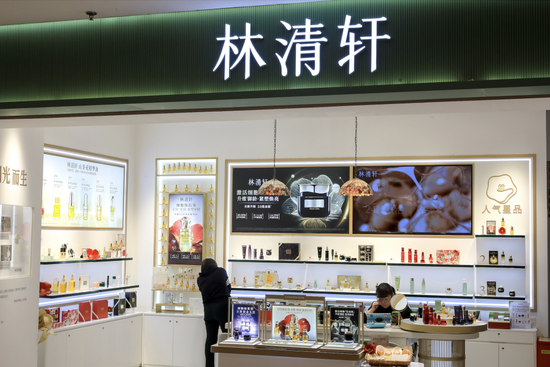
Core Viewpoint - The recent surge in Hong Kong stock listings reflects a shift in domestic beauty brands from chasing traffic to focusing on brand value and product strength, marking a long-term competition in the industry [3][25]. Group 1: Company Overview - Lin Qingxuan, a domestic beauty brand, officially listed on the Hong Kong Stock Exchange on December 30, 2025, with a share price of HKD 77.77 and a total issuance scale of approximately HKD 1.086 billion [3][25]. - The company achieved a market capitalization exceeding HKD 12.4 billion shortly after its listing, with a share price increase of 14.18% on the first day [3][25]. - Lin Qingxuan's revenue reached over CNY 1 billion in the first half of 2025, with a net profit nearly matching the total for the previous year [4][26]. Group 2: Market Trends - By 2024, domestic skincare brands are expected to surpass international brands in market share, with Proya's revenue exceeding CNY 10 billion and Beitaini dominating the sensitive skin segment [4][37]. - The market landscape is shifting, with international brands experiencing sluggish growth while domestic brands gain momentum [4][37]. - The rise of domestic brands is attributed to their ability to adapt to new marketing channels and consumer preferences, particularly among younger demographics [39][40]. Group 3: Financial Performance - Lin Qingxuan's revenue grew from CNY 690 million in 2022 to CNY 1.21 billion in 2024, with a compound annual growth rate of 32.3% [7][30]. - The company turned a profit in 2023 with a net income of CNY 85 million, and by the first half of 2025, net profit reached CNY 182 million [9][32]. - Online sales accounted for 65.4% of total revenue in the first half of 2025, with Douyin contributing significantly to this growth [11][34]. Group 4: Strategic Shifts - The capital strategy for domestic beauty brands is shifting from A-shares to Hong Kong stocks, with several brands, including Lin Qingxuan and Proya, seeking listings in Hong Kong to enhance their valuation and international presence [5][27]. - The transition to online sales and digital marketing has been crucial for Lin Qingxuan's recovery and growth, especially following the pandemic [35][36]. - The competitive landscape is evolving, with domestic brands focusing on technology development and brand value rather than just marketing [29][41].
一位温州二代接班,要IPO了
投资界· 2025-10-31 08:15
Core Viewpoint - Proya Cosmetics has officially submitted an IPO application to the Hong Kong Stock Exchange, aiming to become the largest domestic cosmetics group listed in both A and H shares [4][5]. Company History and Development - Proya was founded in 2003 by Hou Juncheng and his brother-in-law Fang Youyou in Hangzhou, overcoming challenges in a market dominated by international brands [6][7]. - The company initially struggled but began to gain traction around 2007 by associating itself with hydration and leveraging celebrity endorsements, leading to significant revenue growth [7]. - Proya achieved revenue of 1 billion RMB for the first time in 2008 and entered the top tier of domestic cosmetics brands by 2013 [7]. Financial Performance - In 2023, Proya reported revenue of 8.905 billion RMB, surpassing competitors like Shanghai Jahwa and Huaxi Biological, establishing itself as a leader in the domestic beauty market [7][9]. - The company is projected to reach 10.778 billion RMB in revenue for 2024, with net profits expected to grow from 1.230 billion RMB in 2022 to 1.585 billion RMB in 2024 [9][10]. - The first half of 2025 saw Proya generate 5.362 billion RMB in revenue, marking a 7.21% year-on-year increase, with net profit rising by 13.80% [9][10]. Management Transition - In September 2022, Hou Yamen, the son of founder Hou Juncheng, took over as CEO, marking a significant leadership change [9][11]. - The company has experienced several high-level executive departures since the transition, which has raised concerns about management stability [11]. Market Position and Competitive Landscape - Proya's market capitalization is currently around 29.2 billion RMB, but it has seen a decline of over 10% in stock price this year, resulting in a loss of approximately 4 billion RMB in market value [11]. - The company has a diverse brand portfolio, including Proya, Caitang, and Off&Relax, with several brands exceeding 500 million RMB in sales [11]. Industry Trends - There is a growing trend of domestic beauty brands pursuing IPOs, with several companies, including Lin Qingxuan and Zhenyan Biotechnology, also seeking to list [12][13]. - The beauty industry is witnessing a capital wave, with many companies aiming to attract international investment by meeting specific profit thresholds [15].

珀莱雅的两种焦虑
Hua Er Jie Jian Wen· 2025-08-30 05:32
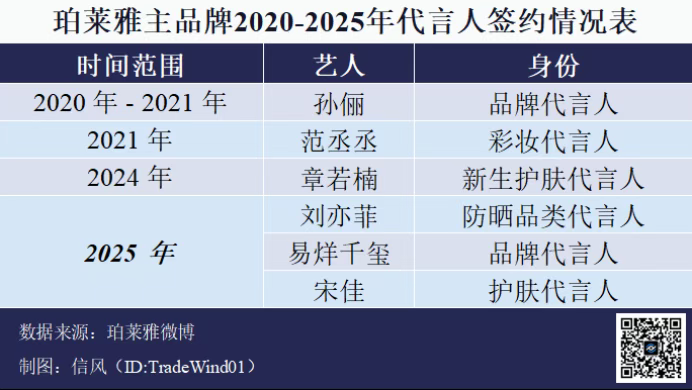
Core Viewpoint - Proya (603605.SH) has become the first domestic beauty brand to surpass 10 billion in revenue but is currently facing pressure from slowing performance [1][2] Financial Performance - In the first half of 2025, Proya reported revenue and net profit attributable to shareholders of 5.362 billion and 799 million respectively, representing year-on-year growth of 7.21% and 13.8% [1] - The second quarter showed a significant slowdown, with revenue of 3.003 billion, a year-on-year increase of only 6.49%, down over 30 percentage points compared to the same period in 2024 [1] - The main brand's revenue declined slightly by 0.08% to 3.979 billion in the first half of 2025, compared to a growth rate of 38% in the same period last year [5] Marketing Strategy - Proya has significantly increased its marketing expenditures, signing at least three top celebrities as brand ambassadors in 2025, which is more than the total of the past five years [1][9] - Marketing expenses reached 2.659 billion in the first half of 2025, a year-on-year increase of 13.64% [7] - The company is focusing on cost control, with operating costs down over 5% year-on-year to 1.427 billion [1][11] Competitive Landscape - Proya is set to compete with its peer, Shiseido's parent company, Up Beauty (2145.HK), which reported a revenue growth rate of 16% in the first half of 2025 [3][15] - Proya's market share is currently around 2%, indicating significant room for growth compared to mature markets [6] Future Plans - Proya is planning to list on the Hong Kong Stock Exchange, aiming to enhance its international strategy and financing capabilities [13][14] - The company has identified potential acquisition targets to boost its performance, with a goal of increasing its overall revenue to 35 billion from its own brands and 15 billion through acquisitions over the next decade [15][16]
创始人儿子上任不到一年,珀莱雅昔日功勋几乎全数出局
阿尔法工场研究院· 2025-06-02 13:38
Core Viewpoint - The article discusses the leadership transition at Proya, highlighting the challenges faced by the new CEO, Hou Yameng, in shifting the company's focus from marketing to research and development, amidst significant executive turnover and a legacy of high marketing expenses [1][10]. Group 1: Leadership Changes - Wang Li, the Vice General Manager and Secretary of the Board, resigned two years before her term ended, indicating potential instability in the company's leadership [4]. - Several key executives, including the R&D Director and Chief Marketing Officer, have left the company recently, suggesting a significant shift in the management team [4][5]. - Hou Yameng, the son of the company's actual controllers, has taken over as CEO, marking a generational transition in leadership [5]. Group 2: R&D and Marketing Focus - Despite Hou Yameng's efforts to enhance R&D hiring, Proya still struggles with the perception of being "heavy on marketing and light on R&D" [10]. - In 2024, Proya's sales expenses reached 5.16 billion yuan, a 30% increase year-on-year, with a sales expense ratio of 48% [10]. - The company's R&D expense ratio has remained around 2%, which is relatively low compared to industry standards, indicating a potential area for improvement [10]. Group 3: Historical Context - Proya's rise can be attributed to effective marketing strategies, including collaborations with influencers and the introduction of popular product lines [8][9]. - The company's founder, Hou Jun Cheng, initially built trust by distributing established brands before launching Proya as its own brand [7][8].