昇腾产品

Search documents
算力狂飙带飞光模块
2 1 Shi Ji Jing Ji Bao Dao· 2025-10-24 23:08
Core Insights - The domestic computing power industry in China is entering a period of explosive growth by 2025, driven by high capital expenditure from major companies and a consensus on domestic computing power [1][2] - The industry is transitioning from the first phase of scale expansion to the second phase, which focuses on deep integration with the real economy and value creation [1] - The light module sector is expected to benefit significantly from this computing power revolution [1] Demand Side - Major companies are maintaining high growth in capital expenditure, contributing to the consensus on domestic computing power [2] - By 2025, China's intelligent computing power scale is projected to reach 1037.3 EFLOPS, with a compound annual growth rate of 46.2% from 2023 to 2028 [3] - The global AI computing power market is expected to reach $1.2 trillion by 2025, with China accounting for 38% of this market [3] Supply Side - Breakthroughs in advanced processes and innovations from companies like Cambrian and Moore Threads are leading to revenue growth [2] - The domestic computing power industry is gradually forming a self-controlled supply chain, supported by significant R&D investments [4] - Companies like Zhongji Xuchuang and NewEase have shown strong financial performance, with Zhongji Xuchuang achieving a revenue of 14.789 billion yuan in the first half of 2025, a year-on-year increase of 36.95% [4] Market Dynamics - The light module market is experiencing a surge in demand, particularly for high-speed products, with Zhongji Xuchuang's gross margin reaching 39.96% [4][5] - The competition landscape shows that Chinese manufacturers dominate the global midstream market, with Zhongji Xuchuang and NewEase ranking among the top three globally [6] - The growth of GPU servers and the increasing penetration of silicon photonic modules are expected to drive further demand for light modules [7] Future Outlook - The capital expenditure of four major overseas cloud companies is expected to increase by 50% to $333.8 billion in 2025 [8] - The demand for light modules is anticipated to continue growing due to advancements in AI and deep learning applications [7][8] - Companies are focusing on high-quality delivery capabilities and supply chain management to maintain competitive advantages in the market [9]


沪指创十年新高 科技股回归 寒武纪再登“股王”宝座
2 1 Shi Ji Jing Ji Bao Dao· 2025-10-24 14:07
Market Overview - On October 24, the Shanghai Composite Index surged to a nearly ten-year high, closing at 3950.31 points, up 0.71%, marking the highest closing record in nearly a decade [2] - The ChiNext Index also performed strongly, rising 3.57% to close at 3126.05 points, with a year-to-date increase of nearly 50%, significantly outperforming other broad indices [2] Technology Sector Performance - The technology sector, particularly AI and semiconductor stocks, led the market rally, with the CSI Information Index increasing by 7.64% this week [2] - Notable stocks included Cambricon Technologies, which saw a price increase of 9.01%, closing at 1525 yuan per share, reclaiming the title of "highest-priced stock" in A-shares [4] Cambricon Technologies - Cambricon's stock has risen 112.46% this year and over 28 times in the past three years, with a market capitalization exceeding 643 billion yuan [4] - The company's strong performance is attributed to market recognition of the AI chip industry, with institutions like Goldman Sachs setting a target price of 1835 yuan, and some projecting a long-term price of 3934 yuan [4] Industry Trends - The valuation of technology stocks is rapidly reshaping, with the market capitalization of the technology sector now exceeding 25% of the A-share market, significantly higher than that of banking, non-bank financials, and real estate combined [5] - By the end of the "13th Five-Year Plan," the number of technology companies in the top 50 by market capitalization increased from 18 to 24 [5] Future Outlook - Analysts predict that by 2025, the domestic AI chip industry will see significant growth, driven by increased capital expenditure from major companies and advancements in domestic manufacturing capabilities [5] - The domestic cloud service providers are expected to accelerate their investments in AI, aiming to catch up with North American firms, which will further drive the growth of the domestic computing power market [5]


算力狂飙带飞光模块 5000亿中际旭创再创新高
2 1 Shi Ji Jing Ji Bao Dao· 2025-10-24 06:04
Core Viewpoint - The domestic computing power industry in China is entering a period of explosive growth by 2025, driven by high capital expenditure from major companies and a consensus on domestic computing power. This is supported by breakthroughs in advanced processes and innovation, leading to a self-controlled industrial chain [1][2]. Demand Side - Major companies are continuing to increase capital expenditure, indicating a strong demand for domestic computing power. The consensus on domestic computing power is gradually forming [1][2]. - By 2025, China's intelligent computing power scale is expected to reach 1037.3 EFLOPS, with a compound annual growth rate of 46.2% from 2023 to 2028, highlighting the significant demand for high-end computing power in AI training and inference scenarios [3]. Supply Side - Breakthroughs in advanced processes are being made, with companies like Cambrian and Moore Threads seeing revenue growth. Huawei has announced a three-year plan for its Ascend products, contributing to the formation of a self-controlled domestic computing power industrial chain [2]. - The light module sector is expected to benefit significantly from the computing power revolution, with companies like Zhongji Xuchuang and New Yisheng showing strong financial performance and technological advancements [1][4]. Financial Performance - Zhongji Xuchuang reported a revenue of 14.789 billion yuan in the first half of 2025, a year-on-year increase of 36.95%, with a net profit of 3.995 billion yuan, up 69.4%. The company's gross margin improved to 39.96% [4]. - New Yisheng experienced explosive growth, with a revenue of 10.437 billion yuan in the first half of 2025, a year-on-year increase of 282.64%, and a net profit of 3.942 billion yuan, up 355.68% [4][5]. Market Trends - The global AI computing power market is projected to reach 1.2 trillion USD by 2025, with China accounting for 38%. Key sectors driving demand include intelligent driving, industrial AI, and medical imaging, which together contribute 62% of computing power consumption [3]. - The light module market is expected to maintain high growth, with significant capital expenditure from major cloud companies projected to increase by 50% to 333.8 billion USD in 2025 [7]. Competitive Landscape - Chinese companies have established a dominant position in the global midstream market, with Zhongji Xuchuang and New Yisheng ranking among the top three globally [5]. - Zhongji Xuchuang's competitive advantages include high-quality delivery capabilities, supply chain strength, and a leading position in silicon photonics technology [8].
工信部放大招!国产算力,重磅消息!资金逢跌抢筹,科创人工智能ETF(589520)近6日连续吸金7792万元!
Xin Lang Ji Jin· 2025-10-17 02:31
Group 1 - The Ministry of Industry and Information Technology (MIIT) has launched a special initiative to achieve a one-way interconnection delay of less than 1 millisecond between medium and large computing centers in urban areas by 2027, addressing the domestic computing power shortage [1] - By 2027, the deployment rate of 400Gbps exits for medium and large computing centers is expected to reach no less than 50%, enhancing user experience in computing power usage [1] - Domestic AI chip manufacturers are rapidly iterating their products, and the seamless adaptation of domestic computing chips is expected to drive the sustainable development of domestic AI [1][2] Group 2 - The demand for domestic computing power is anticipated to rise significantly by 2025, driven by large enterprises' capital expenditures and the formation of a consensus on computing power localization [2] - Companies like Cambricon and Moore Threads are expected to see revenue growth due to breakthroughs in advanced processes, contributing to the formation of a self-controlled domestic computing power industry chain [2] - The upcoming World VR Industry Conference will feature major tech companies, indicating a growing interest in AI glasses and the potential for innovation in the AI+AR glasses industry [2] Group 3 - The current market is experiencing a rotation of hot topics, with discussions on whether the technology sector can maintain its momentum, particularly in the context of the "14th Five-Year Plan" focusing on strong technology attributes [3] - The logic of domestic substitution is being reinforced amid trade disputes, which is a key driver for the strength of technology stocks [3][4] - The AI wave has opened up new growth opportunities across multiple industries, positioning technology stocks as the main focus of the current market rally [4] Group 4 - The Sci-Tech Innovation Artificial Intelligence ETF (589520) is highlighted for its three key advantages: policy support for AI, the importance of self-controlled technology in the context of tech friction, and its high elasticity and offensive potential compared to direct investments in individual stocks [5] - The top ten holdings of the ETF account for over 71.90% of its weight, with semiconductors being the largest sector, indicating a concentrated investment strategy [6]
刚刚,利好来了!算力,重磅消息!
券商中国· 2025-10-16 12:55
Core Viewpoint - The Ministry of Industry and Information Technology (MIIT) has announced a special action plan to develop a low-latency computing network, aiming for a one-way interconnection delay of less than 1 millisecond between medium and large computing centers in urban areas by 2027, which is expected to enhance the importance of computing power in the AI industry [1][3][4]. Group 1: Policy and Infrastructure Development - The MIIT's notification emphasizes the construction of a high-speed, low-latency computing network, targeting a millisecond-level resource network capability within urban areas [3][4]. - By 2027, the plan aims for a deployment rate of at least 50% for 400Gbps connections between medium and large computing centers, with a similar target for all-optical cross-connects at key urban sites [3][4]. - The initiative includes the development of innovative network technologies and protocols to enhance the operational efficiency of computing networks [4]. Group 2: Industry Opportunities and Trends - Multiple brokerages express optimism about long-term investment opportunities in the computing power sector, particularly in light of recent favorable policies [6][7]. - The MIIT and other departments have outlined plans to strengthen new information infrastructure and promote the integration of computing power with various industries, including manufacturing and finance [7]. - The domestic AI computing ecosystem is evolving, with significant orders for servers from major banks and telecom companies, indicating a strong market for domestic computing power suppliers [8]. Group 3: Market Dynamics and Projections - Analysts predict a rise in domestic computing power driven by increased capital expenditure from large enterprises and a growing consensus on the need for localization [9]. - The light communication sector is expected to see substantial growth, with a projected 167% year-on-year increase in net profit for the third quarter [10]. - The demand for optical modules, particularly 800G, is anticipated to continue its rapid growth, benefiting leading manufacturers in the sector [10].

“硬科技”崛起:15家大湾区企业上榜中国科技50强
2 1 Shi Ji Jing Ji Bao Dao· 2025-08-25 14:22
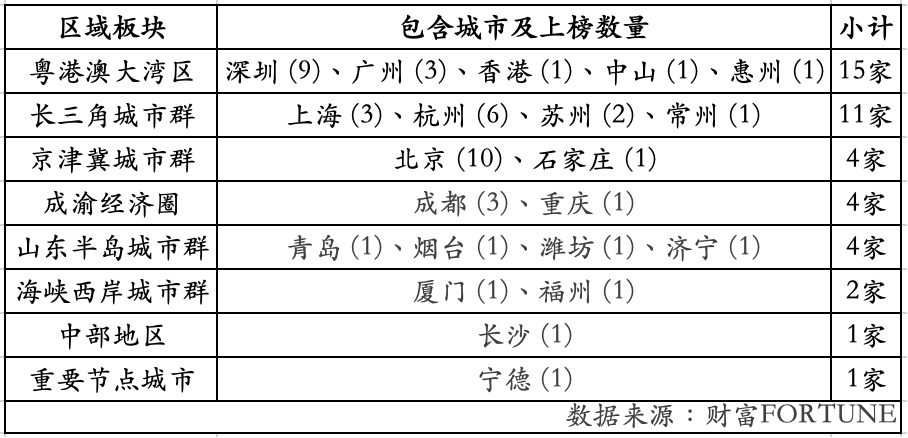
Core Insights - The 2025 China Technology Top 50 list published by Fortune magazine highlights the leading technology companies in China, with a significant representation from the Guangdong-Hong Kong-Macao Greater Bay Area [1][2]. Regional Overview - The Greater Bay Area leads the nation with 15 companies on the list, followed by the Yangtze River Delta with 12 and the Beijing-Tianjin-Hebei region with 10, indicating a concentration of technological innovation in these areas [2][3]. - Shenzhen stands out with 9 companies, while Guangzhou has 3 new entrants, showcasing its growing innovation capabilities [3]. Company Highlights - The list includes established leaders like Huawei, Tencent, and BYD, as well as emerging companies such as DJI, Dazhong Laser, and WeRide, covering sectors like telecommunications, digital technology, new energy vehicles, and life sciences [4][5]. - Notable companies from the Greater Bay Area include: - Huawei Investment Holding (Shenzhen) - Tencent Technology (Shenzhen) - BYD Co., Ltd. (Shenzhen) - DJI Innovations (Shenzhen) - Dazhong Laser Technology Group (Shenzhen) - SF Technology Co., Ltd. (Shenzhen) - Shenzhen BGI Technology Co., Ltd. (Shenzhen) - Kingfa Sci. & Tech. Co., Ltd. (Guangzhou) - Xian Dao Technology Group (Guangzhou) - WeRide (Guangzhou) - Zhongshan Kangfang Biopharmaceutical Co., Ltd. (Zhongshan) - TCL Technology Group (Huizhou) - Bern Optical Holdings Limited (Hong Kong) [5][9]. Evaluation Criteria - The evaluation criteria for the list have evolved from focusing on revenue and market share to emphasizing technological influence, key industry roles, and sustainable innovation [6][8]. - The new standards assess companies based on patent quality, technological independence, R&D investment intensity, and the practical application of technology [6][8]. Industry Trends - The strong performance of Guangdong technology companies reflects a shift from traditional manufacturing to technology-driven innovation, highlighting the rise of "hard technology" and the increasing importance of AI, energy, and biomedicine [4][10]. - The Guangdong government has implemented policies to foster an innovative ecosystem, aiming to build a modern industrial system that integrates technology and industry [10][11].


2025年《财富》中国科技50强
财富FORTUNE· 2025-08-21 04:07
Core Viewpoint - The article emphasizes the emergence of a new era where technology and humanity are increasingly integrated, highlighting the significant role of Chinese companies in driving technological advancements and global influence [2][3]. Group 1: Historical Context - The article traces the evolution of technology from the steam engine in the 18th century to the rise of artificial intelligence and quantum computing in the present day, illustrating how these advancements have transformed human labor and interaction [2]. Group 2: Current Trends in Technology - Chinese companies are focusing on practical applications of technology, particularly in vertical sectors like finance and healthcare, rather than engaging in vague conceptual discussions [3]. - Innovations such as embodied intelligence and brain-computer interfaces are being developed to enhance human capabilities and address complex problems [2][3]. Group 3: Featured Companies - Huawei is recognized for its leadership in 5G technology, with a 15% share of global essential patents, and significant advancements in chip development and AI algorithms [12]. - DeepSeek, a prominent AI model, achieved an MMLU benchmark score of 88.5, ranking it among the top AI models globally [15]. - CATL leads the global battery market with a 37.6% share in power battery installations and a significant investment in R&D [19]. - Alibaba has established itself as a major player in cloud computing and AI, with over 200 million active users on its AI applications [25]. - Tencent holds a strong position in digital technology, with over 86,000 patent applications globally [28]. - BYD's global electric vehicle sales reached 4.27 million units in 2024, with ambitious growth plans for 2025 [31]. - ByteDance is heavily investing in AI, with a capital expenditure of 80 billion yuan in 2024 [34]. - DJI dominates the consumer drone market, holding a 70-85% share globally [40]. - Lenovo leads the global PC market with a 23.8% share as of Q1 2025 [46]. - BOE Technology is a leader in the semiconductor display industry, with a significant share in various display applications [49]. - Other notable companies include Shanghai Yiyu Technology, SF Technology, and others, each contributing to advancements in their respective fields [56][59].