
智能手表等

Search documents
2025中国消费品牌智能创新白皮书
Sou Hu Cai Jing· 2026-01-25 03:22
Core Insights - The 2025 China Consumer Brand Intelligent Innovation White Paper highlights a systemic transformation in the Chinese consumer industry, driven by intelligent innovation and the integration of AI technologies, shifting from scale-driven growth to value-oriented high-quality growth [1][2][7]. Supply Side Summary - AI technologies are permeating the entire value chain of enterprises, enhancing product development through high-throughput screening and trend modeling, leading to shorter development cycles and higher success rates for new products [1][2][14]. - Smart factories and flexible production lines are becoming widespread, utilizing digital twins and intelligent scheduling to break traditional supply chain efficiency limits [1][2][14]. - Generative AI is revolutionizing marketing by automating the generation of marketing materials and enabling precise targeting, thus transforming brand-user interactions from traffic-driven to algorithmic empathy [1][2][14]. - Companies are building innovation ecosystems through mergers, acquisitions, and partnerships with research institutions to accelerate technology implementation [1][2][14]. Demand Side Summary - Consumer demands are evolving, with practicality and health safety becoming core priorities; 83.1% of consumers are willing to pay a premium for technological innovations, but they are increasingly cautious, prioritizing performance improvements and new experiences [2][12]. - The consumption landscape is shifting from single product offerings to comprehensive solutions across various domains such as home, office, health, and beauty, creating a new normal that balances "invisible technology" with "precise services" [2][12]. - Distinct consumer segments are emerging, such as "aesthetic experiencers" and "efficiency pragmatists," driving the market towards personalization and segmentation [2][12]. Industry Trends Summary - The deep integration of AI with the real economy, the scaling of green consumption technologies, and the fusion of globalization with localization in innovation are identified as three major directions for the industry [2][12][27]. - The application of technology is extending from applied innovation to foundational infrastructure innovation, while business models are evolving from online-offline integration to "online-integration" [2][12][27]. - The competitive logic is shifting from cost-performance ratio to "value-performance ratio," necessitating a balance between technological innovation and humanistic care [2][12][27]. Future Outlook Summary - The intelligent innovation revolution is redefining the relationships between people, goods, and venues in the consumer industry, necessitating a focus on user needs, continuous technological iteration, and collaborative ecosystems for companies to thrive in global competition [2][12][27]. - The report emphasizes the importance of understanding the essence of user needs and maintaining a commitment to innovation and evolution to succeed in the rapidly changing market landscape [2][12][27].


四川2025年GDP同比增长5.5% 规上工业增加值增长6.5%
Xin Hua Cai Jing· 2026-01-21 05:30
Economic Overview - In 2025, Sichuan's GDP reached 67,665.34 billion yuan, reflecting a year-on-year growth of 5.5% at constant prices [1] - The primary industry added value was 5,751.35 billion yuan, growing by 3.7%; the secondary industry added value was 23,260.22 billion yuan, increasing by 4.9%; and the tertiary industry added value was 38,653.77 billion yuan, rising by 6.1% [1] Agricultural Production - The total grain output in Sichuan for 2025 was 36.625 million tons, a 0.8% increase from the previous year [1] - Notable increases in agricultural products included vegetables and edible fungi (4.1%), winter rapeseed (2.0%), tea (5.4%), and fruits (6.0%) [1] - Livestock production included 62.48 million pigs (1.6% growth), 3.01 million cattle (1.1% growth), and 1.97 million tons of aquatic products (5.2% growth) [1] Industrial Performance - The added value of Sichuan's above-scale industrial sector grew by 6.5%, with a product sales rate of 96.1% [2] - Among 41 major industries, 33 experienced growth, with automotive manufacturing increasing by 16.7%, electrical machinery by 13.2%, and computer and communication equipment by 12.9% [2] - Key industrial product outputs included natural gas (10.9% growth), industrial robots (45.9% growth), and lithium-ion batteries (45.1% growth) [2] High-Tech Industry Growth - The added value of high-tech manufacturing in Sichuan rose by 12.3%, with electronic and communication equipment manufacturing growing by 20.2% [2] - The aerospace and aircraft manufacturing sector also saw a significant increase of 19.0% [2] Service Sector Development - The added value of the service sector increased by 6.1%, with leasing and business services growing by 14.4% and information technology services by 9.8% [3] - The total retail sales of consumer goods reached 29,135.4 billion yuan, marking a 5.1% increase, with notable growth in communication equipment (50.8%) and jewelry (32.6%) [3] Economic Strategy and Challenges - The overall economic outlook for Sichuan in 2025 indicates steady progress, with a focus on enhancing resilience and vitality [4] - Key strategies include promoting the Chengdu-Chongqing economic circle, implementing synchronized urban-rural development, and ensuring high-quality growth [4]
深圳十二招力推传统产业转型升级
Di Yi Cai Jing· 2025-09-29 10:12
Core Viewpoint - Shenzhen aims to enhance the scale of its traditional industries to exceed 700 billion yuan within approximately three years through 12 new policy measures focused on digitalization and artificial intelligence [1][2][3]. Group 1: Policy Measures - The first measure focuses on optimizing the industrial policy system to support the growth of enterprises in sectors such as clothing, jewelry, furniture, and eyewear [1]. - The second measure emphasizes strengthening investment through a diversified model involving government-guided funds, listed companies, and professional investment institutions to nurture quality enterprises [1]. - The third measure aims to accelerate core technology breakthroughs to promote high-end development in traditional industries by addressing key materials and components [1]. Group 2: Digital Transformation and AI Integration - The fourth measure involves fully embracing artificial intelligence to cultivate new momentum in traditional industries, with plans to integrate AI into various sectors including home appliances and fitness equipment [2]. - The fifth measure focuses on utilizing various special funds to assist traditional enterprises in their digital transformation, targeting over 100 companies within three years [2]. - The sixth measure implements a "three products" strategy to create over 100 popular products by encouraging collaboration between traditional manufacturing and new technologies [2]. Group 3: Brand Promotion and Market Expansion - The seventh measure aims to enhance the promotion of Shenzhen's traditional industry brands, telling their stories to strengthen brand recognition [2]. - The eighth measure supports hosting high-end exhibitions and competitions to establish industry benchmarks and increase domestic and international influence [2]. - The ninth measure focuses on building platforms to help enterprises explore diverse markets and promote integrated development of domestic and foreign trade [3]. Group 4: Resource Coordination and Talent Development - The tenth measure involves coordinating resources to provide "one-stop" services for enterprises, with a dedicated working group established for traditional industry development [3]. - The eleventh measure aims to optimize industrial spatial layout to create high-quality industrial clusters [3]. - The twelfth measure focuses on improving the talent cultivation system to gather skilled professionals needed for industry development [3]. Group 5: Current Industry Competitiveness - Shenzhen has significant competitiveness in various traditional industries, leading in high-end women's clothing, jewelry production, and eyewear manufacturing [5]. - The city is recognized as a major production base for mid-to-high-end eyewear, accounting for about half of global output [5]. - Recent trends show that traditional industries in Shenzhen are accelerating their transformation towards high-end, intelligent, and green production, with a projected 25.6% year-on-year increase in manufacturing technology investment in 2024 [5].
蓝思科技上半年净利增长超3成:全面拥抱AI,新智能终端多点开花
2 1 Shi Ji Jing Ji Bao Dao· 2025-08-26 11:58
Core Viewpoint - The company, Lens Technology, has achieved steady growth in its performance in the first half of the year, driven by its multi-business layout and strategic focus on AI-driven hardware innovation [1] Financial Performance - The company reported a revenue of 32.96 billion yuan, representing a year-on-year increase of 14.18% - Net profit reached 1.194 billion yuan, up 35.53% year-on-year - Basic earnings per share were 0.23 yuan, reflecting a growth of 35.29% year-on-year - A cash dividend of 1 yuan per 10 shares is proposed, totaling approximately 526 million yuan [1] Business Segments Consumer Electronics - The consumer electronics segment, particularly smartphones and computers, generated revenue of 27.185 billion yuan, a year-on-year increase of 13.19% - The company has maintained its leading position in the market for glass, ceramics, sapphire, and metal components, successfully preparing for the production of several flagship smartphones [2] Automotive Business - The automotive segment achieved revenue of 3.165 billion yuan, growing by 16.45% year-on-year - Key products such as central control modules and smart charging piles have seen significant volume growth, with plans for capacity expansion based on customer demand [4] New Smart Devices - The company is actively expanding into new smart device sectors, including AR glasses and smartwatches, with revenue of 1.647 billion yuan, up 14.74% year-on-year - The company has made breakthroughs in core processes such as optical waveguide lens yield optimization and high-precision automated assembly [5][6] Emerging Intelligent Devices - Revenue from emerging intelligent devices reached 364 million yuan, a remarkable increase of 128.20% year-on-year - The company has made substantial progress in partnerships with leading companies in the field of embodied intelligence, focusing on high-end smart manufacturing solutions [7] Future Outlook - The company plans to deepen its vertical integration capabilities across materials, modules, and complete machines, aiming to capture opportunities in the AI-driven smart terminal industry upgrade [8]

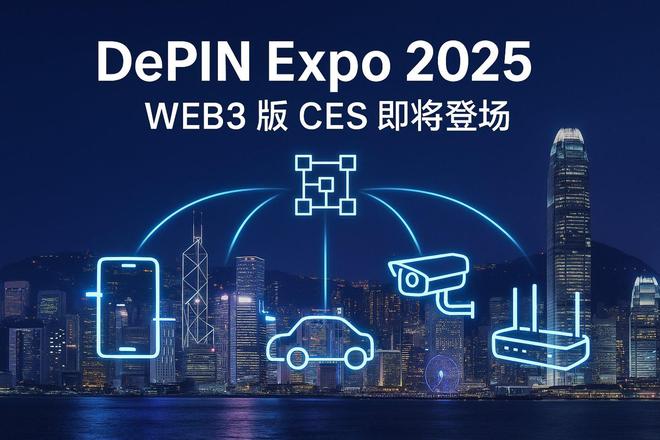
DePIN Expo 2025助力香港打造「Web3版CES」
Tai Mei Ti A P P· 2025-08-04 08:50
Core Insights - The DePIN Expo 2025 is set to be a significant event focusing on decentralized physical infrastructure networks, marking a pivotal moment for the Web3 world [6][16] - The expo aims to showcase the integration of hardware and blockchain technology, similar to the CES, and will take place in Hong Kong in August 2025 [6][8] Event Overview - DePIN Expo 2025 will occur on August 27-28, 2025, at Cyberport, Hong Kong, and is the first industry-level event centered on the DePIN concept [6][16] - The event will feature various categories of MetaDePIN devices, including computing, networking, sensing, identity, energy, logistics, and infrastructure [11][8] Key Themes and Discussions - The expo will explore the role of DePIN in connecting technology breakthroughs with real-world applications, capital markets, and the physical economy [8][12] - Discussions will include the future of DePIN applications, the integration of AI with DePIN, and the transformation of asset paradigms through real-world asset (RWA) tokenization [12][8] Notable Features - A "DePIN City Demonstration Zone" will be established to showcase the deployment and operation of on-chain hardware at a city level, indicating a shift from experimental hardware to infrastructure platforms [13][16] - The event will also include high-profile forums in collaboration with institutions like Stanford University and UC Berkeley, focusing on AI and DePIN, RWA asset rights, and global node ecosystems [12][8] Strategic Importance - The successful hosting of DePIN Expo 2025 is expected to enhance Hong Kong's reputation as a global hub for crypto innovation and the Web3 ecosystem [13][16] - The expo aims to attract hardware manufacturers, public chain platforms, AI developers, and investment institutions to participate in the DePIN industry [14][16]
立讯精密并购闻泰科技资产交割 精密制造龙头拓展业务边界与增长点
Cai Fu Zai Xian· 2025-07-16 02:39
Core Viewpoint - Luxshare Precision is advancing its acquisition of a portion of the equity and assets of subsidiaries from Wingtech Technology, with all preconditions for the transaction being met and the transfer procedures progressing smoothly [1] Group 1: Business Expansion and Profitability - Luxshare Precision's rapid development of new projects in the consumer electronics sector, alongside its strong profitability, is a critical growth direction beyond its major clients in consumer electronics, automotive, and communications [1] - The acquisition strategy of "internal growth + external mergers" is key to Luxshare's continuous expansion and vertical integration in the consumer electronics sector, enhancing its overall competitiveness [2] - The acquired companies possess mature R&D and manufacturing systems in the ODM and OEM fields for mobile phones, tablets, laptops, and small appliances, which will complement Luxshare's existing precision manufacturing capabilities [2] Group 2: Competitive Advantage and Market Position - The acquisition will significantly enhance Luxshare's ODM scale and competitiveness, as Wingtech holds over 20% market share in the global mobile ODM market, serving major brands like Samsung and Xiaomi [3] - Luxshare aims to leverage this acquisition to provide integrated ODM services to well-known clients, increasing customer loyalty and opening new markets for its electronic components and modules [3] - The company has diversified its product offerings across various categories, including AI-driven products, positioning itself to benefit from the upcoming wave of product innovation driven by generative AI [3] Group 3: Global Strategy and Operational Efficiency - Luxshare's acquisition of Wingtech's assets in India marks a significant step in its global strategy, with operations fully taken over as of July 2, 2025 [4] - The company aims to build a "manufacturing + technology" dual-driven global industrial ecosystem over the next three to five years, focusing on deep collaboration with global tech leaders and international cooperation on technology and standards [4] - Luxshare has established a global closed-loop system for "design-manufacturing-service," enhancing its capacity and supply chain resilience, which supports its expansion in consumer electronics and automotive sectors [5] Group 4: Risk Management and Resilience - The company has developed a robust global capacity layout, with established production bases and R&D centers in countries like Vietnam, India, Mexico, and Germany, enhancing its risk management capabilities [5] - Luxshare's strong risk resilience and optimized global capacity layout position it to benefit from the trend of concentration in the supply chain, allowing it to flexibly meet customer market demands [5] - The company is creating a more resilient business model that not only serves existing clients well but also opens up new customer opportunities, thereby creating new growth avenues [5]

