服务机器人等

Search documents
广东将出台制造业与服务业协同融合发展行动方案 对试点项目平台企业给予重点支持
Nan Fang Ri Bao Wang Luo Ban· 2026-02-25 08:09
Core Viewpoint - Guangdong is set to launch an action plan for the coordinated development of manufacturing and service industries, aiming to enhance their integration and create new opportunities for growth [1] Group 1: Development Goals and Achievements - By the end of this year, Guangdong plans to establish over 50 distinctive production service industry clusters and provide key support to pilot projects and enterprises [2] - The province's GDP is projected to reach 14.58 trillion yuan by 2025, with manufacturing value-added accounting for one-third and service industry value-added maintaining a nearly 60% share of GDP [2] - Guangdong has led the nation in several indicators related to the integration of manufacturing and services, with its regional innovation capability ranking first for nine consecutive years [2] Group 2: Action Plan Components - The upcoming action plan will include measures for resource allocation, encouraging the establishment of leading enterprises with industry chain integration capabilities [3] - A "order-based" talent model will be promoted to cultivate cross-disciplinary talents needed for the integration of manufacturing and services [3] - Financial support will be provided for pilot projects and enterprises, including tax incentives for R&D expenses [3] Group 3: Technological Integration - Guangdong aims to advance the high-level application of artificial intelligence across all industries, creating industry-specific models and enhancing the service capabilities of manufacturing enterprises [4] - The province will promote a model that connects consumers directly with factories, shifting from a production-driven to a market-driven approach [4] - Industrial design will be strengthened to enhance product aesthetics, with numerous design innovation centers established [4] Group 4: Business Environment and Market Vitality - By 2025, Guangdong's total business entities are expected to exceed 20.37 million, with a 23% year-on-year increase in the number of enterprises [6] - The province has implemented reforms to streamline business registration and facilitate enterprise migration, achieving significant efficiency improvements [6] - Guangdong has launched 35 quality improvement projects to assist over 85,000 enterprises in overcoming quality management challenges [6] Group 5: Financial Support and Mergers - Guangdong has established a matrix of technology transfer platforms to enhance the conversion of scientific achievements into industrial applications [7] - Financial services have been extended to over 14,000 enterprises through manufacturing loan interest subsidies, with a total of 2.3 billion yuan disbursed [8] - The province is set to support mergers and acquisitions in key sectors, with 248 transactions projected for 2025, amounting to approximately 180 billion yuan [8] Group 6: Service Industry Expansion - Guangzhou and Shenzhen have been approved as national pilot cities for service industry expansion, with significant progress in trial tasks [9] - The province aims to attract foreign investment in service sectors, with a target of 78.35 billion yuan in foreign capital by 2025, reflecting a 6.8% growth [9] - A new implementation plan for expanding service industry openness has been introduced, focusing on key areas such as inbound tourism and cross-border logistics [9]
前三季度广东GDP超10.5万亿元 同比增长4.1% 经济运行总体保持稳定
Nan Fang Ri Bao Wang Luo Ban· 2025-10-27 09:24
Economic Overview - Guangdong's GDP for the first three quarters reached 10,517.698 billion yuan, with a year-on-year growth of 4.1% at constant prices [1] - The primary industry added value was 383.85 billion yuan, growing by 4.5%, while the secondary industry grew by 2.7% to 3,927.075 billion yuan, and the tertiary industry increased by 4.9% to 6,206.773 billion yuan [1] Agricultural Sector - The total output value of agriculture, forestry, animal husbandry, and fishery increased by 4.9%, with early rice production up by 1.0% [2] - Vegetable and edible fungus production rose by 3.1%, while garden fruit and tea production both increased by 6.3% [2] - Livestock production accelerated, with pig slaughter and pork production increasing by 4.6% and 4.7%, respectively [2] Industrial Sector - The added value of industrial enterprises above designated size grew by 3.5%, an increase of 1.3 percentage points compared to January-August [3] - Key industries showed stability, with the computer, communication, and other electronic equipment manufacturing sector growing by 7.5% [3] - New energy products saw significant growth, with industrial robots and service robots increasing by 33.7% and 15.2%, respectively [3] Service Sector - The added value of the service industry increased by 4.9%, accelerating by 0.3 percentage points compared to the first half of the year [4] - The financial sector grew by 9.8%, while transportation, storage, and postal services increased by 4.3% [4] - The information transmission, software, and IT services sector saw revenue growth of 9.5% [4] Investment Trends - Fixed asset investment in Guangdong decreased by 14.1% year-on-year [5] - Infrastructure investments in rail transport, water transport, and air transport grew by 1.8%, 31.8%, and 28.9%, respectively [5] - Investment in research and experimental development increased by 12.7%, with internet and related services growing by 81.2% [5] Consumer Market - The total retail sales of consumer goods increased by 2.8%, with urban retail sales growing by 3.0% and rural retail sales by 0.9% [6] - Retail sales of basic living goods and some upgraded consumption goods showed stable growth, with food and daily necessities increasing by 10.8% and 7.6%, respectively [6] - Online retail through public networks grew by 16.2%, significantly outpacing overall retail growth [7]
我国经济应变克难稳健前行 前三季度国内生产总值同比增长5.2%
Jing Ji Ri Bao· 2025-10-21 00:38
Core Viewpoint - China's economy demonstrated resilience and stability in the face of external pressures and internal challenges, achieving a GDP growth of 5.2% year-on-year in the first three quarters of 2023, with a total GDP of 10,150.36 billion yuan [1][2]. Economic Growth - The GDP growth of 5.2% in the first three quarters represents an acceleration of 0.2 percentage points compared to the previous year and 0.4 percentage points compared to the same period last year, with an economic increment of 39,679 billion yuan, which is 1,368 billion yuan more than the previous year [2]. - The third quarter GDP growth was 4.8%, a decrease of 0.4 percentage points from the second quarter, attributed to complex external environments and significant domestic structural adjustment pressures [3]. Employment and Prices - The average urban unemployment rate for the first three quarters was 5.2%, consistent with the first half of the year, while the Consumer Price Index (CPI) saw a slight decline of 0.1%, with the core CPI (excluding food and energy) rising by 0.6% [2]. International Trade - The scale of goods imports and exports reached a historical high in the first three quarters, with a gradual increase in growth rates, and foreign exchange reserves remained above 3.3 trillion USD by the end of September [2]. Innovation and New Industries - Significant investments in innovation have led to rapid growth in new industries and products, with the automotive manufacturing sector and aerospace industries seeing double-digit growth in investment [4]. - The manufacturing value added in integrated circuit manufacturing and electronic materials grew by 22.4% and 20.5%, respectively, while online retail sales increased by 9.8% [4]. Digital Economy and Green Development - The digital economy has seen rapid growth, with the manufacturing value added of digital products increasing by 9.7%, and production of smart drones and smart vehicle equipment rising by 59.9% and 25.1%, respectively [5]. - The production of new energy products, such as new energy vehicles and lithium-ion batteries, increased by 29.7% and 46.9%, respectively, reflecting a growing emphasis on green development [5]. Economic Resilience - The economic growth in the first three quarters has laid a solid foundation for achieving annual targets, with new productive forces being cultivated to enhance high-quality development [6]. - The manufacturing sector's resilience is highlighted by the recovery of the manufacturing purchasing managers' index and the increase in prices of key industrial products [7].
解码制造业高质量发展之路
Jing Ji Ri Bao· 2025-08-20 00:10
Core Viewpoint - The manufacturing industry is emphasized as the foundation of national strength and economic development, with a focus on high-quality growth and strategic importance in the context of global changes and digital transformation [1][3]. Group 1: Manufacturing Industry Performance - In the first half of the year, the manufacturing value added grew by 7%, surpassing GDP growth by over 1 percentage point, indicating an increasing share of manufacturing in GDP [2]. - Manufacturing investment increased by 7.5%, significantly higher than the overall fixed asset investment growth of 2.8% [2]. - Exports of goods primarily from the manufacturing sector rose by 7.2%, showcasing manufacturing as a key driver of economic growth amid challenges in other sectors [2][3]. Group 2: Structural Trends in Manufacturing - High-end equipment manufacturing led growth with an increase of over 10%, outpacing overall manufacturing growth [2]. - High-tech manufacturing value added grew by 9.5%, exceeding the overall manufacturing growth rate by 2.5 percentage points, with significant increases in industrial robots and 3D printing equipment [2][3]. - The transformation of manufacturing is characterized by three trends: high-end, intelligent, and green development [3][4]. Group 3: Green Transformation - The production of new energy vehicles increased by over 10%, with rapid export growth in lithium batteries and wind power equipment [4][5]. - China's unique approach to green transformation integrates economic growth with environmental sustainability, avoiding the pitfalls of merely imposing costs [5][6]. Group 4: Challenges and Responses - The manufacturing sector faces challenges from external factors such as tariffs and technological restrictions, particularly affecting exports to the U.S. [6][7]. - Despite a decline in exports to the U.S., overall goods exports grew by 7.2%, driven by strong performance in emerging markets [7]. - The manufacturing sector's resilience is highlighted by its ability to adapt and maintain competitiveness through innovation and government support [7][8]. Group 5: Manufacturing Share and Reasonableness - The manufacturing share of GDP is projected to be around 24.9% in 2024, which is still significantly higher than the global average of approximately 15% [9][10]. - The decline in manufacturing share over the past decade reflects a natural evolution as economies develop, with a shift in demand from manufacturing to services as GDP per capita rises [9][10][11]. Group 6: Future Directions and Strategies - The future direction of manufacturing includes maintaining a reasonable share, enhancing technological capabilities, and focusing on high-value-added products [23][24]. - Key areas for development include traditional industries, emerging sectors like new energy vehicles and biopharmaceuticals, and future industries such as artificial intelligence [24][25]. - The integration of various industries through common-purpose technologies is essential for driving innovation and maintaining competitiveness in the global market [25].
生产需求增长,就业物价稳定——国民经济保持稳中有进态势
Xin Hua Wang· 2025-08-15 23:58
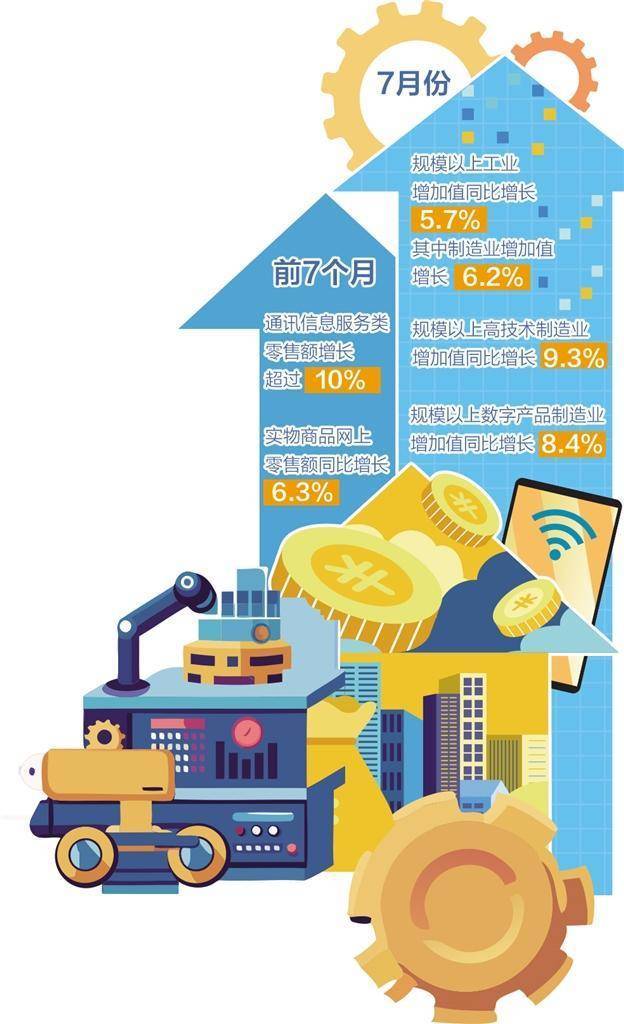
Economic Overview - In July, key economic indicators showed fluctuations due to multiple factors, but overall growth remained stable, reflecting strong resilience and vitality in high-quality development [1] - The international environment remains complex and severe, with trade protectionism and extreme weather impacting economic operations [1] Industrial Growth - In July, the industrial added value of large-scale enterprises grew by 5.7% year-on-year, with manufacturing value-added increasing by 6.2% [2] - The equipment manufacturing sector showed robust growth, with an 8.4% increase in added value, significantly supporting overall industrial growth [2] - High-tech manufacturing added value rose by 9.3%, with notable growth in integrated circuits (26.9%) and electronic materials (21.7%) [2] Digital and Intelligent Transformation - The digital product manufacturing sector saw an 8.4% year-on-year increase, outpacing overall industrial growth [3] - Production of industrial robots and service robots increased by 24% and 12.8%, respectively, indicating rapid advancement in AI applications [3] - The "two new" initiatives are driving industrial production, with shipbuilding and motor manufacturing increasing by 29.7% and 15.9% [3] Consumer Market Dynamics - Retail sales in July grew by 3.7% year-on-year, with a slight decline from the previous month, but overall consumption trends remain positive [4] - The "old-for-new" consumption policy has positively impacted sales of home appliances and communication devices, with significant growth rates in various categories [4] - Service retail related to cultural and recreational activities has also seen robust growth, driven by increased travel and entertainment demand [5] Emerging Consumption Trends - Online retail and new consumption models are thriving, with physical goods online retail growing by 6.3% year-on-year [6] - The development of live-streaming sales and other new consumption formats is maturing, contributing to new growth points in the consumer market [6] Economic Support Factors - The International Monetary Fund has raised its growth forecast for China's economy by 0.8 percentage points, reflecting increased confidence in economic development [7] - The expansion of market demand, supported by consumption and export growth, is creating favorable conditions for stable economic operation [7] - Continuous efforts in reform and opening up are improving economic circulation and enhancing the resilience of foreign trade [8] Policy Implementation - More proactive macroeconomic policies are being implemented to boost production demand and stabilize economic growth [8] - The focus on stabilizing employment, businesses, and market expectations is crucial for effectively releasing domestic demand potential [8]
国民经济保持稳中有进态势
Sou Hu Cai Jing· 2025-08-15 22:39
Economic Overview - In July, the industrial added value above designated size increased by 5.7% year-on-year, with manufacturing added value growing by 6.2%, indicating a stable growth trend despite some fluctuations in economic indicators [2][3] - The overall economic operation remains stable, supported by strong resilience and vitality, with new growth drivers steadily developing [2][8] Industrial Performance - The equipment manufacturing sector showed robust growth, with added value increasing by 8.4% year-on-year, significantly supporting the overall industrial growth [3] - High-tech manufacturing added value rose by 9.3%, with notable increases in integrated circuits (26.9%) and electronic special materials (21.7%) [3] - The production of green and low-carbon products is rapidly increasing, with new energy vehicles, lithium-ion batteries, and wind turbine generators growing by 17.1%, 29.4%, and 19.3% respectively [3] Digital and Intelligent Transformation - The digital product manufacturing sector saw an 8.4% year-on-year increase, outpacing overall industrial growth, with smart device manufacturing and electronic components growing by 13.4% and 11% respectively [4] - The production of industrial robots and service robots increased by 24% and 12.8%, reflecting the rapid advancement of artificial intelligence applications [4] Consumer Market Trends - In July, total retail sales of consumer goods grew by 3.7% year-on-year, with a notable increase in sales of home appliances and communication equipment due to the old-for-new consumption policy [5] - The retail sales of cultural and sports goods increased by 13.7% and 8.2%, indicating a growing demand for quality consumer goods [5][6] - Online retail and new consumption models are thriving, with physical goods online retail sales increasing by 6.3% year-on-year [7] Economic Outlook - Despite facing risks and challenges, the foundation for economic growth remains strong, with the International Monetary Fund raising China's economic growth forecast by 0.8 percentage points [8] - The expansion of market demand is supported by ongoing consumption stimulus actions and the diversification of foreign trade markets [8][9] - Continued efforts in reform and opening up are expected to enhance economic resilience and vitality, promoting stable economic growth [9]

大咖云集|2025智能机器人关键技术大会邀你入席,专家报告、学术征文、青年交流个个精彩
机器人圈· 2025-06-27 10:05
Core Points - The "2025 Intelligent Robot Key Technology Conference" will be held from July 22-24, 2025, in Qiqihar City, focusing on the integration and breakthroughs of embodied intelligence and multimodal interaction technology [1][4]. - The conference aims to facilitate discussions on cutting-edge technologies, common key technologies, industrialization paths, standardization, and interdisciplinary integration in the fields of robotics and artificial intelligence [1][4]. - The event is supported by several prominent organizations and will feature renowned experts and scholars sharing their insights and research progress [1][3][4]. Conference Details - The conference will include keynote speeches, specialized forums, technical exhibitions, and industry-academia matchmaking sessions [4][6]. - Key topics for discussion will include humanoid robots, medical robots, ethical considerations, and core component innovation [4][6]. - The event will also feature a call for papers, with accepted submissions published in leading journals by the end of December 2025 [2][9]. Registration Information - Registration for the conference is open, with different fees for students, general attendees, and corporate representatives [11][12]. - Early registration discounts are available until July 10, 2025 [11]. - Participants are encouraged to register online and submit their papers by specified deadlines [10][12]. Venue and Accommodation - The conference will take place at the Fuli Wanda Jiahua Hotel in Qiqihar, with recommended accommodations nearby [13][14]. - Due to the peak tourist season, early booking is advised to secure rooms at negotiated rates [15].