机架级AI服务器

Search documents
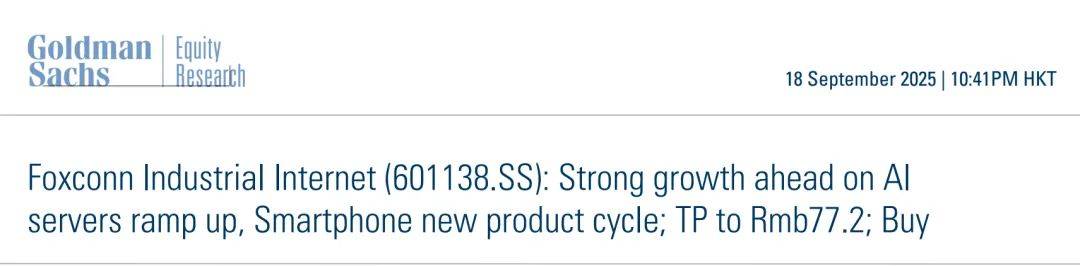
高盛:工业富联增长强劲,目标价77.2元!
Sou Hu Cai Jing· 2025-09-25 09:51
Core Viewpoint - Industrial Fulian (FII) is expected to enter a strong profit growth phase starting from Q3 2025, driven by increased market share in AI servers, modular AI data centers, network upgrades, and a seasonal boost in the smartphone market [1][4][6]. Group 1: Revenue Growth Drivers - Increased market share in AI servers due to strong R&D and execution capabilities, enabling the launch of next-generation rack-level AI servers [1][6]. - Collaboration between FII's parent company Hon Hai and Delta Electronics is expected to accelerate the deployment of AI data centers, supporting growth in AI server shipments [1][6]. - Rising demand for high-speed connectivity will boost the shipment of network devices, with product upgrades to 400G/800G increasing revenue per unit [1][6]. Group 2: Profitability and Financial Projections - Strong growth in rack-level AI servers is anticipated to drive revenue growth while maintaining disciplined operating expenses, supporting operating profit margins (OPM) [4][6]. - Net profit forecasts for 2025-2027 have been raised by 3%/3%/4% due to higher expected revenues from AI infrastructure and a positive market response [4][6]. - Operating expense ratios are projected to decrease to 1.9%/1.3%/1.2% for 2025-2027, down from 2.3% in Q2 2025, while SG&A expenses are expected to grow at a CAGR of 2% and R&D expenses at a CAGR of 14% [6]. Group 3: Target Price and Investment Rating - The target price has been raised by 13% to RMB 77.2, with the target P/E ratio adjusted from 26.9x to 29.4x based on stronger forward-looking net income growth [4]. - The investment rating remains "Buy" [4][7].


恒生指数早盘跌0.99% 航运股跌幅居前
Zhi Tong Cai Jing· 2025-09-22 04:06
Group 1 - The Hang Seng Index fell by 0.99%, down 263 points, closing at 26,281 points, while the Hang Seng Tech Index dropped by 1.18% [1] - Apple-related stocks surged due to strong pre-order demand for new iPhone models, with companies like Q Technology rising by 9%, Sunny Optical Technology increasing by 5.9%, and GoerTek up by 10% [1] - Yihua Tong saw a rise of over 16% after partnering with Toyota to establish a fuel cell company, while also announcing the termination of the acquisition of Xuyang Hydrogen Energy [1] - Hong Teng Precision surged over 17%, benefiting significantly from the ramp-up of rack-level AI servers [1] - Baiguoyuan Group increased by over 22%, planning to raise over 300 million HKD through a share placement, indicating early signs of strategic adjustment effectiveness [1] Group 2 - Kaisa Capital rose by over 10% after a Hong Kong court rejected a winding-up petition against Kaisa Group, as the company expands its RWA business [2] - China Qinfa saw an increase of over 5% due to improved profitability in its Indonesian operations and tax rate advantages on mining license fees [2] - Yunzhihui Technology skyrocketed by over 100%, with a 133% increase in early trading after announcing a global strategic partnership with UBTECH [2] - WuXi AppTec rose by over 6%, reaching a new high after finalizing subscription agreement matters, with WuXi Biologics' shareholding exceeding 50% [2] - Huiju Technology increased by over 11% after OpenAI partnered with Luxshare Precision to develop AI hardware, with the company being a member of the Luxshare system [2] - The demand for Chinese export container shipping appears weak, with ocean freight market rates continuing to adjust, leading to declines in shipping stocks such as COSCO Shipping Energy, which fell over 6%, and Seaspan International, down over 5% [2] - West Air experienced a drop of over 8% following a recent crash of its SR22T single-engine aircraft [2] Group 3 - Hong Kong Broadband fell by over 4% after China Mobile Hong Kong completed a tender offer, planning to raise public shareholding ratio through a share placement [3]
盈利预期远比市场乐观,高盛上调工业富联目标价,称三季度进入盈利高速增长期
硬AI· 2025-09-19 14:51
Core Viewpoint - The article highlights that Goldman Sachs is optimistic about Industrial Fulian's (Hon Hai Precision Industry Co., Ltd.) future profitability, driven by multiple factors including AI server market share growth, modular AI data center construction, network equipment upgrades, and a new smartphone product cycle [2][3][4]. Group 1: Key Growth Drivers - AI server market share growth is expected to enhance Industrial Fulian's competitive advantages in the AI infrastructure market, with strong R&D capabilities and early product launches [8][9]. - The partnership between Hon Hai and Eastern Electric will accelerate AI data center deployments, supporting the growth of AI server shipments [12]. - The network equipment business is entering an upgrade cycle, with increased demand for high-speed connections leading to significant growth in shipment volumes [13]. - The smartphone market is entering a strong release season, which will provide additional support for the company's performance, creating synergies with the AI server business [14]. Group 2: Profit Forecast Adjustments - Goldman Sachs has raised its net profit forecasts for Industrial Fulian for 2025-2027 by 3%/3%/4%, reaching RMB 33.632 billion, RMB 52.161 billion, and RMB 66.240 billion respectively, significantly exceeding market expectations [16]. - The operating profit margin is expected to improve from 4.2% in 2025 to 4.3% in 2027, while the operating expense ratio is projected to decrease from 1.9% in 2025 to 1.2% in 2027 [16][17]. - Revenue forecasts for 2025 and 2026 are also raised, with expected revenues of RMB 945.957 billion and RMB 1,432.428 billion, respectively, surpassing Bloomberg consensus estimates by 8% and 17% [17]. Group 3: Valuation Methodology - Goldman Sachs has adjusted the target price for Industrial Fulian to RMB 77.2, reflecting a 13% increase, with a target price-to-earnings ratio raised from 26.9 to 29.4 [20][21]. - This adjustment is based on a re-evaluation of the AI server supply chain and strong fundamentals driven by the anticipated growth in AI server shipments [20].

盈利预期远比市场乐观,高盛上调工业富联目标价,称三季度进入盈利高速增长期
Hua Er Jie Jian Wen· 2025-09-19 01:49
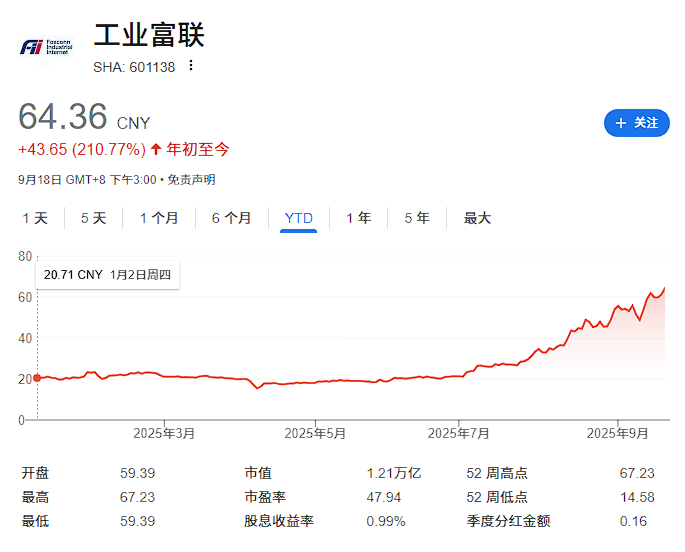
Core Viewpoint - Industrial Fulian's stock price has surged over 200% year-to-date, driven by the AI investment boom, and Goldman Sachs' latest report may provide a new boost to this "trillion-dollar giant" [1] Group 1: Growth Drivers - The company is expected to enter a strong profit growth cycle starting from Q3 2025, benefiting from increased market share in AI servers, modular AI data center construction, and a new smartphone product cycle [1][2] - Industrial Fulian's first-mover advantage in rack-level AI servers will enhance its market share in AI infrastructure, supported by its partnership with Dongyuan Electric, which accelerates AI data center deployment [1][8] - The company has a comprehensive product portfolio and strong R&D capabilities, with next-generation rack-level AI servers set to launch in Q4 2025, minimizing losses during product transitions [6][7] - The global production bases and diverse customer base, including U.S. and Chinese cloud service providers, will support significant revenue growth from AI servers starting in Q3 2025, while operating expenses are expected to decrease [7] Group 2: Financial Forecasts - Goldman Sachs raised net profit forecasts for 2025-2027 by 3%/3%/4%, reaching RMB 33.632 billion, RMB 52.161 billion, and RMB 66.240 billion respectively, significantly above market expectations [2][12] - Operating profit margin is projected to improve from 4.2% in 2025 to 4.3% in 2027, while operating expense ratio is expected to decline from 1.9% in 2025 to 1.2% in 2027 [12] - Revenue forecasts for 2025 and 2026 are set at RMB 945.957 billion and RMB 1,432.428 billion, respectively, exceeding Bloomberg consensus estimates by 8% and 17% [12] Group 3: Valuation Adjustments - Goldman Sachs adjusted the target price for Industrial Fulian to RMB 77.2, a 13% increase, reflecting a new target P/E ratio of 29.4, up from 26.9, indicating a revaluation of the AI server supply chain [2][13] - The current target P/E ratio aligns with historical peak valuations, suggesting strong future fundamentals driven by AI server demand [13]
一声惊雷!算力泡沫论再起
21世纪经济报道· 2025-03-28 04:44
Core Viewpoint - The rapid development of AI technology has led to a global surge in the construction of AI computing power centers, with significant investments from both China and the US, raising concerns about potential bubbles in the market [1][2]. Group 1: US Market Dynamics - The US market is showing signs of potential oversupply in AI computing power, with major companies like Microsoft and Meta announcing substantial investments in data centers, but facing warnings from analysts about a possible adjustment period [4][5]. - Goldman Sachs has revised its sales forecast for rack-level AI servers, reducing expected shipments for 2025 and 2026 significantly [4]. - Concerns about overlapping investments in AI data centers have been raised by industry leaders, indicating a cautious approach to future projects [5]. Group 2: China's Computing Power Landscape - China's computing power capacity is on the rise, with a total scale of 246 EFLOPS expected by September 2024, ranking second globally, and a growth rate exceeding 70% in intelligent computing power [7]. - Despite the overall increase in computing power, there are structural shortages in intelligent computing resources, leading to inefficiencies in resource allocation [7][8]. - Recommendations for improvement include enhancing coordination through national planning, accelerating self-research in high-end chips and software, and promoting green computing initiatives [8]. Group 3: Industry Adjustments - The data center industry in China is experiencing a decline in profit margins among third-party IDC service providers due to increased competition and changing business structures [11]. - Major IDC companies like GDS and DataPort are showing slower revenue growth despite ongoing construction efforts, indicating a cooling off from previous peaks [12][13]. - The current adjustment phase in the computing power sector reflects both necessary investments for the digital economy and some irrational exuberance, similar to the post-dot-com bubble era [13].


一声惊雷:算力泡沫论再起
2 1 Shi Ji Jing Ji Bao Dao· 2025-03-27 13:00
Group 1 - The rapid development of AI technology has led to a global surge in the construction of AI computing power centers, with significant investments from both China and the US [2][3] - Concerns have been raised about potential bubbles in AI computing power investments, with industry leaders warning of oversupply in the US market [3][4] - Microsoft plans to invest $80 billion in AI data centers by fiscal year 2025, while Meta is exploring a $200 billion investment for a massive data center campus [3][4] Group 2 - As of September 2024, China's total computing power reached 246 EFLOPS, ranking second globally, with a significant increase in intelligent computing power [5] - There are structural shortages in intelligent computing resources in China, despite an overall surplus in computing power, leading to inefficiencies [6][7] - Recommendations include enhancing national coordination in computing resource allocation and accelerating the development of high-end chips and core software [7] Group 3 - The third-party IDC service providers hold over 50% market share in China's data center industry, but many have seen declining profit margins due to structural changes and increased competition [8][9] - Despite ongoing construction, the growth rate of some leading third-party IDC companies has slowed compared to previous peaks, indicating a market adjustment [9][10] - The computing power sector has entered an adjustment phase, reflecting both necessary investments and irrational components from the previous boom [11]


高盛大幅调低全球AI训练服务器出货量,全线下调相应供应链股价预期
硬AI· 2025-03-25 12:41
Core Viewpoint - Goldman Sachs has downgraded its forecast for rack-level AI server shipments, projecting a decline in expected volumes for 2025 and 2026 due to product transition impacts and supply-demand uncertainties [2][4]. Group 1: AI Server Market Outlook - Goldman Sachs expects AI training servers to remain the main growth driver in the market, but the growth rate is anticipated to be lower than previously expected due to factors such as product transition, production complexity challenges, demand variability, and tariff risks [7]. - The forecast for rack-level AI server shipments has been revised down to 19,000 units in 2025 and 57,000 units in 2026, with market sizes adjusted to $54 billion and $156 billion respectively [8]. Group 2: Impact on Supply Chain Companies - Goldman Sachs has lowered the target prices for several Taiwanese AI server supply chain companies, including Quanta, with reductions ranging from 7% to 21% [3][11]. - The downgrade reflects a shift from rapid growth to more rational expansion in the AI server industry, indicating that while growth is slowing, AI infrastructure investment remains a key growth driver in the tech sector [11]. Group 3: Performance of Different Server Types - High-performance AI servers are not expected to be completely replaced by rack-level solutions, as some customers prefer motherboard solutions for design flexibility [5]. - AI inference servers are projected to see sales growth of 41% and 39% in 2025 and 2026, respectively, driven by expanding application areas [12].

高盛大幅调低全球AI服务器出货量,全线下调相应供应链股价预期
华尔街见闻· 2025-03-25 10:59
Core Viewpoint - Goldman Sachs has downgraded its forecast for rack-level AI server shipments, indicating a slowdown in industry growth due to product transition impacts and supply-demand uncertainties [1][3][8]. Group 1: Shipment Forecast Adjustments - The forecast for rack-level AI server shipments in 2025 and 2026 has been revised down from 31,000 and 66,000 units to 19,000 and 57,000 units, respectively [1]. - The revenue forecast for AI training servers has also been adjusted, with expected growth of 30% in 2025 to reach $160 billion and 63% in 2026 to reach $260 billion, down from previous estimates of $179 billion and $248 billion [3][5]. Group 2: Factors Influencing Adjustments - The slowdown in shipments is attributed to several factors, including the transition period for GPU platforms, production complexity challenges, demand variability due to new AI models, and tariff risks affecting ODM manufacturers [4][5]. - The production complexity of full rack systems adds uncertainty to capacity ramp-up, while the release of more efficient AI models raises questions about market demand for intensive computing capabilities [4]. Group 3: Impact on Supply Chain Companies - Goldman Sachs has lowered target prices for several Taiwanese ODM and cooling supply chain companies, including Quanta, Foxconn, FII, Wistron, AVC, and Auras, with reductions ranging from 7% to 21% [1][7]. - Quanta's rating has been downgraded from "Buy" to "Neutral" due to limited upside potential in the current market environment [7]. Group 4: Market Dynamics - The market is transitioning from a phase of rapid growth to more rational expansion, reflecting a shift in the AI server industry [8]. - Despite the slowdown, investment in AI infrastructure remains a key growth driver for the technology sector, although growth will be more moderate than previously expected due to various limiting factors [8].

三大利空,突袭!
券商中国· 2025-03-25 08:36
Core Viewpoint - The recent significant decline in stocks related to computing power and artificial intelligence is attributed to concerns over potential market bubbles and lowered sales forecasts for AI servers [1][4][6]. Group 1: Market Performance - Small-cap stocks are underperforming, with significant drops in computing power and AI-related stocks, including a more than 7% decline in Cambrian [1]. - In the Hong Kong market, stocks like Hua Hong Semiconductor and Kingsoft Cloud saw declines of over 6%, while SenseTime dropped over 2% [1]. - The Hang Seng Tech Index fell by 4%, with major stocks like BYD Electronics and Sunny Optical Technology dropping over 11% [3]. Group 2: Analyst Insights - Analysts link the stock declines to two main factors: Alibaba's chairman noted signs of a bubble in AI data center investments, and Goldman Sachs downgraded its sales forecasts for rack-level AI servers for 2025 and 2026 [1][4][6]. - Goldman Sachs revised its forecast for AI server shipments down to 19,000 units and 57,000 units for 2025 and 2026, respectively, from previous estimates of 31,000 and 66,000 units [5]. Group 3: Specific Company Developments - On March 25, Xiaomi announced plans to place 800 million shares to raise approximately HKD 42.5 billion, which may negatively impact its stock price due to dilution concerns [7]. - Alibaba's chairman expressed concerns about overlapping investments in AI, indicating a potential risk of market saturation [6]. - Despite the current downturn, some analysts remain optimistic about the domestic computing power supply chain's growth, driven by increased capital expenditure and advancements in domestic chip technology [7][8].