油气产业指数(H30198)

Search documents
“反内卷” 政策引导,石油板块供需向好,石油ETF(561360)收涨超1.3%
Sou Hu Cai Jing· 2026-02-09 01:07
Core Viewpoint - The oil ETF (561360) rose over 1.3% on February 6, driven by the "anti-involution" policy, which is guiding the oil sector towards improved supply and demand dynamics [1] Group 1: Industry Trends - The "anti-involution" policy is leading to a profound supply-side reform in the industry, which includes the elimination of outdated production capacity, restrictions on inefficient expansion, and encouragement for leading enterprises to pursue high-end and integrated layouts [1] - Despite an overall slowdown in industry growth, the market share and profitability stability of leading companies are expected to strengthen [1] Group 2: Competitive Advantages - The advantages of integrated refining are becoming more pronounced, as leading companies are constructing a full industry chain from "crude oil to chemical products," significantly enhancing their cost control capabilities and resilience against price fluctuations of single products [1] - The global refining focus continues to shift towards China, with domestic leading companies enhancing their competitiveness through scale, technology, and industry chain support [1] Group 3: ETF and Index Information - The oil ETF (561360) tracks the oil and gas industry index (H30198), which focuses on the entire oil and gas sector, covering upstream exploration, midstream transportation, and downstream sales [1] - The constituent stocks primarily consist of representative company securities in oil and gas extraction, refining, and energy services, reflecting the overall performance of publicly listed companies in the oil and gas industry [1]
地缘政治局势紧张抬升油价,资金抢筹布局,石油ETF(561360)近20日资金净流入超20亿元
Sou Hu Cai Jing· 2026-02-05 02:23
Group 1 - The geopolitical tensions have led to an increase in oil prices, with significant capital inflow into oil ETFs, exceeding 2 billion yuan in the last 20 days [1] - It is expected that oil prices will fluctuate between 60-80 USD per barrel by 2026, which will support the petrochemical sector's growth [1] - The "Big Three" oil companies are anticipated to maintain high capital expenditures and enhance their natural gas market expansion, facilitating long-term growth through oil price cycles [1] Group 2 - Domestic high upstream capital expenditures are expected to boost the growth of oil service companies by increasing production and reserves [1] - The refining sector is nearing the end of capacity expansion, and industry supply-demand dynamics are expected to improve under refining constraints [1] - The polyester filament sector is experiencing limited new capacity additions, leading to structural optimization, while the large refining industry is expected to see continuous improvement in supply-demand dynamics [1] Group 3 - The oil ETF (561360) tracks the oil and gas industry index (H30198), which includes listed companies involved in exploration, extraction, refining, and sales of oil and gas [1] - The index components exhibit strong cyclical characteristics and are significantly influenced by international oil price fluctuations, serving as an important indicator of the energy sector's performance [1]
地缘政治催化,石油景气度持续修复,石油ETF(561360)收涨近3%,资金抢筹,近20日净流入超20亿元
Sou Hu Cai Jing· 2026-02-03 13:05
Core Viewpoint - Geopolitical tensions are driving the recovery of the oil sector, with significant inflows into oil ETFs, indicating strong market interest [1] Group 1: Oil Market Dynamics - Oil ETF (561360) saw a nearly 3% increase on February 3, with net inflows exceeding 2 billion yuan over the past 20 days [1] - Global strategic resource competition is intensifying, highlighting the strategic value of deep-sea resources [1] - Oil prices are expected to fluctuate between $60 to $80 per barrel due to high marginal costs of U.S. shale oil, OPEC+'s price stabilization efforts, and positive oil demand forecasts for 2026 [1] Group 2: Supply and Demand Outlook - The refining capacity expansion is nearing completion, and industry supply-demand dynamics are expected to improve under the "anti-involution" policy and accelerated "oil conversion" [1] - The polyester filament sector is experiencing limited new capacity additions, leading to a structural optimization of capacity [1] - Overall, the petrochemical industry's supply-demand situation is anticipated to continue improving, contributing to a sustained recovery in sector prosperity [1] Group 3: Index and Sector Performance - The oil ETF (561360) tracks the oil and gas industry index (H30198), which includes publicly traded companies involved in oil and gas exploration, extraction, and services [1] - This index reflects the overall performance of securities related to the oil and gas industry and is significantly influenced by international oil price fluctuations [1]
地缘冲突催化,油服开支需求有望回暖,石油ETF(561360)连续5日净流入超17亿元
Sou Hu Cai Jing· 2026-02-02 05:45
Group 1 - The core viewpoint is that ongoing geopolitical conflicts are raising concerns about potential reductions in oil and gas supply from producing countries, leading to fluctuations in Brent oil prices and a marginal increase in the oil service industry's outlook [1] - Currently, the global oil service industry's activity level is low, with the number of active drilling rigs still below pre-2019 levels [1] - Domestic capital expenditure in the oil and gas sector is experiencing a temporary contraction due to oil prices and the end of the "14th Five-Year Plan" window, but after several years of capital contraction, industry spending is expected to gradually recover [1] Group 2 - The domestic oil and gas sector remains highly dependent on foreign sources, and capital expenditure is anticipated to gradually trend towards recovery [1] - In the overseas market, the U.S. government continues to implement policies to promote oil and gas development, with expectations for a rebound in oil service expenditure demand by 2026 [1] - The oil ETF (561360) tracks the oil and gas industry index (H30198), which covers companies involved in exploration, extraction, refining, and sales of oil and gas, reflecting the overall performance and development trends of related listed companies [1]
石油ETF(561360)连续5日资金净流入超9亿元,资金积极布局,淡季不淡,库存周期酝酿切换
Sou Hu Cai Jing· 2026-01-29 03:14
Group 1 - The core viewpoint of the article highlights a significant increase in China's crude oil imports despite the traditional demand off-season in the Northern Hemisphere, indicating resilient global oil demand [1] - The International Energy Agency (IEA) has revised upward its global oil demand growth forecast for 2025/2026, driven primarily by non-OECD countries, with China being a key contributor [1] - In December 2025, China's crude oil imports saw a substantial year-on-year increase of 17.4% and a month-on-month increase of 10.0%, reflecting the release of demand for replenishing inventories following the issuance of new import quotas [1] Group 2 - In the West, U.S. refinery utilization rates have risen to near four-year highs after a period of concentrated maintenance, with refined oil inventories beginning to accumulate, indicating steady downstream consumption [1] - Although European demand remains relatively weak, emerging markets are driving global demand, supported by the Federal Reserve entering a rate-cutting cycle, which is expected to boost demand expectations for crude oil and other commodities, particularly in interest-sensitive regions like Africa and Asia [1] - The oil ETF (561360) tracks the oil and gas industry index (H30198), which includes companies involved in oil and gas extraction and related services, reflecting the overall performance of the energy industry [1]
石油ETF(561360)盘中涨超2%,近20日资金净流入超7.4亿元,地缘风险叠加极端天气,全球供给扰动加剧
Sou Hu Cai Jing· 2026-01-28 02:05
Core Viewpoint - The recent geopolitical tensions and extreme weather conditions have significantly impacted global energy and chemical supply, leading to a rebound in oil prices during the off-season and potential shortages in chemical supplies, thereby supporting prices [1][2]. Group 1: Geopolitical and Weather Impacts - The supply side is facing dual shocks from "macro geopolitics" and "micro weather" [2]. - Geopolitical concerns arise from domestic unrest in Iran and a sharp decline in Venezuelan exports, raising fears of oil supply disruptions [2]. - Iran's strategic position at the Strait of Hormuz means any instability could lead to increased supply risk premiums [2]. - OPEC+ has seen a continuous decline in production, with actual output falling below quotas, providing a long-term price support around $60 per barrel [2]. Group 2: Weather-Related Supply Disruptions - A recent large-scale winter storm in the U.S. has directly impacted energy supply, particularly in Texas, a key area for refining and chemical production [2]. - Some facilities have been forced to shut down due to energy interruptions, which could affect the global supply stability and pricing of major chemical products [2]. - Historical events, such as the 2021 "Uri" winter storm, indicate that extreme weather can lead to significant price increases in chemical products [2]. Group 3: Investment Insights - The oil ETF (561360) has seen a more than 2% increase, with over 740 million yuan in net inflows over the past 20 days, reflecting investor sentiment amid these supply disruptions [1]. - The ETF tracks the oil and gas industry index (H30198), which includes companies across upstream exploration, midstream transportation, and downstream sales, reflecting the overall dynamics of the oil and gas industry [2].
石油ETF(561360)近20日资金净流入超5.4亿元,油价有望见底上探
Sou Hu Cai Jing· 2026-01-27 07:16
Group 1 - The oil ETF (561360) has seen a net inflow of over 540 million yuan in the past 20 days, indicating a potential bottoming out and rebound in oil prices [1] - Huatai Securities suggests that geopolitical premiums have led to a seasonal bottoming rebound in oil prices, with expectations for oil prices to rise in Q2 to Q3 of 2026 due to demand recovery and global inventory accumulation [1] - The forecast for the average price of Brent crude oil in 2026 has been raised to 65 USD per barrel, with a long-term price support level around 60 USD per barrel due to the "more profit than quantity" demand from major oil-producing countries and marginal costs [1] Group 2 - The International Energy Agency (IEA) has raised its forecast for global oil demand growth for 2025/2026, with continued recovery in petrochemical feedstock demand and jet fuel leading the growth in fuel products, particularly from non-OECD countries contributing to the entire increment in 2026 [1] - Geopolitical tensions continue to disrupt global crude oil supply, with risks of supply gaps if tensions escalate and affect transportation through the Strait of Hormuz [1] - The oil ETF (561360) tracks the oil and gas industry index (H30198), which focuses on the performance of companies in the oil and gas sector, covering upstream exploration, midstream transportation, and downstream sales to reflect the market dynamics of the entire oil and gas industry chain [1]
石油ETF(561360)近20日资金净流入超3.5亿元,资金积极布局,行业长期成长逻辑稳固
Mei Ri Jing Ji Xin Wen· 2026-01-23 03:35
Group 1 - The oil ETF (561360) has seen a net inflow of over 350 million yuan in the past 20 days, indicating active capital allocation and a solid long-term growth logic in the industry [1] - The oil industry is currently at the bottom of the previous price cycle and entering a new cycle, with the inventory cycle transitioning from passive destocking to active restocking [1] - Since the second half of 2025, the industrial product PPI and chemical raw material PPI have been continuously rebounding, suggesting that the price decline and destocking period is nearing its end, with an upward trend in the economic cycle gradually beginning [1] Group 2 - The long-term growth logic of the industry remains solid, with continuous optimization of capacity structure during the "14th Five-Year Plan" period, focusing on high-end and differentiated ethylene expansion while phasing out outdated capacity [2] - There is significant growth potential in demand, with traditional chemical product demand recovering steadily and emerging fields such as new energy, electronics, and high-end manufacturing driving an explosion in new material demand, providing long-term growth momentum for the industry [2] - The oil ETF (561360) tracks the oil and gas industry index (H30198), which covers exploration, extraction, refining, and sales in the oil and gas sector, selecting high market capitalization and liquidity listed companies to reflect the overall performance of the oil and gas industry [2]
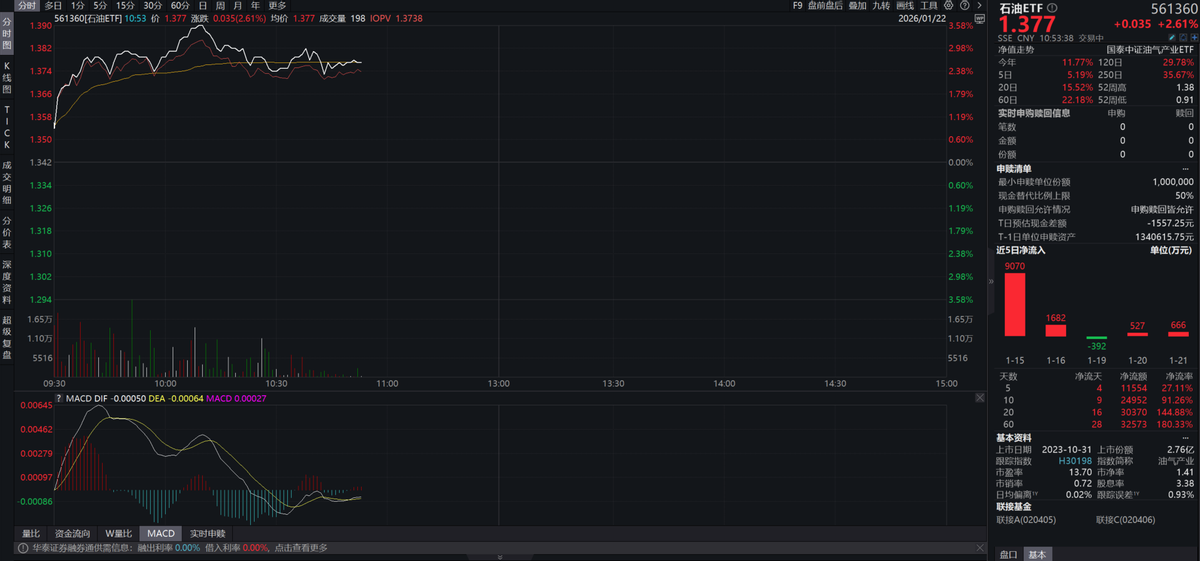
石油ETF(561360)涨超2.4%,油运市场中周期上行态势确定性较强
Sou Hu Cai Jing· 2026-01-22 04:03
Group 1 - The oil ETF (561360) rose over 2.4%, indicating a strong upward trend in the oil shipping market [1] - Supply constraints in the oil shipping market are strong, while demand is influenced by changes in the structure of black oil and compliant oil, leading to a clear mid-cycle upward trend [1] - Spot freight rates are expected to rise in the second half of 2025, reflecting shipowners' optimism about future market conditions [1] Group 2 - New orders for oil tankers are expected to surge in November to December 2025, significantly increasing monthly order volumes compared to the average from January to October [1] - The current supply-demand balance remains tight, with no concentrated shipbuilding orders observed since the beginning of the cycle, leading to continued replacement demand due to aging vessels [1] - The upstream demand outlook is positive, with the chemical industry cycle corresponding to the elasticity of oil tankers [1] Group 3 - The oil ETF (561360) tracks the oil and gas industry index (H30198), which includes publicly traded companies involved in oil and gas exploration, extraction, processing, and related services [1] - The index primarily focuses on the energy sector, emphasizing upstream resource development and midstream refining companies, while also including some downstream sales and service companies [1]
供需重塑+政策赋能,石油板块迎周期机遇,石油ETF涨超2%
Mei Ri Jing Ji Xin Wen· 2026-01-22 03:15
Core Viewpoint - The oil and petrochemical industry is undergoing a critical transition phase characterized by the reshaping of the old structure and the initiation of a new cycle, driven by multiple factors such as global supply adjustments, domestic anti-competition policies, and deepening refining and chemical integration, leading to a gradual increase in industry prosperity and sustained investment value [1] Group 1: Industry Dynamics - The global supply structure is being reshaped, with production focus shifting towards China as overseas capacities exit, including approximately 4.5 million tons/year of ethylene capacity in Europe and 2.7 to 3.7 million tons/year in South Korea, optimizing the global petrochemical supply landscape [3] - China is becoming a core capacity hub, with its PE and PP production capacity share increasing from 2018 to 2025, and a compound annual growth rate of 13.5% for ethylene capacity, with over 37 million tons of related facilities planned during the 14th Five-Year Plan [3] - Geopolitical tensions, such as the Russia-Ukraine conflict, are supporting marginal supply, with reduced oil production and exports from Russia, and uncertainties in Iran, providing temporary support for oil prices [3] Group 2: Domestic Policy and Supply Structure - Domestic anti-competition policies are accelerating the elimination of outdated capacities, with over 35% of old capacities in industries like soda ash and polyester being phased out, indicating significant optimization potential [4] - Industry self-discipline is being promoted, with leading companies in the polyester and organic silicon sectors collaborating on production cuts to stabilize prices, achieving over 24% cumulative production cuts in the polyester filament sector [4] - The industry is shifting from "scale expansion" to "high-quality development," with smaller local refineries gradually exiting the market, leading to increased market share for leading companies like Hengli and Zhejiang Petrochemical [5] Group 3: Refining and Chemical Integration - The deepening of refining and chemical integration is enhancing cost reduction and efficiency, with domestic petrochemical companies accelerating their integration strategies to cover the entire supply chain from crude oil processing to chemical production, effectively hedging against oil price volatility [6] - Technological upgrades are improving competitiveness, with diverse chemical processes like light hydrocarbon cracking and coal-to-olefins rapidly developing, leading to a compound annual growth rate of 22% in ethylene production capacity from 2019 to 2024, boosting overall industry profitability [6] Group 4: Future Outlook - The oil industry is at the bottom of the previous price cycle and is entering a new cycle, with inventory dynamics shifting from passive destocking to active restocking, indicating a gradual onset of an upturn in industry prosperity [7] - Long-term growth logic remains solid, with ongoing optimization of capacity structure during the 14th Five-Year Plan focusing on high-end and differentiated production, and continuous phasing out of outdated capacities [8] - Demand growth potential is broad, with a steady recovery in traditional chemical product demand and explosive growth in new materials driven by emerging fields such as renewable energy, electronics, and high-end manufacturing [9]