波依定

Search documents
康哲药业:集采出清,创新产品逐步發力,公司重回快速增长轨道(繁体版)-20260319
First Shanghai Securities· 2026-03-19 05:40
Investment Rating - The report maintains a "Buy" rating for the company with a target price of HKD 19.3, indicating a potential upside of 40.2% from the current price of HKD 13.78 [4][6]. Core Insights - The company has returned to a rapid growth trajectory with a revenue increase of 9.9% year-on-year to RMB 8.21 billion in 2025, driven by exclusive/brand products and innovative drugs, which saw a revenue increase of 23.3% to RMB 5.61 billion, accounting for 60% of total revenue [2][3]. - The company has achieved significant breakthroughs in innovation, with two new drugs approved for market and several others in various stages of development, enhancing its growth prospects [4][5]. Financial Summary - Revenue for 2025 is projected at RMB 8.21 billion, reflecting a 9.9% increase from the previous year, with a forecasted revenue growth of 23.2% in 2026 and 25.5% in 2027 [5][7]. - Adjusted net profit for 2025 is expected to be RMB 1.49 billion, down 8.1% year-on-year, but projected to rebound with a 29.8% increase in 2026 [5][7]. - The company has a dividend payout of RMB 660 million for 2025, with a payout ratio of 47.5% [2][5]. Product Development and Market Position - The company is focusing on stabilizing sales of older products while ramping up new product launches, including innovative treatments for skin conditions and other diseases, which are expected to contribute significantly to future revenues [3][4]. - The company is expanding its market presence in Southeast Asia and building an overseas platform to enhance its competitive position [4][6].
康哲药业:集采出清,创新产品逐步发力,公司重回快速增长轨道(简体版)-20260319
First Shanghai Securities· 2026-03-19 05:40
Investment Rating - The report assigns a "Buy" rating to the company with a target price of HKD 19.3, indicating a potential upside of 40.2% from the current price of HKD 13.78 [4][6]. Core Insights - The company has returned to a rapid growth trajectory with a revenue increase of 9.9% in 2025, reaching CNY 8.21 billion, driven by strong performance in exclusive/brand products and innovative drugs, which saw a revenue increase of 23.3% to CNY 5.61 billion, accounting for 60% of total revenue [2][3]. - The company has achieved significant breakthroughs in innovation, with two new drugs approved and several others in the pipeline, including treatments for vitiligo and psoriasis, which are expected to contribute to future revenue growth [3][4]. Financial Summary - In 2025, the company reported a revenue of CNY 8.21 billion, with a gross profit margin of 71.5%, a slight decrease of 1.1 percentage points from the previous year [2][5]. - The adjusted net profit for 2025 was CNY 1.78 billion, reflecting a 3.6% increase after accounting for a one-time tax adjustment [2][5]. - The company plans to distribute CNY 660 million in dividends, resulting in a payout ratio of 47.5% [2]. Revenue Breakdown - The revenue growth was driven by various segments: cardiovascular products increased by 2.4% to CNY 2.99 billion, digestive and autoimmune products grew by 3.3% to CNY 2.97 billion, skin health products surged by 73.2% to CNY 1.07 billion, and ophthalmology revenue rose by 12.9% to CNY 710 million [2][3]. Future Projections - The company anticipates a revenue increase of 23.2% in 2026, reaching CNY 10.12 billion, with continued growth expected in subsequent years [5][8]. - The introduction of new products, including innovative treatments for various conditions, is expected to significantly boost revenue, with peak sales projections for certain products reaching CNY 6 billion by 2030 [3][4].
康哲药业(0867.HK):商业化能力卓越 创新转型迎业绩长周期增长
Ge Long Hui· 2026-02-24 20:53
Core Viewpoint - The company, Kangzhe Pharmaceutical, is transitioning into a new growth cycle through innovation and transformation, despite facing revenue declines due to national procurement policies. The negative impacts are expected to be largely mitigated by mid-2025, with a return to positive growth in revenue and net profit [1][4]. Group 1: Business Performance - Kangzhe Pharmaceutical has established itself as a leading open pharmaceutical platform in China, with a comprehensive commercial capability covering over 50,000 hospitals and 300,000 retail pharmacies [1]. - The company’s four main business segments are performing collaboratively: 1. Cardiovascular diseases account for approximately 48% of revenue, with the impact of procurement policies nearly cleared [2]. 2. The digestive and autoimmune segment contributes about 30% of revenue, supported by exclusive products [2]. 3. The skin health segment, operated by a subsidiary, has significant potential with new products and plans for a separate listing [2]. 4. The ophthalmology segment, making up about 8% of revenue, has introduced competitive products to enhance growth [2]. Group 2: Innovation Pipeline - The company has developed nearly 40 innovative products, with six already commercialized. Key products in the NDA stage include treatments for stroke, chronic kidney disease, rabies exposure, tetanus, Alzheimer's disease, and atopic dermatitis, with peak sales potential exceeding 10 billion [3]. - Multiple self-developed innovative drugs are entering clinical stages, indicating a robust pipeline of diverse innovations [3]. Group 3: Financial Forecast - Revenue projections for 2025-2027 are estimated at 8.216 billion, 9.859 billion, and 12.028 billion, with year-on-year growth rates of 10%, 20%, and 22% respectively. Net profit forecasts are 1.615 billion, 1.850 billion, and 2.238 billion, with growth rates of 0%, 15%, and 21% [4]. - The company is viewed positively for its long-term growth potential, receiving a "buy" rating for investment [4].
国元国际:给予康哲药业(00867)“买入”评级 目标价17.68港元
智通财经网· 2025-12-17 06:44
Core Viewpoint - Company has a rich pipeline of innovative drugs, with 40 products globally focused on FIC and BIC, including 5 approved innovative drugs accelerating commercial value [1][2] Group 1: Innovative Drug Pipeline - The company has 40 innovative drugs in its pipeline, with 5 approved drugs that are beginning to release commercial value [2] - 7 NDA applications are under review, and over 10 clinical trials are progressing [2] - The first-in-class injectable Y-3 has received NMPA acceptance for its new drug application, targeting stroke treatment and post-stroke depression and anxiety [2] Group 2: Market Potential and Clinical Trials - The market potential for injectable Y-3 is estimated at 3 billion RMB [2] - The oral JAK1 inhibitor Povorcitinib has received breakthrough therapy designation in China, targeting adult non-segmental vitiligo, with a large unmet treatment need [2] - There are approximately 10.3 million vitiligo patients in China, with 8.2 million being non-segmental [2] Group 3: Financial Performance - In the first half of 2025, the company achieved revenue of 4.67 billion RMB, a year-on-year increase of 8.9%, and a net profit of 930 million RMB, up 3.1% [3] - The skin health line generated revenue of 498 million RMB, a significant increase of 104.3%, accounting for 10.7% of total drug sales [3] - Brand and innovative products accounted for 2.9 billion RMB in sales, a 20.6% increase, representing 62.1% of total revenue [3] Group 4: Investment Recommendations - The company's performance is expected to recover, with a significant optimization of its product structure towards innovative drugs [4] - Projected revenues for 2025-2027 are 7.86 billion, 8.95 billion, and 10.02 billion RMB, with net profits of 1.667 billion, 1.941 billion, and 2.308 billion RMB respectively [4] - The target price is set at 17.68 HKD per share, implying a 32% upside from the current price [4]
二次上市的康哲药业押注海外市场能否实现业绩突围?
Guo Ji Jin Rong Bao· 2025-07-18 14:58
Core Viewpoint - Kangzhe Pharmaceutical has successfully completed a secondary listing on the Singapore Exchange, marking its expansion into international capital markets after its initial public offering on the Hong Kong Stock Exchange in September 2010 [1] Group 1: Company Background - Kangzhe Pharmaceutical was established in 1995, initially focusing on contract sales organization (CSO) and marketing foreign and domestic pharmaceuticals [3] - The company transitioned from pure agency operations to self-operated products after acquiring full control of Ganfu Le in 2013 [3] - Kangzhe's business currently spans four major areas: cardiovascular, digestive, dermatology/aesthetic medicine, and ophthalmology [3] Group 2: Recent Developments - In April 2024, Kangzhe Pharmaceutical spun off its dermatology business, Demai Pharmaceutical, for independent listing [1][4] - The decision to list in Singapore is part of the company's strategy to enhance its presence in Southeast Asia and create more opportunities for international business development and potential financing needs [4] Group 3: Financial Performance - Kangzhe Pharmaceutical has experienced a decline in revenue for two consecutive years, with revenues of 6.8 billion, 8.5 billion, 9.24 billion, 7.76 billion, and 7.4 billion from 2020 to 2024 [6] - Net profits during the same period were 2.5 billion, 3 billion, 3.2 billion, 2.4 billion, and 1.6 billion, with a significant 32% year-on-year decline in 2024 [6] - The company's cash flow from operations dropped nearly 50% to 1.269 billion in 2024, indicating deteriorating operational quality [7] Group 4: Market Challenges - The decline in performance is attributed to the impact of centralized procurement, with major products like Dailixin, Yousif, and Bo Yiding losing market share, resulting in a nearly 30% revenue drop to 2.691 billion [7] - The company is facing increased competition in the dermatology sector, and Demai Pharmaceutical has reported cumulative losses of 165 million from 2022 to 2024 [8] - Despite the challenges, Kangzhe is accelerating the commercialization of its innovative drug, Lurcobatin Cream, expected to launch in the second half of 2025, targeting a market with over 22 million patients in China [8]
康哲药业,以介绍方式在新加坡第二上市
Xin Lang Cai Jing· 2025-07-15 07:40
Group 1 - The core viewpoint of the article is that Kangzheng Pharmaceutical (00867.HK) has announced a secondary listing on the Singapore Exchange, which aims to enhance its business presence in Southeast Asia and tap into the mature investor market in Singapore [1] - The company emphasizes that Southeast Asia, with a population of nearly 700 million, is experiencing rising pharmaceutical demand due to economic growth, an expanding middle class, aging populations, and an increase in non-communicable diseases [1] - Kangzheng Pharmaceutical has established Singapore as its regional headquarters for Southeast Asia and the Middle East [1] Group 2 - Kangzheng Pharmaceutical was listed in Hong Kong on September 28, 2010, and focuses on specialized fields such as cardiovascular, central nervous system, digestive, and ophthalmology [1] - The company currently has five innovative drugs in the commercialization stage, including "Meitai Tong" for psoriasis and "Laifulan" for methylene blue enteric-coated sustained-release tablets, along with three drugs entering national procurement [1] - As of the latest trading session, Kangzheng Pharmaceutical's stock price was HK$12.94, with a total market capitalization of HK$31.567 billion [2]

康哲药业20250630
2025-07-01 00:40
Summary of 康哲药业 Conference Call Company Overview - 康哲药业 is undergoing a strategic transformation from original research drugs to innovative drugs, driven by both collaborative development and independent research. The company has received approval for 5 innovative drugs covering 6 indications and is actively expanding internationally, including a secondary listing in Singapore without involving financing or equity dilution [2][4]. Key Business Segments - The company operates four main business segments: - Cardiovascular and Digestive Health: Stabilized after the impact of the National Volume-Based Procurement (VBP) - Ophthalmology: Strong profitability - Skin Health: 德美医药 is set for a spin-off listing - International Business: Focused on Southeast Asia, expected to contribute to future growth [2][5]. Financial Performance - The core products' revenue has declined due to VBP, with projected revenue of 2.6 billion yuan for three core products in 2024. However, the impact of centralized procurement is expected to be cleared, leading to a phase of rapid growth as innovative drugs are approved [2][7]. - The company’s key product portfolio includes: - Existing national procurement products (波依定, 黛力新, 优思弗) expected to contribute 2.6 billion yuan in 2024 - Exclusive and brand drugs anticipated to maintain around 10% growth [8]. Innovative Product Pipeline - 康哲药业 has nearly 20 self-researched projects, with 5-6 in clinical development. Key upcoming products include: - Y3 injection for stroke treatment, expected to exceed 3 billion yuan in sales - ABP671 for hyperuricemia, with NDA submission expected in mid-2025 - 德西度司他片 for chronic kidney disease anemia, expected to be approved this year [3][10][12][13]. Impact of VBP - The company faced significant impacts from VBP, with core products previously accounting for over 50% of sales. The sales retention rate post-VBP was around 50% [6][7]. Spin-off of 德美医药 - The spin-off of 德美医药 is expected to be completed by the end of 2025, which will not significantly affect 康哲药业's overall financial status but will help improve its valuation. 康哲 will distribute 90.8% of 德美 shares to shareholders [3][15]. Market Expansion and Internationalization - 康哲药业 is expanding into Southeast Asia, establishing a regional headquarters in Singapore and planning a secondary listing. This move aims to explore new growth avenues without limiting business development [20][21]. R&D and Sales Expenses - In 2025, 康哲's R&D and sales expenses are expected to rise due to high costs associated with marketing and brand building for newly launched innovative drugs. Profit growth is anticipated to lag behind revenue growth this year, but significant profit increases are expected starting in 2026 as 德美 is no longer consolidated [22][23]. Conclusion - 康哲药业 is positioned for growth through its innovative drug pipeline and international expansion, despite facing challenges from VBP. The upcoming spin-off of 德美医药 and the focus on Southeast Asian markets are strategic moves to enhance overall company valuation and market presence.
康哲药业分拆德镁医药上市:资本腾挪术下的“求生”与“弃子”博弈
Hua Xia Shi Bao· 2025-05-14 05:33
Core Viewpoint - Kangzheng Pharmaceutical (00867.HK) plans to spin off its skin health business, Demy Pharmaceutical, for a "listing by introduction" on the Hong Kong Stock Exchange, marking it as the first "zero fundraising" IPO case in 2025 [2][5][18] Company Overview - Kangzheng Pharmaceutical has faced declining performance, with revenue dropping from 91.5 billion RMB in 2022 to 80.13 billion RMB in 2023, and further down to 74.69 billion RMB in 2024, representing a year-on-year decline of 12.4% and 6.7% respectively [6][7] - The company experienced a significant drop in net profit, from 23.84 billion RMB in 2023 to 16.13 billion RMB in 2024, a decrease of 27.2% [7] - The decline in performance is attributed to the failure of key products to win bids in national procurement, leading to a loss of market share and revenue [7][8] Demy Pharmaceutical Financials - Demy Pharmaceutical's revenue grew from 384 million RMB in 2022 to 618 million RMB in 2024, but it also reported increasing losses, from 55.17 million RMB in 2022 to 105.63 million RMB in 2024 [8][9] - The company's cost structure is heavily skewed towards sales expenses, which consumed 99% of its gross profit in 2024, leading to a net loss of 106 million RMB [10][12] - Demy Pharmaceutical's research and development expenditure remains low compared to its sales expenses, with a research expenditure rate of only 4% [10][12] Strategic Implications - The spin-off is seen as a strategic move to alleviate financial pressure on Kangzheng Pharmaceutical while allowing Demy Pharmaceutical to seek independent funding and partnerships [18] - The choice of "listing by introduction" allows for a quicker and less costly process, avoiding the dilution of shares and the complexities of traditional IPOs [17][18] - However, Demy Pharmaceutical will still face scrutiny regarding its ongoing losses and the sustainability of its business model post-spin-off [13][15] Market Context - The move reflects a broader trend among Chinese pharmaceutical companies seeking to adapt to the pressures of national procurement policies and increasing competition in the industry [17] - Since 2020, over 20 pharmaceutical companies have pursued similar spin-offs to focus on high-growth areas like medical aesthetics and consumer healthcare [17]

康哲药业分拆德镁医药上市背后:不融资的资本运作 母公司业绩增长失速急甩包袱?
Xin Lang Zheng Quan· 2025-04-29 10:45
Core Viewpoint - Kangzheng Pharmaceutical is planning to spin off its subsidiary, Demai Pharmaceutical, which focuses on skin health, for independent listing on the Hong Kong Stock Exchange. This move raises questions about whether it is a strategic decision or an attempt to offload a loss-making entity [1][4]. Group 1: Spin-off Details - The spin-off will involve a distribution of 90.8% of Demai's shares to existing shareholders, with no new stock issuance for financing. This allows shareholders to directly hold shares of Demai and benefit from independent valuation premiums [1][2]. - Demai Pharmaceutical has shown revenue growth from 384 million yuan in 2022 to 618 million yuan in 2024, but its losses have also increased from 55.17 million yuan to 106 million yuan during the same period [2][3]. Group 2: Financial Performance - Demai's gross margin for prescription drugs is projected to decline from 76.6% in 2023 to 61.7% in 2024, contributing to an overall gross margin drop from 76.9% to 63.5% [2][3]. - The company's sales expense ratio has risen from 57.7% to 62.9%, with sales expenses reaching 388 million yuan in 2024, nearly matching its gross profit [2][3]. Group 3: Strategic Context - Kangzheng Pharmaceutical is facing significant performance pressure, with a revenue decline of 6.8% to 7.469 billion yuan and a net profit drop of 32.3% to 1.613 billion yuan in 2024. The decline is attributed to the impact of national procurement policies on key products [4][5]. - The spin-off aims to achieve three objectives: shedding the loss-making skin business, allowing Demai to raise capital independently, and enhancing the overall market valuation of the group by focusing on higher-margin areas [4][5]. Group 4: Market Landscape - The skin health market is projected to grow significantly, with an estimated market size of 254.9 billion yuan by 2035 and a compound annual growth rate exceeding 15% [4]. - However, Demai faces intense competition from stronger players in the skin health sector, and its reliance on generic products and high sales expenses raises concerns about sustainability [5].
2025年中国医药合同销售外包(CSO)行业发展背景、产业链、发展现状、竞争格局及发展趋势研判:合规化CSO已成为药企降低销售成本、规避财税风险的核心选择[图]
Chan Ye Xin Xi Wang· 2025-04-27 01:44
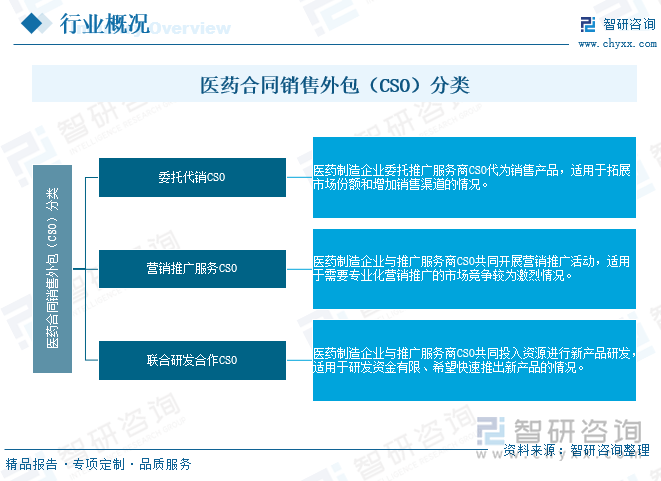
Core Insights - The implementation of policies such as "Two Invoice System" and "Volume-based Procurement" has disrupted traditional pharmaceutical distribution models, compressing profit margins for generic drugs and forcing pharmaceutical companies to shift towards specialized marketing services [1][13] - The market size of the Contract Sales Organization (CSO) industry in China is projected to reach 137.5 billion yuan in 2024, representing a year-on-year growth of 17.72%, and accounting for 32.74% of the overall pharmaceutical outsourcing market [1][13] - As competition intensifies in the pharmaceutical industry, companies are expected to focus on research and production, outsourcing sales functions to professional CSO firms to enhance market efficiency [1][13] Industry Overview - Pharmaceutical outsourcing (CXO) involves the professional outsourcing of various stages of drug discovery, clinical research, and commercialization by pharmaceutical companies, categorized into Contract Research Organizations (CRO), Contract Development and Manufacturing Organizations (CDMO), Contract Manufacturing Organizations (CMO), and Contract Sales Organizations (CSO) [2] - CSOs sign sales contracts with drug manufacturers to obtain sales rights and provide services such as market research, project consulting, promotional activities, and clinical discussions, earning revenue from consultation and service fees [3] Development Background - The Chinese government has prioritized the development of the pharmaceutical outsourcing industry, implementing numerous supportive policies that have accelerated growth, particularly in the CSO segment, which benefits from regulatory incentives [6] - Increasing regulatory scrutiny in the pharmaceutical sector has heightened compliance requirements for CSO firms, necessitating adherence to laws governing drug management, anti-competitive practices, and advertising [6] - The aging population in China has led to increased demand for pharmaceutical products, providing significant market opportunities for the CSO industry [6] Market Size and Growth - The CSO industry in China is expected to grow significantly, with a market size of 137.5 billion yuan in 2024, reflecting a 17.72% increase from the previous year [1][13] - The pharmaceutical manufacturing sector is also expanding, with the number of enterprises reaching 9,793 in 2024, a 4.05% increase, and total sales revenue of 25,298.5 billion yuan, a 0.37% increase [11] Competitive Landscape - The CSO industry in China is characterized by a fragmented market with numerous participants, including major players like Yiteng Pharmaceutical, Shanghai Pharmaceuticals, Baiyang Pharmaceutical, and Jiuzhoutong [16] - Jiuzhoutong, leveraging its national distribution network, provides comprehensive promotional services and has established a significant market presence [16][18] - Shanghai Pharmaceuticals is a leading national pharmaceutical distributor with a diverse service platform, reporting total revenue of 275.3 billion yuan in 2024 [20] Future Trends - As competition in the pharmaceutical market intensifies, CSO firms will need to enhance their professional service capabilities in market research, product planning, academic promotion, and compliance management [22] - CSOs are expected to focus on personalized service offerings tailored to the specific needs of different pharmaceutical companies and products, including differentiated marketing strategies for innovative and generic drugs [22]