
海尔卡奥斯工业互联网平台

Search documents
山东工业“智”变,不是选择题
Sou Hu Cai Jing· 2026-02-27 01:54
Core Insights - The industrial economy is undergoing a fundamental restructuring, with traditional growth dividends diminishing and challenges such as rising labor costs and intensified market competition becoming the norm [1] - Digital transformation is identified as a key strategy for industrial entities to adapt and thrive in this changing landscape, particularly through the integration of "artificial intelligence + manufacturing" [1][2] Group 1: Digital Economy Goals - By 2025, the digital economy in Shandong is expected to account for over 50% of GDP, with a 9 percentage point increase over five years [2] - The coverage rate of digital transformation among large-scale industrial enterprises in Shandong is projected to reach 95.1%, and the output value of high-tech industries is anticipated to constitute 55.3% of large-scale industrial output [2] Group 2: Industrial Transformation Strategy - Shandong aims to adopt a systematic approach to digital transformation, moving away from piecemeal upgrades to a dual strategy of "two lines of operation and dual empowerment" [2][3] - The province has cultivated over 1,100 leading artificial intelligence enterprises, with a 150% growth over five years, and the core AI industry revenue reaching 120 billion yuan, accounting for one-tenth of the national total [2] Group 3: Enhancing Traditional Industries - Traditional industries in Shandong are to be revitalized through digitalization, focusing on energy reduction in steel, emission control in chemicals, precision in equipment manufacturing, and customization in textiles [3] - Maintaining the foundational strength of traditional industries is deemed essential for pursuing new growth avenues [3] Group 4: Implementation of Digital Transformation - The industrial development cycle necessitates a deep, vertical approach to digital transformation, avoiding superficial trends and focusing on integrating digital solutions into production processes [4] - Shandong is committed to developing 80 "industrial brains" in key sectors and aims to strengthen 100 vertical industry models, achieving full coverage across 41 industrial categories [4] Group 5: Leadership in Digital Empowerment - The establishment of leading enterprises is crucial for driving industrial transformation, with examples such as Weichai Power's digital platform significantly reducing simulation analysis time and Haier's platform enhancing production efficiency by over 50% [4] - The focus is on nurturing benchmark enterprises that can lead and inspire others in the digital transformation journey [4]
新时达纳入海尔卡奥斯生态,2025年业绩扭亏为盈
Jing Ji Guan Cha Wang· 2026-02-12 04:46
Group 1 - The core viewpoint is that New Times Da (002527) has officially been integrated into the Haier Kaos industrial internet ecosystem, creating a complementary relationship between "platform and hardware" [1] - Following the acquisition, Haier will promote integration across four dimensions: supply chain, technology, market, and operations, which is expected to gradually release synergistic effects [1] - The performance forecast for 2025 indicates that New Times Da expects a net profit of 5 million to 7.5 million yuan, marking a turnaround from losses, with a non-recurring net profit growth of 80.84% to 84.52% [1] - This strategic integration is viewed as a long-term positive, potentially enhancing the company's ecological competitiveness [1] Group 2 - Recent stock price movements for New Times Da show significant volatility, with a 3.42% increase to 16.62 yuan on February 6, followed by a 1.14% decrease to 16.52 yuan on February 11, resulting in a price fluctuation of 15.73% [2] - In terms of capital flow, there was a net inflow of 2.417 million yuan from main funds on February 10, but a net outflow of 9.8138 million yuan was recorded on February 11, while retail investors saw a net inflow of 7.1054 million yuan [2] - The turnover rate ranged between 1.82% and 4.39%, indicating a high level of trading activity [2]

山东青岛:主攻“10+1”产业 构建创新型产业体系
Zhong Guo Xin Wen Wang· 2026-01-16 07:20
Core Viewpoint - Shandong Qingdao is focusing on the "10+1" industry strategy to build an innovative industrial system [1] Group 1 - The "10+1" industry strategy includes ten key industries plus one emerging industry, aiming to enhance the city's economic structure and innovation capabilities [1] - The initiative is part of a broader effort to foster technological innovation and collaboration among various sectors [1] - Qingdao is investing in industrial internet ecosystems, exemplified by the Haier Kaos Industrial Internet Ecological Park [2] Group 2 - The establishment of the Lu-Gang Technology Cooperation Innovation Center is a significant step towards enhancing regional collaboration in technology [3] - The introduction of transparent factories, such as those by Fengshi Technology, reflects a commitment to modern manufacturing practices [4] - The Qingdao Shangshi Center is noted for its human-centered management services and high-end accommodation, indicating a focus on quality of life and business environment [6]

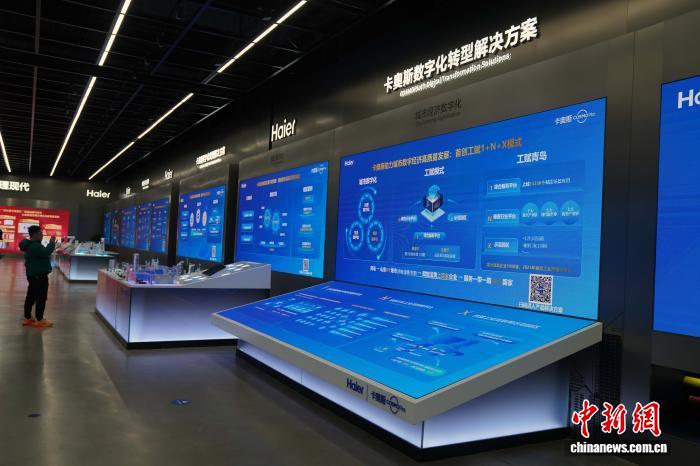
智造拥抱AI,海尔两项成果获国家级认可
Da Zhong Ri Bao· 2025-11-28 07:32
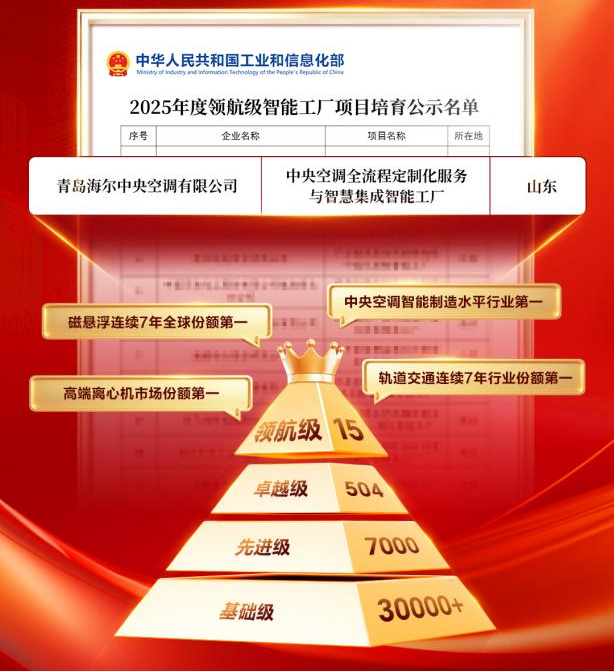
Core Insights - The 2025 World Intelligent Manufacturing Conference was held in Nanjing, showcasing the latest achievements in China's intelligent manufacturing sector [1] - Haier's smart building was included in the Ministry of Industry and Information Technology's first batch of leading intelligent factory projects, representing the highest level in the national intelligent manufacturing cultivation system [1][4] - Haier's "mass customization agile flexible manufacturing technology" from the Kaos industrial internet platform was recognized as one of the top ten technological advancements in Chinese intelligent manufacturing [9] Group 1: Recognition and Achievements - Haier's central air conditioning interconnected factory was recognized as the first "leading intelligent factory" in the central air conditioning industry, among only 15 companies nationwide [4] - The factory utilizes AI technology to enhance high-end, customized, integrated, and international manufacturing capabilities, achieving an average energy savings of 50% and a cumulative energy savings of over 3.3 billion kWh [6][7] Group 2: Technological Innovations - The factory employs AI for intelligent selection, production scheduling, and visualization systems, allowing for the efficient combination of 3.16 million design modules, reducing design cycles by 62% [7] - The self-developed HIMOS platform integrates data across 49 systems and 4,256 devices, leading to a 15% reduction in energy costs and a 32% increase in production efficiency [7] Group 3: Global Impact and Future Directions - The standard model from Haier's intelligent factory has been replicated in 122 factories globally, with products and services reaching 126 countries, maintaining a leading market share in magnetic levitation central air conditioning for seven consecutive years [7][10] - The "mass customization agile flexible manufacturing technology" is designed to address the growing demand for personalized production, enabling real-time parsing of customer needs into manufacturable features [12][14] - Haier's industrial internet platform, COSMOPlat, has evolved to support digital transformation across various industries, linking 900,000 enterprises and serving 160,000 companies globally [16]

海尔或操刀卡奥斯赴港上市
Hua Er Jie Jian Wen· 2025-10-21 13:11
Core Viewpoint - The ongoing trend of companies considering Hong Kong listings continues, with Haier Smart Home contemplating the spin-off of its IoT platform, Kaos, for a potential listing in Hong Kong next year [1][3]. Group 1: Kaos Listing Plans - Kaos has been preparing for an A-share IPO for over a year, having engaged CICC as its sponsor and filed for guidance with the Shandong Securities Regulatory Bureau [2]. - Despite plans to complete IPO guidance by June this year, there has been no significant progress reported on the IPO [2]. - The potential shift from an A-share IPO to a Hong Kong listing appears logical given the current circumstances [3]. Group 2: Shareholding Structure - Technically, Kaos's listing cannot be strictly classified as a spin-off from Haier Smart Home, as Haier holds only a 9.7% stake, while the controlling shareholder is Haier Group through Haier Kaos Digital Technology Development Co., Ltd., which holds 49.11% [4]. Group 3: Market Reactions and Future Plans - Haier Group confirmed that Kaos's listing preparations are proceeding as planned, with no other significant developments to disclose at this time [5]. - The speculation regarding a potential integration between Kaos and Xinsida may be less likely with the recent focus on Kaos's Hong Kong listing [6]. - Haier acquired control of Xinsida earlier this year, which has expertise in industrial automation hardware, potentially enhancing Kaos's capabilities in hardware development [7]. Group 4: Independence and Management - There were earlier market speculations about a possible integration of Kaos with Xinsida if the A-share IPO faced challenges, but Haier Group emphasized that Kaos is currently adhering to independence requirements for IPO management and operations [8].
海尔、美的、TCL、松下…家电巨头们正掀起一场AI联姻潮
Guan Cha Zhe Wang· 2025-10-14 10:08
Core Insights - The home appliance market in China is undergoing a transformation as companies partner with AI technology firms to explore new paths for growth following the end of government subsidies [1][3] - Major players like Haier, TCL, and Midea are actively engaging in AI collaborations, indicating a shift towards integrating AI into their product offerings and operational strategies [1][4] Group 1: AI Collaborations - Haier has signed a comprehensive strategic cooperation agreement with Alibaba, marking a significant step in the ongoing trend of home appliance and AI partnerships [1] - TCL is working with Alibaba Cloud to develop a specialized AI model focused on semiconductor display technology, enhancing smart terminal image quality and interaction [3] - Midea is collaborating with Huawei to create a smart home ecosystem, aiming for seamless interconnectivity across devices and brands [4] Group 2: Marketing and Global Expansion - The partnership between Haier and Alibaba will also focus on deepening cooperation in e-commerce, leveraging Haier's industrial strengths and Alibaba's overseas e-commerce framework to build a digital ecosystem [7] - International brands like Panasonic are also entering AI collaborations, with plans to develop smart home solutions for Southeast Asia and the Middle East in partnership with Alibaba Cloud [7]





海尔与阿里巴巴战略签约,聚焦AI+云、电商、全球化合作
Xin Lang Cai Jing· 2025-10-13 08:06
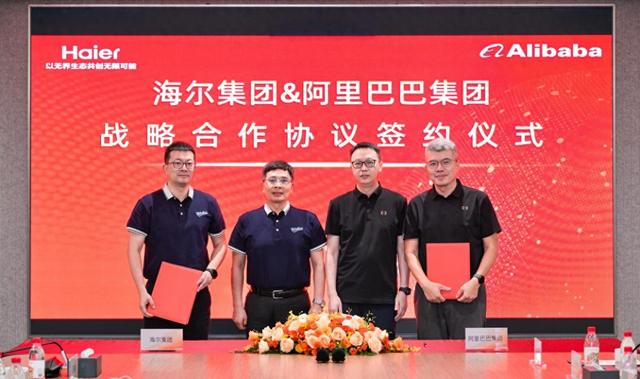
Core Insights - Haier Group and Alibaba Group have signed a comprehensive strategic cooperation agreement to achieve full-scale AI collaboration [1][3] - The partnership aims to leverage Haier's ecosystem and Alibaba's AI capabilities to accelerate innovation in the digital industry [1][3] Group 1: AI and Cloud Collaboration - The collaboration will focus on a full-stack AI partnership in the AI + Cloud sector, developing industry-level models for smart homes and intelligent manufacturing [3] - The partnership will integrate Haier's industrial internet platform capabilities with Alibaba's computing power to drive breakthroughs in AI technology and application innovation in manufacturing [3] Group 2: E-commerce and Globalization - In the e-commerce sector, the two companies will enhance cooperation in domestic and overseas consumer markets, creating a cross-industry and cross-regional digital ecosystem [3] - Haier and Alibaba will build a resilient heterogeneous computing power platform and a highly available architecture for global cloud services, supporting Haier's expansion in key overseas markets like Southeast Asia [3] Group 3: Leadership Statements - Haier's CEO emphasized the synergy between Alibaba's digital technology and Haier's focus on smart living, health, and digital economy, marking a significant exploration of the integration between the real and digital economies [3] - Alibaba's CEO expressed the intention to leverage its strengths in AI and cloud computing to promote deep applications and innovations in the industry alongside Haier's extensive industrial practices [4]
大消息!海尔“牵手”阿里巴巴
Zhong Guo Ji Jin Bao· 2025-10-13 04:21
Core Insights - Haier Group and Alibaba Group have signed a comprehensive strategic cooperation agreement focusing on AI collaboration, aiming to explore new paths for industrial AI transformation [1][2] - The partnership will leverage Alibaba's digital technology advantages and Haier's expertise in smart living, health, and digital economy, creating a high-quality smart living experience for global users [1][2] AI and Cloud Collaboration - The collaboration will involve a full-stack AI partnership in the AI+cloud domain, focusing on smart home and intelligent manufacturing scenarios to build industry-level models and deepen AI applications [2] - Both companies will integrate Haier's industrial internet platform capabilities with Alibaba's computing power to advance AI technology breakthroughs and application innovations in manufacturing and services [2] E-commerce and Globalization - The partnership aims to enhance cooperation in domestic and overseas consumer sectors, utilizing Haier's industrial strengths and Alibaba's overseas e-commerce system to create a cross-industry, cross-region digital ecosystem [2] - Haier and Alibaba will establish a resilient heterogeneous computing power platform and a high-availability architecture globally, supporting Haier's development in key overseas markets like Southeast Asia [2] Strategic Partnerships with Other Companies - Alibaba has been collaborating with various companies, including BMW, China Mobile, China Unicom, and China Telecom, to build a new AI industry ecosystem based on cloud, computing power, and large models [3][4] - These partnerships signify a new phase of strategic cooperation, focusing on advanced technologies such as AI large models and intelligent voice interaction [3]
海尔推出自有品牌汽车?公司澄清:不属实
Xin Hua Wang· 2025-08-12 05:55
Core Viewpoint - Haier is reportedly planning to enter the automotive sector with its own brand of vehicles, but the company has denied these claims, stating that the reports are untrue [1] Group 1: Haier's Automotive Strategy - Haier has been actively investing in the automotive industry through its capital arm, Haier Capital, which has invested in several smart connected vehicle service providers and auto parts manufacturers [2] - The company has signed strategic cooperation agreements with major automotive manufacturers such as SAIC Motor and Chery Holding Group, focusing on building an industrial internet big data platform for digital transformation in the automotive sector [2] - Haier aims to leverage its smart home technology to create a new ecosystem of connectivity between homes and vehicles, enhancing consumer experiences [2] Group 2: Technology Giants in the Automotive Industry - Technology companies are increasingly seen as key players in the automotive sector, particularly in software and algorithm development, with significant advancements in machine vision and artificial intelligence [3] - Unlike Baidu and Xiaomi, which are entering the vehicle manufacturing space, Tencent and Huawei have maintained their stance of not producing cars but instead collaborating with automotive companies to provide software and support [3][4] - Tencent has partnered with over 100 automotive companies and major mobility tech firms, offering cloud services and smart cockpit products to enhance vehicle management and user experience [3] - Huawei, while also not manufacturing vehicles, has developed over 30 products related to automotive technology, including systems for intelligent driving and connected vehicles [4]


“青岛制造”行 消费韧性强
Zheng Quan Shi Bao· 2025-08-08 18:02
Group 1 - The resilience of Qingdao's consumption market is supported by a solid manufacturing base, transitioning from a "internet celebrity" city to a "long-lasting" city due to continuous industrial upgrades [1] - The industrial cluster represented by the "Five Golden Flowers" has evolved, with the home appliance and electronics industry achieving an annual output value exceeding 400 billion yuan, and the rail transit equipment industry accounting for 50% of the national high-speed train production [1] - Qingdao Beer has transformed into a "sustainable lighthouse factory," utilizing digital transformation for flexible production, allowing consumers to customize beer with unique designs, and ensuring 24-hour cold chain delivery nationwide [1] Group 2 - Emerging industries are injecting new momentum into consumption, with companies like GoerTek and Bird's Eye leading in virtual reality, and AstraZeneca's inhaler base and Haier's health industry park under construction in the biomedicine sector [2] - Qingdao is building a "10+1" industrial system, focusing on new generation information technology and artificial intelligence as leading industries, while also nurturing emerging sectors like life health and smart connected new energy vehicles [2] - Over 80 listed companies are located in Qingdao, with more than 60 domestic listings, making it the top in the province and third among northern cities, with nearly 40% of these companies related to consumption [2]