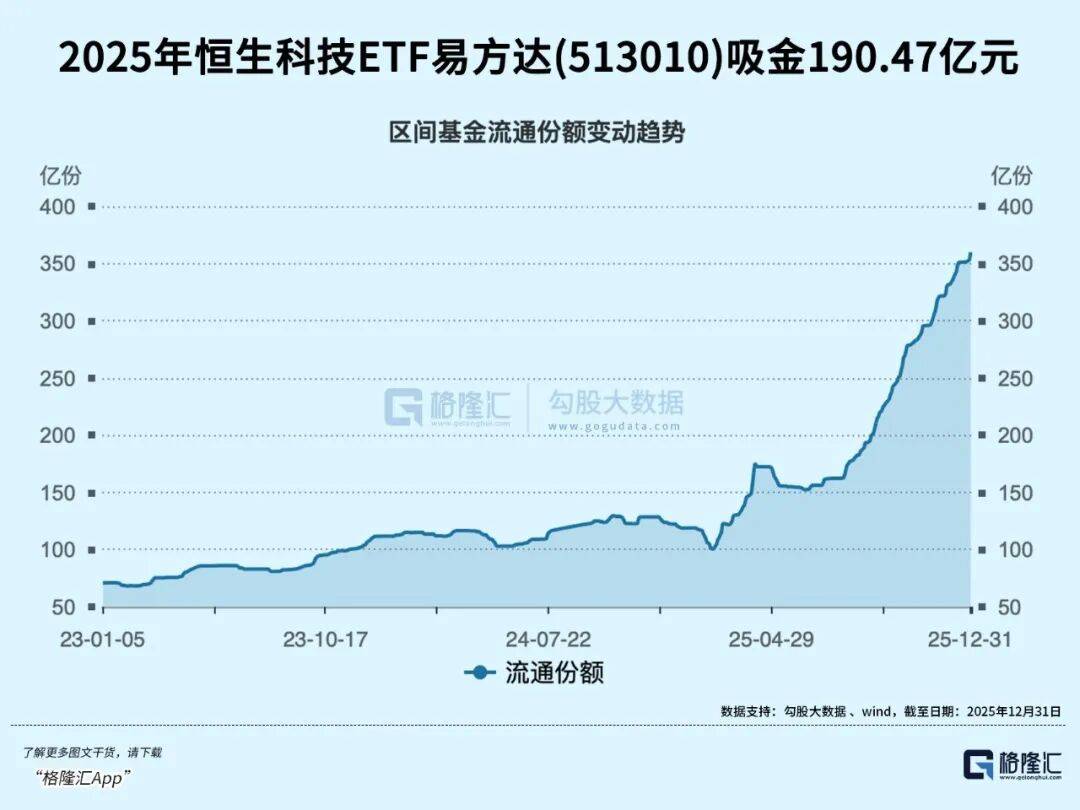
港股通互联网ETF易方达

Search documents
港股科技板块高开高走,恒生科技ETF易方达(513010)等产品助力布局港股“春节行情”
Mei Ri Jing Ji Xin Wen· 2026-02-11 05:59
Group 1 - The core viewpoint of the article highlights a strong performance in Hong Kong's AI applications, smart driving, and robotics stocks, with the Hang Seng Tech Index rising by 1.1% and the CSI Hong Kong Internet Index increasing by 1.3% as of 13:25 on February 11 [1] - Notable stocks within these indices include Bilibili-W, which rose by 6.2%, Xiaomi Group-W, which increased by 4.7%, and SenseTime-W, which saw a rise of 4.1%. Additionally, southbound funds recorded a net purchase exceeding 3 billion HKD during the session [1] - Market analysis indicates that from 2015 to 2025, the Hang Seng Tech Index exhibits significant seasonal characteristics during the Chinese New Year period, with strong performance typically observed in the last three trading days before the holiday and a continuation of this trend in the ten trading days following the holiday [1] Group 2 - The Hang Seng Tech Index comprises the 30 largest stocks listed in Hong Kong that are highly related to technology themes, balancing both "hard tech" and "soft tech." The CSI Hong Kong Internet Index focuses on internet platform companies in Hong Kong, gathering core Chinese AI enterprises [1] - Both indices have rolling price-to-earnings ratios below 25, positioned at the 27.0% and 22.3% percentiles since their inception, indicating potential valuation attractiveness [1] - Investment products such as the E Fund Hang Seng Tech ETF (513010) and the E Fund Hong Kong Internet ETF (513040) are available for investors to conveniently access the Hong Kong tech sector, with the Hang Seng Tech ETF experiencing a net inflow of 2.3 billion HKD over seven consecutive trading days, bringing its total size to over 30 billion HKD [2]
加仓!资金大幅涌入这些方向
Zhong Guo Zheng Quan Bao· 2026-02-08 23:07
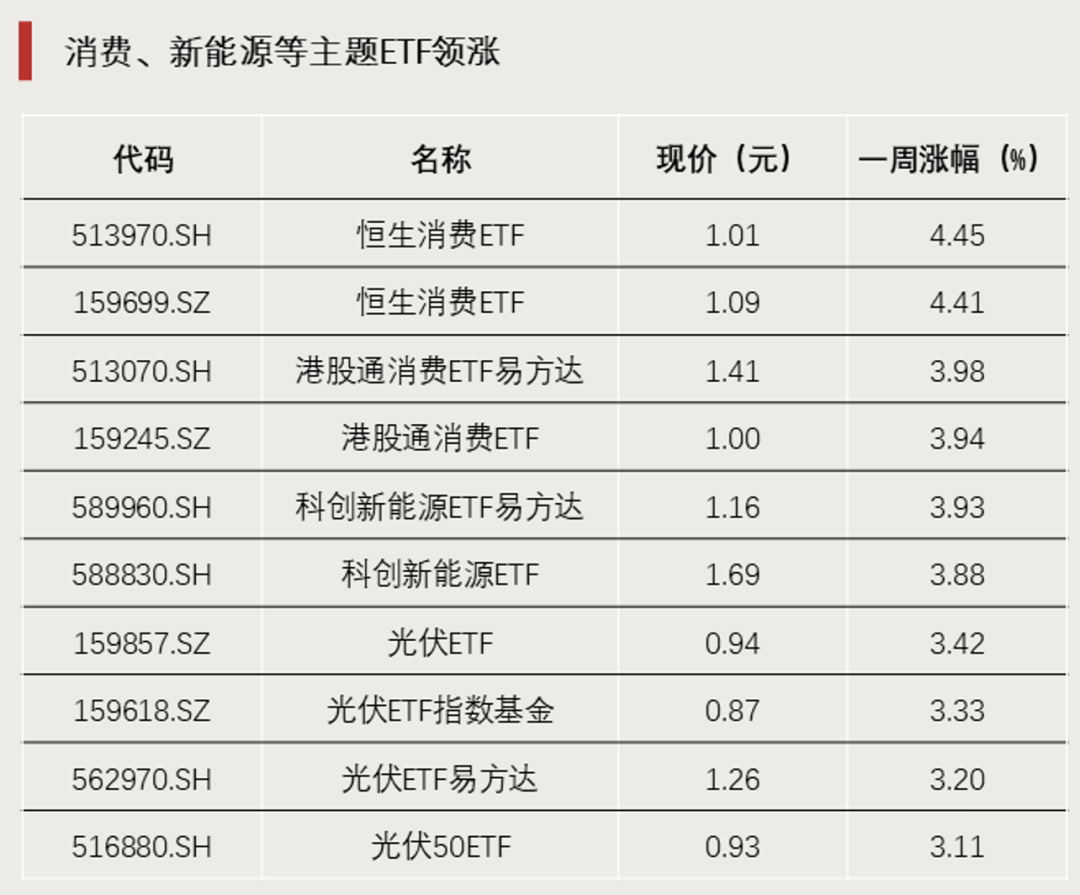
Group 1: Market Performance - The consumption and photovoltaic sectors saw significant gains last week, with several related ETFs, such as the E Fund Consumption ETF (513070) and E Fund New Energy ETF (589960), recording over 3% weekly increases [1][4] - Conversely, gold and artificial intelligence sectors experienced notable adjustments, with multiple related ETFs declining over 9% [1][6] Group 2: Trading Activity - The A-share market saw active trading in broad-based products, with the A500 ETF (159361) and others tracking the CSI A500 index achieving a total trading volume exceeding 254.8 billion yuan [2][8] - The Hang Seng Technology sector attracted significant capital inflow, with ETFs like the E Fund Hang Seng Technology ETF (513010) seeing substantial net inflows [3][10] Group 3: Sector Highlights - The Hang Seng Consumption ETF (513070) tracked the CSI Hong Kong Consumption Index, which rose over 4%, while the E Fund New Energy ETF (589960) and E Fund Photovoltaic ETF (562970) tracked indices that increased over 3% [4][5] - The gold sector showed weakness, with all 14 commodity gold ETFs declining over 5%, and some gold stock ETFs dropping more than 13% [6][7] Group 4: Future Outlook - Industry experts express optimism for the Hong Kong consumption sector in 2026, focusing on high-dividend consumer stocks, resilient domestic demand sectors like education, and timing strategies for new consumption sectors [5] - The market is expected to shift focus towards macroeconomic and industrial cues post-holiday, with a clearer framework for high-quality development and new-old kinetic energy conversion [12]

近90亿!抄底资金来了
Zhong Guo Ji Jin Bao· 2026-02-06 06:37
Core Viewpoint - The stock ETF market has shown significant resilience amid recent market volatility, with a net inflow of nearly 90 billion yuan on February 5, indicating strong investor interest despite broader market declines [1][2]. Group 1: Market Performance - On February 5, the A-share market opened lower due to declines in overseas technology stocks and precious metals, but the stock ETF market experienced a net inflow of 88.99 billion yuan [2]. - The total scale of all stock ETFs (including cross-border ETFs) reached 3.9 trillion yuan as of February 5 [2]. - The net inflow for A-share stock ETFs specifically was 34.95 billion yuan [1]. Group 2: ETF Inflows and Outflows - The leading inflows were observed in Hong Kong stock ETFs and thematic industry ETFs, with net inflows of 53.2 billion yuan and 19.47 billion yuan, respectively [2]. - Conversely, bond ETFs experienced a net outflow of 1.87 billion yuan [2]. - Notably, ETFs tracking the Hang Seng Technology Index saw a net inflow of 29.72 billion yuan, while those tracking the CSI 500 Index had a net outflow of 31.39 billion yuan [2]. Group 3: Fund Company Performance - Major fund companies such as Huaxia, Huatai-PB, and E Fund saw net inflows of 31.8 billion yuan, 28.5 billion yuan, and 28.2 billion yuan, respectively [2]. - In contrast, Southern and Jiashi funds experienced net outflows of 28.5 billion yuan and 3.8 billion yuan [2]. Group 4: Specific ETF Performance - E Fund's ETFs reached a total scale of 651.95 billion yuan, with significant inflows in various ETFs, including 9.2 billion yuan for the China Internet ETF and 3.6 billion yuan for the Hang Seng Technology ETF [3]. - Huaxia Fund's A500 ETF and Hang Seng Technology Index ETF also saw substantial inflows of 11.99 billion yuan and 6.5 billion yuan, respectively [3]. Group 5: Market Outlook - The market is expected to continue its oscillating pattern, with risks that have been accelerating in the short term, particularly in cyclical sectors like metals [5]. - Despite recent adjustments in the technology sector, the overall fundamental outlook remains robust, suggesting limited downside potential [5]. - Consumer sectors may present opportunities for recovery, especially with upcoming events like the Spring Festival and the National People's Congress [5].
ETF午评 | 金价连续第二日反弹,黄金ETF易方达、黄金ETF博时涨3.92%
Ge Long Hui· 2026-02-04 03:57
Market Performance - The three major A-share indices showed mixed performance in the morning session, with the Shanghai Composite Index closing flat, the Shenzhen Component Index down 0.92%, and the ChiNext Index down 1.74% [1] - The North China 50 Index fell by 1.19%, and the total trading volume in the Shanghai and Shenzhen markets reached 16,297 billion yuan, an increase of 127 billion yuan compared to the previous day [1] - Over 2,900 stocks in the market experienced declines [1] Sector Performance - Sectors that saw gains included coal mining and processing, airport and shipping, photovoltaic equipment, real estate, natural gas, port shipping, construction materials, banking, hydrogen energy, and retail [1] - Conversely, sectors that faced declines included precious metals, AI applications, computing power leasing, semiconductors, and CPO concept stocks [1] ETF Performance - Gold prices rebounded for the second consecutive day, surpassing 5,000 USD, with gold ETFs from E Fund and Bosera both rising by 3.92% [1] - International oil prices increased, leading to a 3.22% rise in the Jiasheng Oil and Gas ETF [1] - The Hong Kong dividend strategy ETFs were active, with the Bosera Hong Kong Dividend ETF rising by 1.67% [1] - However, Hong Kong stocks continued to decline, with the Hong Kong Technology ETF, Hong Kong Internet ETF from E Fund, and the Hong Kong Technology 30 ETF falling by 3.73%, 3.73%, and 3.57% respectively [1] - The New Economy ETF from Yinhua dropped by 2.83% [1]
超140亿元!加仓
Zhong Guo Ji Jin Bao· 2026-01-14 06:29
Core Insights - On January 13, the A-share market experienced adjustments, but stock ETFs saw a significant net inflow of 146.46 billion yuan, indicating a reverse trend in funding during market fluctuations [1] Group 1: ETF Performance - The total scale of 1,301 stock ETFs in the market reached 5.06 trillion yuan, with a net inflow of 146.46 billion yuan on January 13 [2] - Industry-themed ETFs and Hong Kong market ETFs attracted the most funds, with net inflows of 175.86 billion yuan and 33.68 billion yuan, respectively [2] - The media sector saw the most significant net inflow, with 45.35 billion yuan on January 13, and over 79 billion yuan in the past five days [2] - The satellite industry also experienced notable inflows of 37.8 billion yuan, with a single product, the Yongying Fund's satellite ETF, seeing a net inflow of 18.86 billion yuan [2] - Other sectors like artificial intelligence, computing, and non-ferrous metals also had substantial inflows, with net inflows of 37.6 billion yuan, 32.6 billion yuan, and 22.4 billion yuan, respectively [2] Group 2: Institutional Insights - The manager of the Rongtong Internet Media Fund anticipates that by 2026, the AI narrative will shift towards commercialization, with the AI application market expected to grow from hundreds of billions to trillions of yuan [3] - EasyOne Fund's AI ETF saw a net inflow of over 7 billion yuan, while other ETFs like software and cloud computing also experienced significant inflows [3] - Huaxia Fund's ETFs, including the electric grid equipment ETF and the Sci-Tech 50 ETF, had notable net inflows of 7.95 billion yuan and 6.26 billion yuan, respectively [3] Group 3: Market Trends - The broad-based ETFs faced significant outflows, totaling 57.65 billion yuan, with the CSI 300 index leading the outflows at 24.7 billion yuan [4] - The market is expected to maintain a stable upward trend in 2026, supported by policy and industrial drivers, with a favorable macro environment anticipated in the first quarter [4] - EasyOne Fund's index investment department believes that the market's rhythm is likely to remain stable and positive in January, with a focus on core growth assets [5]
AI产业进程加速,港股科技板块配置价值凸显,恒生科技ETF易方达(513010)连续获资金加仓
Mei Ri Jing Ji Xin Wen· 2026-01-13 02:53
Group 1 - The core viewpoint of the articles highlights a strong performance in the Hong Kong stock market, particularly in the technology and internet sectors, driven by multiple positive factors [1][2] - The Hang Seng Technology Index rose by 1.9% and the China Securities Hong Kong Stock Connect Internet Index increased by 1.6%, with notable gains from Alibaba Health and Alibaba Group, both rising over 4% [1] - The recent stabilization and recovery of the Hong Kong internet sector are attributed to the listing of AI companies like Zhipu AI and MiniMax on the Hong Kong Stock Exchange, which boosted market sentiment [1] Group 2 - The head technology companies with strategic advantages are expected to undergo systematic re-evaluation, supported by policies, industry developments, and fundamentals [2] - The Hang Seng Technology Index consists of the 30 largest stocks related to technology themes listed in Hong Kong, while the China Securities Hong Kong Stock Connect Internet Index includes 30 stocks involved in internet-related businesses [2] - Investors can access leading Hong Kong technology stocks through products like the E Fund Hang Seng Technology ETF (513010) and the E Fund Hong Kong Stock Connect Internet ETF (513040) [2]
1月7日港股通互联网ETF易方达(513040)份额增加2350.00万份
Xin Lang Cai Jing· 2026-01-08 01:12
Group 1 - The core viewpoint of the article highlights the performance of the E Fund Hong Kong Internet ETF (513040), which experienced a decline of 2.39% on January 7, with a trading volume of 797 million yuan [1] - The fund's total shares increased by 23.5 million, bringing the latest total to 6.06 billion shares, with a notable increase of 962 million shares over the past 20 trading days [1] - The latest net asset value of the fund is calculated to be 8.741 billion yuan, and since its establishment on May 31, 2023, it has achieved a return of 44.24%, although it has seen a decline of 1.52% over the past month [1] Group 2 - The fund's performance benchmark is the CSI Hong Kong Stock Connect Internet Index return, calculated using the valuation exchange rate [1] - The fund is managed by E Fund Management Co., Ltd., with fund managers Li Xu and Zhang Zefeng overseeing its operations [1]
2026一开门,大佬们就忙着加仓
Ge Long Hui· 2026-01-05 08:57
Group 1 - The core viewpoint of the article highlights the strong performance of the Hong Kong stock market, particularly the technology sector, driven by multiple factors including currency appreciation, capital inflows, and favorable policies [1][5][41] - The Hong Kong Technology Index saw a significant increase, with the Hang Seng Technology Index rising over 4% on the first trading day of the year [1][3] - The Chinese Yuan has appreciated against the US dollar, breaking the "7" psychological barrier, which reflects a fundamental shift in confidence and expectations regarding the Chinese economy [8][9][10] Group 2 - The appreciation of the Yuan has led to an increase in the intrinsic value of Chinese companies listed in Hong Kong, making them more attractive to investors [10][11] - In 2025, net inflows from mainland investors through the Hong Kong Stock Connect exceeded 1.4 trillion HKD, a 73.89% increase from the previous year, indicating strong demand for Hong Kong stocks [15][16] - Both domestic and foreign capital are favoring large-cap and technology stocks, with significant net purchases of companies like Alibaba, Tencent, and Meituan [20][22] Group 3 - The technology sector is particularly favored due to improved profit margins and cash flows following cost-cutting measures, as well as advancements in AI applications [26][27] - The Hang Seng Technology Index's dynamic P/E ratio is currently at 22.57, below its historical average, indicating a potential for value recovery [34][35] - The article suggests that the combination of currency strength, policy support, and technical corrections creates a conducive environment for a rebound in the Hong Kong technology sector [41][42]
2026一开门!大佬们就忙着加仓
Sou Hu Cai Jing· 2026-01-05 08:33
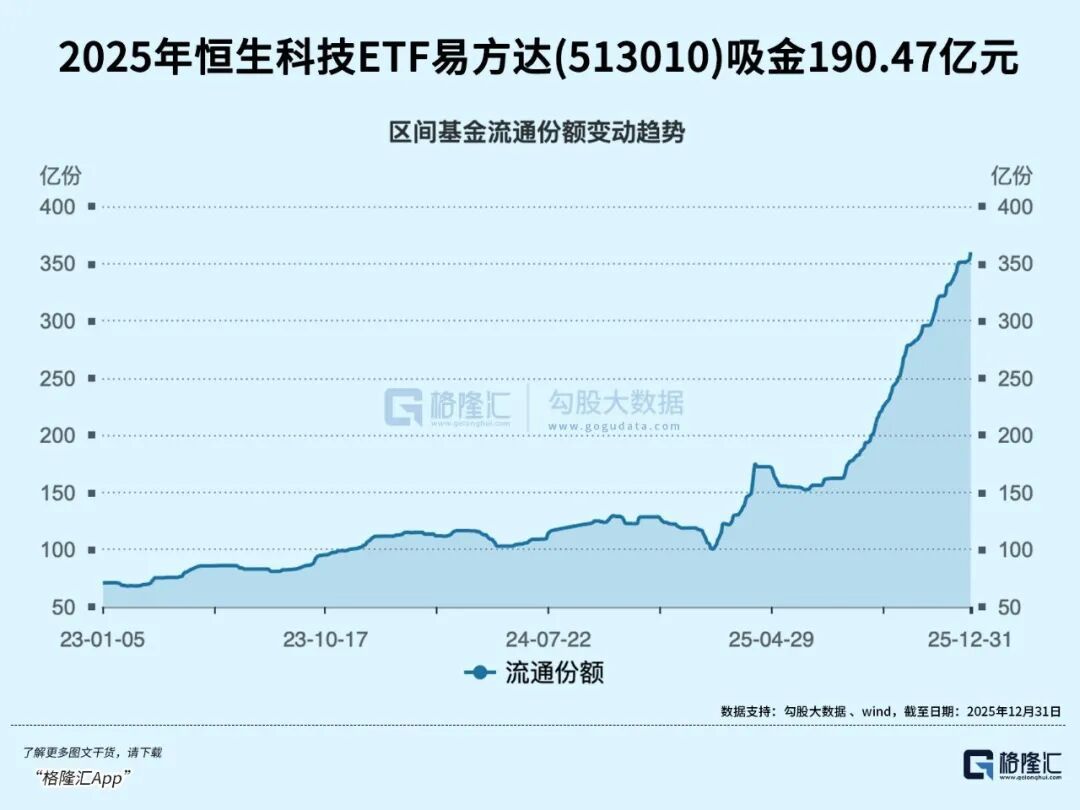
Core Viewpoint - The Hong Kong stock market, particularly the technology sector, is experiencing a strong start to 2026, driven by factors such as the appreciation of the Renminbi, increased capital inflows, and favorable policies [1][2][14]. Group 1: Market Performance - On the first trading day of 2026, the Hang Seng Technology Index rose over 4% [1]. - The A-share market also saw a positive start, with the Shanghai Composite Index returning to 4000 points after 34 trading days [2]. - ETFs focused on Hong Kong stocks, such as the E Fund Internet ETF and the E Fund Hang Seng Technology ETF, saw significant gains of 4.64% and 3.6% respectively [3]. Group 2: Currency Impact - The Renminbi has strengthened against the US dollar, breaking the "7" psychological barrier, indicating a shift in market confidence towards the Chinese economy [7][8]. - This appreciation enhances the intrinsic value of Chinese companies listed in Hong Kong, as their revenues and profits are primarily in Renminbi [9][10]. - A stronger Renminbi reduces foreign investors' currency hedging costs, making Hong Kong stocks more attractive, especially in the technology sector [11]. Group 3: Capital Inflows - In 2025, net inflows from mainland investors through the Hong Kong Stock Connect exceeded 1.4 trillion HKD, a 73.89% increase from 2024 [14]. - Both domestic and foreign capital are converging, providing solid support for the market, characterized by "foreign capital replenishment + domestic capital support" [15]. Group 4: Sector Preferences - Capital is primarily flowing into large-cap and technology leaders, with significant investments in sectors such as finance, technology, pharmaceuticals, and consumer goods [18]. - Major stocks attracting net purchases include Alibaba, Meituan, Tencent, and Xiaomi [18]. - Passive funds have also seen substantial inflows, with the E Fund Hang Seng Technology ETF attracting 19.047 billion HKD and the E Fund Internet ETF attracting 8.645 billion HKD in 2025 [21]. Group 5: Valuation and Technical Analysis - As of January 4, 2026, the dynamic P/E ratio of the Hang Seng Technology Index was 22.57, below its historical average of 31.32, indicating a valuation discount compared to the Nasdaq [28][29]. - The current valuation gap between Hong Kong technology stocks and their counterparts in other emerging markets is significant, suggesting potential for upward correction [29]. - The market has completed a medium-term adjustment, providing a foundation for a rebound, supported by favorable currency movements [26]. Group 6: Future Outlook - The strengthening of the Hong Kong technology sector is attributed to multiple factors, including currency appreciation, capital inflows, supportive policies, technical corrections, and attractive valuations [31]. - The current market phase is seen as a transition from "value recovery" to "value growth," presenting opportunities for long-term investors [32].