白酒等

Search documents
罐车散装运输哪些液态食品需要取得许可?市场监管总局答新京报
Xin Jing Bao· 2026-02-09 10:02
Core Viewpoint - The State Administration for Market Regulation has introduced a licensing system for the road bulk transportation of key liquid foods, aiming to enhance safety and efficiency in the industry [1][2]. Group 1: Policy Implementation - The newly established licensing system will cover 5 major categories and 14 subcategories of liquid foods, addressing the issues of "what can be transported" and "what should be used for transportation" [1][3]. - The specific categories include edible vegetable oils, seasonings, alcoholic beverages, sugars, and starch sugars, which are deemed essential for public welfare and have relatively high safety risks [3]. Group 2: Industry Context - The demand for bulk transportation of liquid foods has been increasing due to the growth of the food industry, with tank vehicles capable of transporting large volumes, thereby reducing transportation costs and frequency [2]. - A survey indicated that aside from fresh milk, the main liquid foods currently transported using tankers include vegetable oils, seasonings, alcoholic beverages, sugars, and starch sugars [2]. Group 3: Implementation Timeline - The licensing requirement will take effect on July 1, 2026, meaning that operators must obtain the necessary permits before engaging in the transportation of the specified liquid foods [3].
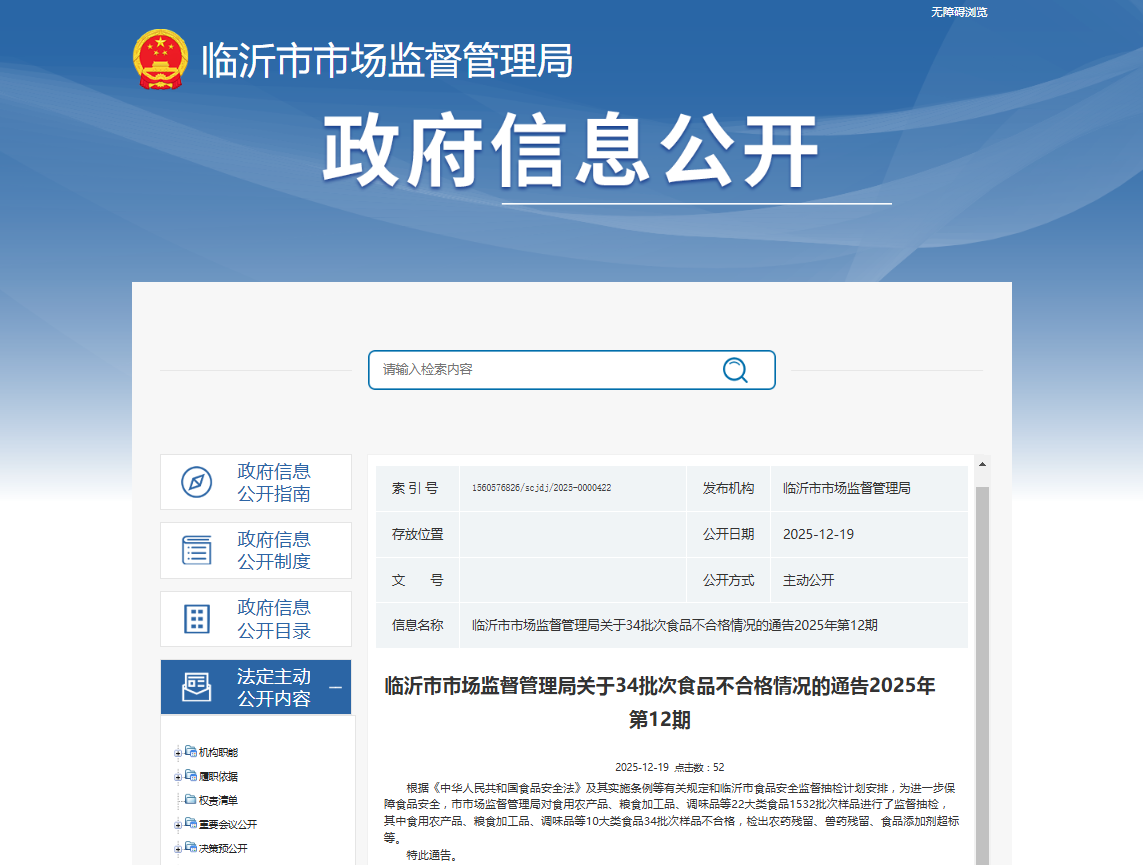
山东省临沂市市场监督管理局关于34批次食品不合格情况的通告2025年第12期
Zhong Guo Zhi Liang Xin Wen Wang· 2026-01-07 08:44
Summary of Key Points Core Viewpoint - The Linyi Market Supervision Administration conducted a food safety inspection on 1,532 samples across 22 categories, revealing that 34 batches from 10 categories of food products failed to meet safety standards due to pesticide residues, veterinary drug residues, and excessive food additives [2]. Group 1: Inspection Results - A total of 1,532 food samples were tested, including edible agricultural products, grain processing products, and condiments [2]. - Out of these, 34 batches were found to be non-compliant with safety standards [2]. - The non-compliance was attributed to issues such as pesticide residues, veterinary drug residues, and excessive food additives [2]. Group 2: Specific Non-Compliant Products - Specific examples of non-compliant products include: - A batch of edible white peony (白芷) with a sulfur dioxide residue of 1.16 g/kg, exceeding the permissible limit [4]. - A batch of chili pepper (辣椒) containing 0.11 mg/kg of pesticide residue (噻虫胺), above the standard limit of 0.05 mg/kg [4]. - A batch of ginger (生姜) with a pesticide residue of 0.12 mg/kg, exceeding the allowable limit of 0.01 mg/kg [4]. Group 3: Regulatory Compliance - The inspections were conducted in accordance with the Food Safety Law of the People's Republic of China and related regulations [2]. - The results are part of a broader effort to ensure food safety and protect public health in Linyi City [2].

华泰人寿山东分公司2025年金融教育宣传周之守护您的“钱袋子”,消费反欺诈指南——识陷阱、懂维权、防风险
Qi Lu Wan Bao· 2025-09-17 05:19
Core Viewpoint - The rapid development of the digital economy has led to an increase in various consumer fraud schemes, which have infiltrated multiple sectors including shopping, dining, and elder care, necessitating heightened consumer vigilance and protective measures [1] Group 1: High-Frequency Consumer Fraud Tactics - "Windfall" inducements through mobile lottery and false promotions are prevalent, with a notable case where a mobile lottery scheme generated transaction volumes of up to 2 billion yuan in a single day [2] - "Health anxiety" exploitation through misleading claims about food and health products targeting the elderly, with potential penalties for violations of advertising laws reaching up to 2 million yuan [4] - "Safety hazard" fraud involving substandard products masquerading as quality goods, such as recycled materials being sold at high prices, posing serious health risks [5] - "Tech-enabled" harassment through AI-generated calls that exploit personal information, complicating regulatory oversight [7] - "Service reduction" schemes where maintenance services are subcontracted to unqualified entities, leading to inflated repair costs [8] - "Brand imitation" fraud with counterfeit products being sold at premium prices, making it difficult for consumers to distinguish between genuine and fake items [9] Group 2: Consumer Rights Protection Guidelines - Consumers should be vigilant against misleading terms like "free" or "limited time" and verify merchant credentials through official channels [11] - Maintaining evidence such as transaction records and communication logs is crucial for effective dispute resolution [12] - Promptly contacting merchants or platforms for complaints can expedite resolution, with specific hotlines available for various issues [13] - Legal recourse is available for unresolved disputes, including mediation through consumer associations or small claims court [14] - Collective action can enhance consumer protection, encouraging reporting of widespread fraud to authorities [15]
品牌破圈:“双标”是张好牌
3 6 Ke· 2025-09-01 03:57
Core Viewpoint - The article discusses the rise of "non-standard" marketing strategies that challenge traditional beauty standards and consumer expectations, particularly in the context of female representation in branding and advertising [7][20]. Group 1: Non-Standard Marketing - "Non-standard" marketing effectively addresses unmet deep-seated consumer needs by proposing unique value propositions that resonate with loyal users [7][8]. - Brands are increasingly moving away from mere product selling to focus on cultural and social issues, particularly those related to women's empowerment and breaking stereotypes [8][10]. Group 2: Case Studies - The skincare brand PMPM launched the "偏偏女孩在闪烁" initiative, showcasing diverse women's stories to challenge conventional definitions of femininity and success [9][10]. - Jissbon, a sexual health brand, has successfully targeted female consumers by focusing on their health needs and desires, breaking away from male-centric marketing [11]. - Muji's use of male models in domestic settings has resonated with consumers, promoting a more inclusive view of gender roles in household responsibilities [11]. Group 3: Challenges and Missteps - Brands must avoid the pitfall of "self-indulgent" marketing that fails to resonate with consumers, as seen in the case of SK-II's campaign that was criticized for being inauthentic [14][15]. - Misunderstanding consumer needs can lead to backlash, as demonstrated by ABC's poorly received product innovation that ignored the core requirements of its target audience [15][17]. Group 4: Strategies for Success - Successful "non-standard" marketing requires a deep understanding of consumer pain points and the ability to articulate these through relatable narratives [21][22]. - Brands should focus on authentic storytelling that features ordinary individuals, allowing consumers to see themselves reflected in the brand's message [22][23]. - Engaging consumers in the narrative can foster a sense of community and shared values, enhancing brand loyalty [22][23].
小红书运营:新与心,2025大食饮行业消费者心智及决策链路研究白皮书
Sou Hu Cai Jing· 2025-07-30 03:19
Core Insights - The report titled "2025 Consumer Mindset and Decision-Making Pathway Research White Paper" focuses on the food and beverage industry, analyzing consumer psychology and decision-making processes [1][3] - Current trends indicate a shift from impulsive to "confirmation-based consumption," with consumers increasingly prioritizing health, emotional connections, and personalized choices [1][10] - The dual engines of "new" and "heart" drive brand growth, where "new" satisfies the desire for novelty and emotional projection, while "heart" relates to value and identity recognition [1][10] Industry Overview - The "big food and beverage" category includes five major sectors: food, beverages, dairy products, alcoholic drinks, and local dining [6][7] - The report highlights the evolving landscape of consumer preferences, emphasizing the importance of understanding underlying motivations behind food choices [10][20] Consumer Behavior Trends - Health consciousness is becoming a fundamental aspect of consumer choices, with 71% of consumers researching product ingredients and nutritional benefits before purchasing [32] - Emotional value plays a significant role in purchasing decisions, with 42% of consumers driven by the desire for relaxation and enjoyment [38][40] - Packaging is increasingly viewed as a form of social currency, influencing consumer choices and brand perception [47][54] Motivational Drivers - Five key motivational drivers for consumer choices in the food and beverage sector are identified: self-control/safety, cultural belonging, emotional value, social expression, and participation/ritual [78][80] - Each driver manifests differently across various product categories, reflecting the nuanced needs of consumers [81] Role of Social Media - Social media platforms, particularly Xiaohongshu, are becoming critical in shaping consumer decisions, facilitating brand connections and user engagement [1][10] - Over 65% of consumers express willingness to engage with food and beverage brands on social platforms, indicating a shift towards collaborative consumption experiences [58] Market Dynamics - The fast-moving consumer goods (FMCG) market is showing signs of recovery, with growth rates of 4.8% across various categories, including beverages and snacks [22][24] - The report suggests that brands must adapt to the changing landscape by recognizing and activating hidden consumer demands [29][30]