
白鹤滩水电站

Search documents
“十四五”时期能源发展成就速览
Xin Hua Wang· 2026-01-14 08:14
Group 1: Energy Supply and Consumption - During the first four years of the "14th Five-Year Plan," China's energy consumption growth reached 1.5 times that of the "13th Five-Year Plan," with an expected increase in electricity consumption exceeding the annual consumption of the EU over five years [4] - The energy production, supply, storage, and sales system has accelerated construction, with a projected national electricity generation of over 10 trillion kilowatt-hours in 2024, accounting for one-third of global production, and energy production reaching approximately 500 million tons of standard coal, representing one-fifth of global output [4] - The energy infrastructure network has been significantly improved, facilitating the transformation of resource advantages in central and western regions into developmental advantages, providing solid energy support for major economic provinces [4] Group 2: Green and Low-Carbon Transition - The "14th Five-Year Plan" has seen unprecedented speed and intensity in green and low-carbon energy development, with the share of renewable energy generation capacity increasing from 40% to around 60% within a year [7] - One-third of the total electricity consumed in society is now green electricity, derived from renewable sources such as wind, solar, and hydropower, with non-fossil energy accounting for an average annual increase of 1 percentage point in total energy consumption [7] - China's exports of wind and solar products during the "14th Five-Year Plan" have contributed to a reduction of approximately 4.1 billion tons of carbon emissions in other countries [7] Group 3: Technological Innovation in Energy - China leads globally in new energy technologies, with over 40% of global renewable energy patents, and has continuously set world records in photovoltaic conversion efficiency and offshore wind turbine capacity [9] - Major energy projects, including the Baihetan Hydropower Station and the domestically developed third-generation nuclear power "Hualong One," have been completed, showcasing China's hard power in energy infrastructure [10] - Energy industrial investment has shown a stepwise increase, with annual investments surpassing 4 trillion, 5 trillion, and 6 trillion yuan, accounting for nearly 10% of total fixed asset investments in society [10] Group 4: Energy Reform and Market Dynamics - The restructuring of the energy system and policy framework has accelerated, with the establishment of a unified national electricity market and the entry of all industrial and commercial users into the market [12] - New business models and formats, such as smart microgrids and virtual power plants, are rapidly developing, with significant applications in energy integration with industrial and transportation sectors [12][13] - The market vitality has been significantly released, with the number of registered electricity market operators reaching 970,000, five times that of 2020, and a majority of photovoltaic and wind turbine manufacturing enterprises being private [13]


超级工程 重塑四川经济地理
Xin Lang Cai Jing· 2026-01-03 22:19
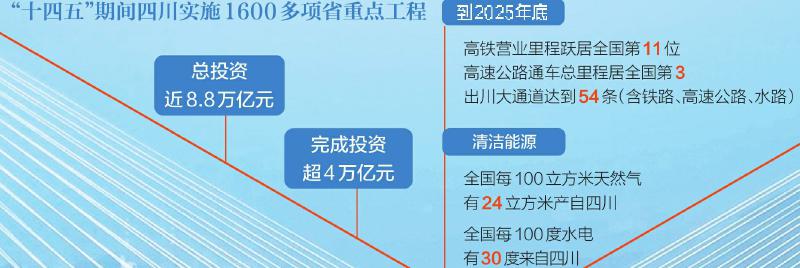
Core Viewpoint - Sichuan is undergoing a significant transformation through the implementation of over 1,600 key projects during the "14th Five-Year Plan" period, with a total investment of nearly 8.8 trillion yuan, reshaping its economic geography and enhancing its infrastructure capabilities [4][16]. Infrastructure Development - The completion of the Jinshajiang-Hubei ±800 kV UHVDC project allows clean energy to be transmitted over 1,900 kilometers in just 0.006 seconds, marking a milestone in energy transmission [3]. - The Leshan to Xichang expressway, which opened on December 31, 2025, features a high bridge-tunnel ratio of 82% and incorporates innovative snow-melting technology for high-altitude sections [3]. - Sichuan has built over 3,000 kilometers of new expressways in the past five years, connecting 15 previously isolated counties to national transport networks [7]. Transportation Achievements - The province's railway network has expanded significantly, with over 7,000 kilometers of operational railways, including the newly opened Chengdu-Yibin high-speed railway, which has transported over 29 million passengers in two years [6][8]. - The total length of highways in Sichuan has surpassed 11,000 kilometers, ranking third nationally, while the overall transportation network reaches 443,000 kilometers, the largest in the country [7]. Energy Sector Advancements - Sichuan has become the first province in China to exceed 100 million kilowatts in hydropower installed capacity, equivalent to 4.5 Three Gorges dams, capable of supplying electricity to approximately 500 million people [11]. - The province's clean energy initiatives include the completion of major hydropower projects and the establishment of new energy transmission corridors, enhancing its role in national energy security [11][12]. Economic Impact - The construction of these mega-projects has stimulated the development of Sichuan's equipment manufacturing and construction industries, with local firms expanding their operations internationally [16]. - Sichuan's strategic location and infrastructure improvements are expected to facilitate greater integration into national and international markets, enhancing its economic competitiveness [9][10].
300余件(套)展品亮相国博呈现中国制造“十四五”成就
Xin Hua She· 2025-12-30 06:17
Core Viewpoint - The exhibition "Building a Strong Nation Road - Achievements of China's Manufacturing during the 14th Five-Year Plan" showcases the robust development of Chinese manufacturing over the past five years, highlighting its hard power and impact on people's livelihoods [1] Group 1: Exhibition Overview - The exhibition will be open to the public at the National Museum of China starting December 30 for a duration of five months [1] - It features over 300 exhibits divided into six sections: high-end manufacturing, industrial foundation, intelligent manufacturing, green manufacturing, integrated development, and better living [1] - The total exhibition area is approximately 4,000 square meters, with more than 85% of the space dedicated to physical and high-precision large models [1] Group 2: Featured Exhibits - The central display includes miniature models of significant projects such as the Baihetan Hydropower Station, the Shenzhen-Zhongshan Link, and the Huajiang Gorge Bridge [1] - Large-scale models of the Long March series rockets, the "Tianhe" core module, the Chang'e 6 probe, the C919 domestic aircraft, the Fujian aircraft carrier, and the "Ida·Magic City" cruise ship are also prominently featured [1] - The high-precision models are designed to meet the technical exploration needs of professional audiences while also providing educational experiences for the general public [1] Group 3: Organizers and Significance - The exhibition is part of the 2025 National Exhibition project by the National Museum of China, co-organized with the News and Publicity Center of the Ministry of Industry and Information Technology [1] - It aims to provide a comprehensive view of the advancements in Chinese manufacturing and its contributions to national development [1]
探访白鹤滩水电站 这个超级工程到底有多“绿”?
Ren Min Wang· 2025-12-26 09:12
Group 1 - The article highlights the significance of the Baihetan Hydropower Station, which is recognized as the world's second-largest hydropower station and has achieved multiple world records [3] - Baihetan is noted for its impressive engineering feats, including the world's largest single-unit capacity for generator sets and the largest underground cavern group [3] - The project emphasizes its commitment to green technology, showcasing its role in promoting sustainable energy solutions [3] Group 2 - The initiative "Witnessing the Road of Science and Technology" aims to popularize scientific knowledge and enhance the scientific literacy of the public [1] - The collaboration between the China Association for Science and Technology and People's Daily focuses on key national technology strategies and core technologies [1] - The project seeks to celebrate the spirit of scientists and contribute to building a strong technological nation [1]
“十四五”规划102项重大工程如期完成规划目标任务
Sou Hu Cai Jing· 2025-12-23 08:31
Core Insights - The "14th Five-Year Plan" has successfully completed its target tasks with 102 major projects, including significant infrastructure like the Baihetan Hydropower Station and the China-Laos Railway [1] - The implementation of these projects has played a crucial role in promoting economic growth, improving people's livelihoods, and strengthening safety foundations [1] Investment and Economic Impact - A total of approximately 3.4 trillion yuan (around 0.5 trillion USD) has been allocated for central budget investments during the "14th Five-Year Plan" period, focusing on public projects that address shortcomings, adjust structures, and benefit people's livelihoods [1] - An additional 1.5 trillion yuan (approximately 0.22 trillion USD) has been allocated through ultra-long-term special bonds to support "two heavy" constructions [1] - Local governments have introduced over 13,000 projects to private capital, involving total investments exceeding 11 trillion yuan (around 1.7 trillion USD), indicating a significant push to enhance effective investment [1]
促增长、保民生、夯基础,成效显著! “十四五”规划102项重大工程如期完成规划目标任务
Yang Shi Wang· 2025-12-23 03:30
Core Viewpoint - The "14th Five-Year Plan" has successfully completed its target tasks for 102 major projects, significantly enhancing effective investment during this period [5][7]. Group 1: Major Projects and Their Impact - The completion of major projects such as the Baihetan Hydropower Station, the China-Laos Railway, and the "Dream" deep-sea drilling vessel has been achieved, contributing to economic growth, improving people's livelihoods, and strengthening safety foundations [5]. - The construction and implementation of 102 major projects have played a crucial role in promoting economic growth and ensuring the improvement of living standards [5]. Group 2: Investment and Economic Growth - A total of nearly 3.4 trillion yuan has been allocated for central budget investments, focusing on public projects that address shortcomings, adjust structures, and benefit people's livelihoods [7]. - An additional 1.5 trillion yuan in long-term special bonds has been arranged to support "two heavy" constructions, while local governments have introduced over 13,000 projects to private capital, involving total investments exceeding 11 trillion yuan [7]. - The continuous increase in effective investment is accelerating the release of domestic demand potential, providing sustained momentum for economic growth [7].
“大国重器”澎湃中国能量 “智慧”大坝点亮绿色未来
Yang Shi Wang· 2025-12-20 03:57
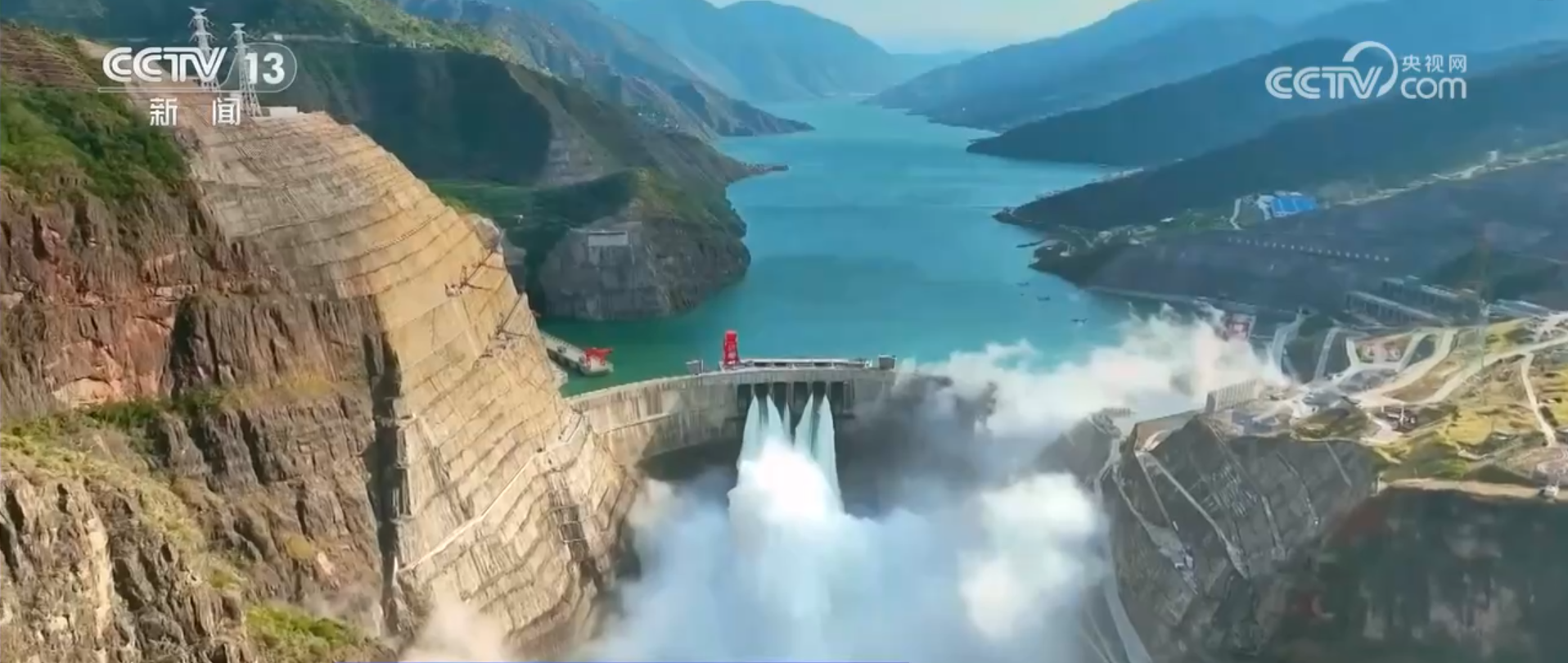
Core Viewpoint - The Baihetan Hydropower Station, the second largest in the world, has achieved significant operational success in its first three years, contributing to energy savings and ecological protection efforts [1][3]. Group 1: Operational Performance - Since the full commissioning of all units in December 2022, the Baihetan Hydropower Station has generated over 200 billion kilowatt-hours of electricity, equivalent to saving over 60 million tons of standard coal and reducing carbon dioxide emissions by over 160 million tons [3]. - The dam, standing at 289 meters, can withstand a water pressure of 16.5 million tons, with operational indicators exceeding premium engineering standards and no operational faults reported [5]. Group 2: Technological Advancements - The station has implemented over 10,000 monitoring instruments in key areas to collect real-time data on the dam's physical and mechanical state, accumulating over 1 billion data points [5]. - A digital twin dam safety monitoring system has been established, allowing for comprehensive inspections of the dam in just three minutes, significantly reducing the manpower and time required for such assessments [7]. Group 3: Ecological Initiatives - The Baihetan Hydropower Station plays a crucial role in flood control for the Yangtze River, with a reservoir capacity of 7.5 billion cubic meters, and conducts over ten ecological adjustments annually to protect fish populations [10]. - The station has developed a diversified ecological protection system, including layered water intake and artificial flood peaks, to support fish spawning while maintaining stable water temperatures [10][12].
行走江河看中国|山河之上,中国水利的奇迹
Zhong Guo Xin Wen Wang· 2025-12-18 07:05
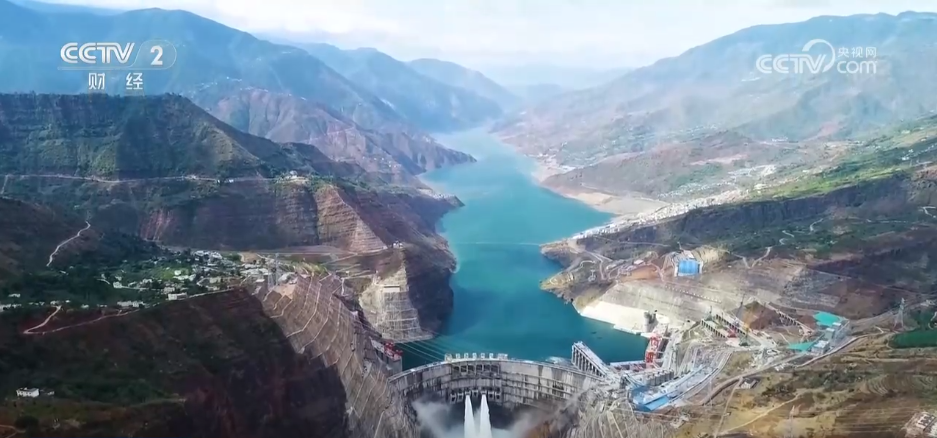
Group 1 - The article highlights the remarkable achievements of China's water conservancy projects, showcasing their historical significance and modern engineering marvels [1][4][5] - The South-to-North Water Diversion Project, particularly the Huanghe Crossing Project, has successfully transported over 34.8 billion cubic meters of water, benefiting millions of people [4] - The Dujiangyan irrigation system, built over 2,000 years ago, continues to play a crucial role in irrigation and flood control, exemplifying ancient Chinese engineering wisdom [5] Group 2 - The Jiangsu Water Conservancy Hub demonstrates innovative engineering by lifting Yangtze River water through 13 pumping stations, elevating it by 65 meters for northern distribution [10] - The E-Jiang-Ji Port Project features a unique steel aqueduct that connects the Yangtze and Huaihe rivers, promoting high-quality regional development [6] - The Baihetan Hydropower Station employs advanced sensor technology for smart monitoring and operation, contributing to the "West-East Electricity Transmission" initiative [14]
“十四五”能源成就企业谈丨国之重器担使命 民之三峡谱新篇
国家能源局· 2025-11-13 12:07
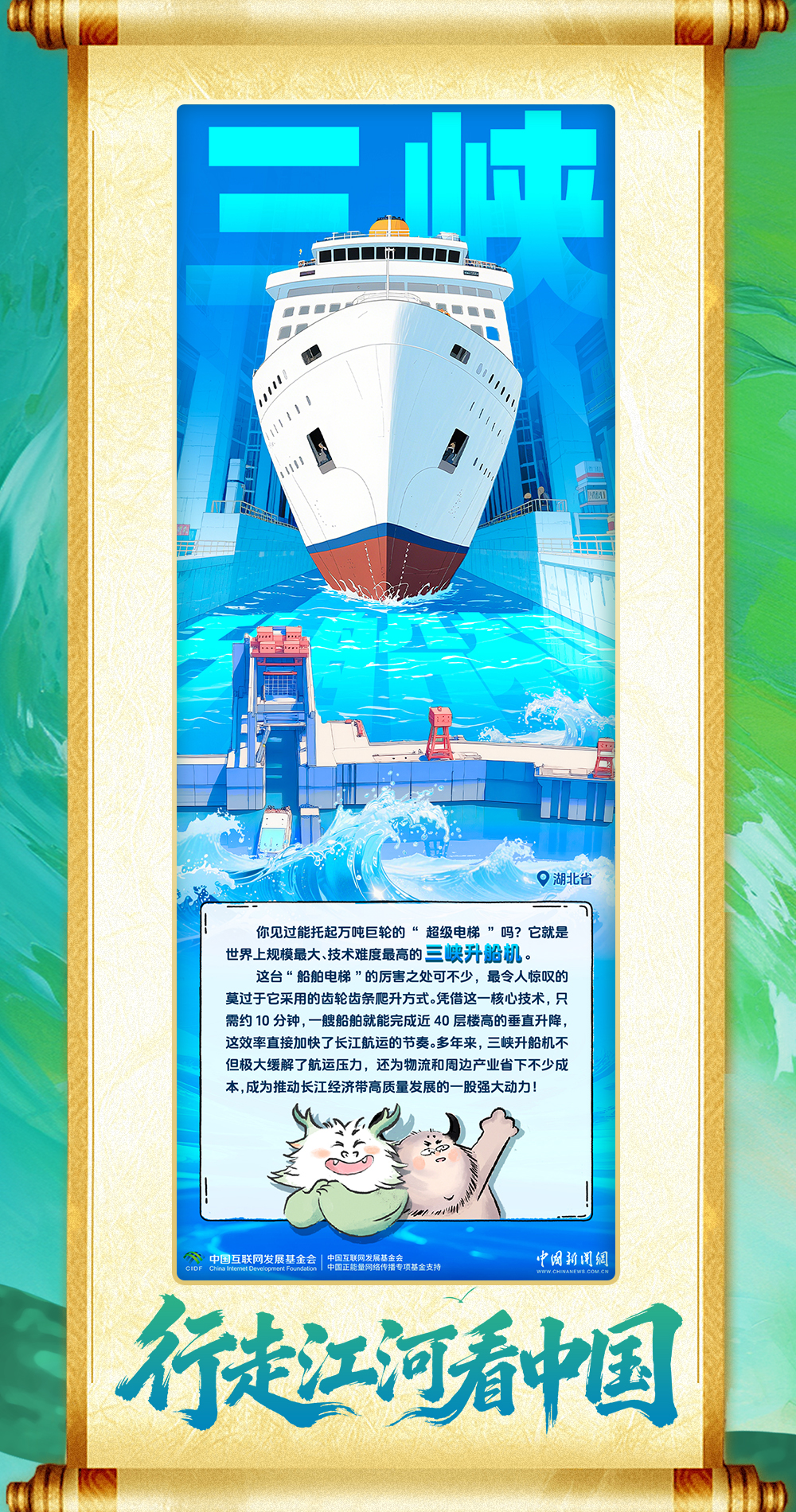
Core Viewpoint - The China Three Gorges Corporation has made significant contributions to national strategic security, energy security, and environmental protection during the "14th Five-Year Plan" period, aligning with the goals of high-quality development and modernization in China [3][4][11]. Group 1: National Strategic Security - The corporation focuses on enhancing core functions to support national strategies such as ensuring the safety of the Yangtze River and promoting energy security [5]. - It has established a comprehensive flood control capacity with a total flood storage capacity of nearly 38 billion cubic meters, having accumulated over 40 billion cubic meters of floodwater retention since the beginning of the "14th Five-Year Plan" [5]. - The company has provided over 1.5 billion cubic meters of water to downstream areas, including an emergency supply of approximately 5.6 billion cubic meters during a severe drought in 2022 [5]. Group 2: Energy Security - Clean energy accounts for approximately 96% of the corporation's total installed capacity, with renewable energy generation ranking first globally [6]. - The completion of the Wudongde and Baihetan hydropower stations has established the world's largest clean energy corridor, with 110 hydropower units in operation along the Yangtze River [6]. - The corporation is advancing offshore wind power projects and has initiated the construction of two large-scale "sand and desert" renewable energy bases in Inner Mongolia and Xinjiang [6]. Group 3: Environmental Protection - The corporation has invested over 120 billion yuan in environmental protection initiatives along the Yangtze River, achieving long-term water quality improvement in key river basins [7]. - It has successfully relocated over 2,000 rare plant species and released more than 28 million rare fish, contributing to the restoration of fish populations to levels seen in the 1980s [7]. - The company has built China's first large-scale green zero-carbon data center and has innovated in wastewater treatment and solar integration [7]. Group 4: Technological Innovation - The corporation has developed a unique innovation model focused on major engineering projects and key technology breakthroughs [9]. - It has made significant advancements in hydropower technology, including the application of ultra-large underground excavation and intelligent construction of high arch dams [9]. - The establishment of an industrial internet platform has enhanced operational efficiency across the hydropower stations [9]. Group 5: New Development Pattern - The corporation is actively promoting the transformation and upgrading of traditional industries while developing strategic emerging industries [12]. - Projects such as the Inner Mongolia renewable energy base and offshore wind power initiatives have been recognized as key national projects [12]. - The company is also involved in international investments, covering 12 countries and regions, with controllable installed capacity expected to exceed 13 million kilowatts [12][13]. Group 6: Future Outlook - The corporation aims to continue its alignment with Xi Jinping's thoughts on socialism with Chinese characteristics, enhancing its role in national strategy and striving to become a world-class enterprise [14].
竞争中练就真本事 新能源产业锻造硬核实力
Ren Min Wang· 2025-11-07 07:38
Core Viewpoint - During the "14th Five-Year Plan" period, China has integrated the requirements of green development into all aspects of economic and social development, promoting both development and protection simultaneously [1][5] Group 1: Green Development Achievements - The new energy industry has significantly contributed to global climate change response and green energy transition, with China maintaining the world's largest production and sales of new energy vehicles for ten consecutive years [2][3] - Wind and solar power exports during the "14th Five-Year Plan" period have cumulatively reduced global carbon emissions by approximately 4.1 billion tons [2] - As of August this year, China's total installed capacity for wind and solar power has surpassed 1.69 billion kilowatts, which is over three times that at the end of the "13th Five-Year Plan" [2] Group 2: Policy and Structural Changes - The establishment of the world's largest and most complete new energy industrial chain has been a crucial foundation for this development [3] - A new round of energy-saving and carbon reduction actions has been initiated, with over 6,400 national-level green factories cultivated, demonstrating significant energy-saving and carbon reduction effects [3] - The implementation of ecological protection measures, such as the ecological protection red line and pollution discharge permit systems, has created a robust institutional framework for environmental protection [4] Group 3: Economic Transformation and Future Goals - The construction of a green, low-carbon, and circular economic system is seen as the key to balancing development and protection [4] - The share of non-fossil energy consumption is projected to rise to 19.8% by 2024, while coal consumption continues to decline, indicating the effectiveness of the green transition [4]