租赁住房REITs

Search documents
公募 REITs 周速览(2026 年 2 月 24-27 日):首批商业不动产REITs审核意见出炉
HUAXI Securities· 2026-03-01 15:19
1. Report Industry Investment Rating No information provided in the content. 2. Core Viewpoints of the Report - This week (February 24 - 27, 2026), the CSI REITs Total Return Index closed at 1,035.8 points, with a weekly decline of 1.08% and a decline of 1.58% compared to the end of January. Trading remained sluggish, and the overall market performance was weak [2][11]. - In the primary market, the number of commercial real - estate REITs applications increased to 14, with a fast - growing trend, and exchanges have issued review opinions on 6 of them, focusing on issues such as rent growth rates, product positioning, and operational data [3]. - In the secondary market, except for the data center and transportation facilities sectors, all other sectors declined. The data center sector showed good performance, and attention can be paid to opportunities such as the expansion of data center REITs and the improvement of distribution rates. For the rental housing and industrial park sectors, although they declined, some REITs with stable fundamentals and high distribution rates are worthy of attention [5]. 3. Summary According to Relevant Catalogs Primary Market: The Number of Commercial Real - estate REITs Applications Increased to 14 - The exchanges newly accepted 2 commercial real - estate REITs this week. As of the end of February 2026, 14 commercial real - estate REITs have been applied for, with a proposed fundraising scale exceeding 41.7 billion yuan, surpassing the fundraising scale of infrastructure public REITs in 2025 [3]. - The exchanges have issued review opinions on 6 commercial real - estate REITs, with concerns including negative current rent growth rates but high - set long - term growth rates in the forecast period, differences from listed infrastructure public REITs on the same platform, and reasons for the decline in hotel operational data [3]. - For infrastructure REITs, as of February 27, 2026, there are 11 cases under inquiry and feedback and 2 cases already applied for [4]. Secondary Market: Data Center Leads the Rise, Rental Housing Leads the Decline, and Trading Sentiment is Low - This week, except for the data center (+2.01%) and transportation facilities (+0.10%) sectors, all other sectors declined. The rental housing sector had the largest decline (-2.24%), followed by the industrial park (-1.87%) and consumer facilities (-1.69%) sectors, and the warehousing and logistics sector had the smallest decline (-0.52%) [5][25]. - Only 17 individual bonds in the whole market closed up, while 62 closed down. The rental housing and industrial park sectors had all individual bonds closing down [5]. - The data center (IDC) sector performed well around the Spring Festival. Runze Technology and Wanguo rose by 2.68% and 0.74% respectively this week, with high trading activity. The distribution rates of Runze and Wanguo have dropped to 3.32% and 3.35% respectively, and attention can be paid to the opportunities after asset fluctuations [5][28]. - Southern Runze Technology Data Center REIT announced an expansion plan, and attention should be paid to the valuation of the proposed acquisition projects and the improvement of the distribution rate [31]. - The rental housing sector had the largest decline this week. Although it has good fundamentals, the price increase space is limited due to the distribution rate being close to the first - home mortgage rate. It is recommended to focus on REITs with a distribution rate of about 3.3%, such as Cathay Haitong Urban Investment Kuanting Rental Housing and Huaxia Fund China Resources Youchao [6][34]. - The industrial park sector had the second - largest decline. It is recommended to focus on park REITs with stable fundamentals, income distribution adjustment mechanisms, and high distribution rates, such as Jinyu Zhizao Gongchang, China Merchants Kechuang, and Chuangjin Hexin Shounong [6][36]. - The consumer infrastructure sector also had a large decline. After the adjustment, some REITs with high distribution rates, such as Hua'an Bailian Consumption, Jiashi Wumei Consumption, and CICC Yinli Consumption, are worthy of attention. Also, attention can be paid to the new - issue opportunities of commercial real - estate REITs and the adjustment opportunities of consumer infrastructure REITs [37][38].
国泰海通|地产:租赁住房REITs投资体系——REITs框架研究系列二
国泰海通证券研究· 2026-02-13 11:57
Core Viewpoint - The article emphasizes that the centralized rental housing market is entering a growth phase driven by dual factors: policy benefits and declining interest rates, which help to resolve profitability challenges [1]. Group 1: Policy and Market Dynamics - Multiple policy incentives and macroeconomic interest rate declines are significantly reducing financing costs, allowing rental enterprises to gradually establish their business models [1][2]. - The supply of rental housing is increasing notably, with the market structure shifting towards state-owned enterprises as the main players, while domestic investors prefer risk diversification through entrusted operations, and foreign investors favor self-operated high-end assets for better risk compensation [1]. Group 2: REITs Asset Characteristics - Rental housing REITs primarily include public rental housing, guaranteed rental housing, and market-oriented apartments, each exhibiting distinct characteristics in tenant structure, revenue models, and lease stability [2]. - Public and guaranteed rental housing targets low-income groups and new citizens, benefiting from low land and tax costs, high lease renewal rates, and demonstrating "high stability, low elasticity" cash flow characteristics [2]. - Market-oriented rental housing caters to a broader audience with potential for rent growth but faces higher marketing costs and tax burdens, making lease stability more susceptible to market fluctuations [2]. Group 3: Evaluation Framework - A comprehensive evaluation framework for rental housing REITs is proposed, encompassing five dimensions: regional economy, asset quality, operational capability, management quality, and market/policy environment [2]. - The framework assigns a weight of 37% to operational management capability, focusing on occupancy rates, rent growth rates, EBITDA profit margins, and cash flow distribution rates [2]. - Asset quality is weighted at 26%, while regional economic factors account for 20%, assessing the economic level, population inflow rates, and rent-to-income ratios of the project’s location [2]. Group 4: Expansion Mechanism - The normalization of REITs expansion mechanisms will enhance asset valuation through three pathways: scale effects, risk diversification, and improved expectations [3]. - Expansion not only leads to growth in scale but also value reconfiguration, as it can dilute fixed management costs and directly enhance net operating income (NOI) profit margins, thereby increasing DCF valuations [3]. - By injecting regionally complementary and tenant-structured differentiated assets, the risk of vacancy in single assets can be effectively reduced, enhancing cash flow stability and lowering capitalization rates [3].


REITs 框架研究系列二:租赁住房 REITs 投资体系
GUOTAI HAITONG SECURITIES· 2026-02-13 09:48
Investment Rating - The report rates the industry as "Overweight" [4] Core Insights - The concentrated rental housing market is entering a growth phase driven by dual factors of policy benefits and declining interest rates, which help to resolve profitability issues [2][18] - The report constructs a comprehensive framework to quantify the investment value of rental housing REITs across five dimensions, analyzing how expansion mechanisms can reshape asset valuations through economies of scale and risk diversification [2][19] Summary by Sections 1. Market Growth Under Policy Benefits - Historical challenges include a long-term divergence between rental yield and housing price growth, leading to profitability issues for rental enterprises [9][10] - Policies from both supply and demand sides are addressing challenges in the concentrated rental market, transitioning it from unprofitable to viable [12][19] - A macroeconomic environment of declining interest rates is effectively reducing financing costs for rental enterprises, contributing to the maturation of their business models [15][17] - The rental housing supply has significantly increased, with institutionalized projects in 16 key cities reaching a total of 1.24 million units by the end of 2024, a year-on-year growth of 35.2% [18][19] - The market for large transactions in rental housing is heating up, with a notable increase in transaction volumes and values [23][24] 2. Rental Housing REITs: Types and Characteristics - Rental housing REITs are categorized into public rental housing, guaranteed rental housing, and market-oriented apartments, each with distinct tenant structures, income compositions, and cost structures [32][34] - Public and guaranteed rental housing have strict tenant admission criteria and regulated pricing, while market-oriented housing is driven by market dynamics [34][36] - The income structure varies significantly, with public and guaranteed housing having lower operational costs due to tax exemptions and subsidies, while market-oriented housing faces higher marketing and operational costs [42][46] 3. Comprehensive Value Assessment of Rental Housing REITs - The assessment framework includes five dimensions: regional economy (20%), asset quality (26%), operational management capability (37%), manager quality (12%), and market and policy environment (5%) [19][32] - Operational management capability is weighted most heavily, focusing on occupancy rates, rental growth rates, EBITDA margins, and cash flow distribution rates [19][32] - The report emphasizes that a normalized expansion mechanism for REITs will enhance asset valuations through economies of scale, risk diversification, and improved expectations [19][23] 4. Future Outlook: Impact of REIT Expansion on Asset Valuation - Growth in net operating income (NOI) will directly elevate asset values, while enhanced cash flow stability will lead to revaluation of existing assets [23][24] - "Platform-type REITs" with sustainable expansion capabilities will achieve higher operational funding multiples, resulting in an upward shift in overall valuation [19][23]
沪市债券新语 | “储备+培育+发行多轨并行” 江苏省用好REITs工具推动高质量发展
Xin Hua Cai Jing· 2025-10-16 09:40
Core Insights - The Chinese real estate market is transitioning towards stock optimization and high-quality development, driven by policy guidance and market adjustments since 2024 [1] - The infrastructure REITs market has seen significant growth, with 75 products listed and a total issuance scale exceeding 200 billion yuan by September 2025 [1] - Jiangsu Province is leading in infrastructure REITs issuance, with 12 public REITs and a fundraising total of 240 million yuan, showcasing a multi-track approach to support high-quality economic development [2] Infrastructure REITs Market Overview - As of September 2025, the Shanghai Stock Exchange has listed 51 projects, raising a total of 140 billion yuan, accounting for approximately 70% of the market [1] - The REITs cover various sectors including data centers, rental housing, logistics, and municipal services, indicating a diverse market landscape [1] - Jiangsu Province has established itself as a modern benchmark in smart cities and comprehensive transportation, with 11 out of 12 public REITs listed on the Shanghai Stock Exchange [1] Notable Projects - Dongwu Suyuan REIT, listed in June 2021, focuses on incubating high-tech enterprises in Suzhou Industrial Park, attracting over 90 billion yuan in incremental funding for infrastructure development [3] - Huatai Jiangsu Expressway REIT, launched in November 2022, raised 30.5 billion yuan for the expansion of the Hu-Wu Expressway, marking a significant achievement in highway REITs [4] - Suzhou Hengtai Rental Housing REIT, launched in May 2025, serves as a model for integrating talent housing with capital markets, achieving a rental rate of 93.33% [4] Recent Developments - The newly listed Nanfang Wanguo Data REIT is a milestone in supporting the private economy and technological development, with a 100% renewable energy usage target for its underlying asset [5] - Local government support has been crucial, with Jiangsu Province incorporating REITs into its "14th Five-Year Plan" and implementing various supportive policies [6][7] - The Jiangsu Securities Regulatory Bureau is actively promoting the use of public REITs to revitalize state-owned assets and enhance financing capabilities [7][9] Regulatory and Policy Support - The Shanghai Stock Exchange is committed to building a robust REITs market, providing feedback on transparent and growth-oriented projects [9] - Jiangsu's Development and Reform Commission is focused on improving project quality and expediting the application process for REITs [8] - Collaborative efforts among regulatory bodies aim to enhance communication and support for REITs projects, ensuring a steady pipeline of quality assets [9]
国内首单租赁住房REITs扩募项目在上交所上市
Zhong Guo Xin Wen Wang· 2025-08-08 08:00
Core Viewpoint - The successful expansion of the Huaxia Beijing Affordable Housing REIT marks a significant milestone in China's public REITs market, indicating a dual-driven model of "initial issuance + expansion" and accelerating the normalization of REITs issuance [1][2]. Group 1: REITs Market Development - The expansion of public REITs is a crucial feature that promotes the sustainable development of the REITs market and enhances its refinancing capabilities [2]. - Since June 2023, the Shanghai Stock Exchange has actively promoted the expansion of listed REITs, with 6 REITs announcing expansion plans in 2024, of which 2 have been approved and 4 are under review [2]. - As of June 25, there are 44 publicly listed REITs on the Shanghai Stock Exchange, with a total issuance scale of 122.6 billion yuan, covering various asset types including toll roads, industrial parks, and rental housing [2]. Group 2: Financial Performance and Projections - The Huaxia Beijing Affordable Housing REIT has distributed approximately 128 million yuan in dividends since its listing in August 2022 [1]. - The recent expansion raised approximately 946 million yuan, with assets including four mature rental housing projects located in various districts of Beijing [1]. - The projected annual cash distribution rate for the expanded project in 2025 is 4.11%, which is higher than the distribution rate calculated based on the market value of the initial issuance [1].
【立方债市通】郑州一国资公司拟首次发债/郑州发投集团拟发债50亿/城投债牛市行情仍在延续
Sou Hu Cai Jing· 2025-06-26 14:25
Group 1 - Zhengzhou Airport Hub Construction Company plans to issue its first corporate bonds with a scale not exceeding 1.6 billion yuan, with a term of no more than 5 years [1] - The company was established in August 2021 with a registered capital of 3 billion yuan, fully owned by Zhengzhou Airport Science and Technology Investment Group [1] Group 2 - Xuchang State-owned Assets intends to invest 217 million yuan in Rebeccah by transferring 70 million shares, accounting for 6.18% of the total share capital [3] - After the transfer, Changda Trading will become the second-largest shareholder of Rebeccah [3] Group 3 - The National Development and Reform Commission announced a new central budget investment to support local implementation of labor-for-relief projects, with a total of 16.5 billion yuan allocated for 2025 [5] - This initiative aims to assist 380,000 individuals from difficult backgrounds in increasing employment and income [5] Group 4 - The Shanghai Stock Exchange and China Securities Index Co., Ltd. will launch a series of indices for convertible bonds and exchangeable bonds with differentiated credit ratings [8] - This initiative aims to provide diversified performance benchmarks and investment targets for the market [8] Group 5 - Zhengzhou Development Investment Group has received approval from the Shenzhen Stock Exchange for two bond projects totaling 5 billion yuan, with a focus on private placements [13] - The projects include a 3 billion yuan issuance of technology innovation corporate bonds and a 2 billion yuan issuance of corporate bonds [13] Group 6 - China Pingmei Shenma Group completed the issuance of 1 billion yuan in technology innovation bonds at an interest rate of 2.85% [14] - The funds raised will be used to repay interest-bearing debts of the issuer and its subsidiaries [14] Group 7 - The first domestic REITs expansion project for rental housing was successfully listed, with a total issuance scale of 180.4 billion yuan across various asset types [11] - This marks a significant milestone in the development of the REITs market in China [11] Group 8 - The Chengdu Eastern Group's executive director is under investigation for serious violations of discipline and law [18] - This incident highlights ongoing scrutiny and governance issues within state-owned enterprises [18] Group 9 - The market outlook for urban investment bonds remains positive, with a focus on extending durations to capture coupon income and exploring private bonds [20] - The report emphasizes the importance of maintaining a balanced supply-demand dynamic in the bond market [20]


中金 • REITs | 租赁住房REITs投资的当下与远方
中金点睛· 2025-06-22 23:46
Core Viewpoint - The rental housing REITs market is experiencing strong demand resilience, with ongoing supply pressures in the short term, driven by urbanization trends and demographic factors [4][10]. Group 1: Market Supply and Demand Dynamics - Demand for rental housing remains robust, supported by net population inflows into major cities and extended rental periods due to delayed marriage and high housing prices [4][8]. - The supply of affordable rental housing is accelerating, with a cumulative construction of 7.27 million units expected by the end of 2024, achieving 84% of the "14th Five-Year Plan" target [4][20]. - The rental market is expected to face short-term supply pressures, particularly in markets with concentrated supply releases, although affordable rental housing is anticipated to outperform the overall rental market [29][30]. Group 2: Evaluating Rental Housing Operational Capability - The operational capability of rental housing can be assessed through asset quality, operational efficiency, and financial metrics [5][45]. - Asset quality considers project location, supply-demand dynamics, and property management capabilities [45][46]. - Operational efficiency focuses on leasing capabilities and tenant management, while financial metrics emphasize cash flow stability [45][49]. Group 3: Outlook for Rental Housing REITs Market Development - The rental housing REITs market is expected to expand through new issuances and capital increases, supported by a substantial stock of rental housing and private fund exit demands [6][52]. - The low-interest-rate environment and "asset scarcity" are likely to sustain the appeal of rental housing REITs as quality investment assets [6][54]. - As of June 18, 2025, the dividend yield for rental housing REITs reached 2.6%, with a narrowing spread compared to the ten-year government bond yield [54][57].

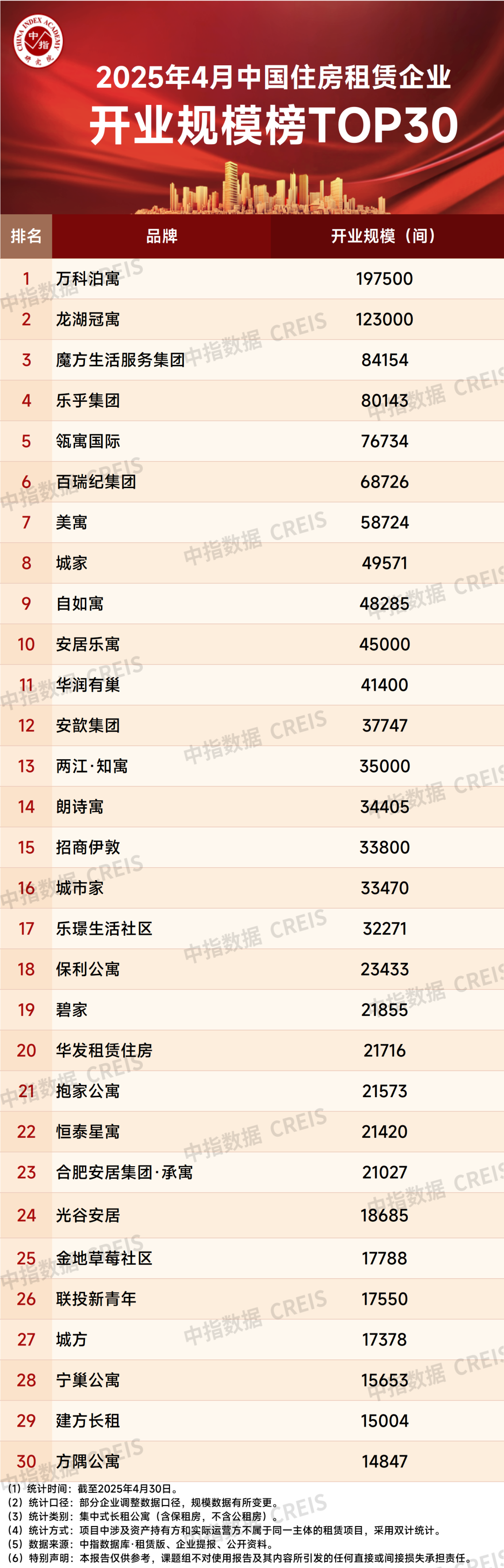
中指研究院:4月住房租赁需求回落 TOP30企业累计管理房源量提升至189.7万间
智通财经网· 2025-05-11 23:57
Core Insights - The housing rental industry in China has entered a low season in April, with a slight decline in rental demand and average residential rents in key cities [1][11] - The average rental price across 50 cities is 35.2 yuan per square meter per month, reflecting a month-on-month decrease of 0.32% and a year-on-year decrease of 3.40% [11][14] - The top 30 rental companies have a cumulative management capacity of 1.897 million units, an increase of approximately 13,000 units from March [5][10] Rental Market Overview - In April 2025, the average rental price in 50 cities decreased by 0.32% month-on-month and 3.40% year-on-year [11][14] - Only 2 cities experienced a month-on-month increase in average rental prices, a significant decrease from the previous month [14] - The number of cities with declining rental prices increased to 48, with Sanya showing the largest decline at 1.10% [14][15] Company Rankings - The top 30 rental companies maintained an opening scale threshold of 14,847 units, with a total of 1.897 million units managed [1][5] - Vanke Bo Lei leads the opening scale with 197,500 units, followed by Longfor Guan Yu with 123,000 units [2][3] - The management scale of the top 30 companies includes 11 housing rental enterprises, 9 local state-owned enterprises, 6 entrepreneurial companies, 3 hotel companies, 1 intermediary, and 1 financial company [4][10] Financing Trends - The rental housing REITs market continues to progress, with new approvals and strategic partnerships being formed [11] - The first public REIT for rental housing was approved in March, and further developments are ongoing for other REITs [11] - Private REITs are also being initiated, with projects seeking to raise significant capital for rental housing investments [11]