绿茶烤鸡

Search documents
“初代网红”还有后劲吗?
Guan Cha Zhe Wang· 2026-02-25 14:12
Core Viewpoint - The Green Tea Group (stock code: 06831.HK) has released its first annual performance forecast since listing on the Hong Kong Stock Exchange, expecting a significant net profit growth of 31.4%-45.1% for the year, reflecting achievements in scale expansion and efficiency improvement. However, challenges such as declining same-store sales and slower-than-expected store expansion raise uncertainties about future growth [1][3][6]. Group 1: Financial Performance - The company anticipates a net profit of approximately RMB 4.60 billion to 5.08 billion for 2025, representing a growth of 31.4%-45.1% compared to RMB 3.50 billion in 2024 [1]. - The adjusted net profit, excluding non-recurring items, is expected to reach RMB 4.81 billion to 5.32 billion, with a year-on-year increase of 33.2%-47.4% [1]. - Revenue is projected to increase by approximately RMB 6.96 billion to 11.74 billion compared to 2024's revenue of RMB 38.38 billion, indicating a revenue growth of about 18.13%-30.59% [3][4]. Group 2: Operational Challenges - Same-store average daily sales have decreased from RMB 23.1 thousand in 2024 to RMB 20.0 thousand in 2025, with significant declines in key markets such as North China and Guangdong [4][5]. - The overall per capita consumption has dropped from RMB 62.9 in 2022 to RMB 55.5 in the first half of 2025, indicating pressure on the single-store profit model due to intensified price competition in the restaurant industry [4][5]. - The company has faced challenges in its ambitious store expansion plan, having only added 37 new stores by June 30, 2025, compared to a target of 150 new stores for 2025 [6]. Group 3: Market Position and Competition - The company is experiencing signs of brand and business model aging, relying on older popular dishes while facing criticism for lack of innovation [6]. - The competitive landscape in the casual Chinese dining market is highly fragmented, with the company holding only a 0.7% market share, facing pressure from both national chains and emerging local brands [6]. - Management capabilities are under scrutiny as the company expands, needing to maintain food safety, service standards, and brand consistency across a growing number of locations [6]. Group 4: Future Expansion Plans - The company plans to focus its expansion on tier-2 and tier-3 cities, with a target of opening 58, 94, and 113 new restaurants in these markets from 2025 to 2027 [7]. - The success of this strategy remains uncertain, as consumer habits and price sensitivity in these markets may differ significantly from established areas [7].

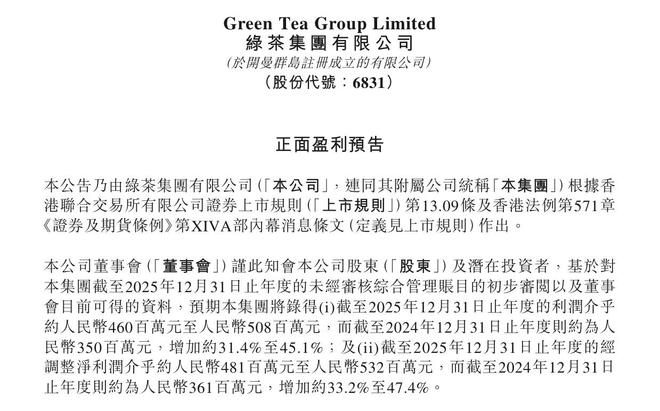
增收更增利,绿茶集团(6831.HK)的这份盈喜“含金量”在哪?
Ge Long Hui· 2026-02-25 09:48
Core Viewpoint - The restaurant industry is experiencing a significant recovery in 2026, driven by improved consumer scenarios and the effects of various consumption-promoting policies, with a notable increase in revenue growth rates [1] Group 1: Company Performance - Green Tea Group has reported a positive earnings forecast, with a projected revenue increase of approximately RMB 6.96 billion to RMB 11.74 billion for 2025, and a net profit growth of 31.4% to 45.1%, reaching between RMB 4.60 billion and RMB 5.08 billion [1] - The growth logic behind this profit increase indicates a qualitative change, where revenue growth is not merely a result of expanding store numbers but is driven by both network expansion and improved operational efficiency [2] Group 2: Operational Strategy - Green Tea Group employs a pragmatic and efficient approach to navigate industry cycles, focusing on a "small store + high efficiency" strategy, developing smaller restaurants under 300 square meters to enhance turnover rates and optimize cost structures [3] - The company has demonstrated resilience in its existing market operations, with an increase in overall turnover rate from 3.05 times per day in the first half of 2024 to 3.10 times in the first half of 2025, outperforming industry averages [3] Group 3: Supply Chain and Growth - The company’s robust domestic operations are supported by a "third-generation supply chain system," which includes partnerships with leading suppliers and a digital cold chain, ensuring freshness and cost efficiency [4] - Green Tea Group has accelerated its global expansion, opening 15 stores in Hong Kong and Southeast Asia since 2024, with overseas stores generating 2.5 to 3 times the revenue and profit of domestic locations [5] Group 4: Conclusion - The positive earnings forecast reflects the company's effective supply chain and operational efficiency, alongside a balanced approach to domestic and international growth, positioning Green Tea Group for sustained growth [6]
绿茶集团王勤松:向“千店”门槛跨越
Shang Hai Zheng Quan Bao· 2025-12-03 18:46
Core Insights - The core viewpoint of the article revolves around the ambitious expansion plans of Green Tea Group, led by Chairman Wang Qinsong, aiming to surpass the threshold of 1,000 stores by 2025, with a focus on both domestic and international markets [2][8]. Company Overview - Green Tea Group was founded in 2004 in Hangzhou, initially starting as a youth hostel that included a restaurant, which later evolved into the Green Tea Restaurant brand [4][5]. - The restaurant gained popularity for its fusion cuisine and affordable pricing, becoming a "net celebrity restaurant" during the rise of social media [4][6]. Expansion Strategy - The company plans to open 563 new restaurants over the next three years, aiming to reach a total of over 1,000 locations [8]. - The first expansion outside of China was marked by the opening of restaurants in Singapore and Thailand, indicating a strategic move towards international markets [8]. Financial Management - Despite rising costs in labor, ingredients, and rent, the company has maintained a customer price point of around 60 yuan, showcasing effective cost management and operational efficiency [8]. - The company has developed a mature supply chain system that allows for reduced costs in key ingredients, enhancing negotiation power with suppliers [7][8]. Market Positioning - The company has strategically positioned itself in high-potential markets, such as Beijing, where it successfully established a foothold despite initial skepticism from competitors and landlords [5][6]. - Wang Qinsong emphasizes the importance of creating a culturally rich dining atmosphere that transcends short-term trends, aiming for longevity in the restaurant industry [7].

绿茶集团(06831):中式融合菜引领者,打造高性价比大众餐厅
CMS· 2025-09-19 08:45
Investment Rating - The report gives a "Strong Buy" rating for the company with a target price of HKD 11.8, while the current stock price is HKD 7.05 [3]. Core Insights - The company, Green Tea Group, is a leader in the Chinese casual dining sector, focusing on high-cost performance fusion cuisine and expanding its restaurant network primarily in East China, North China, and Guangdong [1][7]. - The company has shown rapid growth in revenue and profit, with a significant increase in the number of restaurants, reaching 502 by mid-2025, representing a year-on-year growth of 28.7% [7]. - The Chinese casual dining market is projected to grow, with the market size expected to reach RMB 534.7 billion in 2024, reflecting a year-on-year increase of 7.4% [51]. - Green Tea's strategy includes a focus on small store formats, regional expansion, and market penetration, which is expected to drive future growth [7][26]. Financial Data and Valuation - Total revenue is projected to grow from RMB 3,589 million in 2023 to RMB 8,386 million by 2027, with a compound annual growth rate (CAGR) of 27% [2]. - The net profit attributable to shareholders is expected to increase from RMB 295 million in 2023 to RMB 785 million by 2027, with a remarkable growth rate of 1,669% in 2023 [2]. - The company’s price-to-earnings (PE) ratio is projected to decrease from 14.7 in 2023 to 5.5 by 2027, indicating an attractive valuation [2]. Market Overview - The casual dining market in China is characterized by a strong demand for cost-effective dining options, with consumer preferences shifting towards high-value meals [51][59]. - The market for casual dining restaurants is expected to continue expanding, with a projected market share increase from 16% in 2020 to 19.3% by 2029 [51]. - The competitive landscape is evolving, with a trend towards standardization and digitalization in restaurant operations, which enhances efficiency and customer experience [62][63]. Competitive Advantages - Green Tea's unique selling proposition lies in its fusion cuisine, which combines various culinary styles to attract a diverse customer base [17][18]. - The company has a robust supply chain and a strong focus on menu innovation, with significant investments in research and development to maintain customer interest [7][20]. - The small store format strategy allows for quicker returns on investment, with a payback period of approximately 14-15 months for new openings [7][26].
绿茶集团(06831):首次覆盖:融合菜博采众长,高性价比顺势而为
Haitong Securities International· 2025-09-16 02:14
Investment Rating - The report initiates coverage with an OUTPERFORM rating, targeting a price of HK$12.10 from the current price of HK$6.69 [1]. Core Insights - Green Tea Group is positioned as a leading player in the casual Chinese dining sector, leveraging affordable pricing and fusion cuisine to attract consumers [2][6]. - The casual Chinese dining market is expected to grow significantly, with a projected compound annual growth rate (CAGR) of 9.1% from 2024 to 2029, reaching a market size of RMB 0.8 trillion by 2029 [2][26]. - The company has a strong brand presence, with a focus on menu innovation and customer loyalty, evidenced by over 16.2 million members in its loyalty program [3][33]. Company Overview - Green Tea Group was founded in 2008 in Hangzhou and has established itself as a prominent brand in the casual Chinese dining market, holding a 0.7% market share by revenue in 2024 [2][6]. - The company operates 502 restaurants as of mid-2025, ranking third in terms of the number of outlets in the casual dining segment [3][42]. Financial Performance - Revenue is projected to grow from RMB 3.84 billion in 2024 to RMB 7.65 billion by 2027, reflecting a CAGR of 27% [1][4]. - Net profit is expected to increase from RMB 350 million in 2024 to RMB 804 million by 2027, with a CAGR of 30% [1][4]. - The company has demonstrated strong profitability, with a gross profit margin of 69.5% in 2025 and a return on equity (ROE) of 51.3% [1][4]. Market Dynamics - The Chinese restaurant market is increasingly shifting towards chain operations, with a projected CAGR of 8.2% for chain restaurants from 2024 to 2029, outpacing non-chain establishments [22]. - Casual Chinese dining is identified as the fastest-growing segment within the Chinese restaurant market, driven by consumer demand for high cost-effectiveness and quality dining experiences [26][23]. Competitive Advantages - Green Tea Group's competitive edge lies in its strong brand recognition, efficient supply chain management, and strategic expansion into lower-tier cities with smaller restaurant formats [3][39][42]. - The company has established partnerships with 205 third-party food processing companies to enhance operational efficiency and maintain food quality consistency across its outlets [39][40]. Expansion Strategy - The company plans to continue its expansion strategy by opening 150, 200, and 213 new restaurants in 2025, 2026, and 2027, respectively, focusing on smaller formats to reduce costs [3][42]. - As of mid-2025, Green Tea Group has successfully increased its restaurant count by 37 outlets compared to the end of 2024, demonstrating its commitment to growth [42].
上市之后,绿茶餐厅继续向前
2 1 Shi Ji Jing Ji Bao Dao· 2025-06-16 07:47
Core Insights - Green Tea Restaurant has evolved from a popular internet brand to a well-established player in the restaurant industry, focusing on a sustainable and long-term business model [1][3] - The company recently completed its IPO on the Hong Kong Stock Exchange, raising approximately $87.33 million from eight cornerstone investors, indicating strong market confidence in its long-term value [1][2] Company Development - Founded in 2004, Green Tea started as a youth hostel and transitioned into a restaurant business, initially offering affordable fusion dishes that appealed to young consumers [3] - The restaurant has maintained a high level of menu adaptability, updating about 20% of its dishes annually, with plans to introduce 203 new dishes in 2024 [3][5] - The company has a unique design aesthetic that combines traditional Chinese elements with modern dining experiences, contributing to its brand recognition and customer appeal [4] Financial Performance - Green Tea has achieved a compound annual growth rate of 29.8% in restaurant numbers, expanding from 276 to 465 locations by the end of 2024 [5] - The gross profit margin has increased from 62.1% in 2020 to 65.8% in the first half of 2023, reflecting effective cost management and operational efficiency [6] Market Strategy - The company is focusing on expanding into lower-tier cities where consumer demand for high-quality, affordable dining options is growing, with plans to open 120 new restaurants in 2024 [5][6] - Green Tea aims to establish a central food processing facility to supply 90% of its semi-finished products to its chain restaurants, enhancing operational efficiency [5] Future Outlook - The company has plans to enter international markets, including Thailand, Singapore, and potentially Europe and the United States, aiming to become a globally recognized Chinese restaurant brand [7]
凭预制菜狂卖38亿,上市首日股价暴跌12%,绿茶餐厅能续命成功吗?
Sou Hu Cai Jing· 2025-06-03 14:20
Core Viewpoint - The restaurant chain "Green Tea," known for its pre-made dishes and Jiangsu-Zhejiang cuisine, has successfully gone public after multiple attempts, but its stock price plummeted over 12% on the first day of trading, raising concerns about its future viability and market perception [1][3]. Financial Performance - Green Tea reported an annual sales figure of 3.8 billion yuan, but same-store sales are projected to decline by 10.3% in 2024, indicating reliance on new store openings for growth [1][3][6]. - The average consumer spending is expected to decrease from 61.8 yuan in 2023 to 56.2 yuan in 2024, while the overall table turnover rate is projected to drop from 3.3 times in 2023 to 3 times in 2024 [6][7]. Market Position and Brand Perception - The brand is struggling with aging appeal, failing to attract new customers and losing existing ones due to declining reputation and quality control issues, such as reports of unsanitary conditions in its kitchens [9][11]. - Green Tea's menu lacks innovation, with no new signature dishes or differentiation from competitors, leading to a loss of interest from social media influencers and consumers [5][9]. Operational Challenges - The company relies heavily on external suppliers, with 205 third-party food processing companies, which limits its ability to ensure food safety and maintain profit margins [9][11]. - Despite plans to invest 26.3% of the funds raised from the IPO into building a self-operated central food processing facility, concerns remain about whether these efforts are too late to reverse the brand's decline [9][11]. Growth Strategy - Green Tea plans to open over 500 new stores in the next three years, but the effectiveness of this strategy is questioned given the current market dynamics and the brand's inability to innovate [11].
绿茶集团登陆港股,开启高质量发展新篇章
Huan Qiu Lao Hu Cai Jing· 2025-05-23 02:18
Core Insights - Green Tea Group officially listed on the Hong Kong Stock Exchange on May 16, 2024, attracting significant interest from both institutional and retail investors, with cornerstone investors contributing approximately $87.33 million [1][2] - The IPO saw an impressive subscription rate of 317.54 times during the public offering phase, indicating strong market demand [1][2] - The company aims to leverage the funds raised to expand its restaurant network, establish a central food processing facility in Zhejiang, and upgrade its IT systems [3] Company Overview - Green Tea Group is recognized as a benchmark brand in China's dining industry, with nearly 500 restaurants globally and projected revenues exceeding 3.8 billion yuan in 2024 [1] - The company ranks third in terms of the number of restaurants and fourth in revenue among casual Chinese dining brands in mainland China [1] Market Positioning - The company has strategically positioned itself in the competitive landscape by focusing on high cost-performance, unique decor with national style elements, and a diverse menu [5][6] - Green Tea Group's average consumer spending is between 50-70 yuan, making it the lowest among the top five casual Chinese dining brands in 2024 [5] Financial Performance - The company has demonstrated robust financial growth, with revenues of 2.375 billion yuan, 3.589 billion yuan, and 3.838 billion yuan from 2022 to 2024, respectively [7] - Adjusted net profits for the same period were 25 million yuan, 303 million yuan, and 361 million yuan, reflecting a strong growth trajectory [7] Expansion Strategy - Green Tea Group plans to open 563 new restaurants over the next three years, with 50% of these located in lower-tier cities [7] - The company has optimized its store model to include smaller, more efficient "lightweight stores," which have higher turnover rates and lower operating costs [7] Shareholder Returns - The company intends to distribute at least 180 million yuan in special dividends post-IPO, equating to a return rate of approximately 4% based on the current share price [10] - Green Tea Group plans to distribute 50% of its annual profits as dividends, potentially offering a yield exceeding 10% for investors [10] Future Outlook - The company is well-positioned for future growth, with plans for international expansion and a clear strategy to capitalize on the rising consumer demand in the dining sector [9][10]
观察 | “网红餐厅鼻祖”上市,餐饮企业迎上市潮
Sou Hu Cai Jing· 2025-05-20 13:57
Group 1: Company Overview - Green Tea Group successfully listed on the Hong Kong Stock Exchange on May 16, with an initial share price of HKD 7.19, but closed the first day at HKD 6.79, giving it a market capitalization of HKD 45.73 billion [1] - The company plans to issue 168 million shares, raising a total of HKD 12.11 billion, with a net amount of approximately HKD 7.46 billion after excluding the sale of existing shares [1] - As of April 2024, Green Tea Group operates 489 restaurants across 21 provinces, 4 municipalities, 2 autonomous regions, and Hong Kong, with a compound annual growth rate (CAGR) of 29.8% in restaurant numbers from 2022 to 2024 [2] Group 2: Financial Performance - Green Tea Group's revenue has shown consistent growth, with reported revenues of CNY 2.375 billion, CNY 3.589 billion, and CNY 3.838 billion for the years 2022, 2023, and 2024 respectively, alongside profits of CNY 16.579 million, CNY 296 million, and CNY 350 million [4] - The total number of customers served increased from 37.786 million in 2022 to 68.071 million in 2024, although the average spending per customer decreased from CNY 62.9 to CNY 56.2 during the same period [4] Group 3: Industry Context - The Chinese restaurant industry is experiencing significant transformation, moving from rapid expansion to a focus on refined operations, driven by consumer demand and technological innovation [7] - The market size of the Chinese restaurant industry is projected to grow from CNY 39.5 trillion in 2020 to CNY 55.7 trillion by 2024, with a CAGR of 9.0%, indicating strong resilience and growth potential [8] - The industry is becoming increasingly competitive, attracting substantial capital and entrepreneurial interest due to its large market size and stable growth expectations [8]
港股再添餐饮新兵:绿茶餐厅上市,能否打破中式连锁‘估值天花板’?
Sou Hu Cai Jing· 2025-05-20 06:45
Core Insights - Green Tea Restaurant successfully went public on the Hong Kong Stock Exchange on May 16, achieving a market capitalization exceeding HKD 46 billion [2][3] - Founders Wang Qinsong and Lu Changmei hold a 65.8% stake, with their combined net worth surpassing HKD 30 billion [3][4] - The restaurant chain has expanded to nearly 500 locations nationwide, generating over CNY 38 billion in annual revenue [2][6] Company Development - Green Tea Restaurant originated from a youth hostel opened by the founders in 2004, which transitioned into a restaurant in 2008 due to popular demand for their affordable and delicious fusion dishes [3][4] - The restaurant's unique decor and high-quality dishes led to its rapid rise as a "first-generation internet celebrity restaurant" in Hangzhou [3][4] - The company received significant investment from Swiss private equity giant Hony Capital in 2017, which valued the restaurant at approximately USD 233 million (around CNY 1.678 billion) [4] Financial Performance - Revenue increased from CNY 23.75 billion in 2022 to CNY 35.89 billion in 2023, with projections of reaching CNY 38.38 billion in 2024 [6][8] - Net profit surged from CNY 0.17 billion in 2022 to CNY 2.96 billion in 2023, with expectations of CNY 3.5 billion in 2024 [8] - The restaurant's market share remains below 1% in the competitive casual dining sector, prompting plans to open 150, 200, and 213 new locations in 2025, 2026, and 2027 respectively [8][6] Industry Context - The recent IPO of Green Tea Restaurant is part of a broader trend in the Hong Kong market, with several other dining establishments also going public [9][10] - The restaurant sector is experiencing a wave of IPOs, driven by favorable market conditions and a growing appetite for consumer-focused investments [11][12] - Analysts suggest that the current market environment presents a significant opportunity for quality dining brands to enter the public market [11][12]