美元存单

Search documents
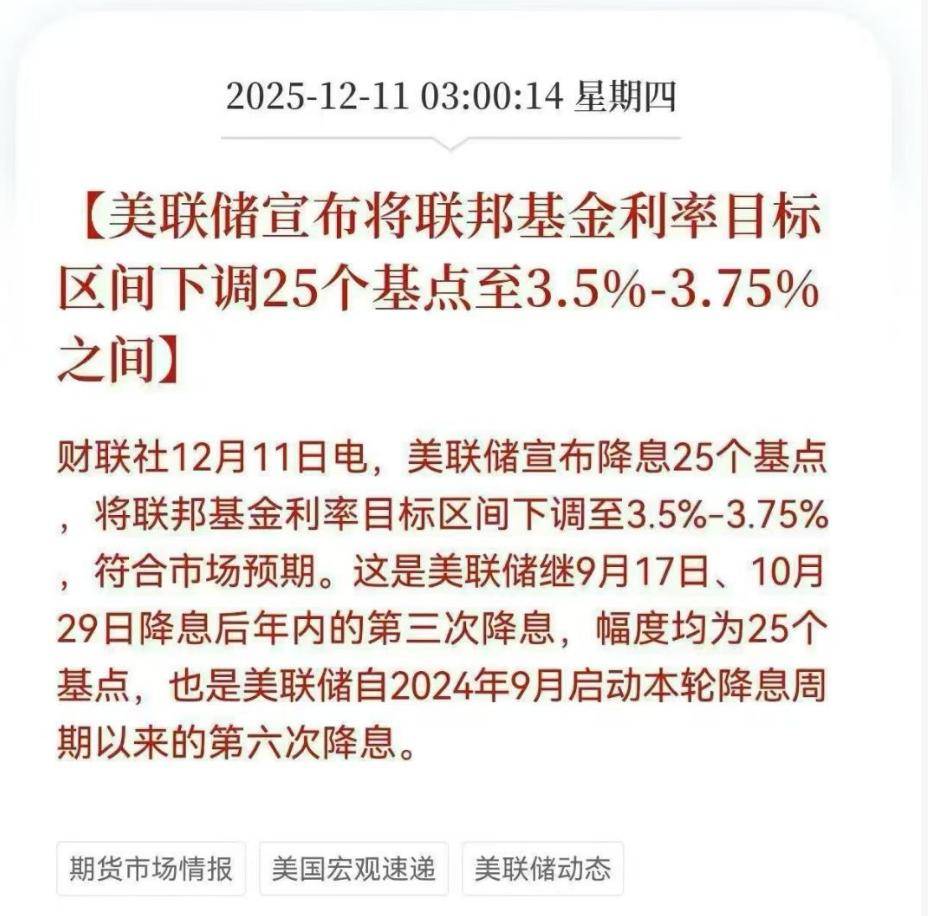
美联储再度降息,全球大放水已经来了!但川普并不满意
Sou Hu Cai Jing· 2025-12-11 04:09
Core Viewpoint - The Federal Reserve is likely to lower interest rates again in December due to deteriorating employment data and persistent inflation concerns, indicating a potential risk of stagflation in the U.S. economy [2][4]. Group 1: Economic Indicators - The primary indicators influencing the Fed's decision on interest rates are employment and inflation. Recent U.S. employment data showed a significant decline, with a loss of 32,000 jobs in November, the largest drop in two and a half years, suggesting a weakening job market [2][4]. - The U.S. national debt is approaching $37 trillion, and a 2% reduction in interest rates could save approximately $750 billion annually in interest payments, highlighting the urgency for rate cuts to manage debt [9][11]. Group 2: Implications of Rate Cuts - A series of rate cuts is anticipated, with Morgan Stanley predicting up to seven cuts by 2026, which could alleviate the debt burden significantly [5][11]. - The potential for a weaker dollar due to rate cuts could lead to capital outflows from the U.S. to other markets, particularly benefiting China, which is becoming increasingly attractive to foreign investors [4][12]. Group 3: Asset Class Reactions - The anticipated rate cuts are expected to negatively impact low-risk, high-yield assets such as U.S. Treasury bonds and savings products, as the attractiveness of these investments diminishes with falling interest rates [23][24]. - Conversely, commodities like gold, silver, and other raw materials are likely to see price increases as the dollar weakens, creating investment opportunities in these asset classes [22]. Group 4: China's Economic Context - As the U.S. enters a rate-cutting cycle, China may also follow suit to stimulate its economy, particularly in light of its struggling real estate market and the need for lower borrowing costs [26][27]. - The current economic environment presents a critical opportunity for China to lower interest rates, which could further support its economic recovery while also impacting domestic savings and investment strategies [25][27].

从小确幸到大牛市
半夏投资· 2025-11-29 05:03
Core Viewpoint - The article discusses the increasing difficulty of asset allocation in a chaotic global environment, highlighting the challenges faced by high-net-worth individuals in securing their wealth and achieving satisfactory returns [2][3]. Domestic Asset Dilemma - Over the past decade, fixed-income assets, particularly non-standard assets, have been crucial for wealthy individuals in China. However, current comprehensive interest rates are at historical lows, and non-standard assets are gradually being phased out [4]. - Real estate, once a primary investment for affluent individuals, now shows an average rental return of 2.3% in the top 20 cities, making it less attractive due to liquidity issues and high transaction costs [4]. Increased Uncertainty Overseas - The trend of investing abroad has been beneficial for high-net-worth individuals in recent years, with investments in USD deposits, US stocks, and real estate in the US and Japan yielding good returns. However, potential returns are now significantly lower, and uncertainty has increased [5][6]. AI Investment Uncertainty - Current AI investments in the US resemble past infrastructure investments in China, appearing beneficial but ultimately unsustainable due to the mismatch between cash flow and debt burdens [7][8]. - Structural uncertainties in AI investments have risen, including questions about technology paths and which service providers will succeed [8]. Economic Outlook - The US economy is expected to slow significantly in the second half of next year, with AI investment being a major support for economic resilience over the past two years. However, signs of layoffs and declining housing prices in Silicon Valley indicate emerging challenges [10]. - The current high valuations and earnings in the US stock market suggest limited future returns, with a likelihood of long-term depreciation of the USD against the RMB [10]. Gold Investment Outlook - The best phase for gold investment appears to be over, with rising uncertainties and potential overvaluation based on historical pricing models [12][14]. - Recent sales of gold by central banks, particularly by Russia, signal a significant change in the market dynamics for gold [18]. Asset Allocation Challenges - The article emphasizes that asset allocation has become more complex, with increasing uncertainties regarding the safety of wealth, especially for Chinese individuals with assets abroad [20]. - The potential for major countries, including the US, to face fiscal issues could further complicate the investment landscape [20]. Investment Opportunities - Despite economic challenges, the A-share and Hong Kong stock markets currently offer some of the highest implied returns globally, with the Shanghai Composite Index trading at a PE ratio of around 13, implying a return of approximately 7% [21]. - The article suggests that even in a weak economic environment, the return on equity (ROE) for core indices may stabilize, providing a foundation for future growth [23][25]. Examples of Resilience - The article highlights examples of leading companies in struggling industries, such as construction materials and real estate, that have managed to maintain profitability and even grow amidst broader market challenges [26][33]. Future Market Outlook - The potential for a significant bull market is discussed, driven by the return of wealth from overseas and the reallocation of global capital towards Chinese assets as the domestic economy stabilizes [39][43]. - Historical patterns suggest that a low-interest environment combined with a lack of investment opportunities in other major markets could lead to a new bubble in Chinese assets [44][46].

储户注意了:存取5万以上不用登记?新规之下这些细节要明白
Sou Hu Cai Jing· 2025-08-25 01:18
Group 1: International and Domestic Trends - The Federal Reserve maintained the federal funds rate at 4.25%-4.5% in March 2025, but signals of potential rate cuts were released by Powell at the Jackson Hole meeting on August 23, leading to a 91.3% market bet on a September rate cut [1][2] - The international trend of rate cuts has impacted the Chinese financial market, with household deposits increasing by 10.77 trillion yuan in the first half of 2025, but a decrease of 1.11 trillion yuan in July, indicating a shift of funds towards wealth management and funds [1][3] Group 2: Effects of Rate Cuts on Capital Flow - Following three rate cuts by the Federal Reserve in 2024, foreign institutions increased their holdings of Chinese bonds by over 300 billion yuan in Q4 2024, while enterprises in the Shanghai Free Trade Zone saw a 45% year-on-year increase in cross-border purchases of high-yield foreign deposits [3] - In response to the Fed's rate cuts, the People's Bank of China lowered the reserve requirement ratio by 0.5 percentage points in September 2024 and again in May 2025, resulting in a historical low average interest rate of 3.68% for new corporate loans in the first half of 2025 [3] Group 3: Structural Changes in Domestic Deposits - The acceleration of fund migration is evident as non-bank institution deposits surged by 2.14 trillion yuan, while the interest rates on three-year large deposits fell from 2.8% in 2023 to 1.8%-2.2% in 2025, contrasting with an average return of 4.5% for balanced stock and bond funds during the same period [3] Group 4: New Regulations and Their Implications - The new regulation allows cash withdrawals of over 50,000 yuan without mandatory registration of the source or purpose, addressing previous concerns over excessive scrutiny [4] - Financial institutions must still adhere to the "Know Your Customer" principle, with enhanced scrutiny for high-risk clients, while technology is being utilized to streamline processes and protect customer privacy [4][5] Group 5: Economic and Real Estate Impacts - The central bank's liquidity injection of 600 billion yuan through a one-year MLF operation aims to alleviate market pressure and direct more funds into the real economy [6] - The rental market is expected to grow due to new housing rental regulations, which may divert some funds from home purchases and ease pressure on the housing market [7] Group 6: Expert Analysis on Regulatory Changes - The new regulations do not relax anti-money laundering efforts but instead focus resources on higher-risk areas, ensuring that banks maintain rigorous checks on clients from high-risk regions [9] - Innovations in local policies, such as the introduction of combination products by banks, aim to enhance customer returns while maintaining compliance with new regulations [12]




大额存单转让潮再现,存款吃利息的时代已经过去了吗?
Sou Hu Cai Jing· 2025-08-25 00:44
Group 1: Impact of International Rate Cuts on China's Financial Market - The Federal Reserve's rate cuts led to a decline in the US dollar index from 105.8 in September 2024 to 102.3 in July 2025, while the RMB appreciated from 7.35 to 7.18 against the dollar, prompting cross-border capital movements [2] - In response to the Fed's rate cuts, the People's Bank of China (PBOC) lowered the reserve requirement ratio by 0.5 percentage points and reduced the reverse repo rate to 1.5%, resulting in a historical low average interest rate of 3.68% for new corporate loans in the first half of 2025 [3] Group 2: Large Certificate of Deposit (CD) Transfer Trends - The interest rate for three-year large CDs in China fell from 2.8% in 2023 to a range of 1.8%-2.2% in 2025, while high-yield CDs issued in 2022 offered annualized returns of up to 9.4% upon transfer, leading to a transfer volume of 1.2 trillion yuan in Q1 2025 [5] - The global interest rate decline prompted domestic investors to reallocate assets, with A-share daily trading volume exceeding 1.2 trillion yuan in August 2025, a 58% increase from the beginning of the year [6] Group 3: Market Adjustments and Innovations - The Shanghai Free Trade Zone launched a pilot program for "offshore bonds + digital RMB," allowing real-time global fund allocation, resulting in higher transfer rates for large CDs compared to newly issued products [7] - The ongoing rate cuts from the Fed accelerated the marketization of domestic deposit rates, with three-year deposit rates dropping to 1.25% by July 2025, aligning with low-rate countries like Japan and Europe [8] Group 4: Strategies for Individuals - Individuals can utilize policy benefits by exploring high-yield offshore CD products through the "Cross-Border Wealth Management Connect" platform, with potential annualized returns of 3.5%-4.0% [10] - A recommended asset allocation strategy involves 60%-70% in deposits or government bonds and 30%-40% in funds and bonds, with a focus on local policies that may enhance returns [11]