
美豆油期货

Search documents
美豆周度报告-20260308
Guo Tai Jun An Qi Huo· 2026-03-08 08:49
1. Report Industry Investment Rating - Not mentioned in the provided content 2. Core Viewpoints of the Report - The price of US soybeans rose significantly this week driven by crude oil. The price increase order is US soybean oil futures > US soybean futures > US inland soybean spot > US soybean meal > Brazilian port spot and US port spot > Brazilian inland spot > Argentine May FOB price. The main drivers of this price increase are the sharp rise in crude oil prices leading to increased shipping costs and optimistic expectations for biodiesel consumption. The supply pressure will gradually emerge in the medium term, and the price range of 1200 - 1250 cents per bushel may face significant pressure [1]. - South America has a bumper harvest, so there is no basis for a bull market. However, demand is expected to improve, limiting the downside space. Overall, the market is expected to be volatile and slightly bullish, with a price range of 1050 - 1250 cents per bushel [5]. 3. Summary by Relevant Catalogs 3.1. Overall View and Bull - Bear Logic of US Soybeans - **Overall View**: South America has a bumper harvest, no basis for a bull market; demand is expected to improve, limited downside space, overall volatile and slightly bullish, with a price range of 1050 - 1250 cents per bushel [5]. - **Bearish Logic**: After China purchases US soybeans, the Trump administration's support for biodiesel addition policies may weaken; Brazil's harvest is accelerating, continuing the pattern of a good harvest; Argentina is expected to receive precipitation after a short - term drought, with little impact on the final yield [6]. - **Bullish Logic**: After China purchases 12 million tons of US soybeans, it adds an additional 8 million tons of soybeans for this crop year; Argentina experienced early - stage drought, and the yield may be revised down; the sharp rise in global crude oil prices may lead to inflation [8]. 3.2. Spot and Futures Market Prices - As of March 6, 2026, the price of the US soybean futures continuous contract rose 43.5 cents per bushel to 1200.75 cents per bushel; the US soybean meal futures continuous contract rose $1.7 per short ton to $317.2 per short ton; the US soybean oil futures continuous contract rose 5.29 cents per pound to 66.58 cents per pound [8]. - As of March 5, 2026, the spot soybean purchase price in Illinois rose 17 cents per bushel to 1176.75 cents per bushel compared to the previous week; the soybean quotation at the US Gulf port rose 4.5 cents per bushel to 1268.25 cents per bushel compared to the previous week [8]. - As of March 6, 2026, the spot price of soybeans in the inland region of Mato Grosso, Brazil, rose 0.8 reais per bag to 102.43 reais per bag compared to the previous week; the spot price at the Paranagua port rose 2.71 reais per bag to 129.54 reais per bag compared to the previous week [9]. - As of March 4, 2026, the FOB price of Argentine soybeans for the May shipment decreased by $2 per ton to $416 per ton; the price for the June shipment remained flat at $423 per ton [9]. 3.3. Weather Conditions in Main Producing Areas - According to the weather forecast released on March 7, 2026, in the next week, precipitation in Brazil will be mainly concentrated in the central and northern regions, with less precipitation in the southern and eastern regions. In the next two weeks, the cumulative precipitation in the central region will be higher than the normal level, while that in the southern and northern regions will be lower. In specific main - producing states, Mato Grosso will have slightly more than normal precipitation; South Mato Grosso will have more than normal precipitation in the next week; Paraná will have less rain in the next two weeks, which is conducive to the harvest; Rio Grande do Sul will have light rain in the next week and less rain in the second week, which is not conducive to crop yield [12]. - In the next week, Argentina will have less precipitation, concentrated in the central and northern producing areas. In the next two weeks, Buenos Aires will have little precipitation, and Córdoba will have light rain in the next week and dry conditions in the second week [12]. 3.4. US Soybean Demand - According to USDA data, as of the week ending February 27, 2026, the US soybean export inspection and quarantine volume was 1.119 million tons, compared with 0.8114 million tons in the previous week; the net sales for this crop year were 383,400 tons, compared with 407,000 tons in the previous week; the net sales for the next crop year were 0 tons, the same as in the previous week; the shipment volume to China was 734,600 tons, compared with 344,800 tons in the previous week [31]. 3.5. CFTC Positions and Planting Costs - According to CFTC data, as of March 3, 2026, the net long positions of funds in soybean futures and options were 214,100 lots, an increase of 9,300 lots compared to the previous week; the net long positions of funds in soybean oil futures and options were 65,900 lots, an increase of 8,800 lots compared to the previous week; the net short positions of funds in soybean meal futures and options were 62,000 lots, an increase of 30,000 lots compared to the previous week. From the perspective of fund positions, the operation idea for soybeans, soybean oil, and soybean meal is to continue to increase long positions [38]. - In terms of planting costs, the cost in the US remains high, while the cost in Brazil is lower than that in the US but has also increased compared to the previous year. The US planting cost is expected to be 1200 - 1250 cents per bushel, and the Brazilian cost is expected to be 950 - 1000 cents per bushel [39].
美豆周度报告-20260301
Guo Tai Jun An Qi Huo· 2026-03-01 08:52
1. Report Industry Investment Rating - Not provided in the report 2. Core View of the Report - The price of US soybeans is likely to continue to fluctuate within a range. South America's bumper harvest means there is no basis for a bull market, but demand is expected to improve, limiting the downside. Overall, it is expected to oscillate moderately, with a price range of 1000 - 1200 cents per bushel [2][6] 3. Summary by Relevant Catalog 3.1. Overall View and Long - Short Logic of US Soybeans - **Overall View**: South America's bumper harvest, no basis for a bull market; demand is expected to improve, limited downside, overall oscillating moderately in the range of 1000 - 1200 cents per bushel [6] - **Short Logic**: 1. After China purchases US soybeans, the Trump administration's support for biodiesel addition policies may weaken; 2. Brazil has entered the harvest stage, continuing the harvest pattern; 3. Argentina is expected to receive precipitation after a brief drought; 4. The strengthening of the Brazilian exchange rate puts pressure on the premium quote [7] - **Long Logic**: 1. After China purchases 12 million tons of US soybeans, it will purchase an additional 8 million tons of soybeans in the current crop year; 2. Due to the previous drought in Argentina, the yield per unit may be reduced; 3. The weakening of the US dollar supports US soybeans [8] 3.2. Spot and Futures Market Prices - As of February 27, 2026, the price of the continuous US soybean futures contract rose by 19.75 cents per bushel to 1157.25 cents per bushel; the continuous US soybean meal futures contract rose by $5.7 per short ton to $315.5 per short ton; the continuous US soybean oil futures rose by 2.37 cents per pound to 61.29 cents per pound [8] - As of February 27, 2026, the spot soybean purchase price in Illinois increased by 21.25 cents per bushel to 1159.25 cents per bushel compared to the previous week; the soybean quote at the US Gulf port increased by 24.25 cents per bushel to 1264.75 cents per bushel compared to the previous week [8] - As of February 27, 2026, the spot price of soybeans in the inland region of Mato Grosso, Brazil, decreased by 0.21 reais per bag to 101.63 reais per bag compared to the previous week; the spot price at the Paranagua port increased by 0.34 reais per bag to 126.83 reais per bag compared to the previous week [9] - As of February 25, 2026, the FOB price of Argentine soybeans for May shipment increased by $4 per ton to $418 per ton; the price for June shipment increased by $3 per ton to $421 per ton [9] 3.3. Weather Conditions in Main Producing Areas - According to the weather forecast released on February 28, 2026, in the next week, precipitation in Brazil will be mainly concentrated in the central region, with less precipitation in the south and north; in the next two weeks, the cumulative precipitation in the central region will be slightly higher than the normal level, and less in the southern region. In specific major producing states, the harvest in Mato Grosso is nearly complete, with normal to slightly more precipitation; in the next two weeks, precipitation in South Mato Grosso will be less, which is conducive to the progress of the harvest; in the next two weeks, precipitation in Parana will be less, which is conducive to the harvest work; in the next week, precipitation in Rio Grande do Sul will be scarce, and it will return around March 6 [12] - In the next week, precipitation in Argentina will be less and concentrated in the central and northern producing areas, and the cumulative precipitation in the next two weeks will be generally less, with less precipitation in the southern producing areas and still insufficient cumulative rainfall [12] 3.4. US Soybean Demand - According to data released by the USDA, as of the week ending February 20, 2026, the US soybean export inspection and quarantine volume was 814,900 tons, compared with 1.29 million tons in the previous week; the net sales in the current crop year were 407,000 tons, compared with 798,000 tons in the previous week; the net sales in the next crop year were 0 tons, compared with 66,000 tons in the previous week; the shipment to China was 344,800 tons, compared with 684,000 tons in the previous week [30] 3.5. CFTC Positions and Planting Costs - According to data released by the CFTC, speculative funds increased their net long positions in soybeans. As of February 24, 2026, the net long positions of funds in soybean futures and options were 204,700 contracts, an increase of 16,000 contracts compared to the previous week; the net long positions of funds in soybean oil futures and options were 57,000 contracts, an increase of 20,000 contracts compared to the previous week; the net long positions of funds in soybean meal futures and options were 31,600 contracts, an increase of 33,400 contracts compared to the previous week. From the perspective of fund positions, the operation idea for soybeans, soybean oil, and soybean meal is to reduce short positions and increase long positions [36] - In terms of planting costs, the cost in the United States remains high, while the cost in Brazil is lower than that in the United States but has also increased compared to the previous year. The US planting cost is expected to be 1200 - 1250 cents per bushel, and the Brazilian cost is expected to be 950 - 1000 cents per bushel [37]
【冠通期货研究报告】油粕日报:偏强震荡-20260225
Guan Tong Qi Huo· 2026-02-25 11:05
Report Industry Investment Rating - Not provided Core Viewpoints - The soybean meal market is expected to continue its upward trend this week, while the oil market is cautiously optimistic with limited downside and policy - guided upside potential [1][2] Summary by Related Content Soybean Meal - As of the week ending February 19, 2026, the US soybean export inspection volume was 669,865 tons, down from the revised 1,215,299 tons last week and 879,226 tons in the same period last year. The total US soybean export inspection volume for the 2025/26 season so far has reached 25,033,167 tons, a year - on - year decrease of 32.2%, and it has reached 58.4% of the annual export target [1] - ANEC estimates that Brazil's soybean exports in February 2026 will be 10.69 million tons, about 0.8 million tons lower than the previous estimate, but still 9.9% higher than 9.726 million tons in February last year. The estimated Brazilian soybean exports in 2026 will reach a record 112 million tons [1] - US soybean exports continue to be strong, and the lower - than - expected shipments from Brazil in February may reduce the expected arrivals in April, leading to a significant increase in soybean meal prices. Attention should be paid to arrivals and state reserve releases, and the market is expected to remain strong and volatile this week [1] Fats and Oils - According to MPOA, Malaysia's palm oil production from February 1 - 20, 2026, is estimated to have decreased by 12.29%, with different degrees of decline in different regions [2] - According to AmSpec, Malaysia's palm oil exports from February 1 - 25, 2026, were 922,649 tons, a 16.05% decrease from 1,099,033 tons in the same period last month [2] - The US EPA will submit the final biofuel blending quota to the White House before the weekend, and the White House will review and announce the final result within about 30 days, meeting the self - set deadline of the end of March to complete the renewable energy use targets for 2026 and 2027 [2] - US soybean oil is supported by US biofuel policies and shows a strong trend. During the holiday, Malaysian palm oil is in a stage of weak supply and demand. February inventory is expected to decline again, but the large original inventory will suppress the near - term rebound height. The oil sector is generally cautiously optimistic, with limited downside and policy - guided upside. Attention should be paid to the US - Iran negotiations and the implementation of US biofuel policies [2]
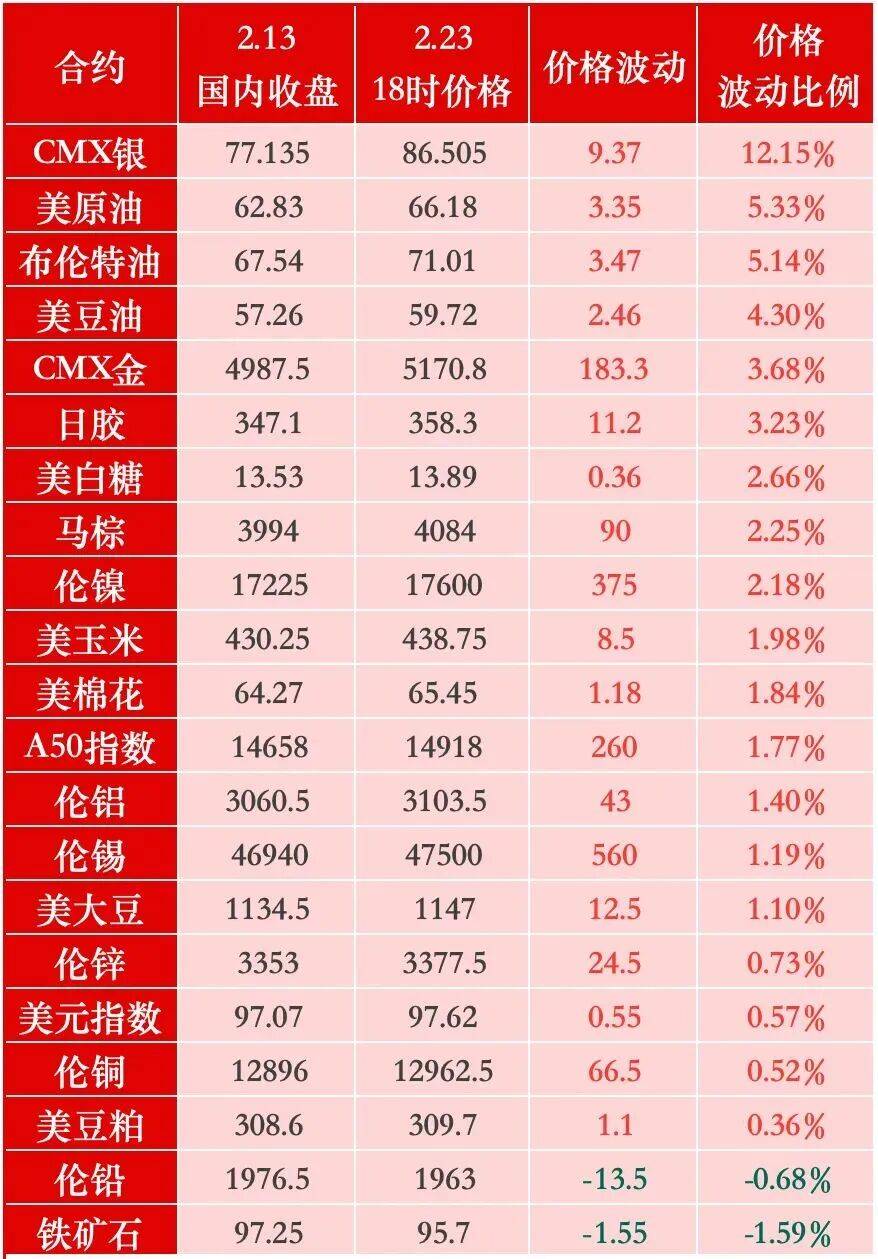
假期风云激荡,银价油价飙升!国内期市开盘在即,贵金属稳了?能化品种分化加剧?谁将成为“黑马”?︱开市前瞻
Sou Hu Cai Jing· 2026-02-23 14:20
Core Viewpoint - The global macro environment remains turbulent during the Spring Festival holiday, with significant events such as changes in U.S. tariff policies and escalating geopolitical conflicts leading to volatility in major asset prices, adding uncertainty to the domestic market opening after the holiday [1] Group 1: Market Reactions and Predictions - The international market experienced significant price fluctuations during the holiday, impacting domestic market expectations for various commodities, with potential for rebound opportunities in certain sectors [1] - The U.S. Federal Reserve's internal divisions regarding interest rate policies have intensified, with discussions around rate cuts, pauses, and hikes, which could significantly influence global markets [3][5] - Market expectations for the Fed's interest rate decisions have shifted, with a reduced likelihood of rate cuts in June, although the overall expectation for potential cuts later in the year remains unchanged [5] Group 2: Commodity Insights - Precious metals are expected to see significant price increases, supported by overseas market trends, although high volatility is anticipated due to potential regulatory measures [16] - The energy sector is likely to experience price increases, particularly in crude oil, driven by geopolitical risks and supply-demand dynamics, despite a general oversupply in the global market [14][15] - Agricultural products, particularly wheat, are gaining attention due to declining inventories and potential for price rebounds, with notable increases in prices for soybean oil and palm oil during the holiday [16] Group 3: Risk Factors and Trading Strategies - The market is expected to open broadly higher with structural differentiation, focusing on rebound opportunities, particularly in precious metals and crude oil [17] - Key risks to monitor include potential gaps in pricing, unusual changes in positions, and liquidity risks, with recommendations for cautious trading strategies [17]

美豆油价格窄幅震荡 2月3日阿根廷豆油(4月船期)C&F价格下调60美元/吨
Jin Tou Wang· 2026-02-04 03:06
Core Viewpoint - The Chicago Board of Trade (CBOT) soybean oil futures prices are experiencing narrow fluctuations, with a slight decrease observed in recent trading sessions [1][2]. Group 1: Market Performance - On February 4, CBOT soybean oil futures opened at 54.49 cents per pound and are currently at 54.44 cents per pound, reflecting a decline of 0.15% [1]. - The trading session on February 3 saw soybean oil open at 53.35 cents, reach a high of 54.78 cents, and close at 54.32 cents, marking an increase of 2.28% [2]. Group 2: Price Adjustments - The price of Argentine soybean oil for April shipment has decreased by $60 per ton to $1,142, while the June shipment price has dropped by $16 per ton to $1,127 [2]. Group 3: Inventory and Trading Volume - As of February 3, the national soybean oil port inventory stands at 879,000 tons, down from 892,000 tons on January 27, indicating a reduction of 13,000 tons [2]. - The trading volume for national first-grade soybean oil on February 3 was 49,000 tons, which represents an increase of 113.04% compared to the previous trading day [2].
美豆油价格延续涨势 1月20日阿根廷豆油(2月船期)C&F价格上调9美元/吨
Jin Tou Wang· 2026-01-21 03:05
Group 1 - The core viewpoint of the news is that CBOT soybean oil futures prices are experiencing an upward trend, with the current price at 52.59 cents per pound, reflecting a 0.13% increase [1] - On January 20, the opening price of soybean oil futures was 52.65 cents per pound, with a closing price of 52.55 cents per pound, showing a slight increase of 0.08% [2] - The highest price during the trading session on January 20 reached 53.19 cents per pound, while the lowest was 52.41 cents per pound [2] Group 2 - Argentine soybean oil prices for February shipment increased by $9 per ton to $1218 per ton, while April shipment prices rose by $16 per ton to $1155 per ton [2] - Domestic soybean oil inventory as of the end of the third week of 2026 is 1.1404 million tons, a decrease of 68,800 tons from the previous week, representing a 5.69% decline [2] - Coastal soybean oil inventory is reported at 1.0395 million tons, down 60,000 tons from the previous week, which is a 5.46% decrease [2] - The national first-class soybean oil transaction volume on January 20 was 21,000 tons, an increase of 31.25% compared to the previous trading day [2]
利多来袭 美豆油期价飙升!油脂板块表现分化
Qi Huo Ri Bao· 2026-01-16 00:20
Group 1: Market Overview - The oilseed market received positive news as the Trump administration plans to finalize the 2026 biofuel blending quotas by early March, maintaining the initial proposal while dropping penalties on renewable fuel imports [1] - The U.S. Environmental Protection Agency indicated an increase in biomass diesel targets made from soybean oil and other crops, which could significantly boost biomass diesel production if adopted [1] - Soybean oil futures surged by 3.81%, while domestic futures for rapeseed oil rose by 2.57%, and palm oil and soybean oil futures saw slight increases [1] Group 2: Palm Oil Market Dynamics - The palm oil market is shifting focus, with Indonesia experiencing a production decline due to the rainy season and strong export performance [2] - Indonesia is considering raising palm oil export taxes to support its B50 plan, which could elevate global price levels and enhance the competitiveness of Malaysian palm oil [2] - Strong export data, particularly a nearly 50% year-on-year increase in exports to India, has shifted market attention from static high inventories to tightening supply-demand expectations [2] Group 3: Rapeseed Oil Market Challenges - The rapeseed oil market is primarily driven by trade policy expectations, with short-term price support from delayed arrivals and low inventories [3] - However, long-term supply pressures are anticipated due to improved trade relations following the Canadian Prime Minister's visit to China, which may lead to policy adjustments [3] - Market participants are awaiting outcomes from high-level meetings between China and Canada, as any news regarding tariffs or trade policies could cause significant market fluctuations [3] Group 4: Soybean Oil Market Insights - Domestic demand for small packaged oil is strong ahead of the Spring Festival, with a forecasted decrease in soybean arrivals in Q1, supporting soybean oil prices [4] - However, favorable weather in Brazil is raising expectations for a bumper crop, alongside domestic policy-driven stock releases, which may limit price increases [4] - The domestic soybean oil inventory has dropped to a near five-month low, creating a solid price floor amid consumption peak expectations [4] Group 5: Future Market Outlook - The potential implementation of increased export taxes by Indonesia will be crucial in determining the sustainability of the palm oil price rebound, impacting global demand distribution [4] - The soybean oil market is expected to maintain a stable fundamental outlook in Q1 due to ongoing holiday consumption support, with limited changes anticipated [4] - The market is entering a phase of expectation validation, with a focus on the speed of inventory reduction in palm oil and a range-bound trading pattern for soybean oil until South American production is fully realized [5]
利多来袭,美豆油期价飙升!油脂板块表现分化
Qi Huo Ri Bao· 2026-01-15 23:50
Group 1 - The U.S. government plans to finalize the 2026 biofuel blending quotas by early March, maintaining the initial proposal while dropping penalties on renewable fuel imports, which could lead to a significant increase in biomass diesel production [1] - Soybean oil futures surged by 3.81% following the news, while domestic vegetable oil futures also saw gains, with palm oil and soybean oil futures rising slightly [1] - The palm oil market is currently in a state of "bad news exhausted, new drivers arriving," with a focus on the potential impact of Indonesia's export tax increase on palm oil, which could enhance its competitiveness globally [2] Group 2 - Indonesia's rainy season is expected to reduce palm oil production in January and February, while strong export performance is noted, particularly with a nearly 50% year-on-year increase in exports to India [2] - The palm oil price rebound faces challenges due to higher-than-expected production in December, leading to inventory accumulation, which creates price pressure [2] - The canola oil market is primarily driven by trade policy expectations, with short-term price support from delayed imports and low inventory, but long-term supply pressures are anticipated due to improved trade relations with Canada [3] Group 3 - Domestic demand for soybean oil is strong ahead of the Spring Festival, with a forecasted decrease in soybean imports in the first quarter, supporting short-term prices [3] - The international soybean market lacks new developments, but domestic soybean oil inventories have dropped to a five-month low, providing a solid price floor [3] - Future market dynamics will focus on the speed of inventory reduction for palm oil and the balance between tight supply and policy expectations for canola oil, with potential for trend-driven movements [4]

美豆油价格涨势不断 1月12日大商所豆油期货仓单减少229手
Jin Tou Wang· 2026-01-13 03:04
Group 1 - The core viewpoint of the news is that Chicago Board of Trade (CBOT) soybean oil futures prices are experiencing a continuous upward trend, with the current price at 50.56 cents per pound, reflecting a 0.42% increase [1] - On January 12, the opening price for soybean oil futures was 49.80 cents per pound, reaching a high of 50.89 cents and closing at 50.25 cents, marking an increase of 1.11% [2] - As of January 9, 2026, the commercial inventory of soybean oil in key regions of the country stands at 1.0251 million tons, which is a decrease of 55,900 tons or 5.17% compared to the previous week [2] Group 2 - On January 12, the number of soybean oil futures warehouse receipts at the Dalian Commodity Exchange was 29,197, a decrease of 229 from the previous trading day [2] - The national first-level soybean oil trading volume on January 12 was 19,500 tons, which is a decrease of 11.36% compared to the previous trading day [2]
美豆油价格窄幅震荡 12月29日阿根廷豆油(2月船期)C&F价格持平
Jin Tou Wang· 2025-12-30 03:05
Group 1 - The core viewpoint of the news is that CBOT soybean oil futures are experiencing narrow fluctuations, with a slight increase in price observed on December 30 [1] - On December 29, the opening price of soybean oil was 49.29 cents per pound, with a closing price of 49.25 cents, reflecting a decrease of 0.06% [2] - The highest price reached on December 29 was 49.44 cents per pound, while the lowest was 49.02 cents per pound [2] Group 2 - As of December 26, 2025, the commercial inventory of soybean oil in key regions of the country was 1.089 million tons, a decrease of 34,500 tons from the previous week, representing a decline of 3.07% [2] - The C&F price for Argentine soybean oil for February shipment remained stable at $1,140 per ton, while the April shipment price was also stable at $1,075 per ton [2] - According to the industry journal "Oil World," Argentina's soybean oil export volume in November was 524,000 tons, down from 646,000 tons in the previous month and 687,000 tons in November of the previous year [2]