苹果AI眼镜

Search documents
宇瞳光学2026年业绩预告及新客户供应链合作引关注
Jing Ji Guan Cha Wang· 2026-02-12 06:44
Core Viewpoint - Yutong Optical (300790) is set to disclose its 2025 annual performance report in 2026, focusing on new customer supply chain collaborations and executing long-term strategic goals [1] Financial Performance - The company announced on January 21, 2026, that it expects a net profit attributable to shareholders of between 240 million to 280 million yuan for 2025, representing a year-on-year growth of 30.75% to 52.54% [2] Business Development - Yutong Optical has entered Apple's core product supply chain, providing glass spherical lenses for the iPhone 18 and supplying molded glass for Apple's AI glasses through Yujingguang, with both businesses expected to start mass production in the second half of 2026 [3] Strategic Advancement - In a public letter dated January 4, 2026, the company set a target for a compound annual growth rate of revenue or net profit of no less than 20% to 50% for the years 2025-2027, aiming for revenue to reach 5.835 billion yuan over the next three years [4]

每日投资策略-20260202
Zhao Yin Guo Ji· 2026-02-02 07:26
Group 1: Macro Commentary - The manufacturing PMI in China has shown a decline, indicating weaker demand, with new orders and export orders decreasing [5] - Domestic and external demand weakness is expected to slow growth momentum, prompting potential policy easing before and after the "Two Sessions" [5] - GDP growth is projected to decrease from 5% in 2025 to 4.6% in 2026, with expectations of RRR and LPR cuts [5] Group 2: Industry Commentary - Apple reported FY1Q26 earnings that exceeded expectations, with a 16% year-on-year revenue growth driven by strong iPhone sales and a 38% increase in the Chinese market [5] - The gross margin for Apple improved to 48.2%, and the guidance for FY2Q26 indicates a revenue growth of 13-16% despite supply constraints [5] - The technology sector is expected to benefit from Apple's product cycle and collaborations with Google AI, with companies like Luxshare Precision and BYD Electronics positioned for growth [5] Group 3: Company Commentary - Thermo Fisher reported a strong 4Q25 performance with a 7.2% year-on-year revenue growth, driven by demand from pharmaceutical clients [6] - The company expects a revenue growth of 3.9% to 5.9% for 2026, with adjusted EPS growth of 5.9% to 8.4% [6] - Recent acquisitions are expected to enhance Thermo Fisher's capabilities and drive future growth, with an anticipated adjusted EPS growth of 7-9% [7][8] Group 4: Company Forecasts - Zhengli's battery sales forecast for 2025 has been raised from 18.4 GWh to 19.6 GWh due to strong demand from new electric vehicle models [9] - The average selling price is expected to increase, leading to a projected net profit growth of 550% to 591 million yuan in 2025 [9] - For 2026, Zhengli's sales forecast remains at 30 GWh, with an 8% revenue increase expected, raising the net profit forecast to 1.36 billion yuan [9]
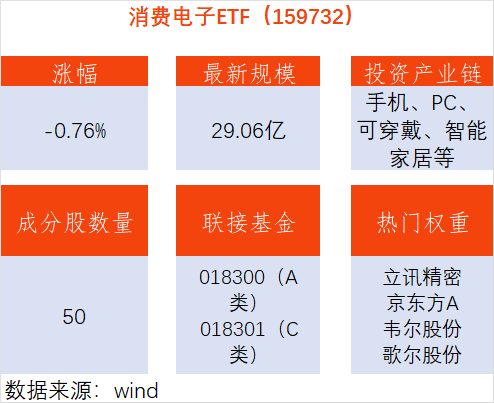
苹果AI眼镜或Q2亮相,消费电子ETF(159732)下跌0.76%,电连技术涨5.41%
Mei Ri Jing Ji Xin Wen· 2026-01-27 02:27
Group 1 - The A-share market opened on January 27 with all three major indices declining, with the Shanghai Composite Index down by 0.15% during the session [1] - The sectors showing gains included oil and petrochemicals, national defense and military industry, and banking, while the power equipment and pharmaceutical sectors experienced the largest declines [1] - In the consumer electronics sector, the Consumer Electronics ETF (159732.SZ) fell by 0.76%, with individual stocks like Xingchen Technology up by 5.73% and Deliang Technology up by 5.41%, while Huajin Technology and Lingyi Technology saw declines of -2.79% and -2.72% respectively [1] Group 2 - Recent reports indicate that Apple's AI glasses project has made significant progress and is expected to debut in the second quarter of 2026, featuring a magnesium alloy design without an integrated screen to enhance user experience [3] - The core functionality of Apple's AI glasses will rely on pairing with the iPhone, highlighting the importance of this hardware in the AI application landscape [3] - Galaxy Securities emphasizes the AI glasses as a crucial hardware category for AI applications and suggests monitoring investment opportunities within the AI glasses supply chain [3]


机械设备:3C设备周观点:苹果AI眼镜或将在2026年Q2亮相,龙头积极布局眼镜市场-20260125
Huafu Securities· 2026-01-25 05:48
Investment Rating - The industry rating is "Outperform the Market," indicating that the overall return of the industry is expected to exceed the market benchmark index by more than 5% in the next 6 months [13]. Core Insights - Apple's AI glasses project has made significant progress and is expected to officially debut in Q2 2026, utilizing magnesium alloy materials and special lenses to enhance the wearing experience, relying on integration with the iPhone for core functionalities [2]. - Meta is shifting its core strategy from the metaverse to AI wearable devices, with plans to double the annual production capacity of its AI smart glasses to 20 million units by the end of 2026, potentially increasing to 30 million based on market conditions [3]. - The smart glasses market is becoming increasingly competitive with major players like Apple, Samsung, and Xiaomi entering the field, leading to strong sales performance for products like the Ray-Ban Meta series, which saw a year-on-year sales increase of over 200% [4]. Summary by Relevant Sections - **Apple's AI Glasses**: Expected to launch in Q2 2026, focusing on a design that does not include an integrated screen and enhances user experience through its pairing with iPhones [2]. - **Meta's Strategy**: Transitioning to AI wearable devices, with a significant increase in production capacity planned for its smart glasses [3]. - **Market Dynamics**: The entry of major hardware manufacturers into the smart glasses market is intensifying competition, with notable sales growth reported for existing products [4]. - **Investment Opportunities**: Suggested focus on companies involved in smart glasses (e.g., Deep Science, Quick Intelligent), silicon-based OLED screens (e.g., Yirui Technology), and automation equipment [5].

有的发新品 有的停项目 AI眼镜赛道为何有进有退
Shang Hai Zheng Quan Bao· 2026-01-23 18:12
Group 1 - The AI glasses industry is experiencing a dichotomy between rapid product launches and project suspensions, reflecting the tension between technological prospects and commercial realities as seen with brands like Xuanjing and Vivo [1] - Major tech companies such as Google and Apple are set to release significant AI glasses products in 2026, while Vivo has reportedly halted its AI glasses project, raising discussions about the industry's future [1] - The industry faces challenges of homogenization and competition barriers, with many products lacking differentiation in performance and pricing, which may have contributed to Vivo's decision to pause its project [1][2] Group 2 - The low entry barriers and high degree of product similarity in the AI glasses market are highlighted, with a significant price range from several thousand yuan for branded AI glasses to a few hundred yuan for unbranded ones [2] - The convergence of supply chains has led to a lack of innovation in product design, resulting in a uniform appearance that fails to excite consumers [2] - To overcome hardware homogenization, a customized supply chain upgrade is necessary, which requires a substantial market volume to support the development of unique components [2] Group 3 - AI technology empowerment is becoming the core competitive advantage in the AI glasses sector, shifting the industry dynamics towards companies with strong AI capabilities like Alibaba and ByteDance [3] - The current players in the market are categorized into three groups: internet and AI model giants, smartphone manufacturers, and startup smart glasses companies, with AI model companies gaining market favor [3] - Startups are showing resilience and innovation, with companies like XREAL and Rokid presenting new products at CES 2026, focusing on niche market segments for differentiation [3] Group 4 - The AI hardware sector is expected to undergo structural changes by 2026, driven by the integration of multimodal large model technologies with hardware, which will enhance content ecosystems and application scenarios [4]
首席联合电话会-科技组
2025-12-16 03:26
Summary of Conference Call on Technology Sector Industry Overview - The conference call focused on the AI industry, particularly the development trends of AI models and their applications in various sectors, including storage, computing power, and PCB markets [1][2][3]. Key Points and Arguments AI Model Development - The trend in AI model development emphasizes enhancing intelligence density, stability, and cost efficiency under unit computing power, with domestic companies like Deepseek and Tongyi Qianwen excelling in cost optimization and open-source initiatives [1][2]. - Recent releases include Google's Gemini 3, which restructured search functionalities, and OpenAI's GPT-5.2, showing significant improvements over previous versions [2]. Productization of AI Models - AI models are increasingly being productized, with examples such as Google's Gemini 3 and the Doubao app, which utilizes operating system-level permissions for cross-app price comparisons [1][3][4]. - The Robot Taxi industry is projected to reach a market size of 100 billion RMB by 2035, with a penetration rate of 10%, indicating a shift from conceptual discussions to practical implementations [3][14]. Storage and Computing Power Trends - The AI industry is driving growth in upstream storage and computing power, with DRAM capital expenditures expected to exceed NAND, and DDR4 prices strengthening due to supply structure adjustments [1][6][7]. - TrendForce predicts DRAM capital expenditures could reach $61 billion by 2026, a 14-15% increase, while NAND is expected to grow by 5% to over $22 billion [7]. PCB Market Insights - The PCB market is currently chaotic, but investment opportunities in Google's ASIC chain are seen as stronger than those in NV chains, with recommendations for companies like ShenNan, Huadian, and Dongshan [11]. - The introduction of mid-plane designs in PCBs is expected to enhance system stability and drive demand and prices upward [9][10]. End-User Market and Future Products - The end-user market is expected to see innovative products such as OpenAI hardware and Apple AI glasses, with specific companies recommended for investment [12]. - The upcoming Siri iteration in 2026 is anticipated to enhance Apple's valuation [12]. Robot Taxi Industry Analysis - The Robot Taxi model focuses on providing a consistent user experience rather than merely competing on price, with local governments showing positive attitudes towards its development [13][14]. - The industry has transitioned from conceptual hype to practical validation, with companies like Waymo and domestic players like Xiaoma Zhixing and Wenyuan Zhixing making significant progress [15]. Autonomous Driving Technology - L4 autonomous driving technology is expected to have a short-term advantage, while L2+ technology companies like Xiaopeng Motors and Horizon Robotics may also see valuation opportunities [16][17]. Additional Important Insights - The emphasis on product design and user experience in AI applications is crucial for future competitiveness [5]. - The need for substantial storage resources in both training and inference phases of AI models highlights the importance of selecting the right stocks in the semiconductor sector [6].

3C设备周观点:三星Galaxy XR头显正式发布,阿里夸克AI眼镜开启预售:机械设备-20251026
Huafu Securities· 2025-10-26 09:50
Investment Rating - The industry rating is "Outperform the Market" [6][14] Core Insights - Samsung has officially launched its first native AI headset, the Galaxy XR, marking its entry into the extended reality (XR) field. This product is part of a long-term collaboration with Google and Qualcomm, aiming to integrate AI technology into immersive computing [1] - Alibaba's Quark AI glasses have begun pre-sales, featuring applications from various platforms and plans to open API interfaces for developers [2] - Meta's smart glasses have seen strong market demand, with nearly all retail locations sold out and trial appointments fully booked [3] - Apple is reportedly prioritizing the development of AI glasses to compete with Meta, with plans to preview the first model in 2025 and release it in 2027 [3] Summary by Sections - **Smart Glasses Market**: The report highlights the active participation of major players like Samsung, Alibaba, Meta, and Apple in the smart glasses market, indicating a growing trend and competition [1][2][3] - **Product Launches**: New products such as Samsung's Galaxy XR and Alibaba's Quark AI glasses are set to enhance the XR ecosystem and attract developer interest [1][2] - **Market Dynamics**: The report notes the competitive landscape, with significant advancements from companies like Meta and Apple, suggesting a robust future for the smart glasses segment [3] - **Investment Opportunities**: The report suggests focusing on companies involved in smart glasses, silicon-based OLED screens, panel equipment, automation assembly, and 3D printing applications [4]
3C设备周观点:三星Galaxy XR头显正式发布,阿里夸克AI眼镜开启预售-20251026
Huafu Securities· 2025-10-26 06:03
Investment Rating - The industry rating is "Outperform the Market" [6][13] Core Insights - Samsung has officially launched its first native AI headset, the Galaxy XR, marking its entry into the extended reality (XR) field. This product is the first in the Android XR ecosystem and signifies a long-term collaboration between Samsung, Google, and Qualcomm, aiming to deeply integrate AI technology into immersive computing [1] - Alibaba's Quark AI glasses have begun pre-sales, featuring a sleek black design and integration with various applications such as Amap, Alipay, Taobao, and Fliggy. Future plans include opening API interfaces to attract more developers [2] - Meta's smart glasses, Ray-Ban Display, have seen strong market demand, with nearly all retail locations sold out and trial appointments fully booked before November [3] - Apple is reportedly prioritizing the development of AI glasses to compete with Meta, with plans to preview the first model in 2025 and release it in 2027, while an originally planned display version has been accelerated [3] Summary by Sections - **Smart Glasses Market**: The report highlights the active participation of major players like Samsung, Alibaba, Meta, and Apple in the smart glasses market, indicating a growing trend and competition in this sector [1][2][3] - **Product Launches**: New products such as Samsung's Galaxy XR and Alibaba's Quark AI glasses are set to enhance the XR ecosystem and attract consumer interest [1][2] - **Market Dynamics**: The report suggests a robust demand for smart glasses, with significant sales and pre-orders indicating a positive market outlook [3] - **Investment Opportunities**: The report recommends focusing on companies involved in smart glasses, silicon-based OLED screens, panel equipment, automation assembly, and 3D printing applications, suggesting potential investment opportunities in these areas [4]
资金动向 | 北水加仓美团、中芯国际,连续3日净买入中海油
Ge Long Hui· 2025-10-24 12:36
Group 1 - Southbound funds net bought HK stocks worth HKD 34.14 billion on October 24, with notable net purchases in Meituan (HKD 6.54 billion), SMIC (HKD 6.01 billion), CNOOC (HKD 5.7 billion), Tencent (HKD 3.75 billion), Xiaomi (HKD 2.98 billion), and Alibaba (HKD 1.7 billion) [1] - Southbound funds have continuously net bought SMIC for four days, totaling HKD 17.9796 billion, and Tencent for three days, totaling HKD 9.4926 billion, as well as CNOOC for three days, totaling HKD 29.7542 billion [3] Group 2 - CNOOC's largest offshore oil and gas platform in the Beibu Gulf, the Weizhou 11-4CEPD platform, completed land engineering on October 24 and has entered the offshore installation phase, with a total weight exceeding 14,000 tons and an annual processing capacity exceeding one million tons, which will enhance the region's oil and gas self-sufficiency [4] - Alibaba launched its first self-developed Quark AI glasses on October 24, featuring dual flagship chips from Qualcomm and Hengxuan, while Apple plans to release a competing AI glasses product by the end of 2026 [4] - The Chinese government emphasized the importance of technological modernization in its 14th Five-Year Plan, aiming to enhance independent innovation capabilities and seize opportunities in the new round of technological revolution and industrial transformation [4] Group 3 - A fire incident involving a Li Auto Mega vehicle occurred on October 23 in Shanghai, with the vehicle catching fire during normal operation without prior collision or impact [5][6]





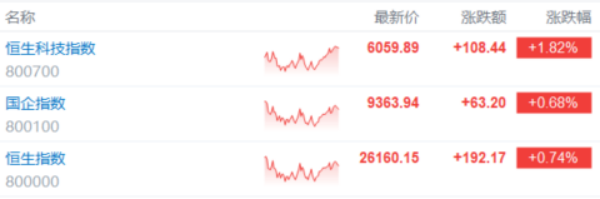
港股收评:恒指涨0.74%,半导体飙升,有色金属活跃
Ge Long Hui· 2025-10-24 08:48
Market Overview - On October 24, Hong Kong's three major indices collectively rose, with the Hang Seng Tech Index leading with a gain of 1.82%, while the Hang Seng Index increased by 0.74%, recovering the 26,000-point mark, and the State-Owned Enterprises Index rose by 0.68% [1][2] - Large technology stocks generally saw increases, with Alibaba and Kuaishou rising over 2%, and Baidu and NetEase up over 1% [1][2] Sector Performance - Semiconductor stocks performed notably well, with Hua Hong Semiconductor surging nearly 14% [1][4] - Military stocks were active, with significant gains in Chinese brokerage stocks in the afternoon session [1] - Precious metals and non-ferrous metals sectors saw collective gains, while water utilities, nuclear power, new consumption concept stocks, domestic real estate, gas, and coal sectors mostly underperformed [1] Company News - Alibaba launched its first self-developed Quark AI glasses on October 24, featuring dual flagship chips from Qualcomm and Hengxuan [3] - The Central Committee of the Communist Party of China emphasized the importance of technological modernization to support China's development during a press conference on October 24 [5] Individual Stock Movements - Hua Hong Semiconductor led the semiconductor sector with a 13.73% increase, followed by ASMPT and Center International with gains of 8.11% and 8.04%, respectively [4][6] - Military-related stocks like AVIC and Aerospace Holdings also saw increases, with AVIC rising over 4% [8] - The non-ferrous metals sector was active, with Jiangxi Copper and Luoyang Molybdenum both rising over 6% [10] Investment Trends - Southbound funds recorded a net inflow of 3.414 billion HKD, indicating strong interest in Hong Kong stocks [18] - Analysts from Guotai Junan Securities believe that if market concerns are alleviated, Hong Kong tech stocks will benefit from current industry trends, particularly with the potential return of foreign capital due to anticipated interest rate cuts by the Federal Reserve [20]