
蜜雪冰城珍珠奶茶

Search documents
1.3亿人尝鲜后,千问推“每日首单必减”:让AI点奶茶、订门票成为生活日常
Yang Zi Wan Bao Wang· 2026-02-17 11:28
Core Insights - Qianwen APP has launched a new promotional activity called "Daily First Order Discount," allowing users to enjoy a minimum discount of 3.8 yuan on their first order each day, which can be combined with existing offers from platforms like Taobao Flash Sale, Fliggy, and Damai [1][2] Group 1 - The "Spring Festival Free Order" campaign has seen unprecedented success, with over 130 million people experiencing the one-sentence ordering feature, resulting in 5 billion requests for assistance [1] - The new "Daily First Order Discount" is designed to encourage users to transition from trying the service during the holiday to regular daily use, exploring new lifestyles in the AI era [1] - The process for using the "Daily First Order Discount" is straightforward, allowing users to place orders by simply stating their requests, with automatic recommendations and discounts applied at checkout [1] Group 2 - Qianwen's C-end business group president, Wu Jia, noted that this is the first large-scale operational activity for Qianwen, and the level of user engagement exceeded expectations [2] - February 17 marks the last day to claim the "Super Free Order Card," after which users can continue to enjoy discounts through the "Daily First Order Discount," applicable to services including Taobao Flash Sale, Fliggy, Gaode, and Damai, with plans to expand to AI taxi services and mobile phone top-ups in the future [2]

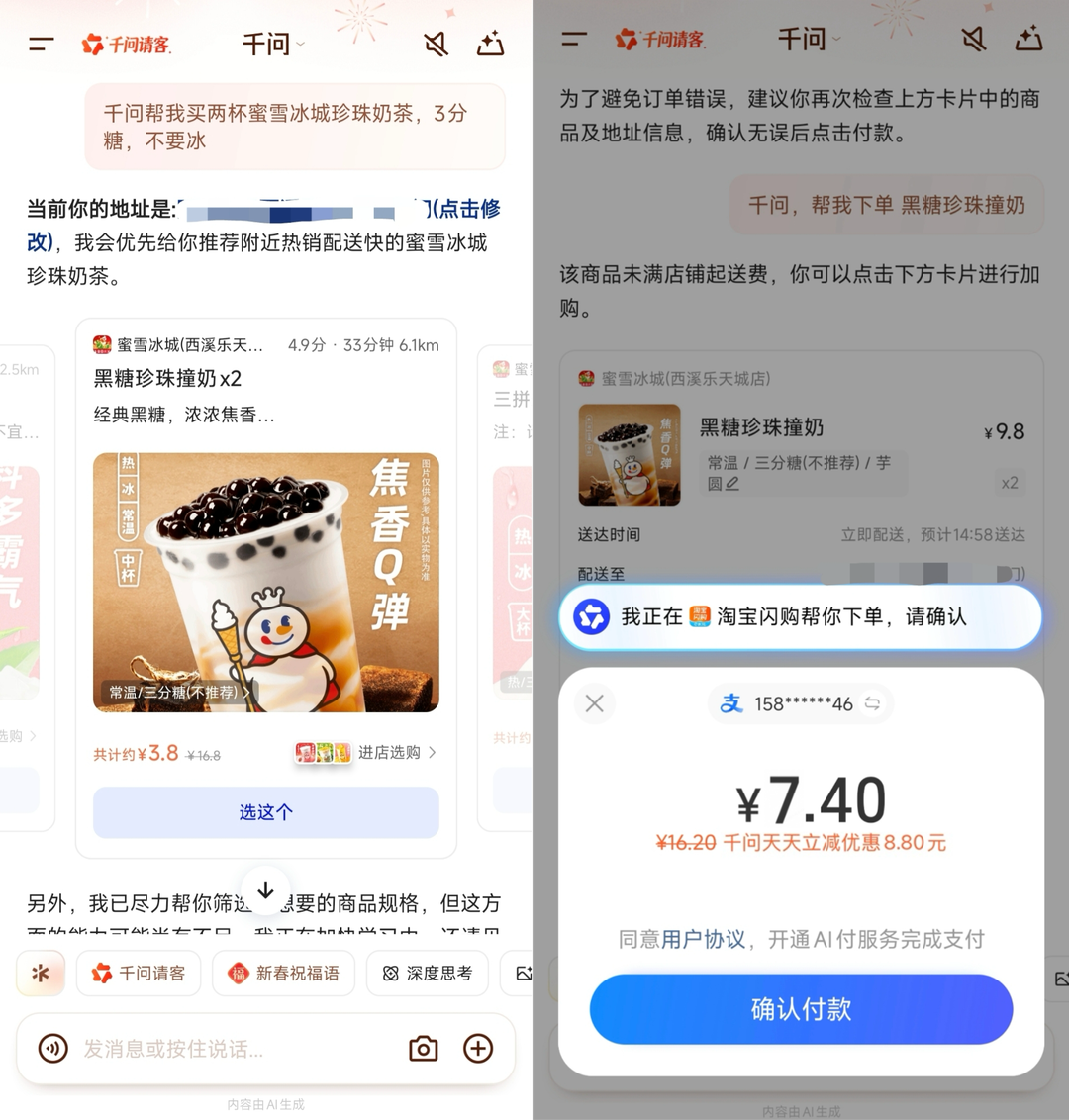
将一句话下单变成日常,千问向所有人推出“每日首单必减”
Zhong Guo Jing Ji Wang· 2026-02-17 07:52
Group 1 - The core idea of the news is that Qianwen APP has launched a new promotional activity called "Daily First Order Discount," which allows users to enjoy a minimum discount of 3.8 yuan on their first order each day, in addition to existing discounts from platforms like Taobao and Fliggy [1][4] - Over the past 10 days, the "Spring Festival Free Order" campaign has been highly successful, with more than 130 million people experiencing the one-sentence ordering feature, resulting in 5 billion instances of the phrase "Qianwen help me" being used [1] - The new discount initiative aims to encourage users to transition from trying the service during the holiday to incorporating it into their daily lives, promoting the exploration of new lifestyles in the AI era [1] Group 2 - Qianwen's C-end business group president, Wu Jia, stated that this is the first large-scale operational activity for Qianwen, and the level of user engagement exceeded expectations [4] - The "Super Free Order Card" can be claimed until February 17, after which users can continue to enjoy discounts through the "Daily First Order Discount," applicable to services including Taobao Flash Sale, Fliggy, Gaode, and Damai [4] - Future expansions of the service will include AI taxi booking, mobile phone recharge, and group buying on Gaode, indicating a strategy to integrate AI into everyday life [4]
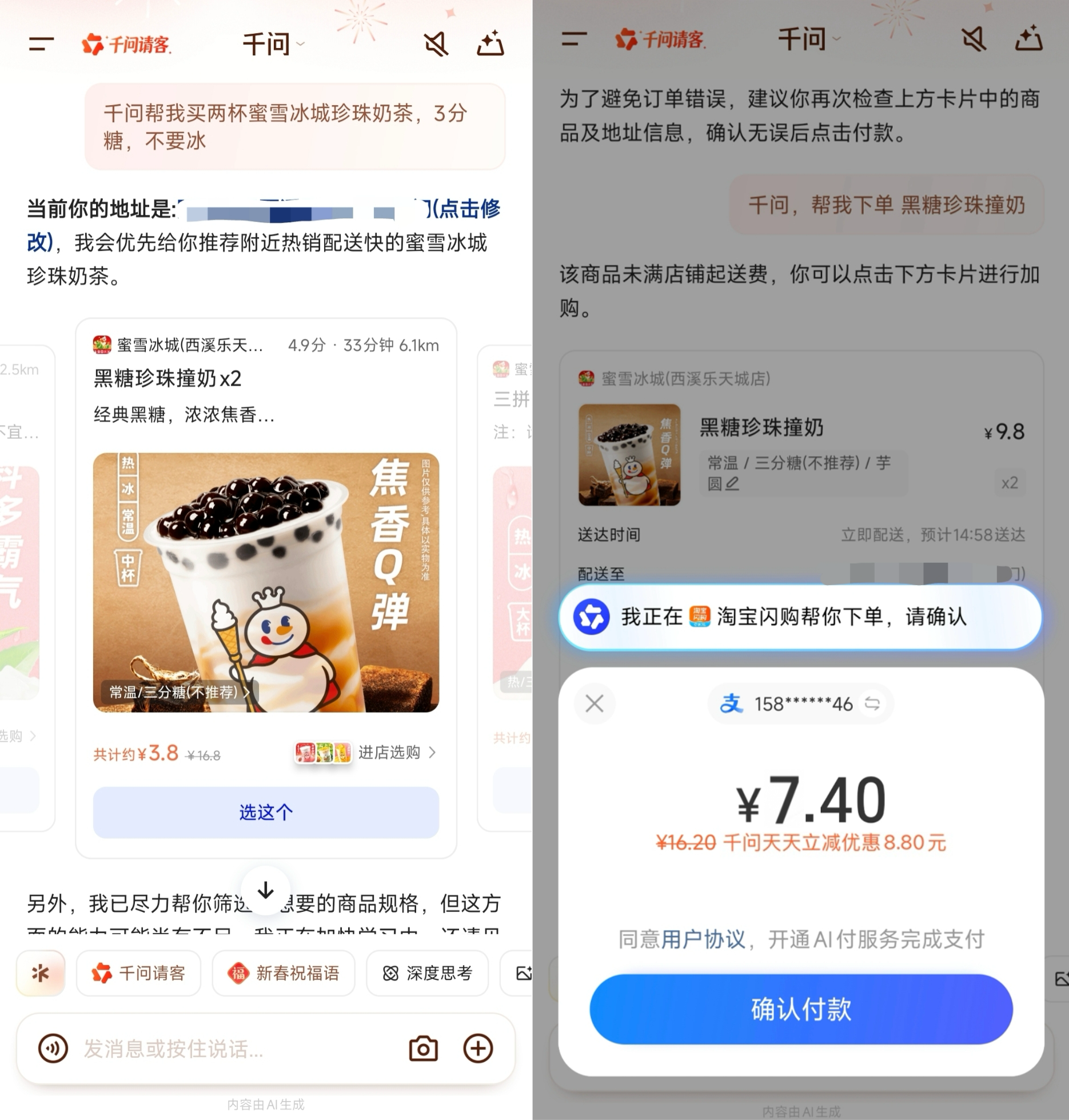
新消费2025:十大关键词,一个新江湖
3 6 Ke· 2026-01-04 02:36
Core Insights - The article highlights significant changes in the consumer market in 2025, emphasizing the emergence of new consumption patterns and the evolution of various sectors within the industry [2]. Instant Retail - Instant retail is recognized as the "explosion year" in 2025, expanding beyond food delivery to encompass a wide range of products [3]. - Major players like JD.com and Alibaba have entered the market, leading to intense competition and a subsidy war among platforms [4]. - The industry is shifting towards a more sustainable model, focusing on long-term ecological coexistence rather than short-term gains [4]. Emotional Consumption - Emotional consumption has become a key trend, driven by the desire for psychological comfort and social recognition among consumers [5]. - The market for emotional consumption in China reached 2.3 trillion yuan in 2024, with projections to exceed 4.5 trillion yuan by 2029 [5]. - Various segments, including healing products and immersive experiences, are gaining popularity, reflecting a shift in consumer preferences [6]. Reverse Tourism - There is a notable increase in tourism orders in county-level areas, with local entrepreneurs capitalizing on unique cultural experiences [7]. - The focus has shifted from traditional sightseeing to immersive local experiences, appealing to younger demographics [7]. Consumption Downward - Lower-tier cities are experiencing a surge in consumer activity, with significant growth in orders during events like Double 11 [8]. - Brands are increasingly targeting these markets, with local players gaining traction through culturally resonant products [8]. Hard Discounts - The hard discount retail sector is expanding, challenging the perception that low prices equate to low quality [11]. - Major internet companies are driving this trend, with new store formats and streamlined supply chains enhancing efficiency [11]. Light Health - Health-conscious products are becoming popular among younger consumers, with a focus on convenience and effectiveness [13]. - The market is evolving to include innovative health products that cater to the busy lifestyles of young professionals [14]. Circular Economy - The circular economy is gaining traction, with a shift in consumer attitudes towards second-hand goods and sustainability [16]. - Platforms like Xianyu and Zhuanzhuan are adapting their strategies to enhance trust and user experience in the second-hand market [17]. Pet Economy - The pet economy is experiencing rapid growth, with a market size exceeding 811.4 billion yuan and a 25.4% annual growth rate [18]. - There is a diversification of products and services catering to pet owners, reflecting a shift towards more personalized and premium offerings [18]. Value Export - Chinese brands are increasingly focusing on global markets, leveraging cultural resonance and operational efficiency to build brand loyalty [19]. - The strategy of value export is reshaping perceptions of "Made in China" and driving foreign trade growth [19]. Prepared Dishes - The prepared dishes industry is moving towards standardization and innovation, addressing consumer trust issues through transparency [20]. - Technological advancements in preservation and quality control are enhancing product offerings in this sector [20].
华与华,给蜜雪冰城帮了倒忙?
3 6 Ke· 2025-12-30 11:35
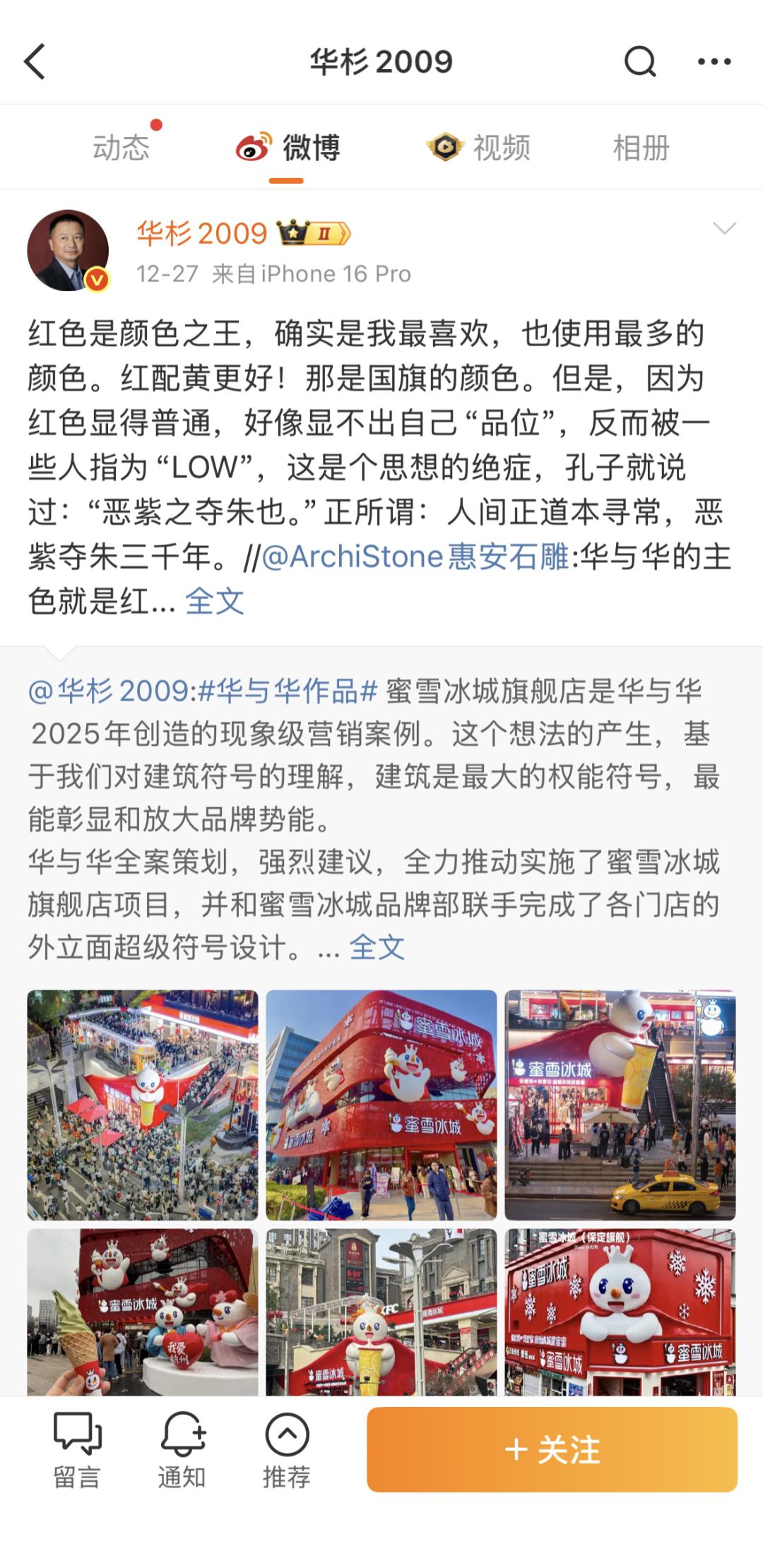
Core Viewpoint - The controversy surrounding Hua Yu Hua's design for the Mixue Ice City flagship store has sparked significant public debate, particularly regarding the aesthetic choices and branding strategies employed by the company [1][4][12]. Group 1: Controversy and Public Reaction - Hua Yu Hua's founder, Hua Shan, faced backlash after defending the design of the Mixue Ice City flagship store, attributing criticism to a misunderstanding of color usage [4][12]. - The flagship store in Hangzhou has drawn large crowds, shifting the focus from design criticism to the store's popularity and product offerings [4][5]. - Hua Shan's comments, which included references to Confucius and national pride, were perceived as dismissive of public opinion, leading to further criticism of both him and Hua Yu Hua [12][13]. Group 2: Marketing Impact and Brand Strategy - Hua Yu Hua played a significant role in elevating Mixue Ice City from a local brand to a national sensation through catchy advertising, such as the viral song "You Love Me, I Love You, Mixue Ice City Sweet" [5][21]. - Despite the controversy, the success of Mixue Ice City is attributed to its strategic management and product quality, rather than solely to advertising efforts [5][23]. - As Mixue Ice City expands internationally, there is a need for a rebranding strategy to avoid being associated with "low" aesthetics, especially in competitive markets like North America [6][28][34]. Group 3: International Expansion and Pricing Strategy - Mixue Ice City has opened approximately 4,700 stores in 13 countries, focusing on a low-cost pricing strategy to attract customers [28][30]. - The pricing of Mixue Ice City's products in the U.S. ranges from $1.19 to $4.99, significantly lower than competitors like Starbucks, which charges nearly $6 for a latte [30][31]. - However, concerns have been raised about the sustainability of this pricing model in the North American market, where consumer expectations and competition are evolving [32][34].

蜜雪冰城珍珠奶茶被送检含糖量最高 回应称没有关注
Zhong Guo Jing Ji Wang· 2025-08-26 07:58
Group 1 - The article discusses the results of a recent inspection of eight popular tea brands in China, revealing that five brands, including Heytea and Nayuki, contained trans fats, and the sugar and sodium levels were generally high [1] - The highest sugar content was found in Mixue's pearl milk tea, with a total sugar content of 7.7g/100g, translating to approximately 50.82 grams of sugar per large cup (650ml), which exceeds the daily added sugar recommendation of 50g set by the Chinese Dietary Guidelines [1] - Mixue's response to the inspection results indicated that they were not aware of the report and had no comments on the findings [1] Group 2 - Mixue Group successfully listed on the Hong Kong Stock Exchange on March 3, 2025, with an IPO price of HKD 202.50 per share, issuing approximately 17.06 million H shares, raising a total of about HKD 34.55 billion [2] - The IPO is noted as one of the most anticipated in Hong Kong in recent years, with Huatai International serving as the overall coordinator and joint bookrunner for the issuance [2]
茶咖日报|多个奶茶品牌被检出含反式脂肪酸
Guan Cha Zhe Wang· 2025-08-25 12:10
Group 1: Milk Tea Brands and Health Concerns - Multiple milk tea brands, including Heytea and Naixue Tea, were found to contain trans fats and high sugar levels, with Mixue Ice City’s pearl milk tea having 50.82 grams of sugar per 650ml, exceeding the recommended daily limit of 50 grams [1] - Heytea's roasted brown sugar bubble milk tea had a sodium content of 942mg/kg, translating to approximately 1.2 grams of salt per 500ml serving, marking it as the "salt champion" [1] - The presence of trans fats in products from several brands, including Heytea and Naixue Tea, raises health concerns, as long-term consumption is linked to increased cardiovascular disease risk [1] Group 2: Company Responses to Health Claims - Heytea responded to the health claims, stating that the detected trans fats are from natural sources in dairy products, and emphasized the use of high-quality ingredients [2] - Bawang Chaji also denied the claims, asserting that their product met national food safety standards regarding trans fat content [2] Group 3: Coca-Cola's Strategic Evaluation of Costa Coffee - Coca-Cola is considering selling its UK coffee brand, Costa Coffee, and has engaged Lazard to explore potential sale options, following its acquisition of the brand for £3.9 billion in 2018 [3] - Costa Coffee operates in 50 countries and includes a comprehensive business model with chain stores, ready-to-drink products, and coffee machines [3] - Initial bids from potential buyers may be submitted in early autumn, but the sale process remains uncertain [3] Group 4: Tea Yan Yue Se's Apology for Design Issues - Tea Yan Yue Se issued an apology for allegedly copying designs from four bloggers in their new product line, acknowledging unauthorized use of certain elements [4][5] - The company plans to establish a dedicated investigation team to address management and design oversight issues to prevent future occurrences [5] Group 5: Keurig Dr Pepper's Acquisition of JDE Peet's - Keurig Dr Pepper announced its acquisition of JDE Peet's for €15.7 billion, with plans to split into two independent companies focusing on North American beverages and global coffee [6] - The acquisition price of €31.85 per share represents a 33% premium over JDE Peet's average stock price [6] - This move is seen as a significant transformation in the beverage industry, with KDP aiming to establish itself as a global coffee leader [6] Group 6: Lucky Coffee's International Expansion - Lucky Coffee, a brand under Mixue Group, opened its first overseas store in Malaysia, selling nearly 2,000 cups on the opening day [7] - The store incorporates local cultural elements into its design and product offerings, including localized flavors like matcha lemon and strawberry iced tea [7] - Lucky Coffee has rapidly expanded in the domestic market, surpassing 7,000 signed stores by July, marking a new phase in its international growth [7]


