诊断试剂

Search documents
研判2026!中国诊断试剂行业发展历程、产业链、发展现状、竞争格局、发展趋势分析:行业规模持续上涨,产品逐渐向高端化转型[图]
Chan Ye Xin Xi Wang· 2026-02-26 01:16
Core Viewpoint - The diagnostic reagent industry in China is experiencing fluctuations in market size due to the impact of COVID-19, with a projected recovery and growth expected by 2025, reaching a market size of 140 billion yuan, an 8% increase year-on-year [6][7]. Industry Overview - Diagnostic reagents are essential tools in medicine and biology for detecting diseases, infections, and other medical conditions through interactions with biological samples [4][6]. - The market is primarily dominated by in vitro diagnostic reagents, while in vivo diagnostics remain relatively small [6]. Market Size and Trends - The market for in vitro diagnostic reagents in China has shown an upward trend since 2015, with rapid growth from 2020 to 2022 due to the pandemic, but a 14% decline in 2023 due to reduced demand for COVID-19 diagnostic reagents [6][7]. - The market is expected to recover in 2024, with projections indicating a market size of 140 billion yuan by 2025, reflecting an 8% year-on-year growth [6][7]. Competitive Landscape - The diagnostic reagent market includes both domestic companies like Mindray Medical, Antu Bio, and Wanfu Bio, and international firms such as Roche Diagnostics and Abbott, all competing for market share [8]. - Domestic companies are noted for their strong R&D capabilities and significant market presence [8]. Industry Development Stages - The diagnostic reagent industry in China has progressed through four stages: nascent, initial, extensive development, and rapid growth, with significant advancements in technology and regulatory improvements since the 21st century [5]. Industry Chain - The industry chain consists of upstream raw materials (diagnostic enzymes, antigens, antibodies, etc.), the midstream diagnostic reagent production, and downstream applications in medical institutions and third-party diagnostic organizations [6]. Market Segmentation - The in vitro diagnostic reagent market is segmented, with immunodiagnostic reagents holding a 32% market share, followed by molecular diagnostic reagents at 19%, and biochemical diagnostic reagents at 18% [7]. Future Trends - The industry is expected to focus on high-end product upgrades, with companies increasing R&D investments to enhance product value amidst price pressures from centralized procurement [9]. - There is a trend towards market penetration in lower-tier cities and global expansion, with domestic products entering emerging markets in Southeast Asia and Africa [10]. - The industry is evolving towards a model centered on clinical value and personalized medicine, integrating diagnostic solutions with treatment recommendations [11].



奋勇进取打造行业标杆
Jing Ji Ri Bao· 2026-01-29 22:11
Core Insights - The Xiamen Biopharmaceutical Port has established a complete industrial chain from R&D innovation to incubation, acceleration, and industrial parks, showcasing strong R&D and transformation capabilities in various fields such as gene engineering vaccines and high-end health products [1][2] - The industrial scale of Xiamen Biopharmaceutical Port is projected to average approximately 39 billion yuan during the 14th Five-Year Plan period, representing an over 80% growth compared to the average during the 13th Five-Year Plan [1] - The port has maintained a top 15 position in the national biopharmaceutical industrial park competitiveness ranking for seven consecutive years, entering the top 10 in 2022 [1] Policy and Service Improvements - Xiamen City has continuously optimized policies and services, facilitating the rapid formation of an innovation and entrepreneurship ecosystem, which has led to the emergence of new enterprises and business models [2] - Various supportive policies have effectively addressed issues such as clinical transformation difficulties and long hospital admission cycles, enhancing the efficiency of research and public technology service platforms [2] - The Biopharmaceutical Industry Service Center has addressed over 370 enterprise requests, deepening collaboration among government, industry, academia, and healthcare [2] Industry Growth and Talent Attraction - Over 530 biopharmaceutical companies have settled in the park, including 108 national high-tech enterprises and 9 specialized "little giant" companies [2] - The park has nurtured 4 companies listed on the Shanghai and Shenzhen stock exchanges and 12 companies in the pipeline for listing, with over 20 listed companies establishing projects in the area [2] Future Outlook - The Xiamen Biopharmaceutical Port aims to focus on five key areas: high-performance medical devices, innovative drugs, and specialty generics, while optimizing the investment and financing environment and enhancing talent retention [3]
利德曼:预计2025年全年净亏损1500万元—2800万元
2 1 Shi Ji Jing Ji Bao Dao· 2026-01-29 09:25
Core Viewpoint - Lidman is expected to report a net loss attributable to shareholders of the listed company ranging from 15 million to 28 million yuan for the year 2025, indicating a challenging financial outlook for the company [1] Financial Performance - The company anticipates a net loss of 24 million to 37 million yuan when excluding non-recurring gains and losses for the year 2025 [1] - The expected impact of non-recurring gains and losses on net profit for the current period is approximately 9 million yuan, primarily from government subsidies and fair value changes [1] - In the previous year, the impact of non-recurring gains and losses on net profit was 22.37 million yuan [1] Industry Context - The company's main business revenue and gross margin for diagnostic reagent products have declined year-on-year due to factors such as the expansion of domestic diagnostic reagent centralized procurement, further implementation of DRG/DIP policies, and intensified industry competition [1]

利德曼:预计2025年净利润亏损1500万元–2800万元
Xin Lang Cai Jing· 2026-01-29 09:17
Core Viewpoint - The company expects a net loss of 15 million to 28 million yuan for the fiscal year 2025, compared to a loss of 75.1013 million yuan in the same period last year [1] Group 1: Financial Performance - The anticipated impact of non-recurring gains and losses on net profit is approximately 9 million yuan, while the previous year's impact was 22.37 million yuan [1] - The company's main business revenue and gross margin of diagnostic reagent products have decreased year-on-year due to the expansion of domestic diagnostic reagent centralized procurement, further implementation of DRG/DIP policies, and intensified industry competition [1] Group 2: Industry Context - The industry is facing increased competition, which has contributed to the decline in the company's main business revenue and gross margin [1]
诺唯赞1月22日获融资买入165.45万元,融资余额1.23亿元
Xin Lang Cai Jing· 2026-01-23 01:40
Group 1 - The core business of the company includes research and development of functional proteins and high molecular organic materials, with a focus on biological reagents, in vitro diagnostics, and antibody drug development [2] - As of September 30, the company reported a total revenue of 952 million yuan for the period from January to September 2025, representing a year-on-year decrease of 3.40%, and a net profit attributable to shareholders of 6.6152 million yuan, down 63.57% year-on-year [2] - The company has a total of 9,447 shareholders, which is an increase of 9.90% compared to the previous period, while the average circulating shares per person decreased by 9.01% to 42,101 shares [2] Group 2 - The company has distributed a total of 731 million yuan in dividends since its A-share listing, with 611 million yuan distributed over the past three years [3] Group 3 - On January 22, the company's stock price increased by 0.70%, with a trading volume of 35.0056 million yuan [1] - The financing buy-in amount on January 22 was 1.6545 million yuan, while the financing repayment was 3.3677 million yuan, resulting in a net financing buy-in of -1.7132 million yuan [1] - The total balance of margin trading for the company as of January 22 was 123 million yuan, accounting for 1.43% of the circulating market value, which is above the 90th percentile level over the past year [1]

圣湘生物跌2.04%,成交额7828.35万元,主力资金净流出509.14万元
Xin Lang Cai Jing· 2026-01-15 03:48
Core Viewpoint - Shengxiang Bio's stock price has shown fluctuations, with a recent decline of 2.04% and a total market value of 11.663 billion yuan, while the company has experienced a year-to-date stock price increase of 6.45% [1] Financial Performance - For the period from January to September 2025, Shengxiang Bio achieved operating revenue of 1.244 billion yuan, representing a year-on-year growth of 20.49%, while the net profit attributable to shareholders decreased by 2.10% to 191 million yuan [2] - Cumulatively, since its A-share listing, Shengxiang Bio has distributed a total of 2.363 billion yuan in dividends, with 967 million yuan distributed over the past three years [3] Shareholder Information - As of September 30, 2025, the number of shareholders for Shengxiang Bio increased by 4.17% to 21,600, with an average of 26,772 circulating shares per person, which is a decrease of 4.01% [2] - Among the top ten circulating shareholders, Huabao Zhongzheng Medical ETF holds 9.8053 million shares, a decrease of 1.7872 million shares compared to the previous period, while Hong Kong Central Clearing Limited is a new shareholder with 3.6601 million shares [3] Business Overview - Shengxiang Bio, established on April 23, 2008, and listed on August 28, 2020, focuses on innovative gene technology, encompassing the research, production, and sales of diagnostic reagents and instruments, as well as third-party medical testing services [1] - The company's main revenue sources include diagnostic reagents (87.39%), diagnostic instruments (5.71%), testing services (4.55%), and other supplementary services (2.34%) [1]
“九三浙商重庆行”成功举行 渝浙推动科技创新协同发展
Zhong Guo Xin Wen Wang· 2026-01-13 11:52
Group 1 - The "93 Zhejiang Business Chongqing Tour" event was held from January 11 to 13, inviting 17 Zhejiang enterprise leaders to explore advanced fields such as intelligent manufacturing, biomedicine, and new materials in Chongqing [1] - Chongqing is accelerating the construction of a modern manufacturing cluster system called "33618," leveraging national strategies like the Chengdu-Chongqing Economic Circle and the Western Land-Sea New Corridor, with rapid growth in industries such as intelligent connected new energy vehicles and next-generation electronic information manufacturing [1] Group 2 - The delegation visited Chongqing Hikvision Technology Co., Ltd., where they learned about AI-based intelligent monitoring equipment that enhances operational management decision-making through real-time video analysis [3] - At Zhongyuan Huijie Biotechnology Co., Ltd., the delegation observed the latest in vitro diagnostic instruments and diagnostic reagent products [3] - The tour included visits to leading companies in the Liangjiang New Area, showcasing the strength of advanced manufacturing and technological innovation [3] Group 3 - During a special seminar on cooperation between Chongqing and Zhejiang, both sides discussed national strategic positioning and industrial layout, focusing on key industries such as automotive, electronic information, high-end equipment, and digital economy [5] - The efficient and pragmatic service of Chongqing government departments impressed the delegation, particularly the one-stop service platform and transparent approval processes that allow companies to focus on technological innovation [5] - There is a strong desire to establish a regular communication mechanism between the two regions to promote the implementation of collaborative outcomes, with two Zhejiang enterprises expressing intentions to invest [5]

“拐点”未至,万孚生物上市十年首现亏损,院内业务遭量价双杀
Hua Xia Shi Bao· 2026-01-12 11:12
Core Viewpoint - Wanfu Bio (300482.SZ) is expected to face its lowest annual net profit since its listing in 2015, with a projected net profit of 46 million to 69 million yuan for 2025, representing a year-on-year decline of 87.71% to 91.81% [2][3] Financial Performance - The company's net profit after deducting non-recurring gains and losses is projected to be between -15 million and -7.5 million yuan, marking a decline of 101.51% to 103.02% year-on-year [2][3] - For the first three quarters of 2025, Wanfu Bio reported total revenue of 1.689 billion yuan, a year-on-year decrease of 22.52%, and a net profit of 133.74 million yuan, down 69.32% [4][6] - The gross profit margin for the first three quarters of 2025 was 60.3%, down 3.13 percentage points year-on-year, while the net profit margin was only 7.48%, down 12.68 percentage points [5] Reasons for Decline - The decline in revenue is attributed to shrinking domestic business income due to VAT rate adjustments and pressure on hospital business from medical industry policies [4][7] - The drop in net profit is influenced by three main factors: declining gross margins due to price reductions and product structure changes, high R&D and sales expenditures, and impairment losses from divesting non-core, low-profit businesses [4][7] Industry Context - Wanfu Bio's performance reflects broader challenges in the in vitro diagnostics (IVD) industry, which is experiencing a downturn as the benefits from the COVID-19 pandemic fade [8] - The IVD industry is currently in a consolidation phase, with ongoing pressures from policy changes and pricing strategies affecting demand and profitability [8] Strategic Adjustments - The company has decided to pause the construction of its "Knowledge City Production Base" project to avoid resource waste and control costs, indicating a strategic shift in response to changing internal and external conditions [9][10] - Wanfu Bio aims to enhance cash flow and strategic flexibility through this pause, which is seen as a prudent move rather than a sign of financial distress [10] Future Outlook - The company is focusing on innovation and AI-driven strategies to transition its business from point-of-care (POC) to IVD, with hopes for significant business improvement in 2026 [10]


多笔里程碑款项到账,中国创新药“兑现价值” ,1.5万亿美元大市场加速成长
Jin Rong Jie· 2026-01-12 00:44
Group 1 - The core viewpoint of the articles highlights the acceleration of innovation in the biopharmaceutical sector in Guangzhou, focusing on monoclonal antibodies, vaccines, blood products, and diagnostic reagents, aiming for high-end and international development [1] - By 2025, the total value of China's innovation drug license-out transactions is expected to reach $135.655 billion, with an upfront payment of $7 billion and a total of 157 transactions, significantly surpassing the 2024 figures of $51.9 billion and 94 transactions [1] - The collaboration between Bai Li Tian Heng and Bristol-Myers Squibb (BMS) resulted in a milestone payment of $250 million, setting a record for domestic ADC projects, while other partnerships are also expected to yield substantial payments [1] Group 2 - The National Medical Products Administration reports that by the first half of 2025, China's innovation drug license-out transaction scale is nearing one-third of the global market, with 210 innovative drugs approved during the "14th Five-Year Plan" period [2] - The "15th Five-Year Plan" suggests that specialized funds for cell therapy and gene editing will exceed 30 billion yuan, indicating a strong future for these sectors [2] - The domestic innovation drug market is projected to grow, with the share of overseas revenue increasing from 15% in 2025 to 30% by 2030, contributing to a new growth driver for the industry [2]
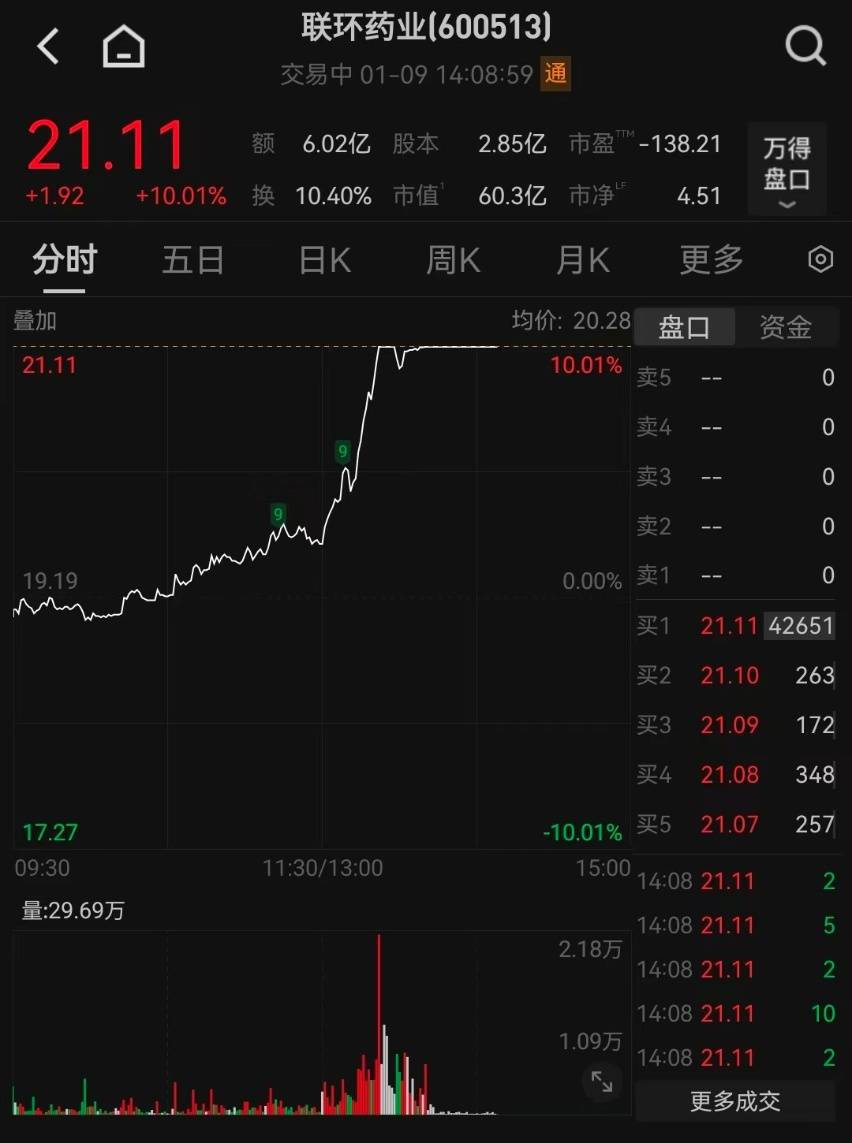
个股异动 | 联环药业涨停 广州出台规划加速创新药物战略布局
Sou Hu Cai Jing· 2026-01-09 07:05
Core Viewpoint - Lianhuan Pharmaceutical experienced a stock price surge, reaching the daily limit on January 9, indicating strong market interest and potential investor confidence in the company [1]. Group 1: Company Overview - Lianhuan Pharmaceutical's primary business encompasses pharmaceutical manufacturing and distribution [3]. Group 2: Industry Developments - The Guangzhou Municipal Government has issued a plan titled "Guangzhou Accelerates the Construction of an Advanced Manufacturing Powerhouse (2024-2035)," which emphasizes the acceleration of innovative drug strategies and the development of monoclonal antibodies, vaccines, blood products, and diagnostic reagents in the biopharmaceutical sector [3]. - The plan aims to address major health issues and advance cutting-edge biotechnologies, targeting breakthroughs in gene engineering, new drug targets and mechanisms, synthetic biology, and bioinformatics [3]. - Leveraging the unique advantages of Lingnan traditional Chinese medicine, the initiative seeks to promote the standardization and internationalization of traditional medicine, creating a comprehensive industrial chain from raw materials to pharmaceuticals [3]. - By 2035, the goal is to establish a leading position in the biopharmaceutical and high-end medical device industries, with an industrial scale reaching 500 billion [3].