通义系列大模型

Search documents
阿里云深度-AI驱动下的全栈布局与全球扩张机遇
2026-01-15 01:06
Summary of Alibaba Cloud Conference Call Industry and Company Overview - **Company**: Alibaba Cloud - **Industry**: Cloud Computing and AI Key Points and Arguments 1. **Development Stages of Alibaba Cloud**: Alibaba Cloud has gone through four stages: - 2009-2013: Technical breakthrough with over 5,000 servers in operation - 2014-2017: Commercial expansion with revenue growth of 20 times - 2018-2022: Accumulation of hardware and foundational technology assets - 2023-present: "AI-driven, public cloud first" strategy leading to a recovery in growth to 34.5% [2][3] 2. **Organizational Structure**: As of the end of 2023, Alibaba Cloud is structured into three main areas: public cloud, private cloud, and international business, with leadership roles clearly defined [3] 3. **Main Competitors**: In the AI era, Alibaba Cloud's primary competitor is ByteDance's Volcano Engine, with competition in large models, cloud infrastructure, ecosystem applications, and international markets [4] 4. **Characteristics of Tongyi Series Models**: The Tongyi series models have four key features: - Steady iteration every six months - Rich ecosystem covering various fields - Diverse parameters ranging from 0.5 billion to trillion levels - Dual-track approach of open-source and closed-source [5] 5. **C-end Layout**: Alibaba has restructured its C-end layout, including the renaming of Tongyi APP to Qianwen APP and the establishment of a C-end business group, integrating various AI applications and traditional business transformations [7] 6. **Infrastructure Advantages**: Alibaba Cloud operates in 29 public cloud regions and 92 availability zones, with significant advantages in the Asia-Pacific region and ongoing international data center expansions [9] 7. **Capital Expenditure Plans**: Alibaba plans to invest 380 billion RMB in capital expenditures over the next three years, with annual CAPEX expected to exceed 160 billion RMB from FY25 to FY28 [10] 8. **Self-developed Hardware Progress**: The latest AI server release has garnered attention, with successful projects showcasing Alibaba's self-developed chips and their competitive edge in the market [11] 9. **Open-source Ecosystem Support**: Alibaba supports enterprise clients through its "Bailian" model service platform, which has seen a 15-fold increase in daily usage, enhancing user experience and facilitating customized solutions [12] 10. **Domestic Business Expansion Strategy**: Alibaba Cloud's domestic strategy includes deepening relationships with large clients through benchmark cases, marketplace strategies with partners, and leveraging GPU resources to maximize client value [14] 11. **International Business Expansion**: Since 2025, Alibaba has established new data centers in multiple countries and accelerated AI product internationalization, serving over 220,000 Chinese enterprises abroad [15][16] 12. **Revenue Growth Expectations**: Revenue is expected to grow over 30% from FY25 to FY28, driven by AI and international market expansion, with AI market growth projected at 45% [17][18] 13. **Profit Margin Outlook**: Despite increased capital expenditures leading to higher depreciation costs, Alibaba Cloud aims to maintain stable profit margins, with an expected EBITDA margin of 15% by FY28 [19] 14. **Valuation and Target Price**: Alibaba is valued at approximately 1.7 trillion RMB based on a 27x PS ratio, with a target price of $204 per share [21] 15. **Competitive Landscape in AI**: Alibaba's open-source models cater to security-sensitive clients, while ByteDance's closed-source models limit accessibility, creating distinct competitive barriers [22] 16. **Valuation of Alibaba's Ecosystem**: The valuation of Alibaba's ecosystem could reach significant multiples, with potential for increased revenue and profit growth from AI applications and international business [23][24] 17. **Differences in Development Strategies**: ByteDance's aggressive investment in GPU resources contrasts with Alibaba's approach, which focuses on leveraging existing infrastructure and partnerships [25] 18. **AI Private Cloud Deployment Trends**: Chinese medium to large enterprises prefer private cloud deployments for data compliance, often choosing Alibaba's open-source models for their flexibility and resource availability [27]

大模型时代小公司,怎么走出OpenAI的路
新财富· 2026-01-14 08:05
Core Insights - The article discusses the recent IPOs of AI companies, highlighting the significant oversubscription rates and initial stock price surges, indicating strong market interest in AI ventures [3][5] - It emphasizes the challenges faced by AI startups in a landscape dominated by major tech firms like Tencent, ByteDance, and Alibaba, suggesting that these giants create a difficult environment for smaller companies to thrive [7][15] Group 1: Market Dynamics - The IPO of Zhihua Huazhang on January 8, 2026, had an issue price of HKD 116.2 per share, with a subscription rate of approximately 1,159 times, and a first-day price increase of 13.17%, leading to a market cap of nearly HKD 90 billion [3] - MiniMax, established only four years prior, went public on January 9, 2026, at HKD 165 per share, with an oversubscription of over 1,800 times and a first-day price increase of 109.1%, resulting in a market cap exceeding HKD 100 billion shortly thereafter [5] Group 2: Technological Paradigms - The article argues that the current AI landscape is shaped by the "Scaling Law," which suggests that increasing model size, data, and computational power leads to predictable improvements in performance [9][10] - It notes that the success of OpenAI is seen as a unique historical occurrence that may not be replicable, as the current environment is characterized by concentrated computational resources and homogenized model capabilities [12][13] Group 3: Competitive Landscape - The emergence of DeepSeek has altered industry perceptions by significantly reducing training and inference costs, challenging the narrative that only large investments can yield viable models [19][22] - Major companies are now treating models as foundational infrastructure rather than profit centers, which complicates the ability of startups to justify their value propositions to clients [22][23] Group 4: Strategies for Startups - Startups like MiniMax and Zhihua Huazhang are finding sustainable paths by avoiding direct competition with large firms, focusing instead on niche markets or specific applications [26][30] - MiniMax is targeting overseas markets with products centered on companionship and interaction, while Zhihua focuses on complex enterprise applications that larger firms may overlook [28][31] - The article suggests that successful startups must carve out unique positions within existing paradigms rather than attempting to replicate the success of giants like OpenAI [42]


赛博炒股时代来了,股票成为“千问第一问”
美股研究社· 2025-12-22 13:45
Core Insights - The article highlights the growing trend of AI applications in various fields, particularly in stock trading, where users are increasingly turning to AI as a "personal investment advisor" [3][5][8] - The rise of AI in decision-making processes reflects a shift in societal roles and knowledge barriers, with AI emerging as a low-cost, fast-feedback alternative to traditional professionals [6][9] Group 1: AI's Role in Investment - "Stocks" emerged as the top query in AI applications, indicating a high frequency of investment decisions that are often solitary and prone to immediate regret [10][11] - AI systems are perceived to provide objective, data-driven analyses, contrasting with human investors who may be influenced by anxiety and irrational behavior [11][22] - A recent competition demonstrated that AI can outperform human traders, achieving a 22.32% return in a 17-day trading period [15][22] Group 2: AI's Impact on Traditional Professions - The article discusses the potential disruption of traditional roles such as stock analysts, lawyers, and psychologists by AI, which can provide professional-level insights at a lower cost [6][31] - AI's ability to process information and execute strategies is advancing from mere information handling to professional service execution, marking a new era in financial services [28][31] - The integration of AI into financial institutions is accelerating, with major players like China UnionPay partnering with Alibaba Cloud to develop AI models for financial applications [25][27] Group 3: Future of Human Analysts - While AI is set to take over routine data processing tasks, the role of human analysts will evolve to focus on providing emotional value and understanding clients' deeper financial goals [33][34] - The collaboration between AI and human analysts will redefine the value proposition in financial advisory, emphasizing the need for enhanced psychological and communication skills among analysts [33][34] - The article concludes that while AI will handle technical aspects of investment, humans will still be responsible for addressing the philosophical questions surrounding wealth and its significance in life [36]

广汽集团与阿里云合作升级:签署全栈AI协议,将基于通义打造专属大模型
Feng Huang Wang· 2025-11-14 12:41
Core Insights - GAC Group and Alibaba Cloud have signed a comprehensive AI strategic cooperation agreement to enhance technology collaboration in the automotive industry [1] - The partnership aims to integrate GAC's experience in vehicle R&D and smart manufacturing with Alibaba Cloud's cloud infrastructure and AI models [1] Infrastructure Development - GAC Group will utilize Alibaba Cloud's high-performance computing and cloud products to build a flexible cloud architecture [1] - This new architecture will support GAC's core business systems and provide foundational technology for smart driving, intelligent cockpits, vehicle networking, and global services [1] AI Application - GAC plans to develop a proprietary enterprise-level AI model based on Alibaba Cloud's Tongyi series [1] - The integration of AI aims to enhance business processes, including complex multimodal interactions in intelligent cockpits and AI knowledge assistants for sales [1] - The goal is to improve operational efficiency and user experience across all business scenarios [1] Previous Achievements - Since May 2021, GAC and Alibaba Cloud have successfully reduced model training time by 50% and data processing cycles from weekly to daily [2] - The collaboration has also led to a 50% reduction in data costs for GAC's Middle East vehicle networking platform, with vehicle network latency reduced to 2-3 seconds [2]

广汽集团与阿里云签署全栈AI战略合作协议
Zheng Quan Shi Bao Wang· 2025-11-14 11:11
Core Viewpoint - GAC Group has signed a comprehensive AI strategic cooperation agreement with Alibaba Cloud to develop an AI-driven full-chain system covering research and development, production, marketing, management, and user services [1] Group 1 - The agreement leverages GAC's deep expertise in vehicle research and development and intelligent manufacturing [1] - Alibaba Cloud will provide its leading cloud infrastructure and Tongyi series large models to support the initiative [1]
西贝回应闭店属正常经营行为;阿里巴巴与万豪国际集团达成战略合作|未来商业早参
Mei Ri Jing Ji Xin Wen· 2025-11-11 23:07
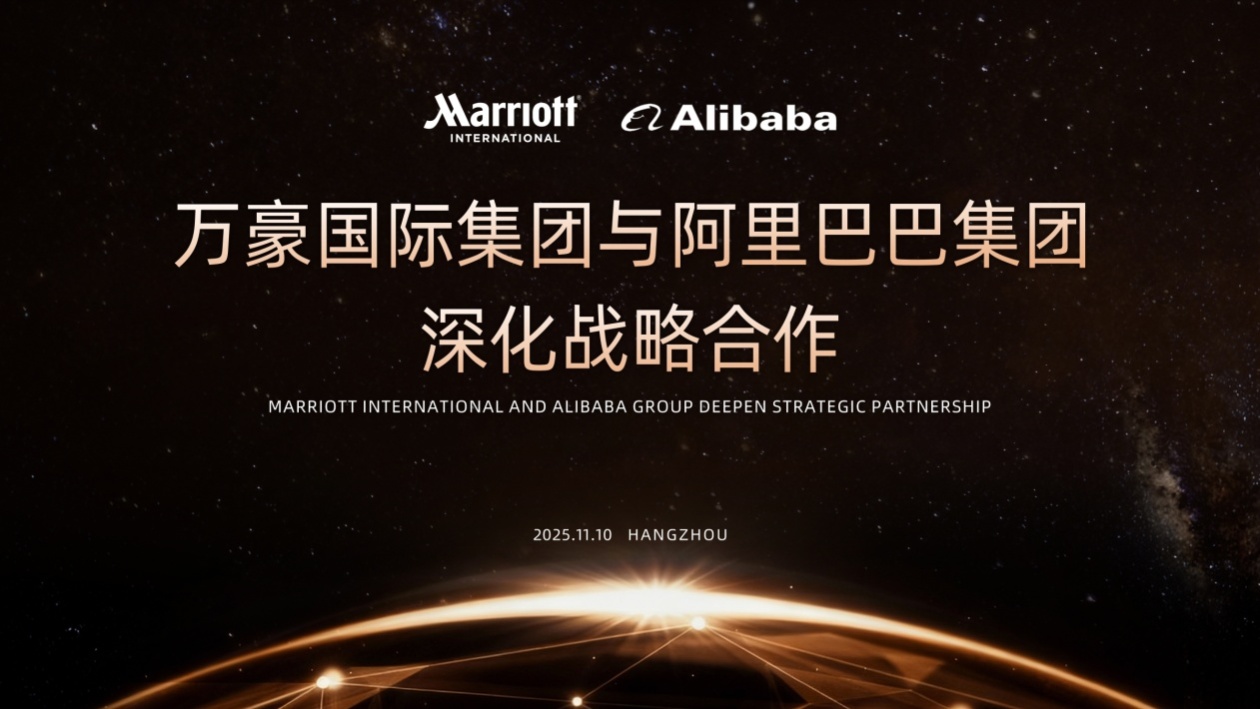
Group 1: Alibaba and Marriott International Strategic Cooperation - Alibaba Group and Marriott International announced a strategic AI cooperation focused on cloud infrastructure and AI application innovation in the Chinese market [1] - Marriott will integrate Alibaba's Tongyi series large models to enhance customer service and marketing through intelligent upgrades [1] - The partnership aims to establish an innovation mechanism for AI applications in hotel scenarios, with a pilot AI smart application set to launch at the Fliggy Marriott flagship store by 2026 [1] Group 2: Xibei's Store Adjustments - Xibei stated that opening and closing stores is a normal operational behavior in the restaurant industry, with dynamic adjustments based on business conditions [2] - Recent store closures in cities like Shenzhen, Shantou, and Yiwu are part of this normal adjustment process, while new stores have also opened in Harbin and Jinan [2] - The domestic restaurant market is experiencing polarization, with consumers favoring options that balance cost-effectiveness and experience, while high costs are forcing restaurants to optimize their store layouts [2] Group 3: ByteDance's Stake in Zhongtong Express - ByteDance denied rumors of becoming a new shareholder in Zhongtong Express, clarifying that it made a small investment in the company back in 2021 with a low shareholding ratio [3] - The recent increase in registered capital from 420 million to approximately 600 million yuan is attributed to internal structural adjustments within Zhongtong Express [3] - The core competitiveness of companies in the industry should focus on "network, efficiency, and service," with external capital being supportive but not decisive [3]


阿里巴巴与万豪国际集团达成战略合作 用AI创新升级用户体验
Zheng Quan Ri Bao· 2025-11-11 04:13
Core Insights - Alibaba and Marriott International have announced a strategic AI collaboration aimed at enhancing personalized travel experiences in the Chinese market [1][2] - The partnership will leverage Alibaba Cloud's infrastructure and data products to support Marriott's business growth and operational efficiency [1] - Initial focus will be on AI applications in customer service and marketing, with plans to pilot AI smart agent applications by 2026 [1][2] Group 1 - The collaboration represents an upgrade of their existing partnership, focusing on the integration of AI technology into various applications [1] - Marriott will utilize Alibaba's leading cloud infrastructure to build a robust technological foundation for the AI era [1] - The partnership aims to transition from "passive response" to "proactive anticipation" in service delivery [1] Group 2 - Marriott will strengthen supply chain cooperation with Alibaba to enhance service consistency and competitiveness across its platforms [2] - The collaboration will support Marriott's smart marketing initiatives and explore new growth opportunities in the Chinese market [2] - The partnership builds on a previous strategic collaboration established in 2017, which included the formation of a joint venture [2] Group 3 - Marriott and DingTalk will explore the feasibility of using AI to enhance hotel staff efficiency for better guest service [3] - The collaboration aims to create personalized travel experiences by leveraging AI for intelligent recommendations and customized planning [3] - Alibaba's CEO expressed the goal of utilizing the company's full-stack AI technology to innovate consumer experiences in the hotel industry [3]
阿里巴巴与万豪国际集团达成AI战略合作 以AI重塑旅宿体验
Zheng Quan Shi Bao Wang· 2025-11-11 03:19
Core Insights - Alibaba Group and Marriott International announced a strategic AI partnership focused on enhancing personalized travel experiences in the Chinese market [1][2] - The collaboration aims to accelerate the integration of AI technology and application scenarios, with Marriott adopting Alibaba Cloud's infrastructure and data products to improve operational efficiency [1] - Initial efforts will concentrate on the Chinese market, with plans to explore broader cooperation areas in the future [1] Group 1: AI Integration and Applications - Marriott will integrate Alibaba's Tongyi series large models to upgrade customer service and marketing processes [1] - An innovative mechanism will be established to support AI applications in hotel scenarios, with a pilot AI smart agent set to launch in 2026 at the Fliggy Marriott flagship store [1] - The AI smart agent will provide personalized itinerary suggestions, enhancing booking efficiency and digital experiences, transitioning from "passive response" to "proactive anticipation" in service [1] Group 2: Supply Chain and Marketing Collaboration - Marriott will strengthen supply chain cooperation with Alibaba to enhance service advantages across official channels, ensuring consistency in pricing, benefits, and membership services [2] - The partnership will leverage a joint venture to support intelligent marketing initiatives in the Chinese market and explore new growth opportunities [2] - Marriott's CEO emphasized the importance of combining Alibaba's digital and AI strengths with Marriott's member ecosystem to create personalized travel experiences [2]
阿里巴巴与万豪国际集团官宣 将在AI应用创新等领域深度合作
Huan Qiu Wang· 2025-11-11 02:58
Core Insights - Alibaba Group and Marriott International have announced a strategic AI partnership aimed at enhancing personalized travel experiences in the Chinese market [1][3] Group 1: Partnership Overview - The collaboration is an upgrade of their existing relationship, focusing on the integration of AI technology and applications [3] - Marriott will utilize Alibaba Cloud's advanced cloud infrastructure and data products to support business growth and operational efficiency [3] Group 2: Application and Innovation - Initial efforts will concentrate on the Chinese market, with plans to explore broader cooperation areas [3] - Marriott will integrate Alibaba's Tongyi series large models to enhance customer service and marketing processes [3] - A pilot AI application is set to launch in 2026 at the Fliggy Marriott flagship store, providing personalized itinerary suggestions to improve booking efficiency and digital experience [3] Group 3: Supply Chain and Marketing - The partnership will strengthen supply chain collaboration, ensuring competitive pricing and service consistency across platforms like Fliggy and Marriott Bonvoy App [3] - Both companies will leverage a joint venture to enhance smart marketing efforts in the Chinese market and explore new growth opportunities [3] Group 4: Leadership Statements - Marriott's CEO emphasized the focus on guest needs and the goal of creating personalized travel experiences through AI [4] - Alibaba's CEO expressed the intention to leverage the company's full-stack AI technology to innovate consumer experiences in the hotel industry [4]
重投AI,阿里起飞
雷峰网· 2025-08-29 14:25
Core Viewpoint - Alibaba has significantly increased its investment in AI, with over 100 billion yuan spent in the past four quarters, demonstrating its commitment to the AI sector and dispelling market concerns about reduced investment [2][3]. Group 1: Financial Performance - In Q1 of FY2026, Alibaba's AI and cloud capital expenditure reached 38.6 billion yuan, a year-on-year increase of 220%, marking a new quarterly high [2]. - Alibaba Cloud's revenue growth accelerated to 26%, the highest in three years, driven by AI-related products, which have seen triple-digit year-on-year growth for eight consecutive quarters [2][3]. - AI revenue now accounts for over 20% of external commercialization revenue [2]. Group 2: AI Strategy - Alibaba's AI strategy focuses on a full-stack approach, integrating capabilities across various layers, including computing power, cloud, models, and applications, similar to Google's strategy [5][6]. - The company plans to invest 380 billion yuan in cloud and AI hardware infrastructure over the next three years, surpassing the total investment of the past decade [6]. Group 3: Global Infrastructure and Model Development - Alibaba Cloud has launched eight new AI and cloud data centers in various regions, with plans to expand to 30 regions and 95 availability zones by the end of the year [7]. - The company has developed a series of advanced AI models, achieving multiple global open-source championships and significant downloads, with over 300 models released and more than 400 million downloads [10]. Group 4: AI Applications - Alibaba is integrating AI across its various business units, with initiatives like DingTalk's new AI-driven office system and the launch of Gaode Map 2025, which features an AI assistant for personalized travel planning [14][16]. - The introduction of the RecGPT model on Taobao aims to enhance user experience and efficiency, resulting in over 5% increases in user engagement metrics [19]. Group 5: Long-term Vision - Alibaba's long-term commitment to AI is characterized by substantial investments in model development and open-source initiatives, positioning the company as a leader in the AI ecosystem [21][22].