
通胀保值国债(TIPS)

Search documents
“抛售美国”谎言破灭?外国资金回流美债,获配比例飙升至近三年新高!
Jin Shi Shu Ju· 2026-02-11 03:07
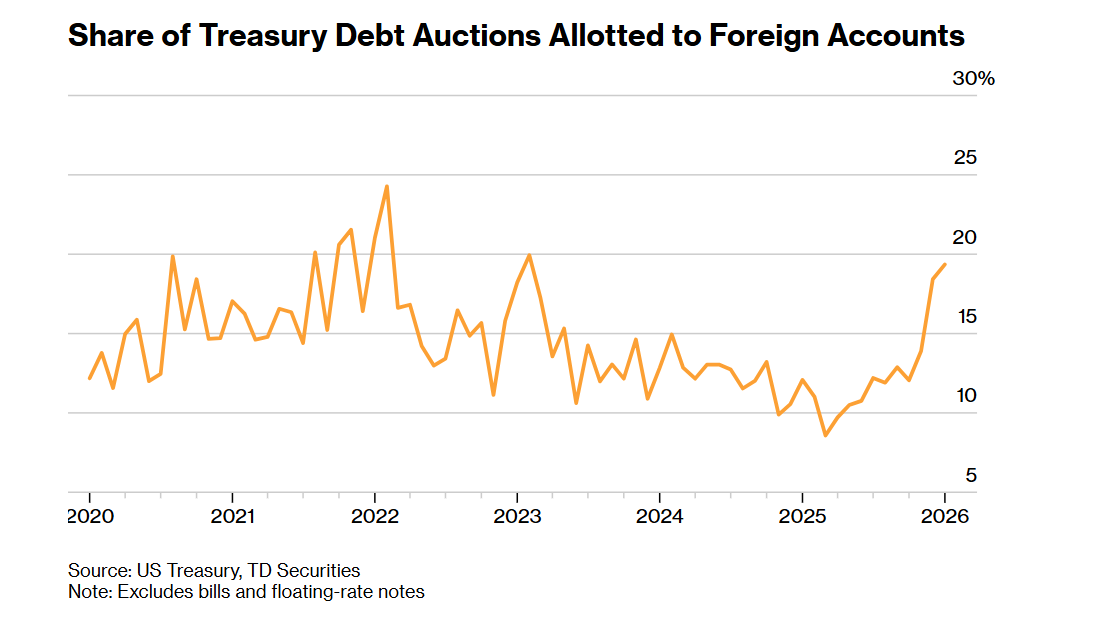
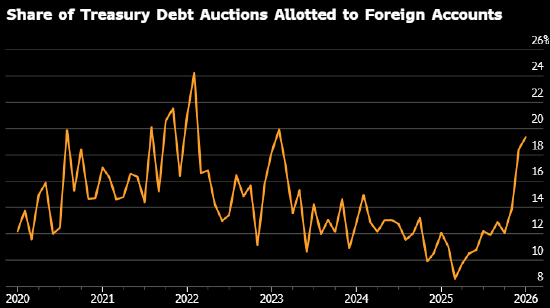
Group 1 - The core viewpoint of the article highlights that the allocation ratio of foreign buyers in U.S. Treasury auctions has been increasing, alleviating concerns about the loss of the safe-haven status of U.S. Treasuries and the impact of large fiscal deficits on foreign investments [1][4] - According to TD Securities' analysis, in January, the allocation ratio for foreign and international accounts in Treasury auctions reached approximately 19%, marking a three-year high. This ratio had previously peaked at nearly 25% in early 2022 but declined to below 10% by November 2024 [1][4] - The report indicates that the increase in foreign account allocations is broad-based, suggesting that the narrative of a "sell America" trend may be more of a market story than reality [4] Group 2 - Despite a significant sell-off of $53 billion in U.S. Treasuries by foreign investors following tariff announcements in April 2025, they subsequently increased their holdings by $354 billion by November of the same year [4] - The participation of foreign investors in Treasury auctions notably increased in November and December, driven by the expansion of the term premium, which is the additional yield of 10-year Treasuries over shorter-term bonds [4][6] - The upcoming auction of $58 billion in three-year Treasuries and the issuance of 10-year and 30-year bonds may further influence foreign investment behavior, as a lack of alternative assets could compel investors to continue holding U.S. dollar assets [7]

道明证券称外资对美债需求稳健 “抛售美国”更多是叙事而非现实
Xin Lang Cai Jing· 2026-02-10 22:02
Core Viewpoint - Foreign buyers have increased their participation in U.S. medium- to long-term Treasury auctions, alleviating market concerns about the loss of safe-haven status and the potential withdrawal of overseas funds due to large fiscal deficits [1][5]. Group 1: Foreign Participation in Treasury Auctions - In January, foreign and international accounts accounted for approximately 19% of allocations in U.S. Treasury auctions, marking the highest level in nearly three years [1][5]. - This participation rate had previously peaked at nearly 25% in early 2022 but fell to below 10% by November 2024 [1][5]. Group 2: Market Sentiment and Investor Behavior - Analysts from TD Securities suggest that the narrative of a "sell-off of America" is more of a story than reality, as data indicates foreign investors have been increasing their holdings [3][8]. - After a sell-off of $53 billion in U.S. Treasuries following tariff announcements in April 2025, foreign investors subsequently increased their holdings by $354 billion by November [8]. Group 3: Factors Influencing Investment Decisions - The increase in foreign participation in Treasury auctions during November and December indicates that the widening term premium—additional yield offered by 10-year Treasuries compared to shorter-term bonds—has been a driving factor [8]. - The lack of alternative assets may be compelling investors to set aside concerns temporarily, with a weaker dollar suggesting that foreign investors are continuing to accumulate dollar-denominated assets while hedging against currency risks [10].
通胀担忧再起!全球资管巨头“未雨绸缪”:贝莱德做空国债,PIMCO增持TIPS
Zhi Tong Cai Jing· 2026-02-01 23:44
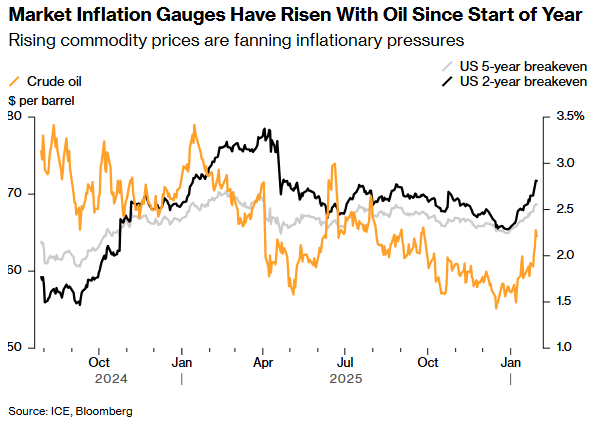
Group 1 - BlackRock, Bridgewater, and PIMCO are adjusting their portfolios to guard against a new wave of inflation, with BlackRock establishing short positions in US Treasuries and UK investment-grade bonds, while Bridgewater favors stocks over bonds, and PIMCO looks at Chinese bonds that offer inflation-adjusted yields for protection [1] - There are increasing signs that concerns about inflation are justified, as the yield spread between regular Treasuries and Treasury Inflation-Protected Securities (TIPS) has widened sharply, reaching its highest level in months, and inflation swap rates have also risen [1] - The expectation of a strong US economy reigniting price growth is heightened by the recent nomination of Kevin Warsh as the next Federal Reserve Chair, which could lead to faster or larger rate cuts if he aligns with President Trump's desires [1] Group 2 - UBS's senior trader Ben Pearson believes that the "inflationary boom" led by the US is the most underestimated risk for investors this year, potentially causing the Fed to remain inactive in the first half of the year and forcing the market to adjust to rate hike expectations in the second half [4] - Standard Bank's G-10 strategist Steven Barrow predicts that if the White House's desire for rate cuts is thwarted, the yield on 10-year Treasuries could soar from around 4.25% to 5% [4] - The situation presents challenges for Warsh, who, if confirmed by the Senate, will take over in May when Jerome Powell's term ends, as investors must weigh Warsh's hawkish reputation on inflation against his willingness to meet Trump's rate cut demands [4] Group 3 - The cautious stance of these fund managers contrasts sharply with the broader market belief that inflation, which had previously weighed on bond returns post-pandemic, is now largely under control [5] - In the Eurozone, investors generally believe that price growth will stabilize at or slightly below target levels, despite long-term inflation expectations rising alongside US indicators [5] Group 4 - The outlook in the UK is more uncertain, with recent positive economic data prompting traders to reassess the pace of potential rate cuts, reducing the probability of a second cut this year to about 50% [6] - In Australia, persistent domestic price growth has led traders to increase bets on a rate hike, marking a significant policy shift less than six months after the last cut [6] Group 5 - Diverging views among global investors are most pronounced regarding the US economy, with some, like Amova's Steven Williams, believing price pressures are easing and predicting the Consumer Price Index (CPI) could fall below 2% before summer [7] - Conversely, Lazard's CEO Peter Orszag argues that a rise in US inflation above 4% by year-end is not only possible but the most likely scenario [7] Group 6 - The current environment for predicting inflation is filled with uncertainty due to renewed tariff tensions and the rapid development of emerging technologies, alongside geopolitical threats impacting oil prices and industrial metals [10] - The Fed's recent decision to maintain interest rates signals that inflation remains "somewhat elevated," presenting a challenging task for Warsh to either justify rate cuts or suggest necessary hikes [10] Group 7 - Bridgewater highlights the AI boom as another uncertain factor, suggesting that while it may ultimately reduce inflation through increased productivity, the immediate demand for chips and data scientists could exacerbate challenges for bonds [11] - BlackRock's Tactical Opportunities Fund has been increasing short positions in long-term US Treasuries and UK investment-grade bonds, anticipating that strong economic growth and rising commodity prices will continue to exert upward pressure on consumer prices [11] - TIPS are viewed as a potential hedge against inflation, although they carry their own risks, as noted by Vanguard's senior portfolio manager, who emphasizes the importance of monitoring oil prices in relation to TIPS performance [11]
美股债券投资指南:收益与风险的动态平衡
Sou Hu Cai Jing· 2025-07-15 11:08
Core Viewpoint - The U.S. bond market is becoming a crucial asset allocation choice for investors to manage stock market volatility, especially as the Federal Reserve's interest rate hike cycle approaches its end [1] Group 1: Market Structure and Characteristics - The multi-tiered market structure meets diverse needs, with U.S. Treasuries serving as the risk-free rate benchmark, influencing global asset pricing [3] - Investment-grade corporate bonds offer a credit premium of 150-250 basis points over Treasuries, while high-yield bonds provide an 8%-12% coupon to compensate for default risk [3] - Inflation-protected securities (TIPS) and convertible bonds are emerging as new tools to combat volatility, with TIPS linked to the CPI index [3] Group 2: Risks and Challenges - Interest rate risk is a core challenge, as bond prices move inversely to yields; a 1% increase in the 10-year Treasury yield could lead to a price drop of over 10% for long-term bonds [3] - The yield curve is currently deeply inverted, indicating recession risks while providing a window for positioning in medium to long-term bonds [3] - Credit risk requires dynamic assessment, with default rates for investment-grade bonds typically below 0.5%, while high-yield bonds can see rates of 5%-8% during economic downturns [5] Group 3: Currency and Liquidity Considerations - Currency fluctuations significantly impact cross-border returns, with a 14% appreciation of the dollar in 2022 leading to negative real returns for RMB-denominated holdings of U.S. Treasuries [5] - Daily trading volume for Treasuries exceeds $600 billion, with minimal bid-ask spreads, while high-yield corporate bonds may face 2%-5% price spread losses [5] - Retail investors are advised to use bond ETFs to mitigate liquidity shocks associated with individual bonds [5] Group 4: Strategic Recommendations - Current strategies for U.S. Treasury allocation should focus on a threefold balance: employing a barbell strategy with short-term and ultra-long-term Treasuries to address interest rate uncertainty [7] - Credit risk exposure should be limited to 20% of the portfolio, prioritizing corporate bonds with cash flow coverage ratios exceeding three times [7] - For holdings exceeding one year, hedging tools are recommended to manage currency risk, especially during periods of anticipated shifts in Federal Reserve policy [7]

特朗普即使错了也不会回头,MAGA版美联储即将上位!
Jin Shi Shu Ju· 2025-07-04 09:52
Core Viewpoint - The upcoming appointment of a new Federal Reserve Chair by Trump is likely to lead to a shift in monetary policy, with expectations of lower interest rates despite current economic indicators suggesting otherwise [1][2]. Group 1: Federal Reserve and Monetary Policy - The current Federal Reserve Chair Jerome Powell and the FOMC have resisted calls for interest rate cuts, maintaining rates until inflation is under control and economic slowdown is confirmed [1]. - Trump's criticism of Powell includes accusations of incompetence and calls for interest rates to be lowered to 1% or lower, reflecting a significant divergence in economic outlook [1][2]. - The bond market does not support Trump's views, as long-term Treasury yields remain stable, indicating investor confidence in current rates and inflation expectations [2]. Group 2: Economic Indicators and Debt - Current U.S. inflation stands at 2.4%, above the Fed's target of 2%, with significant volatility, while the economy maintains a state of full employment [1]. - The Congressional Budget Office (CBO) projects that Trump's proposed "Big and Beautiful" bill could increase U.S. debt to 130% of GDP by 2034, a historic high [3]. - Rising interest burdens on debt are expected to consume nearly 25% of tax revenues by 2035, surpassing expenditures on healthcare or defense [3]. Group 3: Potential Policy Responses - Various options to address the debt crisis include promoting economic growth, which the CBO estimates will yield minimal GDP growth from the proposed legislation [3][4]. - Direct default on debt is a potential risk, which could destabilize the global economic system, while tax increases are politically unlikely [3][4]. - Proposed "MAGA monetary policy" could involve lowering short-term interest rates below 1% and initiating quantitative easing to manage debt interest payments [4]. Group 4: Investment Implications - The anticipated "MAGA version" of the Federal Reserve may lead to a scenario of high inflation combined with artificially low interest rates, posing risks for traditional bond investors [5]. - Investors are advised to consider Treasury Inflation-Protected Securities (TIPS) as a hedge against potential inflation and low returns on standard bonds [5].
达利欧再次抨击美国债务问题:必须进行两党合作“拆弹”!
Jin Shi Shu Ju· 2025-07-01 03:12
Group 1 - Ray Dalio emphasizes the need for bipartisan cooperation to address the U.S. "deficit/debt bomb" through a mix of tax increases and spending cuts [1] - The Congressional Budget Office estimates that Trump's tax and spending plan could add nearly $3.3 trillion to the U.S. deficit over the next decade [1] - Dalio warns that excessive government debt could lead to a hollow economy that fails to serve citizens and deter global investors [1] Group 2 - The U.S. is projected to generate about $5 trillion in revenue this year while spending $7 trillion, resulting in a $2 trillion deficit [2] - Interest payments on the debt are expected to reach $1 trillion, with the government needing to issue approximately $12 trillion in debt next year [2] - Dalio suggests that to restore fiscal health, the budget deficit must be reduced from 6.5% of GDP to 3% through spending cuts, tax increases, and lower interest rates [2] Group 3 - Dalio believes that the government is likely to resort to printing money when faced with difficult choices regarding debt management [3] - He advises investors to hedge against inflation risks and diversify their portfolios [3] Group 4 - Dalio advocates for inflation-protected securities (TIPS) as a safe investment for risk-averse individuals seeking inflation protection [4] - He states that TIPS can provide returns slightly above the inflation rate, making them an attractive option [4] Group 5 - Gold is highlighted as another preferred investment by Dalio, serving as a time-tested store of value and providing diversification and inflation protection [5] - He recommends allocating 10% to 15% of an investment portfolio to gold as a prudent strategy [5]