
长丝FDY

Search documents
供增需减 PTA上行乏力
Qi Huo Ri Bao· 2025-11-22 02:34
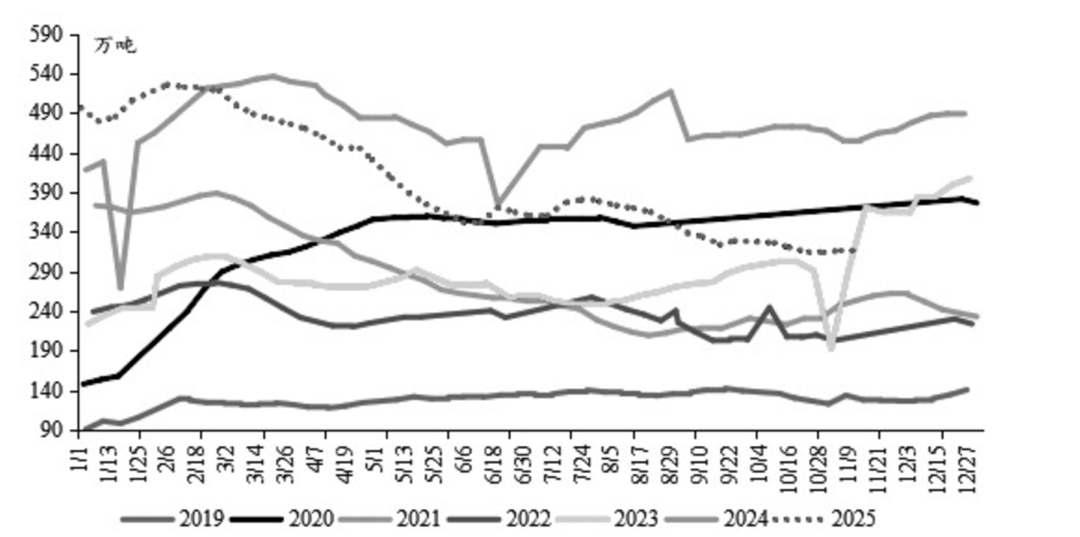
Core Viewpoint - PTA is currently supported by cost factors, with market focus on the execution of maintenance schedules and the recovery of export orders. The polyester futures prices are expected to remain supported due to cost boosts, domestic "anti-involution" policies, and improved export expectations from India [1] Cost Support - Cost support remains strong, with expectations of oversupply in oil from Q4 to Q1 next year, leading to a weak and fluctuating international oil price. The transmission of oil price changes to downstream industries is relatively mild due to low PTA processing fees [2][3] PX Supply and Demand - Domestic PX operating rates have slightly decreased to 86.8%, a drop of 3 percentage points. Asian PX operating rates are at 78.5%, down 1.7 percentage points. Several PX facilities in Asia are undergoing maintenance, tightening the PX spot market supply. The overall PX supply-demand balance is improving, supporting PTA costs [6] Inventory Pressure - PTA social inventory is approximately 3.1561 million tons, showing a slight accumulation. The inventory structure is reasonable, with polyester factories maintaining raw material stock for 13-14 days. The overall inventory level is lower than in the past two years, indicating limited inventory pressure [8] PTA and Polyester Production - By 2025, PTA production capacity is expected to reach 91.715 million tons, with a growth rate of 9.5%. The polyester industry is projected to maintain a high average operating rate of 88.29%, providing rigid demand support for PTA. However, weak weaving orders may lead to reduced purchasing intentions among polyester companies [11][13] Market Dynamics - The PTA market is currently facing a balance between cost support and demand suppression, with prices expected to fluctuate between 4500 and 4900 yuan per ton [11][13]

供增需减,PTA上行乏力
Qi Huo Ri Bao· 2025-11-21 23:55
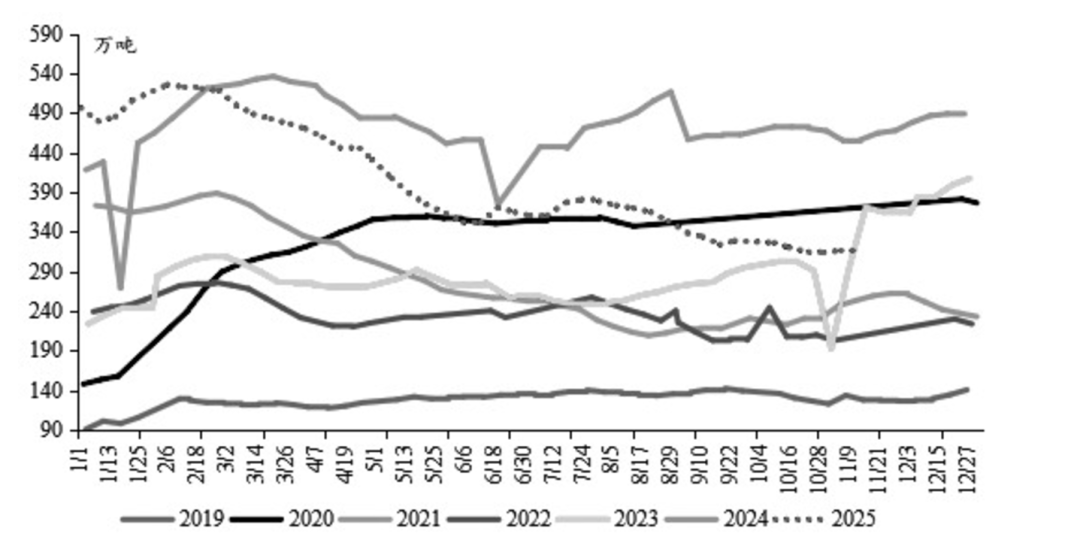
Core Viewpoint - PTA is currently supported by cost factors, with market focus on the execution of maintenance schedules and the recovery of export orders. The polyester futures prices are expected to remain supported due to cost boosts, domestic "anti-involution" policies, and improved export expectations from India [1] Group 1: Cost Support - The oil supply surplus is expected to be strong from Q4 to Q1 next year, leading to a weak and fluctuating international oil price. The low PTA processing fee results in a mild transmission of oil price changes to downstream industries [2] - The domestic PX operating rate has slightly decreased to 86.8%, down 3 percentage points week-on-week, while the Asian PX operating rate is at 78.5%, down 1.7 percentage points. This decline in operating rates is due to maintenance activities, leading to tight PX spot market supply [4] Group 2: Inventory Pressure - The total PTA production capacity is projected to reach 91.715 million tons by the end of 2025, with a capacity growth rate of 9.5%. Recent new capacities have led to a relatively loose spot liquidity [5] - PTA social inventory is approximately 3.1561 million tons, showing a slight accumulation. The inventory structure is reasonable, with polyester factories maintaining raw material stock for 13-14 days. The overall inventory level is lower than the same period in the past two years [5] Group 3: Market Dynamics - The PTA industry operating rate has adjusted to 75.7%, while the polyester industry operating rate is at 90.5%. The overall supply-demand dynamics for PTA remain stable [7] - The polyester industry is expected to exceed 90 million tons in total production by 2025, with an average operating rate of 88.29%. However, the demand for polyester is showing signs of weakness, leading to a forecasted trading range for PTA contracts between 4500 and 4900 yuan/ton [8]
强成本VS弱需求 PTA上行乏力
Qi Huo Ri Bao· 2025-11-21 01:15
Core Viewpoint - PTA is currently supported by cost factors, with market focus on the execution of maintenance schedules and the recovery of export orders. The polyester futures prices are expected to remain supported due to cost boosts, domestic "anti-involution" policies, and improved export expectations from India [1] Group 1: Cost Support - The oil supply surplus is expected to persist from Q4 to Q1 next year, leading to a weak and fluctuating international oil price. The transmission of oil prices to the downstream industry is relatively mild due to low PTA processing fees [2] - Domestic PX operating rates have slightly decreased to 86.8% as of November 14, down 3 percentage points week-on-week, while Asian PX operating rates fell to 78.5%, down 1.7 percentage points. This decline is due to maintenance at several PX facilities in Asia, tightening PX spot market supply [2] - The PX market has seen a strong performance, with PXN absolute prices rising to $257 per ton, supported by favorable supply-demand dynamics [2] Group 2: Inventory Pressure - The PTA production capacity is expected to reach 91.715 million tons by the end of 2025, with a capacity growth rate of 9.5%. Recent new capacities have led to a relatively loose spot liquidity [3] - PTA social inventory is approximately 3.1561 million tons, showing a slight accumulation. The inventory structure is reasonable, with polyester factories maintaining raw material stock days at 13-14 days [3] - The recent removal of BIS certification for PTA and polyester products in India may accelerate inventory reduction if export demand materializes [3] Group 3: Polyester Production - The domestic polyester industry is projected to exceed 90 million tons in total production by 2025, with an expected average operating rate of 88.29%, providing rigid demand support for PTA [4] - Despite a high operating rate, the polyester industry has seen a decline in raw material stock levels and a weakening order atmosphere in the weaving sector [4] - The market is expected to face a balance between cost support and demand suppression, with PTA futures prices projected to fluctuate between 4500 and 4900 yuan per ton [4]
PTA:需求预期弱,成本弱
Ning Zheng Qi Huo· 2025-10-20 08:56
Report Industry Investment Rating - Not provided Core Viewpoint of the Report - Despite many PTA maintenance expectations, polyester load is expected to decline during the traditional off - season, so PTA supply - demand is expected to be weak. Considering the cost side, the load of Asian and domestic PX will remain at a relatively high level, PXN is under pressure, and crude oil is oscillating weakly. Overall, the fundamental driving force of PTA is weak, and attention should be paid to the progress of China - US economic and trade negotiations [2][14] Summary by Relevant Catalogs Chapter 1: Market Review - The PTA01 contract oscillated weakly. The weekly opening price was 4506, the highest was 4532, the lowest was 4392, and the closing price was 4402, a weekly decline of 132 or 2.92% [3] Chapter 2: Analysis of Price Influencing Factors 2.1 PX Supply - Demand Marginal Weakness - In terms of PX production capacity, the commissioning of new domestic PX production capacity in 2024 is gradually coming to an end. In 2024, only Yulongdao has a plan to put into operation a new 3 million - ton production capacity, and there is no expectation of new project commissioning in 2025. From January to September 2025, domestic PX production was 28.07 million tons, a year - on - year increase of 0.82%; imports were 7.04 million tons, a year - on - year increase of 5.02%. In August, the PX social inventory was 3.9179 million tons, a month - on - month increase of 0.49%. This month, PX imports were high and downstream device operating loads were low, leading to an increase in PX social inventory [5] - The domestic PX load decreased by 0.81% to 87.4%, and the Asian PX load increased by 0.96% to 77.92%. This week's PX output was 733,100 tons, a decrease of 6,900 tons compared with last week. During the period, the average PX - N was $225.68/ton, a month - on - month increase of $6.9/ton [5] - This week, Urumqi Petrochemical's 1 - million - ton device was under maintenance from October 14 for half a month; Fujia Dahua's two 1.4 - million - ton devices continued maintenance and were planned to restart in early November. Overseas, the PX of Indonesia's TPPI refinery was still operating after a fire, and South Korea's SK refinery's PX device was not affected by a fire. Next week, PTT and Satorp will have devices for planned maintenance, and the overseas PX load is expected to decrease. There will be few Asian PX device maintenance in the fourth quarter, and the load of Asian and domestic PX is expected to remain at a relatively high level, with PXN under pressure [6] 2.2 Increased PTA Maintenance Intensity - From January to September 2025, domestic PTA production was 54.61 million tons, a year - on - year increase of 3.3%. This week, domestic PTA production was 1.3983 million tons, a decrease of 42,400 tons compared with last week and 7,500 tons compared with the same period last year. The domestic PTA weekly average capacity utilization rate was 75.56%, a month - on - month decrease of 2.28% and a year - on - year decrease of 6.09%. The average PTA cost was 4,234.73 yuan/ton, a month - on - month decrease of 127.46 yuan/ton; the average profit was - 277.73 yuan/ton, a month - on - month decrease of 17.54 yuan/ton; the average processing fee was 182.27 yuan/ton, a month - on - month decrease of 17.54 yuan/ton [8] - This week, Hengli Petrochemical reduced production as planned, Yisheng New Materials increased load in the middle of the week, the loads of Sanfangxiang's 3.2 - million - ton and Weilian Chemical's 2.5 - million - ton devices increased, and Yisheng Ningbo's 2.2 - million - ton device slightly reduced load. The domestic supply met expectations, and the domestic overall production inventory decreased this period. The current PTA social inventory is 3.1984 million tons, a decrease of 61,200 tons or 1.88% compared with last week. With the recovery of some PTA device loads and news of new device commissioning, the PTA spot basis weakened significantly. However, as the basis approaches the risk - free arbitrage point and some mainstream PTA suppliers reduce device loads, the subsequent basis decline space is limited [8] 2.3 High Polyester Operating Load - From January to September 2025, domestic polyester production was 58.6 million tons, a year - on - year increase of 7.2%. From January to August 2025, the cumulative net export of polyester products was 91.18 million tons (accounting for 18% of the same - period polyester production), a year - on - year increase of 15.8% [12] - This week, China's polyester industry output was 155,400 tons, an increase of 60 tons or 0.04% compared with last week. The weekly average capacity utilization rate was 87.78%, a month - on - month decrease of 0.02%. Longzhong predicts that next week, China's polyester industry output is expected to be around 155000 - 156000 tons, a slight increase compared with this period. At present, after the previous device commissioning and the restart of long - stopped devices, the load will gradually increase, and there are also device commissioning plans next week. It is expected that the domestic polyester industry supply will increase slightly next week [12] - As of October 17, the weekly average operating rate of Jiangsu and Zhejiang looms was 68.1%, a week - on - week decrease of 0.9%. As of October 17, the inventory of grey cloth of East China weaving enterprises was 30.0 days, a week - on - week decrease of 1.0 day. As of October 17, the inventories of POY, FDY, bottle chips, and staple fibers were 16.8 days, 22.1 days, 16.0 days, and 6.1 days respectively. The operating rate of Jiangsu and Zhejiang looms first decreased and then increased, the downstream polyester load was relatively stable, the market production and sales structure was differentiated, the filament inventory accumulated, and the staple fiber inventory decreased month - on - month. However, recently, trade frictions have escalated, terminal export orders have declined. As the terminal demand enters the off - season, it is expected that the loads of filaments and staple fibers may decline, and the load increase of bottle chips is limited due to poor efficiency and the off - season [12][13] Chapter 3: Market Outlook and Investment Strategy - Despite many PTA maintenance expectations, polyester load is expected to decline during the traditional off - season, so PTA supply - demand is expected to be weak. Considering the cost side, the load of Asian and domestic PX will remain at a relatively high level, PXN is under pressure, and crude oil is oscillating weakly. Overall, the fundamental driving force of PTA is weak, and attention should be paid to the progress of China - US economic and trade negotiations [14]
市场整体交投恢复淡季 PTA期货仍震荡偏弱运行
Jin Tou Wang· 2025-08-14 07:29
Group 1 - The domestic futures market for energy and chemicals shows a downward trend, with PTA futures main contract opening at 4692.00 CNY/ton and experiencing a decline of 2.92% in early trading [1] - PTA's price fluctuated between a high of 4704.00 CNY and a low of 4630.00 CNY, reflecting a decrease of approximately 1.36% [1] - The overall PTA market is exhibiting a weak performance, with institutions indicating a bearish outlook for the near future [1] Group 2 - PTA's capacity utilization rate increased by 3.05% to 76.70% compared to the previous working day, with some plants restarting while others are under maintenance [1] - The demand for downstream polyester remains weak, with the comprehensive production and sales rate of polyester sample enterprises at 42.94%, down by 9.26 percentage points from the previous period [1] - The supply-demand balance for PTA is expected to improve slightly compared to last week, although the overall market is still in a weak trading phase [1] Group 3 - East China Futures notes that the sentiment around "anti-involution" is easing, leading to a slight decline in PTA alongside other sectors [2] - The recovery of profits remains limited, and the expected increase in downstream operating rates in August may be constrained [2] - The supply pressure for PTA is expected to decrease as two production units are either shutting down or delaying startup, leading to a more balanced supply-demand situation in August [2] Group 4 - Ningzheng Futures highlights that the PTA operating rate is recovering, with new capacities from Hong Kong Petrochemical and Sanfangxiang contributing to supply pressure [2] - The traditional textile peak season in August and September may lead to an increase in polyester operating rates, potentially reaching around 90% [2] - However, poor profitability in polyester products may affect the production enthusiasm of polyester enterprises moving forward [2]
