防水

Search documents
中东战局升级,终于开始影响普通人的生活了
吴晓波频道· 2026-03-22 00:52
Core Viewpoint - The escalation of the Middle East conflict has led to a significant increase in oil prices, which has a direct impact on the costs of travel, commuting, shopping, and dining for ordinary people [2][6]. Group 1: Oil Price Impact on Travel - The tourism market is particularly affected, with rising fuel surcharges leading to increased travel costs. For example, Spring Airlines announced a fuel surcharge increase of over 50% for certain routes [10][15]. - Specific routes have seen fuel surcharges rise from 200 CNY to 312 CNY, indicating a substantial increase in travel expenses [11]. - Predictions suggest that domestic fuel prices may rise again, with 92 and 95 octane gasoline expected to increase by 1.60 CNY and 1.69 CNY per liter, respectively [17][18]. Group 2: Broader Economic Effects - The rise in oil prices is expected to trigger a price increase across various sectors, including textiles, construction materials, and consumer goods [26][30]. - The price of polyester, a key material in outdoor clothing, surged by 67.56%, with some textile companies already announcing price hikes [27][28]. - Construction materials are also seeing price increases of 5% to 10%, affecting items like waterproofing and paint, which are derived from petroleum [30][32]. Group 3: Agricultural Sector Implications - The agricultural sector is facing rising costs for fertilizers and pesticides, which are heavily reliant on oil derivatives. Fertilizer prices have already increased by 30% to 40% [43]. - The Chinese government has paused fertilizer exports to ensure domestic supply during the critical spring planting season, reflecting the tight global fertilizer market [42]. - Predictions indicate that if the conflict continues, prices for major agricultural products like wheat and corn may rise significantly, with wheat projected to reach 6.5 USD per bushel [43]. Group 4: Long-term Outlook and Policy Response - Despite the current volatility, China's policy toolbox for stabilizing prices is considered robust, with mechanisms in place to prevent excessive price increases [51]. - China's oil reserves are estimated to support consumption for 110 to 140 days, providing a buffer against supply disruptions [51]. - The diversification of energy sources in China, including a strong renewable energy sector, is expected to enhance resilience against future shocks [52].


春节错期扰动投资数据表现
HTSC· 2026-03-18 06:50
Investment Rating - The industry investment rating is "Overweight" for both the construction and building materials sectors [6]. Core Insights - Infrastructure investment in January-February 2026 showed a year-on-year increase of 11.4%, while real estate and manufacturing investments decreased by 11.1% and increased by 3.1%, respectively. The overall performance of infrastructure investment is positive, but sustainability remains to be observed due to the late timing of the Spring Festival [1]. - The report suggests focusing on opportunities in waterproofing and engineering pipe materials, as well as the impact of rising raw material prices on consumer building materials [1]. - The report highlights the potential for recovery in the building materials sector, with a narrowing decline in housing prices in major cities, indicating a possible improvement in retail sales of building materials [2]. Summary by Sections Infrastructure and Real Estate - In January-February 2026, infrastructure investment increased by 11.4% year-on-year, while real estate sales, new starts, and completions decreased by 13.5%, 23.1%, and 27.9%, respectively [1][2]. - The report emphasizes the need to monitor the sustainability of infrastructure investment growth and suggests that the recovery in real estate sales could signal a rebound in building materials sales [2]. Building Materials - The average price of cement in January-February 2026 was 351 RMB/ton, a decrease of 14.5% from December 2025 and 2.3% year-on-year. The average cement shipment rate was 28.0%, showing a year-on-year increase of 3.6% [3]. - The report notes that the price of flat glass has been under pressure, with a year-on-year decrease of 17.4% in January-February 2026, despite some support from production line cold repairs [4]. Stock Recommendations - The report recommends several stocks with a "Buy" rating, including: - Dongfang Yuhong (002271 CH) with a target price of 25.87 RMB - Yaxiang Integration (603929 CH) with a target price of 235.62 RMB - Zhongcai International (600970 CH) with a target price of 14.64 RMB - China Chemical (601117 CH) with a target price of 12.05 RMB - China Liansu (2128 HK) with a target price of 6.35 HKD [8][32].


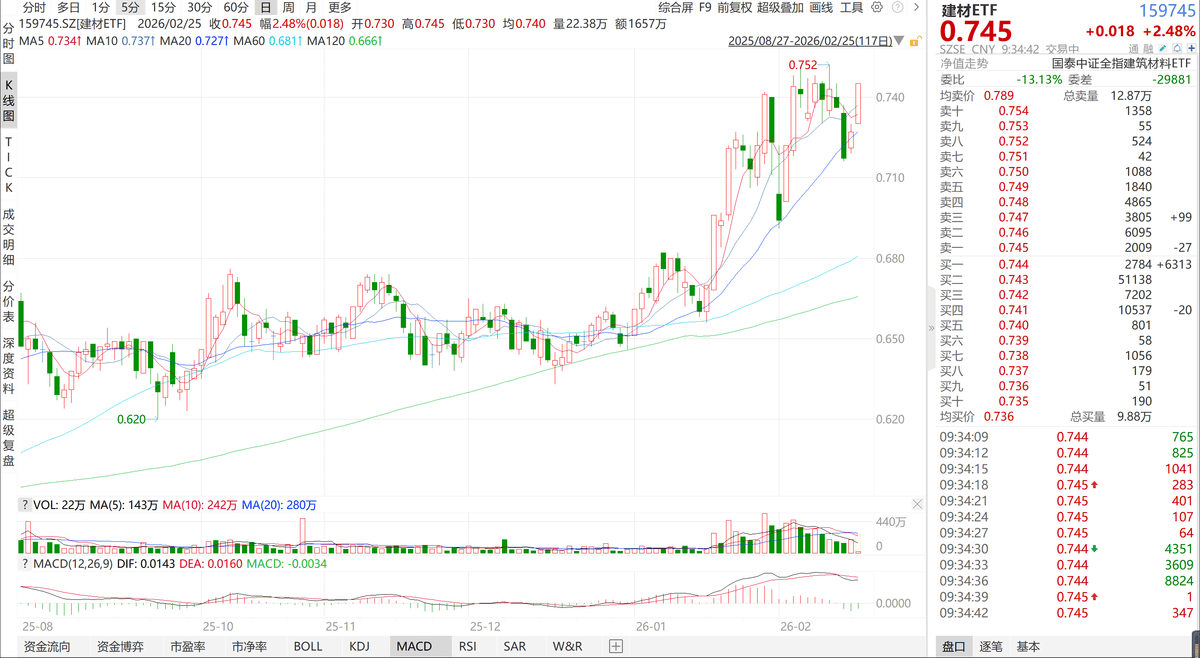
建材ETF(159745)强势领涨超2% 政策驱动+需求回暖 建材板块迎来布局良机
Sou Hu Cai Jing· 2026-02-25 01:49
Core Viewpoint - The recent strong performance of the building materials sector in the A-share market is attributed to multiple favorable factors, including macroeconomic policies, gradual improvement in industry fundamentals, and consensus on low-level capital allocation [1][3]. Policy Support - The real estate sector is experiencing a combination of policies aimed at stabilizing expectations, sales, and construction, which have led to increased demand for construction materials such as waterproofing, coatings, pipes, and tiles [3]. - Infrastructure investment continues to support the economy, with local governments accelerating the issuance of special bonds and major projects commencing, leading to a steady recovery in demand for traditional cyclical building materials like cement, glass, and fiberglass [3]. Cost and Profitability - Prices of core raw materials for building materials, such as coal, soda ash, and natural gas, have decreased, effectively lowering production costs and enhancing profit margins for companies [3]. - Ongoing supply-side reforms, including staggered production and capacity regulation, are clearing out outdated capacities, leading to increased industry concentration and improved profitability for leading companies [3]. Future Outlook - The investment opportunities in the building materials sector are clear, driven by both cyclical recovery and growth upgrades, with short-term benefits expected from accelerated construction and demand recovery [4]. - Long-term demand will be supported by urban renewal and the promotion of green and energy-efficient materials, while new materials like fiberglass and advanced composites are expected to grow due to high demand in new energy and AI sectors [4]. - The building materials sector is characterized by low valuations and high dividends, providing room for continued valuation recovery, supported by favorable policies, improving demand, and rising profitability [4]. Investment Strategy - For investors, the building materials ETF (159745) is recommended as an efficient tool for exposure to the sector, tracking the CSI All Share Construction Materials Index and covering a full industry chain [4]. - The ETF allows for easy trading, low fees, and risk diversification, making it suitable for both trend-following and value-oriented investors [4][5].
电子布涨价超预期,看好26年涨价持续性
China Post Securities· 2026-02-09 06:50
Industry Investment Rating - The investment rating for the construction materials industry is "Outperform the Market" and is maintained [1]. Core Insights - The report highlights a significant price increase in electronic cloth, driven by high demand for high-end products and supply constraints, with price hikes of approximately 0.5-0.6 yuan/meter expected to continue into 2026 [4]. - The cement market is entering a seasonal downturn, with a year-on-year production decline of 6.6% in December 2025, while the demand remains weak, particularly in the housing market [5][9]. - The glass industry is facing ongoing demand pressure, with high inventory levels among intermediaries and expected price stability at low levels due to supply-demand imbalances [16]. - The fiber glass sector is experiencing a demand surge driven by the AI industry, with expectations for continued price and volume increases [5][6]. Summary by Sections Cement - The national cement market is entering a seasonal low, with a notable decline in demand and production [9]. - The production in December 2025 was 144 million tons, down 6.6% year-on-year [9]. Glass - The glass industry is under pressure with high inventory levels and limited demand improvement, leading to expected low price fluctuations [16]. Fiber Glass - The fiber glass sector is seeing a positive outlook due to AI-related demand, with expectations for a significant increase in both price and volume [5][6]. Consumer Building Materials - The consumer building materials sector is anticipated to see a bottoming out of profits, with strong price increase demands across various categories expected to improve profitability in 2026 [6].
地产政策有望持续宽松,地产链建材经营改善可期
Guotou Securities· 2026-02-04 10:04
Investment Rating - The industry is rated as "Leading the Market - A" indicating an expected investment return that will exceed the CSI 300 Index by 10% or more over the next six months [3]. Core Insights - The real estate policy is expected to remain accommodative, which is likely to improve the operating conditions for the building materials sector. Recent initiatives, such as Shanghai's acquisition of second-hand housing for rental projects, signal a positive shift in the market [1]. - The transaction volume of second-hand homes continues to grow, with prices showing signs of stabilization. In January 2026, second-hand home transactions in Shanghai reached approximately 22,000 units, marking a year-on-year increase of about 25% [1]. - The consumption building materials sector is anticipated to see improved performance, with several companies initiating price increases across various product categories, including coatings and waterproof materials [2][7]. Summary by Sections Real Estate Policy and Market Conditions - Recent real estate policies across multiple regions, including adjustments in loan-to-value ratios for commercial properties, aim to stabilize the market and boost housing consumption [1]. - The sales area of new homes is projected to decline at a slower rate, supporting the demand for building materials [1]. Performance of Consumption Building Materials - The revenue of the consumption building materials sector declined by 6.21% year-on-year in the first three quarters of 2025, but there are signs of improvement in the latter part of the year [2]. - Companies like Oriental Yuhong and Sanke Tree have announced price increases, indicating a potential end to the intense price competition in the industry [7]. Retail Channel Development - Companies are actively expanding their retail channels, which is expected to enhance profitability and cash flow. For instance, Sanke Tree's revenue from retail has increased significantly, demonstrating resilience in a challenging market [8]. - The shift towards retail and small B-end channels is becoming more pronounced, with companies like Oriental Yuhong and Beixin Building Materials benefiting from this trend [8]. Investment Recommendations - The report suggests a positive outlook for leading companies in the consumption building materials sector, particularly those involved in coatings, waterproofing, gypsum boards, and panels. Key companies to watch include Sanke Tree, Oriental Yuhong, Beixin Building Materials, and Rabbit Baby [9].
东方雨虹:预期差中的市场共识重塑
Ge Long Hui· 2026-01-28 00:14
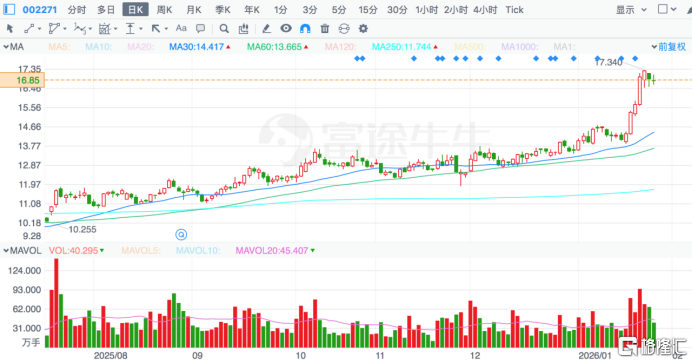
Core Viewpoint - The stock price of Dongfang Yuhong (002271.SZ) has shown strong performance, with a cumulative increase of approximately 24% since the beginning of the year, and its market capitalization has surpassed 40 billion [1][3]. Group 1: Company Developments - The controlling shareholder has announced a plan to reduce holdings by up to 3% of the total share capital, which will be used to fulfill employee stock ownership commitments and repay personal pledged loans [3]. - This reduction is seen as a move to stabilize the governance structure and reduce potential risks to the company, aligning with recent strategic actions such as selling multiple real estate assets and liquidating holdings in Jinke Services [3]. - The company is optimizing its asset structure to focus more on its core business, preparing for strategic initiatives in 2026 and beyond [3]. Group 2: Industry Trends - The construction materials industry is at a turning point, transitioning from a high-growth model reliant on real estate development to new structural opportunities [4]. - The industry is expected to reach a bottom in fundamentals by 2024-2025, with potential for growth in 2026 as supply-side improvements stabilize prices [5]. - The demand structure is fundamentally changing, with a significant shift towards renovation needs, which currently account for about 50% of demand and are expected to rise to nearly 70% by 2030 [5]. Group 3: Company’s Strategic Positioning - Dongfang Yuhong is undergoing a strategic transformation from a high accounts receivable model to a healthier development model focused on retail and engineering channels, with a projected revenue contribution from these channels reaching 84.06% by mid-2025 [8]. - The company is also expanding its sand powder and overseas businesses, with sand powder production expected to exceed 12 million tons in 2025, marking a 50% increase from 2024 [10]. - Recent acquisitions, such as the purchase of Construmart in Chile, are part of a strategy to establish an international retail platform and enhance global distribution capabilities [12]. Group 4: Market Expectations and Recovery Signals - There are three significant expectation gaps regarding Dongfang Yuhong: the market underestimates the depth of its strategic transformation, overlooks the reality of its new business growth engines, and focuses on overall industry lows while ignoring positive turning points [7][10][13]. - The company has shown a revenue growth of 8.51% year-on-year in Q3 2025, marking the first positive growth in recent years, indicating a shift in growth momentum [13]. - The competitive environment is improving, with supply-side adjustments and price stabilization signaling an end to the most intense phases of price competition, suggesting a recovery in profitability for leading companies in 2026 [13][14].
东方雨虹(002271.SZ):预期差中的市场共识重塑
Ge Long Hui· 2026-01-28 00:12
Core Viewpoint - The stock price of Dongfang Yuhong (002271.SZ) has shown strong performance, with a cumulative increase of approximately 24% since the beginning of the year, and its market capitalization has surpassed 40 billion [1] Group 1: Company Developments - The controlling shareholder has announced a plan to reduce holdings by no more than 3% of the total share capital, which has attracted market attention [2] - The funds from the reduction will primarily be used to fulfill employee stock ownership plan commitments and repay personal pledged loans, which will help stabilize the core team and reduce potential risks to the company [2] - The company has been optimizing its asset structure by selling multiple real estate properties and liquidating its holdings in Jinke Services, indicating a focus on its core business for future strategic initiatives [2][4] Group 2: Industry Trends - The construction materials industry is at a crossroads, transitioning from a high-growth model reliant on real estate development to new structural opportunities [4] - The industry is expected to reach a bottom in fundamentals by 2024-2025, with potential for growth in 2026 [5] - The demand structure is fundamentally changing, with a significant shift towards renovation needs, which currently account for about 50% of demand and are expected to rise to nearly 70% by 2030 [7] Group 3: Market Dynamics - The most intense phase of price competition in the industry appears to be over, with leading companies expected to see profit recovery in 2026 [7][8] - The global market presents a second growth opportunity for the industry, driven by initiatives like the Belt and Road and the wave of Chinese manufacturing going abroad [8] Group 4: Company-Specific Expectations - Dongfang Yuhong has significant potential for profit and valuation recovery, with three key expectation gaps identified [10] - The first gap is the market's underestimation of the depth and long-term value of the company's strategic transformation from a high receivables model to a healthier retail and engineering channel model [11] - The second gap is the market's perception of new business ventures as long-term stories, while they are already becoming significant growth engines, particularly in the sand powder and overseas markets [13][14] - The third gap is the market's focus on overall industry lows, overlooking multiple signals of recovery, including a revenue growth of 8.51% year-on-year in Q3 2025, marking the first positive growth in recent years [16]
国泰海通|策略:增量政策聚焦城市更新与新兴科技
国泰海通证券研究· 2026-01-26 14:03
Core Viewpoint - The article highlights a decline in trading heat for hot themes, with commercial aerospace, resource products, and building materials leading the market. The focus of incremental policies is on expanding domestic demand and fostering new technological momentum, particularly in urban renewal, commercial aerospace, domestic computing power, and new power grids [1]. Group 1: Urban Renewal - Urban renewal is expected to stabilize the real estate market and expand domestic demand, with 60,015 urban renewal projects planned nationwide in 2024, involving a total investment of 2.9 trillion yuan. Key components include the renovation of old residential areas, urban villages, and underground pipeline upgrades [2]. Group 2: Commercial Aerospace - Elon Musk predicts that space will become the most cost-effective location for deploying AI data centers within 2-3 years, with the potential for launch costs to drop by 100 times if the Starship achieves full reusability. China aims to establish a leading space computing center by 2030, addressing high energy consumption and carbon emissions from ground data centers [3]. Group 3: Domestic Computing Power - TSMC's capital expenditure is expected to exceed expectations, boosting demand in the semiconductor advanced manufacturing sector. The company anticipates a 35% year-on-year increase in net profit by Q4 2025, with capital expenditures potentially reaching $56 billion in 2026, a 37% increase from 2025 [4]. Group 4: New Power Grid - The State Grid plans to invest 4 trillion yuan during the 14th Five-Year Plan period, a 40% increase from the previous plan, focusing on the construction of a new power system. The share of non-fossil energy consumption is projected to reach 20% by 2025 and 25% by 2030 [5].

建材板块走高,建材ETF易方达、建材ETF涨超3.6%
Ge Long Hui A P P· 2026-01-22 07:13
Group 1 - The Shanghai Composite Index rose by 0.14%, while the ChiNext Index increased by 1.01%, driven by gains in the building materials sector, with Jinju Group hitting the daily limit and Dongfang Yuhong rising over 8% [1] - The building materials ETFs, including E Fund and others, saw increases of over 3.8% year-to-date, with E Fund's building materials ETF showing a year-to-date gain of 10.77% [2] - The Ministry of Housing and Urban-Rural Development recently issued guidelines aimed at improving housing quality, targeting significant progress by 2030 in various aspects such as standards, design, materials, and construction [2] Group 2 - According to Shenwan Hongyuan Securities, the real estate chain has been in decline for five years, but there are positive signals emerging. The building materials industry has faced pressures such as demand decline and increased competition, but long-term changes are now visible [3] - The report suggests that the building materials sector is expected to benefit from a recovery in housing demand, particularly in renovation and improvement of living conditions as income expectations improve [3] - Huafu Securities indicates that supply-side reforms and declining interest rates may enhance home-buying willingness, potentially stabilizing the real estate market and boosting demand for building materials [3] Group 3 - Guotai Junan Securities highlights that despite static total physical data showing a year-on-year decline, leading building materials companies have achieved revenue and profit growth through increased market share and expansion into overseas markets [4] - The growth in revenue and profitability is attributed to factors such as material upgrades driven by AI and new energy, as well as the easing of competition [4] - The intrinsic growth potential of leading building materials companies is seen as attractive, with the possibility of significant benefits if macroeconomic expectations improve [4]



中国联塑3日累涨近10%,机构看好消费建材核心标的
Ge Long Hui· 2026-01-22 06:04
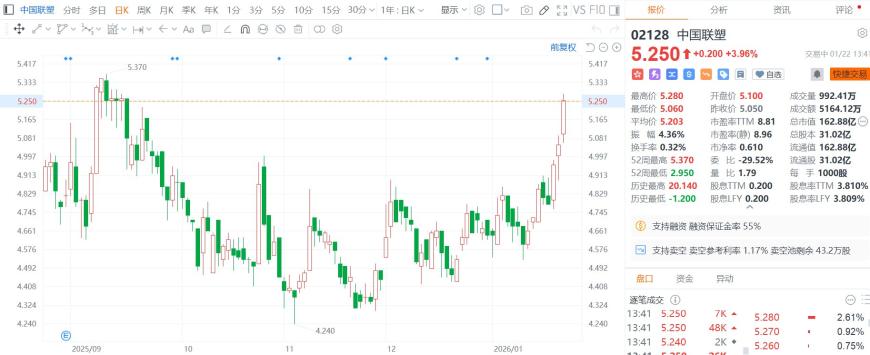
Core Viewpoint - China Lesso (2128.HK) has seen a significant increase in stock price, rising 3.96% to HKD 5.25, with a total market capitalization of HKD 16.288 billion, and a cumulative increase of nearly 10% over the last three trading days [1] Group 1: Industry Insights - The consumer building materials sector is experiencing a recovery in revenue and profit margins, with a focus on alpha opportunities [1] - Long-term demand for consumer building materials is stable, with increasing industry concentration and favorable competitive landscape, indicating substantial growth potential for quality leading companies [1] - The real estate sector is still in a bottoming phase, awaiting stabilization in sales; core leading companies exhibit strong operational resilience [1] Group 2: Investment Recommendations - Shanghai Shenwan Hongyuan Securities recommends paying attention to the current real estate chain market, expressing optimism about core consumer building material stocks [1] - By 2026, there is an expectation for improvement in real estate construction starts, with the market having low expectations for this segment; building materials related to waterproofing and plastic pipes are currently undervalued and may outperform under policy catalysts [1] - The demand for home improvement will gradually manifest as income expectations improve, benefiting sectors such as coatings, hardware, tiles, and boards in the later stages of the economic cycle [1]