零钱通

Search documents
银行花式“抢客” 理财“春节档”营销热闹登场
Shang Hai Zheng Quan Bao· 2026-02-11 17:50
Core Viewpoint - The banking industry is intensifying its marketing efforts for the upcoming Spring Festival, focusing on attracting customers through various promotional activities and tailored financial products aimed at year-end bonuses and traditional "lucky money" [1][2][4]. Group 1: Marketing Strategies - Banks are leveraging both online and offline channels for marketing, with mobile apps featuring festive themes and special investment links, while physical branches are decorated and hosting engaging activities [2][4]. - The marketing campaigns are primarily targeting year-end bonuses and "lucky money," with banks creating specialized financial products and services to cater to these seasonal funds [2][3]. Group 2: Product Offerings - Financial products designed for year-end bonuses include short-term, high liquidity, and stable return options, with some products offering annualized returns 0.3 to 0.8 percentage points higher than regular offerings [2][4]. - For "lucky money," banks are promoting children's exclusive bank cards and educational savings accounts, along with low-threshold fund investment plans [3]. Group 3: Industry Challenges - The current banking environment is characterized by declining interest rates and a scarcity of quality assets, leading to increased competition for "quality liabilities" [4]. - Banks are facing dual challenges of rising liability costs and profitability pressures, as the macroeconomic transition has made stable, high-return assets scarce [4]. Group 4: Investment Recommendations - Suitable short-term investment options for the Spring Festival include money market funds, government bond reverse repos, and bank cash management products, each with varying risk and liquidity profiles [5]. - Investors are advised to focus on product risk levels, asset allocation clarity, and redemption rules to ensure effective fund utilization during the holiday period [6][7].
普通人如何跨越财富鸿沟?这5大法则助你攒下第一桶金
Sou Hu Cai Jing· 2026-01-15 02:47
Core Insights - Financial management is not just for the wealthy; it is about discipline and asset allocation for ordinary people [1] - The journey to wealth often begins with a seemingly insignificant initial capital [1] Group 1: Money Management Strategies - Reject the "Latte Factor" by controlling small, overlooked expenses to save money [2] - Implement a "pay yourself first" strategy by saving 10%-15% of income immediately upon receiving it [3] - Invest in personal skills and education for guaranteed returns rather than risking capital in volatile markets [4] Group 2: Emergency Fund and Investment Principles - Establish an emergency fund covering 3-6 months of essential living expenses before making any investments [6] - Choose optimal storage channels for emergency funds that balance liquidity and returns, such as high-quality money market funds with annual yields of 1.5%-2.5% [7] - Avoid high-interest consumer debt, which accelerates wealth loss [8] Group 3: Investment Strategies - Diversify investments using a "core-satellite" strategy, allocating 50%-60% to stable assets and 20%-30% to index funds [11] - Utilize index fund dollar-cost averaging as a simple investment tool for those without time to analyze markets [12] - Be cautious of high-yield investment schemes promising returns above 6%-8%, as they may be Ponzi schemes [13] Group 4: Long-term Wealth Building - Embrace a long-term investment approach, minimizing frequent trading to avoid high fees and emotional decision-making [15] - Use a laddering savings method to ensure liquidity while securing higher interest rates [16] - Regularly review and rebalance asset allocations to optimize returns [17] Group 5: Psychological Aspects of Wealth - Cultivate a sense of abundance and resist the urge to compare oneself to others, focusing on personal financial goals [19] - Accept imperfections and start with small savings habits, as even minor contributions can lead to significant long-term benefits [20] - Understand that financial freedom is about gaining choices and control over one's life, not merely accumulating wealth [21]


腾讯给“分付”备了百亿“弹药”
3 6 Ke· 2025-12-15 04:03
Core Viewpoint - Tencent's subsidiary, Shenzhen Financial Payment Network Small Loan Co., Ltd. (referred to as "Financial Payment Small Loan"), has received regulatory approval for a capital increase of 4.5 billion yuan, raising its registered capital to 15 billion yuan, marking a 50-fold increase over five years through six rounds of capital increases [1][4]. Group 1: Capital Increase and Regulatory Impact - The increase in registered capital allows Financial Payment Small Loan to leverage a maximum of 750 billion yuan in lending capacity based on the regulatory "1+4" financing leverage rule [1]. - Following the capital increase, Financial Payment Small Loan ranks second among national online small loan institutions, only behind ByteDance's Zhongrong Small Loan Co., Ltd., which has a registered capital of 19 billion yuan [2]. - The capital increase trend among internet small loan companies is driven by both regulatory logic and business needs, with 12 companies having registered capital exceeding 5 billion yuan as of July 2025 [2]. Group 2: Regulatory Framework - The regulatory framework for online small loans has evolved since the draft of the "Interim Measures for the Management of Online Small Loan Business" was released in November 2020, establishing a capital requirement of 5 billion yuan for cross-provincial operations [4]. - The new regulations, effective January 2025, focus on business norms and regional management, tightening requirements for the capital contribution ratio in joint loans with banks to a minimum of 30% [4]. Group 3: Product Development and Market Position - Financial Payment Small Loan offers two main products: "Fenfu," which allows for flexible repayment with a daily interest rate of 0.04%, and "Fengqi," which is designed for larger payments with fixed repayment terms [5][6]. - The "Fenfu" product has evolved from a consumption credit service to a cash loan service, allowing withdrawals to bank accounts, thus broadening its product offerings [7][8]. - As of June 2024, the loan balance for Financial Payment Small Loan was approximately 12.9 billion yuan, while the loan balance for WeChat's "Fenfu" reached 120 billion yuan by June 2025 [7]. Group 4: Financial Ecosystem and Performance - Tencent's financial ecosystem includes WeBank, which has become a significant profit contributor, with a net profit of 10.9 billion yuan in 2024, surpassing the combined net profits of 18 other private banks [9]. - The financial technology and enterprise services segment contributed 168.6 billion yuan in revenue in the first three quarters of 2025, becoming the second-largest revenue pillar for Tencent [11]. - The gross margin for the financial technology and enterprise services segment improved from 28% in 2020 to 50% in the third quarter of 2025, indicating a positive shift in revenue structure [10].

财富效应:普通人的逆袭窗口
Sou Hu Cai Jing· 2025-12-12 03:39
Group 1 - The core idea of the article emphasizes that the wealth effect is not only a macroeconomic phenomenon but also an important opportunity for individuals to achieve financial growth through effective wealth management strategies [1][10] Group 2 - Establishing an emergency fund is crucial, with a recommendation to save an amount equivalent to 3-6 months of living expenses, which should be kept in high liquidity funds with annual returns between 1.8%-2.5% [4] - Budget planning is essential to avoid unnecessary expenses, and using accounting software or manual tracking can help keep spending within controllable limits [2] Group 3 - The article highlights the power of compound interest, stating that even small amounts can significantly grow over time through long-term investments [3] - Regular investment in index funds, such as the CSI 300 or S&P 500, is recommended, with historical annual returns typically ranging from 5%-8% [4] Group 4 - Selecting appropriate financial tools is key to wealth appreciation, with different tools carrying varying levels of risk and return, necessitating alignment with individual risk tolerance and investment horizon [6] Group 5 - Risk management is emphasized, advising caution against high-yield traps, fund mismatches, and verifying product authenticity to avoid unnecessary losses [7][9] Group 6 - The importance of execution is highlighted, suggesting that practical steps like setting up an emergency fund and starting regular investments are essential for accumulating financial experience [8] Group 7 - The article suggests that individuals should enhance their financial knowledge and skills, as well as build networks and credibility, which are considered "intangible assets" that contribute to wealth growth over time [10]

腾讯金融,藏不住的“赚钱巨兽”
Xin Lang Cai Jing· 2025-11-19 11:11
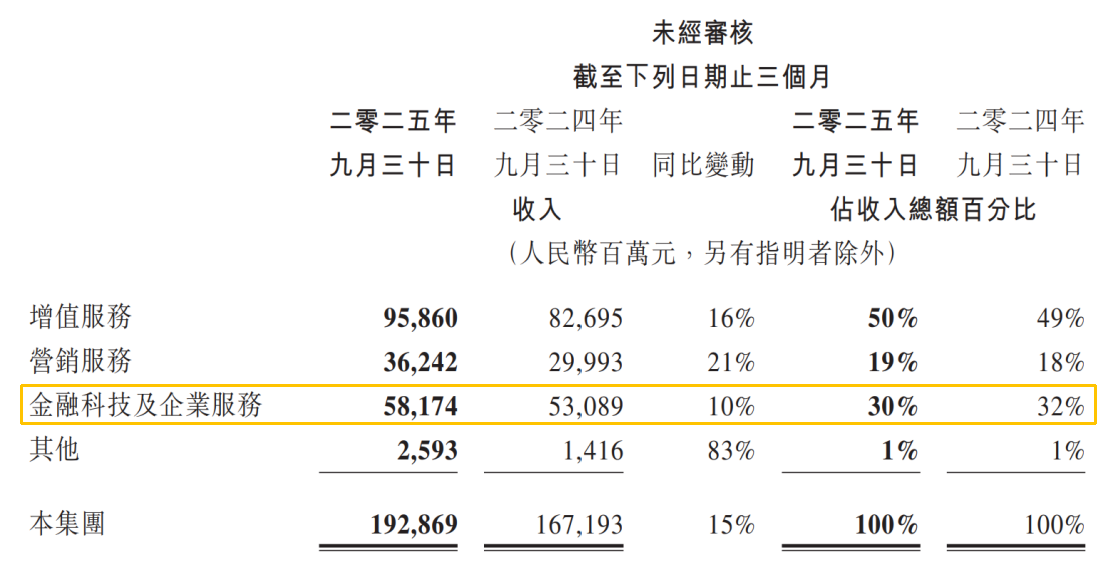
Core Viewpoint - Tencent has reported strong financial performance for Q3 2025, with revenue reaching 192.87 billion yuan, a 15% increase year-on-year, and net profit of 63.13 billion yuan, up 19% from the previous year [1] Financial Performance - Revenue for Q3 2025 was 192.87 billion yuan, an increase of 25.68 billion yuan compared to the same period last year, representing a 15% growth [1] - Net profit attributable to shareholders was 63.13 billion yuan, an increase of nearly 10 billion yuan year-on-year, reflecting a 19% growth [1] - The Financial Technology and Enterprise Services segment generated revenue of 58.17 billion yuan, a 10% increase year-on-year, contributing approximately 30% to total revenue [1][4] Financial Technology Overview - Tencent's financial services are characterized by a diverse range of offerings, including payment, banking, credit, insurance, and wealth management, which are integrated into daily life [6] - WeChat Pay, launched in 2013, is a key component of Tencent's financial ecosystem, with over 1.4 billion monthly active accounts and an average daily usage frequency of about 2.7 times [6] - By Q1 2025, WeChat Pay is projected to surpass Alipay in market share, reaching 59.7% compared to Alipay's 36.2% [6] Strategic Positioning - Tencent's financial strategy emphasizes the role of WeChat Pay as a "super entry point" for data collection and user engagement, which supports its various financial services [7] - The company has established a comprehensive financial ecosystem, including WeBank, which is China's first private and internet bank, and has achieved significant profitability [10][12] - Tencent's wealth management platform, LiCaiTong, has evolved from a tool to a habit for users, indicating strong user engagement and retention [12] International Expansion - Tencent is actively pursuing international opportunities, with investments in digital banks and fintech companies across various countries, including the UK, Brazil, and Germany [15][16] - The company has established a presence in cross-border payments and digital banking, indicating a strategic focus on global financial markets [15][16] Financial Technology Growth - From 2018 to 2024, the revenue from the Financial Technology and Enterprise Services segment grew from 73.14 billion yuan to 211.96 billion yuan, with a compound annual growth rate of nearly 20% [17] - Financial technology is estimated to account for approximately 80% of the revenue in the Financial Technology and Enterprise Services segment, highlighting its significance to Tencent's overall financial performance [20] Cautious Approach - Tencent's financial growth is characterized by a cautious and restrained approach, focusing on stability and compliance in a highly regulated environment [23][29] - The company has not pursued a public listing for its financial services, maintaining a close integration with its core platform [28] - Tencent's strategy involves acting as a "connector" within its financial ecosystem, collaborating with various partners while minimizing direct control to mitigate risks [26][27]
“双节”将至,节前理财怎样买收益多?
Xin Lang Cai Jing· 2025-09-30 00:33
Core Viewpoint - The upcoming National Day and Mid-Autumn Festival present an opportunity for investors to optimize their cash management strategies, ensuring funds remain active during the holiday period [1][6]. Group 1: Investment Strategies - Investors are advised to complete their purchases of financial products before the market closes for the holiday, with many products requiring a T+1 confirmation time [1]. - Various financial institutions, including banks and online platforms, have released "pre-holiday investment guides" to help clients maximize their returns during the holiday [5][6]. - Cash management products are recommended for investment, with suggestions to buy before September 29 at 15:00 to enjoy nine days of returns [1][7]. Group 2: Product Performance - Alipay's Yu'ebao offers 33 money market fund products with annualized returns ranging from 1.0170% to 1.2720%, with the highest being "ICBC Wealth Money A" at 1.2720% [3]. - WeChat's "零钱通" features 10 money market fund products with annualized returns between 1.0750% and 1.1590%, with the highest being "E Fund Easy Finance Money A" at 1.1590% [4]. - Investment in short-term bond funds is also suggested, with some products offering annualized returns up to 2.89% [4][7]. Group 3: Recommendations from Financial Institutions - Several financial institutions, including 招银理财 and 工银理财, recommend early investment in cash management and short-term bond products to take advantage of holiday returns [7][8]. - 招银理财 emphasizes the importance of purchasing cash management products by September 29 to maximize holiday earnings [7]. - Other institutions, such as 平安理财 and 民生理财, have also encouraged investors to seize the "golden window period" for investment opportunities [8].
R1等级基金真能稳赚不赔?当前市场下,真正安全的基金就这三类!
Sou Hu Cai Jing· 2025-09-24 02:41
Core Viewpoint - The article discusses the characteristics and risks associated with R1-rated funds, emphasizing that "low risk" does not equate to "zero risk" and provides guidance for conservative investors on selecting suitable low-risk funds [1]. Fund Risk Level System - The fund risk level system ranges from R1 to R5, indicating increasing levels of risk and corresponding investor risk tolerance [2]. - R1 funds are considered "quasi-savings" but still carry three main potential risks: yield fluctuation risk, liquidity risk, and minimal credit risk [4][5][6]. R1 Fund Characteristics - R1 funds are suitable for cautious investors seeking capital safety and stable returns, with maximum drawdown typically controlled within 0.5% [7]. - The average annualized return for R1 funds over the past decade is 2.4%, with the maximum single-day decline not exceeding 0.05% [6]. Types of Low-Risk Funds - Money Market Funds: Known for liquidity, suitable for cash management [9]. - Interbank Certificate of Deposit Index Funds: Enhanced yield version of money market funds, with higher yield volatility [9]. - Pure Bond Funds: Core for stable returns, requiring differentiation between short and long-term [9]. Investment Characteristics - Money Market Funds: Seven-day annualized yield ranges from 1.8% to 2.8% [10]. - Interbank Certificate of Deposit Index Funds: Annualized yield over the past three years is between 2.8% and 3.5%, with volatility 1.5 times that of money market funds [10]. - Pure Bond Funds: Short-term pure bond funds yield between 2.5% and 3.2%, while long-term pure bond funds yield between 3.5% and 4.5% [10]. Investment Strategy for Conservative Investors - For conservative investors, a combination of money market funds for cash management, interbank certificate of deposit funds for enhanced yield, and pure bond funds for core returns can achieve a stable annualized return of 2.8% to 4% [13].
当前持有货基的正确姿势:流动性管理>收益预期
Xin Lang Ji Jin· 2025-09-23 05:37
Group 1 - The core value of money market funds is not high returns but liquidity management, especially in a low-interest-rate environment [1] - Money market funds are characterized as low-risk, low-return, and high liquidity investment tools suitable for short-term fund management [1] - Compared to bank fixed deposits, money market funds offer superior liquidity, allowing for immediate purchase and redemption without prior appointment [1] Group 2 - Despite the overall decline in money market fund yields, investors can adopt reasonable management strategies to optimize the use of "liquid funds" [1] - Funds needed in the short term can be placed in money market funds for easy access, while funds that may not be used for three months or longer can be allocated to slightly less liquid but higher-yield products [1] - The integration of money market funds into daily life through services like Yu'ebao and WeChat's "零钱通" enhances their utility for both payment and investment [1]
给新入场的基金萌新手册
Sou Hu Cai Jing· 2025-09-23 04:46
Group 1 - The article emphasizes the importance of understanding the fundamentals of funds before investing, highlighting that many individuals jump into investments without proper knowledge, leading to potential losses [1][2] - It presents a metaphor comparing funds to a group dining experience where a professional chef (fund manager) prepares a meal (investment portfolio) using pooled resources from investors [3][4] - The core message is that investing in funds is about hiring a professional team to manage money rather than betting on individual stocks [5] Group 2 - The article categorizes funds into four main types based on risk and return: equity funds, mixed funds, bond funds, and money market funds, providing a clear framework for investors to identify suitable options [6][7] - Equity funds are described as high-risk, high-reward investments, suitable for those with a strong risk tolerance and a long investment horizon [8][10] - Mixed funds offer flexibility and balance, appealing to moderate risk-takers and those with limited investment experience [11][12] Group 3 - Bond funds are characterized as conservative investments, ideal for risk-averse individuals seeking stable cash flow [13][14] - Money market funds are presented as extremely low-risk options, suitable for all investors, especially beginners looking for a safe place to park their emergency funds [17][18] - The article also introduces specialized fund types like QDII funds for overseas investments and FOF funds that invest in a basket of other funds, catering to more advanced investors [19][21] Group 4 - The article concludes with three essential questions for investors to determine their investment strategy: investment goals, risk tolerance, and available funds, guiding them to make informed decisions [24][25][26] - It stresses that understanding fund categories and aligning them with personal financial situations can significantly enhance investment outcomes [27][29]
写给理财小白:我学买基金的那点破事儿
Sou Hu Cai Jing· 2025-07-31 17:16
Core Insights - The essence of mutual funds is to entrust money to skilled managers who handle investments, sharing profits and losses among investors [1] Group 1: Understanding Mutual Funds - Mutual funds can be likened to pooling money with others to invest in stocks, managed by a knowledgeable fund manager [5] - There are different types of mutual funds: 1. Money Market Funds: Low risk, slightly higher returns than bank savings [8] 2. Bond Funds: Invest in government and corporate bonds, with annual returns of 3-5% [9] 3. Stock Funds: High volatility, suitable for risk-tolerant investors [10] 4. Mixed Funds: A combination of stocks and bonds, catering to moderate risk appetites [10] Group 2: Investment Strategies - Selecting a platform for investment is crucial, with options like Alipay and others available [12] - Evaluating fund managers based on long-term performance rather than short-term gains is essential [12] - Establishing a fixed investment amount, such as a monthly contribution, helps mitigate impulsive decisions [12] Group 3: Common Pitfalls - Investors often make the mistake of reacting to short-term market movements, leading to unnecessary stress [15] - Understanding fee structures is vital, as different classes of funds may have varying charges that impact overall returns [16] Group 4: Recommendations for New Investors - New investors are encouraged to review a fund's historical performance and documentation before investing [17] - Starting with a small amount, such as 100 yuan, can help build confidence and understanding of the investment process [18] - The primary goal of investing should be to understand potential losses rather than expecting immediate profits [18]