
5G通信设备

Search documents
欧盟炮制所谓“高风险供应商” 华为迅速回应
Zhong Guo Jing Ying Bao· 2026-01-23 19:54
Core Viewpoint - The European Commission has released a draft revision of the EU Cybersecurity Law, aiming to phase out components and equipment from "high-risk suppliers" across 18 critical sectors, implicitly targeting Chinese high-tech companies like Huawei [1][2]. Group 1: Legislative Changes - The draft expands the scope of the previous 2020 5G security toolbox, now covering 18 key sectors including semiconductors, medical devices, and autonomous driving, with a legally binding requirement to eliminate high-risk components within 36 months [3][4]. - The new measures introduce a "high-risk supplier" list and require joint risk assessments by the EU Commission or three member states before implementation [3]. Group 2: Industry Impact - Chinese companies, particularly in sectors where they hold over 90% market share, may face significant operational cost increases and potential market exit due to the new regulations [5]. - The draft is expected to elevate market entry barriers based on non-technical factors, pressuring Chinese firms to accelerate innovation and diversify their global market presence [5]. Group 3: Geopolitical Context - The legislative shift reflects a broader geopolitical trend, with the EU's technology policy moving from risk management to systematic exclusion of Chinese technology, influenced by external pressures from the U.S. [4]. - Internal divisions within the EU exist, as countries like Germany and Spain express concerns over the timeline for phasing out Chinese equipment, indicating a complex interplay of external pressure and internal strategic considerations [4].
欧盟“高风险供应商”政策升级,华为霸气回怼:损人不利己
Jing Ji Guan Cha Wang· 2026-01-22 03:41
Core Viewpoint - The European Commission has escalated its stance against "high-risk suppliers," effectively banning member states from procuring products from Chinese high-tech companies, which politicizes economic issues and severely hinders technological exchange and economic development [2][4]. Group 1: Legislative Changes - The EU has released a draft revision of the EU Cybersecurity Law, aiming to phase out components and equipment from "high-risk suppliers" across 18 critical sectors, including 5G communication, semiconductors, and medical devices [2][3]. - The draft mandates that telecom operators in EU countries replace equipment from identified high-risk suppliers within three years, marking a shift from voluntary to mandatory compliance for all member states [3][4]. Group 2: Targeted Companies - Although the draft does not explicitly name any countries or companies, it is widely interpreted as targeting Chinese firms, particularly Huawei, which has a significant market share in the affected sectors [3][4]. - Huawei has responded by stating that the legislative proposal violates fundamental legal principles of fairness and non-discrimination, and it plans to monitor the legislative process closely [2][5]. Group 3: Political Context - The EU's move reflects a broader trend influenced by the U.S., which has been pressuring European allies to adopt similar restrictions on Chinese technology firms since 2022 [4][6]. - The shift from a risk management approach to a systematic exclusion of Chinese technology indicates a clear trend towards "decoupling" from China in technology policy [4][5]. Group 4: Industry Reactions - The Chinese Ministry of Foreign Affairs has expressed serious concerns over the EU's actions, urging the EU to avoid protectionism and warning that such measures could harm the EU's market openness and investment confidence [5][6]. - The EU-China Chamber of Commerce has also voiced strong opposition to the proposed mandatory exclusion measures, arguing that they could disrupt normal market operations and negatively impact Europe's digital development and industrial competitiveness [5][6].


欧盟拟推“高风险供应商”禁令,华为回应:基于来源国的立法提案违背公平原则
Xin Lang Cai Jing· 2026-01-21 11:18
Core Viewpoint - The European Commission has proposed a draft revision of the EU Cybersecurity Law, aiming to phase out components and equipment from "high-risk suppliers" in 18 critical sectors, which is perceived as a measure targeting Chinese high-tech companies [1][2]. Group 1: Legislative Proposal - The draft includes 18 key sectors such as 5G communication, semiconductors, power systems, autonomous driving, and medical devices [1]. - The proposal does not name specific companies or countries but is widely interpreted as a move against Chinese technology firms [1]. Group 2: Company Response - Huawei has responded, arguing that the proposal violates fundamental legal principles of fairness and non-discrimination, and does not align with the EU's obligations under the World Trade Organization (WTO) [1]. - Huawei emphasizes its commitment to monitoring the legislative process and reserves the right to take measures to protect its legal rights [1]. Group 3: Political Context - The EU Commission's Vice President stated that the new cybersecurity measures are crucial for ensuring European technological sovereignty and enhancing overall security [2]. - There are concerns that the classification of "high security risk" lacks solid evidence and is politically motivated to exclude Chinese companies from the European mobile communication network [2]. Group 4: Chinese Government Reaction - The Chinese government has expressed serious concerns regarding the EU's actions, urging the EU to avoid protectionism and warning that it will take necessary measures to protect the rights of Chinese companies [2]. - The Chinese Foreign Ministry highlighted that Chinese enterprises have operated legally in Europe without threatening national security and have contributed positively to the development of the European telecommunications and digital industries [2].
特朗普紧急发文,直言美国可能要完,中国或成为其自救的关键
Sou Hu Cai Jing· 2026-01-17 05:35
Group 1 - The current political climate in the U.S. is marked by deep systemic crisis, as indicated by President Trump's alarming statements about the potential collapse of the nation [1] - The Supreme Court is reviewing a significant case regarding the legality of tariffs, which could have a more substantial impact than a localized war, potentially affecting the financial backbone of the U.S. [2] - Trump's reliance on tariffs as a tool for economic strategy has backfired, with the courts ruling that his unilateral tariff actions are unconstitutional, leading to a critical situation for U.S. finances [4] Group 2 - If the Supreme Court upholds the previous ruling, the U.S. may face catastrophic consequences, including the need to refund hundreds of billions of dollars in tariffs and potential claims from global companies, which could total trillions [6] - The economic control measures implemented under the guise of national security have ironically created severe risks to the nation, undermining Trump's foreign policy strategies [7] - The U.S. is experiencing increasing isolation as former allies shift towards cooperation with China, highlighting the fragility of Western unity in the face of shifting interests [8] Group 3 - The U.S. economy's reliance on China is underscored by the significant bilateral trade volume, which reached $688.3 billion in 2024, indicating the critical role China plays in U.S. supply chains [10] - American multinational companies depend heavily on the Chinese market for profits, which is essential for their global operations, suggesting that any reduction in trade barriers could alleviate corporate burdens [12] - The U.S. Treasury's proposed fiscal alternatives will be ineffective without cooperation from China, emphasizing the interdependence of the two economies [13] Group 4 - Recent communications from Trump's team suggest a potential softening of the U.S. stance towards China, indicating a shift from pressure tactics to pragmatic engagement aimed at stabilizing supply chains and economic order [15] - The situation serves as a lesson for those clinging to the notion of unilateral dominance, as the U.S. faces the reality of its diminished capacity to exert power without considering the economic interdependencies with China [17] - The economic relationship between the U.S. and China is characterized by mutual support and interdependence, challenging the narrative of one-sided dominance and highlighting the need for a balanced approach to avoid future crises [18]
曾经他们说,中国不高端
Xin Lang Cai Jing· 2025-12-28 03:56
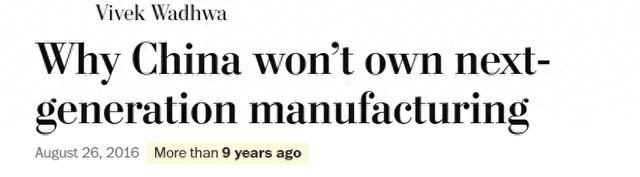
Core Viewpoint - The article critiques a 2016 prediction that China would not dominate next-generation manufacturing, highlighting how this view has been proven wrong as China's manufacturing sector continues to thrive and innovate in the face of challenges [1][2]. Summary by Sections China's Manufacturing Landscape - China's manufacturing sector has not only survived but is at the forefront of global industrial digital transformation, countering earlier predictions of its decline [2][12]. - The International Federation of Robotics reported that by 2025, China will have over 2 million industrial robots in operation, accounting for nearly half of the global total, solidifying its position as the world leader in this field [3]. Technological Advancements - Chinese companies are increasingly developing their own robotic technologies, improving their market share in critical components like control systems and servos, and are now significant players in the global market [5][8]. - The ability to rapidly scale production and refine prototypes in real industrial environments has become a core competitive advantage for China, shifting the focus from merely having advanced algorithms to actual implementation and scalability [8][10]. Engineering Talent and Education - China boasts the largest and most comprehensive engineering talent pool globally, with over 5 million STEM graduates entering the workforce annually, and a growing emphasis on quality in engineering education [9][10]. - Major Chinese companies like Huawei and BYD leverage their engineering talent as a core asset, investing heavily in R&D to create a complete chain from basic research to engineering realization [10]. Global Manufacturing Role - China's manufacturing ecosystem is characterized by a robust industrial system, efficient infrastructure, and a large market, which collectively provide a competitive edge beyond just low labor costs [15][18]. - The narrative around China's manufacturing has shifted from being seen as a laggard to a formidable competitor, with its role in global supply chains evolving as it moves up the value chain [15][18]. Future Outlook - The article concludes that China's manufacturing capabilities are not only viable but are essential in the global context, as the country continues to adapt and innovate despite past criticisms [18][19].
【太平洋科技-每日观点&资讯】(2025-09-23)
远峰电子· 2025-09-22 11:09
Market Performance - The main board led the gains with notable increases in stocks such as Hu塑控股 (+10.13%), 徕木股份 (+10.04%), and 冠捷科技 (+10.04%) [1] - The ChiNext board saw significant growth with 长盈精密 (+20.01%) and 鸿富瀚 (+20.01%) leading the charge [1] - The Sci-Tech Innovation board was also strong, with 中科蓝讯 (+20.00%) and 芯原股份 (+17.34%) showing impressive performance [1] - Active sub-industries included SW Consumer Electronics Components and Assembly (+6.64%) and SW Digital Chip Design (+5.72%) [1] Domestic News - A new project for the ARAI glasses by 艾邦 was signed, with a total investment exceeding 300 million yuan and a target annual production capacity of 1 million sets [1] - Huawei announced two patents related to silicon carbide heat dissipation, aimed at improving the thermal management of electronic devices [1] - 联发科 launched the Dimensity 9500 flagship 5G AI chip, utilizing TSMC's 3nm process and achieving significant performance improvements over its predecessor [1] - KLA reported that TSMC has secured orders for its first-generation 2nm process from about 15 clients, indicating strong demand driven by AI applications [1] Company Announcements - 艾融软件 announced a cash dividend of 0.50 yuan per 10 shares, totaling 10,444,165 yuan [3] - 并行科技 plans to purchase AI computing servers and related equipment for a total contract amount not exceeding 113.39 million yuan [3] - 力鼎光电 declared a cash dividend of 0.30 yuan per share, amounting to 123,205,200 yuan [3] - 波长光电 announced a cash dividend of 0.5 yuan per 10 shares [3] Overseas News - Ericsson secured an 8-year contract worth 12.5 billion Swedish Krona (approximately 1.33 billion USD) to provide 5G communication equipment for Vodafone's UK network [1] - Ibiden plans to increase the production of integrated circuit packaging substrates for AI servers, expecting a 150% increase by 2027 compared to 2024 levels [1] - The U.S. House recently passed an amendment prohibiting the military from purchasing digital display technology from Chinese or Russian state-owned enterprises [1] - JK Materials announced its first order for OLED panel film materials, which are crucial for improving panel yield in smartphone production [1]

爱立信获英国百亿5G合同
Guan Cha Zhe Wang· 2025-09-22 10:13
Core Insights - Ericsson has signed an 8-year contract worth 12.5 billion Swedish Krona (approximately 9.467 billion RMB) with Vodafone Three to provide 5G communication equipment in the UK [1][4] - Vodafone Three was formed from the merger of Vodafone and CK Hutchison's Three UK, and plans to invest 11 billion GBP (approximately 105.64 billion RMB) over the next 10 years to establish an advanced independent 5G network in Europe [1][4] - Vodafone Three is now the largest operator in the UK with approximately 28.8 million users [1] Group 1 - The contract positions Ericsson as a major supplier for the core network across the UK, providing hardware, software, and solutions [4] - Ericsson will introduce new 5G products, including AI and energy-optimized hardware, to enhance data speeds for customers in London, Edinburgh, Cardiff, and Belfast [4] - Nokia is also a supply partner for Vodafone Three, providing equipment for around 7,000 sites in the UK [4]



【奋楫前行•强国建设新高度】制造业由大到强攀高向优
Zhong Guo Jing Ji Wang· 2025-08-14 08:43
Core Viewpoint - China's manufacturing industry has significantly enhanced its comprehensive strength and international influence during the "14th Five-Year Plan" period, maintaining its position as the world's largest manufacturing nation for 15 consecutive years, with an annual manufacturing value added exceeding 30 trillion yuan [2]. Group 1: Manufacturing Strength - China's manufacturing industry has ranked first globally in the production of over 200 major industrial products [2]. - The country has the most complete industrial categories and systems in the world, leveraging its existing foundation to reshape new advantages and unleash new momentum in manufacturing [2]. Group 2: Innovation and Technology - The number of high-tech enterprises reached 463,000 in 2024, 1.7 times that of 2020, with over 570 industrial enterprises entering the global R&D investment top 2500, accounting for nearly one-fourth [4]. - Major landmark achievements in technology, such as 5G communication equipment and large LNG ships, are continuously emerging, showcasing China's leading position globally [4][5]. - The annual production of integrated circuits increased by 72.6% compared to the end of the "13th Five-Year Plan," adding approximately 190 billion pieces [5]. Group 3: Industrial Structure Optimization - The proportion of value added from high-tech manufacturing and equipment manufacturing has increased, with high-tech manufacturing accounting for 16.3% in 2024, up from 15.1% in 2020 [6]. - The density of industrial robots has risen from 246 units per 10,000 people in 2020 to 470 in 2023, indicating a trend towards greater automation [6]. Group 4: Green Transformation - By 2024, there are 6,430 national-level green factories, contributing to approximately 20% of the total manufacturing output value [7]. - The sales volume of new energy vehicles reached 12.866 million units in 2024, which is 9.4 times that of 2020 [7]. Group 5: Emerging Industries - New emerging industries, represented by new energy vehicles, lithium batteries, and photovoltaic products, have seen exports surpassing 100 billion yuan [8]. - The technology level and market competitiveness in fields such as low-altitude economy, biomedicine, and high-end equipment have significantly improved [8].

【奋楫前行 强国建设新高度】制造业由大到强攀高向优
Zhong Guo Jing Ji Wang· 2025-08-14 08:35
Core Viewpoint - China's manufacturing industry has significantly enhanced its comprehensive strength and international influence during the "14th Five-Year Plan" period, maintaining its position as the world's largest manufacturing country for 15 consecutive years, with an annual manufacturing value added exceeding 30 trillion yuan [2]. Group 1: Manufacturing Strength - China's manufacturing industry has maintained its global leadership, producing over 200 major industrial products with the highest output in the world [2]. - The country has the most complete industrial categories and systems globally, leveraging its existing foundation to reshape new advantages and unleash new momentum in manufacturing [2]. Group 2: Innovation and Technology - The number of high-tech enterprises reached 463,000 in 2024, 1.7 times that of 2020, with over 570 industrial companies entering the global R&D investment top 2,500, accounting for nearly one-fourth [4]. - Significant technological achievements include advancements in 5G communication equipment, high-speed trains, photovoltaic equipment, large aircraft, and large LNG ships, all at the world-leading level [4][5]. - The annual output of integrated circuits increased by 72.6% compared to the end of the "13th Five-Year Plan," adding approximately 190 billion units [5]. Group 3: Industrial Structure Optimization - The proportion of value added from high-tech manufacturing and equipment manufacturing has increased, with high-tech manufacturing accounting for 16.3% in 2024, up from 15.1% in 2020 [6]. - The density of industrial robots has risen significantly, from 246 units per 10,000 people in 2020 to 470 in 2023 [6]. Group 4: Green Transformation - By 2024, there were 6,430 national-level green factories, contributing to about 20% of the total manufacturing output value [7]. - New energy vehicle sales reached 12.866 million units in 2024, a 9.4-fold increase from 2020 [7]. Group 5: Emerging Industries - Emerging industries, represented by new energy vehicles, lithium batteries, and photovoltaic products, have become new engines of economic growth, with exports surpassing 100 billion yuan [8]. - The technology level and market competitiveness in low-altitude economy, biomedicine, and high-end equipment sectors have significantly improved [8].

制造业由大到强攀高向优
Jing Ji Ri Bao· 2025-08-04 22:07
Core Insights - China's manufacturing industry has made significant strides in innovation and competitiveness during the "14th Five-Year Plan" period, maintaining its position as the world's largest manufacturing nation for 15 consecutive years [1][2][6] Group 1: Scale and Competitiveness - The scale advantage of China's manufacturing sector has been continuously reinforced, with a complete industrial system and strong supply capabilities driving global competitiveness [2] - The number of high-tech enterprises in China is projected to reach 463,000 by 2024, a 1.7-fold increase from 2020, highlighting the enhancement of independent innovation capabilities [2][6] - China's industrial enterprises accounted for nearly one-fourth of the global top 2,500 R&D spenders, showcasing the growing role of leading technology companies in industrial innovation [2] Group 2: Innovation and Technological Advancements - The production of integrated circuits is expected to increase by 72.6% by 2024, adding approximately 190 billion units, indicating a significant shift towards domestic technology [3] - Major breakthroughs have been achieved in high-speed rail, marine engineering, and emerging technologies such as AI and quantum science, with multiple global firsts being recorded [3][6] Group 3: Structural Optimization - The digital transformation of manufacturing is seen as a key driver for new industrialization, with traditional industries integrating digital technologies to enhance productivity [4] - The proportion of high-end manufacturing in the industrial value added has steadily increased, with high-tech manufacturing's share rising from 15.1% in 2020 to 16.3% in 2024 [5] - By 2024, the number of national-level green factories is expected to reach 6,430, contributing to approximately 20% of the total manufacturing output value [5] Group 4: New Quality Productivity - The manufacturing sector has become a primary arena for cultivating new quality productivity, with rapid growth in high-tech industries and the digital economy [6] - Emerging industries, particularly in new energy vehicles, lithium batteries, and photovoltaic products, have become new engines for economic growth, with exports surpassing 1 trillion yuan [6] Group 5: Challenges and Future Directions - Despite advancements, there remains a significant gap in R&D innovation and corporate competitiveness compared to the U.S., with China's manufacturing sector needing to enhance its core technology capabilities and brand quality [7] - Key areas for improvement include strengthening independent control over core technologies, enhancing the stability and competitiveness of supply chains, and promoting a comprehensive green transformation in manufacturing [7][8]