
AI云业务

Search documents
\十五五\政策背景下房地产周期:环球市场动态2026年3月20日
citic securities· 2026-03-20 05:30
Market Overview - Global markets faced pressure due to geopolitical tensions, with A-shares declining and oil and gas stocks rising against the trend[3] - European markets experienced significant declines, with the Eurozone Stoxx 600 down 2.4% and the UK FTSE 100 down 2.3%[7] - US stocks also fell, with the Dow Jones down 0.4% and the S&P 500 down 0.3%, although losses narrowed towards the end of the trading session[8] Commodity and Forex Trends - Gold prices fell over 3% for the seventh consecutive trading day, closing at $4,650.02 per ounce[25] - Brent crude oil saw volatility, closing up 1.18% at $108.65 per barrel, while NY crude oil dropped 0.8% to $95.55 per barrel[25] - The US dollar index decreased by 0.9%, while the euro appreciated by 1.2% against the dollar[24] Fixed Income Market - The Bank of England's hawkish stance led to a significant drop in UK bonds, with the two-year yield rising by 30 basis points to 4.40%[29] - US Treasury yields showed mixed movements, with the 10-year yield at 4.25% after a slight decline[29] Real Estate Sector Insights - The "14th Five-Year Plan" indicates a shift towards high-quality development in China's real estate sector, with sales expected to stabilize and interest rates potentially rising moderately during this period[5] - The Chinese government reported a 3.6% year-on-year increase in general public budget expenditure for January-February[5] Stock Performance Highlights - Alibaba's Q3 revenue was below expectations, with a 1.7% year-on-year increase, while its cloud business grew by 36%[11] - In the Hong Kong market, the Hang Seng Index fell by 2.02%, with technology stocks underperforming due to hawkish signals from the Fed[9]
野村东方国际证券2026年A股策略展望
野村东方国际证券· 2026-01-30 11:11
Core Insights - The article highlights the significant correlation between the performance of global markets in 2025 and advancements in AI computing power, with the US stock market leading the gains due to its AI development [3] - The liquidity landscape has changed, with participation from insurance funds, passive funds, and high-net-worth individuals driving market strength, contrasting with previous bull markets that relied on leveraged funds and thematic/active funds [3][6] - For 2026, the A-share market is expected to experience structural differentiation, characterized by industry, profit and loss, and domestic versus external demand disparities [5][6] Group 1: Market Performance and Trends - The US stock market performed best in 2025, followed by South Korea and Japan, due to active AI-related industries [3] - The Hang Seng Tech Index, with a high proportion of AI cloud business, attracted significant capital allocation [3] - A-share micro-cap stocks and the banking sector showed strong performance supported by improved liquidity [3] Group 2: Structural Differentiation in A-shares - The A-share market is anticipated to enter a second phase of structural differentiation in 2026, with the tech sector's profit contributions continuing to encroach on financial and real estate sectors [5] - Despite overall profit growth in A-shares, more than half of the companies may experience declining profit growth [5] - Companies with high overseas revenue contributions (over 20%) are expected to account for more than 25% of net profit, indicating a shift in market dynamics [5][6] Group 3: Profit and Revenue Forecasts - The net profit growth forecast for the CSI 300 Index has been raised to 7.2% and 8.4% for 2026 and 2027, respectively, with profits expected to be the main contributor to returns [7] - Revenue growth forecasts for the CSI 300 Index have been adjusted to 5.3% and 10.6% for 2026 and 2027, respectively [7] - The financial sector's high profit base may pose a drag on overall profit growth for the CSI 300 [7] Group 4: Investment Focus Areas - Investors are advised to focus on three main lines: 1. "Intelligent manufacturing going global," emphasizing high-value manufacturing sectors such as AI hardware, innovative pharmaceuticals, new energy, automotive, engineering machinery, and military industries [9] 2. "Aesthetic consumption going global," highlighting opportunities in Chinese consumer goods, including inbound tourism, short dramas, cultural and creative toys, mobile games, console games, and new-style tea beverages [9] 3. "Incremental capital becoming passive," focusing on the marginal liquidity increase from balanced funds and individual investors increasing their holdings in ETFs [9]


未知机构:资金回归传统算力板块机构放量买入纯股基可转债基情绪大幅回落2026012-20260128
未知机构· 2026-01-28 02:00
Summary of Key Points from Conference Call Records Industry Overview - The focus is on the traditional computing power sector, with significant institutional buying in pure equity funds and a notable decline in sentiment towards convertible bond funds [1][2] - The precious metals market remains a key focus, with COMEX gold and silver experiencing volatility but recovering due to news of Zijin Mining's overseas acquisitions [2] Market Dynamics - The stock market experienced significant selling pressure early in the day, with over 4,500 stocks declining, but later recovered to close up 0.14% [1] - The overall trading volume decreased by 360 billion, falling to 2.92 trillion [1] - Growth sectors such as technology and emerging industries saw substantial gains, while traditional sectors like CPO, semiconductor, and storage rebounded sharply [1][2] Investment Trends - Institutional funds showed a continued increase in positions in equity assets, with a shift towards pure equity funds, indicating a potential influx of higher-risk capital [2][3] - The net subscription ratio for passive equity funds was reported at 1.61%, with significant buying from wealth management subsidiaries [3] - The net subscription ratio for active equity funds was slightly higher at 1.62%, with all institutions increasing their positions [3] Sector-Specific Insights - The automotive and machinery sectors received 40% of the inflows, followed by electronics, communications, and new energy [4] - The top sectors for increased investment included electronics, banking, automotive, new energy, and non-bank financials [5] - The convertible bond market saw a net subscription ratio of 0.27%, but overall buying volume significantly decreased compared to the previous two weeks [5] Risk Considerations - The convertible bond market is facing supply-demand imbalances, which could lead to significant volatility if demand weakens [2] - The lithium battery sector experienced a sharp decline due to a sudden drop in lithium carbonate prices, highlighting localized risks [2] Conclusion - The market is currently characterized by a return to traditional computing power investments, with a mixed sentiment in the convertible bond space and a focus on growth sectors. The overall trading environment remains cautious, with attention to sector-specific dynamics and potential risks.
百度集团-SW:4Q经营现金流持续为正,昆仑芯上市有望持续释放估值-20260123
海通国际· 2026-01-23 00:24
Investment Rating - The report maintains an "OUTPERFORM" rating for Baidu Group [2] Core Views - Baidu's operating cash flow is expected to remain positive in Q4, supported by prudent spending and the integration of AI tools in operations [4][13] - The listing of Kunlun Chip (KLX) is anticipated to unlock significant valuation for Baidu, with potential revenue comparable to Cambricon [5][14] - Apollo Go is set to accelerate its global expansion in 2026, which may further support Baidu's stock performance [15] Financial Summary - Baidu's revenue for FY25 is projected at RMB 128.7 billion, a decrease of 2.4% year-on-year, with a net profit of RMB 18.6 billion, down 31% [3][11] - The core business is expected to generate an adjusted operating profit of RMB 14.1 billion, corresponding to a margin of 13.8% [11] - For Q4, total core revenue is estimated at RMB 25.8 billion, reflecting a year-on-year decline of 6.9% but a quarter-on-quarter increase of 4.5% [12] Valuation and Recommendations - The report employs a Sum-of-the-Parts (SoTP) valuation method, estimating a total market cap of approximately HK$481.8 billion or a target price of HK$178, corresponding to a 24x PE for FY26 [6][14] - The valuation breakdown includes traditional search ads, AI cloud, AI SaaS, AI ads, and other segments, with significant contributions from the Robotaxi and Kunlun Chip businesses [6][15]

华泰证券今日早参-20260112
HTSC· 2026-01-12 07:22
Group 1: Macroeconomic Insights - The forecast for the US GDP growth in 2026 has been raised to 2.6%, up from a previous estimate of 2.3%, driven by factors including the upcoming midterm elections and potential policy changes from the Trump administration [2][3] - The report highlights a potential rebound in inflation in the second half of 2026, despite a slight downward adjustment in inflation predictions due to various economic factors [2][3] - Structural issues in the US economy, such as asset price inflation and income inequality, are expected to worsen, indicating a "K-shaped" recovery [2][3] Group 2: Real Estate Policies - The Trump administration has announced a series of real estate policies aimed at stimulating demand, including a $200 billion mortgage-backed securities purchase plan and restrictions on large institutional investors in the single-family housing market [3][4] - These measures are expected to provide marginal support to the real estate market but may not effectively address housing affordability issues [3][4] Group 3: Employment Data - In December, the US added 50,000 non-farm jobs, falling short of the Bloomberg consensus estimate of 70,000, with the unemployment rate decreasing to 4.4% [5] - The labor participation rate declined to 62.4%, while hourly wage growth showed a slight increase, indicating a mixed employment landscape [5] Group 4: Sector Performance - The report suggests that the A-share market is experiencing a "spring rally," with a focus on sectors such as gaming, duty-free, batteries, engineering machinery, and agricultural chemicals for potential investment opportunities [7] - The Hong Kong stock market is expected to benefit from a combination of factors, including improved liquidity and upward revisions in profit expectations [8] Group 5: REITs Market - Recent policies from the China Securities Regulatory Commission and stock exchanges are expected to enhance the REITs market, promoting high-quality development amid OCI disturbances [22] - The report indicates that the REITs market may experience improved sentiment and quality as it enters a new phase of development [22] Group 6: Semiconductor Industry - The report emphasizes the growing demand for cleanroom facilities in the semiconductor industry, driven by increased capital expenditure from global tech giants [23] - The cleanroom engineering services sector is expected to see a rise in order rates, benefiting from the demand for advanced manufacturing processes [23]



AI云业务被严重低估?富国:市场悲观过头,甲骨文存在50%上涨空间
美股IPO· 2025-12-23 00:51
Group 1 - The core viewpoint of the report is that Oracle's stock has nearly 50% upside potential due to its strong AI cloud infrastructure, with a target price reaching $285 [1][4][5] - The report emphasizes that Oracle's undervalued AI cloud business exposure will be a key driver supporting its bullish stock outlook [4][8] - Analysts suggest that if AI applications accelerate, Oracle's stock could face significant rebound opportunities, contrasting with the prevailing cautious sentiment in the market [7][10] Group 2 - The report argues that the current pessimism surrounding AI investments is overblown, presenting a significant value re-evaluation opportunity for Oracle [3][10] - Oracle's recent expansion in AI data centers and partnerships positions it favorably against competitors [9] - The report challenges the mainstream narrative that scrutinizes high valuations of tech giants, asserting that Oracle's fundamentals are stronger than market expectations [10][11]
AI云业务被严重低估?富国:市场悲观过头,甲骨文存在50%上涨空间
Hua Er Jie Jian Wen· 2025-12-22 13:54
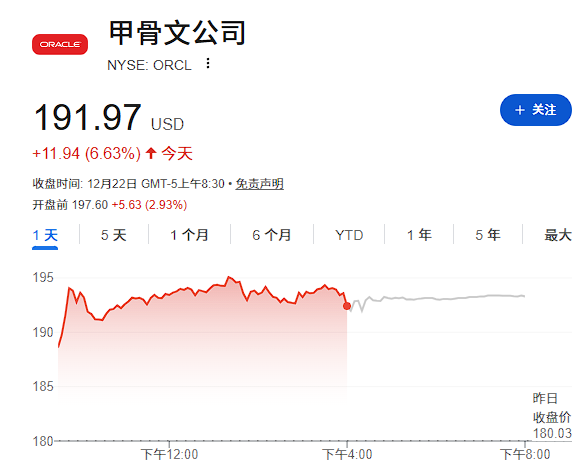
Core Viewpoint - Wells Fargo believes that the current pessimism surrounding AI investments is "overdone," and Oracle is facing a significant opportunity for value re-evaluation due to its undervalued AI cloud business [1][4]. Group 1: Oracle's Stock Potential - According to Wells Fargo's report, Oracle's stock price has an implied upside of nearly 50%, with a potential target price of $285, up from approximately $190 as of December 21, 2025 [1][5]. - The optimistic outlook is presented against a backdrop of volatility in the tech sector and growing concerns about high valuations and slowing growth for AI-driven companies [1][4]. Group 2: Market Sentiment and AI Integration - The report emphasizes that Oracle's robust cloud infrastructure and AI integration are undervalued assets, positioning the company favorably against competitors [4]. - Analysts argue that the current market's pessimism towards the AI sector stems from scrutiny of tech giants' high valuations, overshadowing the actual growth potential of companies like Oracle [4][5]. Group 3: AI Investment Growth - The report projects that global AI investment will reach $200 billion by 2025, with Oracle poised to benefit from this growth through its technological advancements [5].
比特币矿场转型AIDC:现状与展望
GOLDEN SUN SECURITIES· 2025-12-12 11:58
Investment Rating - The report maintains an "Accumulate" rating for the industry [6] Core Insights - In recent years, several Bitcoin mining companies have partnered with AI cloud providers, utilizing part of their electricity for GPU hosting and developing AIDC (AI Data Center) businesses, with contracts totaling $53.6 billion and involving 1.959 GW of power [1][11] - The market perceives that Bitcoin mining companies primarily have an advantage in electricity resources compared to other AIDC competitors, but many have prior experience in self-operated cloud services [4][10] - The report suggests that companies with more AI electricity capacity tend to have higher market valuations, with average valuations of $4.73 million/MW for total electricity, $12.26 million/MW for mining electricity, and $144 million/MW for AI electricity [4][55] Summary by Sections 1. Current Status of Bitcoin Mining Transformation to AIDC - As of November 3, 2025, six Bitcoin mining companies have signed contracts with at least five cloud providers, totaling $53.6 billion and involving 1.959 GW of power [1][11] - Over 50% of the AI cloud providers that signed contracts with Bitcoin mining companies are emerging firms, with Coreweave being the largest [2][13] - The average contract duration for AIDC projects is 14 years, with a minimum of 5 years and a maximum of 25 years [3][24] - The average price for key IT load contracts is $1.73 million/MW/year, indicating a consistent pricing structure across projects [3][27] 2. Reasons and Models for Transformation - The transition to AIDC is driven by the uncertainty in revenue and profitability from Bitcoin mining, which faces challenges such as fluctuating prices and increasing competition [33][35] - AIDC offers higher gross margins compared to Bitcoin mining, with various projects reporting net operating income margins between 80% and 88% [40][39] 3. Self-Operated Cloud Services by Mining Companies - Companies like Iris Energy, Hive Digital, and Bitdeer are actively developing self-operated AI cloud services, with Iris Energy expected to operate 140,000 GPUs by the end of 2026 [43][47] - Bitdeer plans to operate 1,160 GPUs by the end of 2025, while Hive Digital aims to exceed 11,000 GPUs by the end of 2026 [44][51] 4. Future Outlook for AIDC Transformation - The report anticipates an acceleration in the transformation of Bitcoin mining companies to AIDC, as companies with more AI electricity capacity are valued higher in the market [55] - The report highlights the importance of companies having substantial electricity reserves and experience in AI cloud services for future investment opportunities [4][55]






大行评级丨高盛:金山云第三季经调整EBITDA超预期 目标价微升至13.8美元
Ge Long Hui· 2025-11-20 05:22
Core Insights - Goldman Sachs reports that Kingsoft Cloud's Q3 revenue growth accelerated to 31% year-on-year, surpassing the previous quarter's 24% growth and meeting market expectations [1] Revenue Performance - AI cloud business revenue grew by 7% quarter-on-quarter and 116% year-on-year, accounting for 32% of total Q3 revenue [1] - Revenue from related parties, such as Xiaomi and the Kingsoft ecosystem, increased by 84% year-on-year, up from 70% in the previous quarter, driven by stronger AI training demand, representing 28% of total revenue [1] Profitability Metrics - Adjusted EBITDA reached 652 million yuan, exceeding both Goldman Sachs' and market expectations by 8% and 9% respectively, after excluding approximately 170 million yuan in one-time government subsidies [1] - Adjusted EBITDA margin improved by 14 and 9 percentage points year-on-year and quarter-on-quarter, reaching 26.3% [1] Future Projections - The firm raised its revenue forecasts for Kingsoft Cloud for 2026 and 2027 by 3% to 5%, and adjusted EBITDA forecasts by 5% to 7% [1] - The target price for US stocks was slightly increased from $13.5 to $13.8, maintaining a "Neutral" rating [1]
百度20251118
2025-11-19 01:47
Summary of Baidu's Q3 2025 Earnings Call Company Overview - **Company**: Baidu - **Quarter**: Q3 2025 - **Total Revenue**: 31.2 billion RMB, a decrease of 7% year-over-year [2][13] - **Core Revenue**: 24.7 billion RMB, with online marketing revenue at 15.3 billion RMB, down 18% year-over-year [13] Key Highlights Financial Performance - **Non-Advertising Revenue**: 9.3 billion RMB, up 21% year-over-year, driven by AI cloud business [2][13] - **AI Cloud Infrastructure Revenue**: 4.2 billion RMB, up 33% year-over-year [2][13] - **Subscription-based AI Accelerator Revenue**: Increased by 128% year-over-year [2][4] - **Operating Loss**: 15.1 billion RMB, with a net loss of 11.2 billion RMB, translating to a diluted loss per share of 33.88 RMB [14][21] AI Cloud Business - **Growth Drivers**: Strong demand for AI products and solutions, with a shift towards sustainable recurring revenue models [4][16] - **Long-term Asset Impairment**: 16.2 billion RMB due to outdated infrastructure not meeting current efficiency requirements [4][14] Autonomous Driving (Apollo Go) - **Service Growth**: Provided 3.1 million fully autonomous rides, a 212% increase year-over-year [2][6] - **Geographic Expansion**: Coverage in 22 cities, with international expansion into Switzerland, Abu Dhabi, Dubai, and Hong Kong [6][18] Ernie Model Development - **Ernie 5.0 Launch**: Introduced the first native full-language model, excelling in language understanding and creative writing [7][15] - **Impact on Business**: Supports various applications, enhancing enterprise efficiency across sectors [15] Agent and Digital Human Technology - **Revenue Growth**: Generated 2.8 billion RMB, a 262% increase year-over-year [8][14] - **Applications**: Utilized in healthcare, automotive, and legal services, improving lead conversion rates for advertisers [8] Mobile Ecosystem Innovations - **AI-Generated Content**: Approximately 70% of mobile search results feature AI-generated content, enhancing user experience [12][19] - **User Engagement**: Increased user retention and interaction time, with a 6% rise in AI search queries [12][19] Future Outlook AI Business Growth - **Investor Transparency**: New classification views for AI applications to enhance visibility of underlying value drivers [17][18] - **Sustainable Revenue Growth**: Anticipated increase in revenue and profit margins from AI applications and services [17][18] Shareholder Returns - **Stock Buyback**: $2.3 billion worth of stock repurchased in 2023, with plans for future buybacks and potential dividend policies [4][21] Capital Expenditure - **Investment in AI**: Over 10 billion RMB invested in AI technologies, with plans for continued investment to enhance operational efficiency [20][21] Conclusion - **Overall Assessment**: Despite a decline in total revenue, Baidu's strategic focus on AI and cloud services, along with significant growth in autonomous driving and digital human technologies, positions the company for future growth and innovation in the rapidly evolving tech landscape [2][4][18]