
Apple Glass

Search documents
报道称苹果正开发可穿戴AI别针,预计2027年推出
硬AI· 2026-01-22 07:34
Core Viewpoint - Apple is developing an AI-driven wearable pin device, currently in early stages and subject to cancellation, with a target production of 20 million units [2][4]. Group 1: Product Details - The device is similar in size to the AirTag, featuring a flat circular design with aluminum and glass casing [3]. - It will include standard and wide-angle cameras for capturing images and photos nearby [3][9]. - The device will have three microphones, a speaker, and a magnetic charging interface similar to the Apple Watch [8]. - Unlike the AirTag, this device will feature a physical button, and the camera configuration is a core functionality [9]. - Expected to be powered by Apple's Apple Intelligence technology, specific AI functionalities are not yet disclosed [10]. Group 2: Market Challenges - Previous attempts at AI pins, such as Humane AI Pin and Rabbit R1, have failed to achieve market success, with Humane AI Pin ceasing operations in February 2025 [12]. - Rabbit R1 struggled to gain traction despite a more affordable positioning, remaining within a niche market [13]. - The challenges faced by these prior products highlight the difficulties Apple may encounter in launching its AI pin [12][13]. Group 3: Broader AI Hardware Strategy - The AI pin is part of Apple's broader exploration of AI hardware, which includes the development of Apple Glass, AirPods with cameras, and Apple Ring [5][16]. - Apple Glass is anticipated to launch by the end of 2026, potentially incorporating augmented reality features by 2027 [16]. - AirPods with built-in cameras are also being considered, designed to work in conjunction with the iPhone [17]. - Apple Ring is under discussion as a control device rather than a standalone AI product [18].



苹果传闻开发可穿戴AI别针,预计2027年推出
Hua Er Jie Jian Wen· 2026-01-22 00:08
Core Viewpoint - Apple is developing an AI-driven wearable pin device, currently in early stages and subject to cancellation, with a potential release date as early as 2027 and a production target of 20 million units [1] Design Details and Core Functions - The AI pin will feature a flat disc design similar to AirTag, equipped with two cameras (standard and wide-angle), three microphones, a speaker, and a physical button, with a magnetic charging interface akin to the Apple Watch [2] - The device aims to provide comprehensive visual capture capabilities, driven by Apple's Apple Intelligence technology, although specific AI functionalities remain undisclosed [2] Market Challenges and Previous Attempts - Previous attempts at AI pins, such as Humane AI Pin and Rabbit R1, have failed to meet market expectations, with Humane ceasing operations in February 2025 and Rabbit R1 struggling to gain traction [3] - Notably, Jony Ive and OpenAI's CEO Sam Altman are reportedly working on a prototype for an OpenAI device expected to launch in 2027, which may resemble smart glasses or an AI pin [3] Multi-Line AI Hardware Strategy - The AI pin is part of Apple's broader strategy in the wearable AI sector, with plans for Apple Glass smart glasses potentially launching by the end of 2026, incorporating audio and camera functionalities along with augmented reality features by 2027 [4] - Apple is also considering AirPods with built-in cameras and the Apple Ring smart ring, which is viewed more as a control device rather than an independent AI product [5]
AI浪潮转向硬科技 专家:2026年大概率成为AI手机元年
Mei Ri Jing Ji Xin Wen· 2025-12-25 14:57
Core Insights - In 2025, DeepSeek emerged, significantly lowering the application cost and threshold of AI technology, leading to a boom in vertical applications and a shift in industry competition from single model comparisons to full-stack ecosystem battles [1] - The AI landscape is transitioning from a dominance of OpenAI to a multi-polar competition, with applications expanding from software to intelligent hardware [1][2] - The "Hundred Mirrors War" in AI hardware is intensifying, with major tech companies investing heavily in AI glasses and smartphones, marking a significant shift in human-computer interaction [6] Group 1: AI Application Market Dynamics - The introduction of DeepSeek in February 2025 has drastically reduced AI inference costs, spurring growth in vertical applications such as AI in health, education, and office settings, leading to a reshuffling of the AI application market [2] - User data shows a concentration effect, with DeepSeek achieving an average monthly download of 34.72 million and ByteDance's Doubao at 31.44 million, dominating the general AI assistant market [2] - Vertical scenarios are becoming crucial for AI applications, evolving from language Q&A and content generation to multi-task intelligent agents across various industries [2][3] Group 2: Hardware Developments and Market Trends - McKinsey predicts a surge in vertical AI intelligent agents by 2025, with over 70% of AI value potential expected to come from these applications [3] - The global smart glasses market saw a shipment of 4.065 million units in the first half of 2025, a 64.2% year-on-year increase, with China accounting for 26.6% of the market share [6] - The global smart glasses market is projected to reach $42 billion by 2030 and $117 billion by 2040, despite facing challenges in technology maturity and privacy compliance [6] Group 3: Future Growth Areas - Key growth points in the AI field for 2026 include large models with continuous learning capabilities, real-time interactive 3D models, and seamless intelligent agents that integrate tools, data, and workflows [4] - The AI smartphone market is expected to see a shipment of 147 million units in China in 2026, a 31.6% year-on-year growth, capturing 53% of the overall market [8] - The "Doubao phone" model is gaining attention, with a focus on a multi-to-multi intelligent connection ecosystem, avoiding a zero-sum game in the internet ecosystem [9]
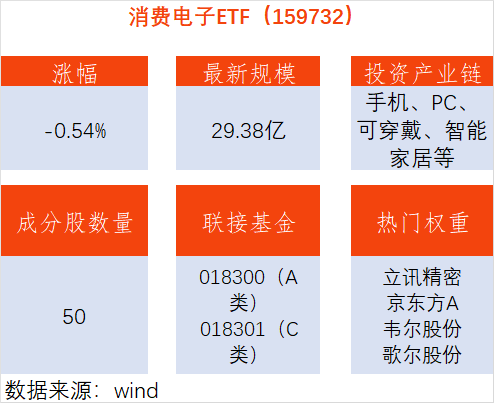
Apple Glass将于2026年发布,消费电子ETF(159732.SZ)下跌0.54%显分化,信维通信上涨7.96%
Sou Hu Cai Jing· 2025-12-25 02:16
Group 1 - The A-share market showed mixed performance on December 25, with the Shanghai Composite Index rising by 0.07%, while sectors such as defense, non-bank financials, and real estate performed well, whereas metals and composites lagged behind [1] - The Consumer Electronics ETF (159732.SZ) decreased by 0.54%, with individual stocks like Xinwei Communication rising by 7.96%, Changying Precision increasing by 2.94%, Dongshan Precision up by 2.26%, and Shengbang Technology gaining 1.95%. In contrast, stocks like Jinghe Integrated and Jingce Electronics saw declines of -3.24% and -2.64%, respectively [1] Group 2 - Apple plans to release its first smart glasses, Apple Glass, in 2026, with a formal launch in 2027. The product is positioned as a smart wearable accessory rather than a standalone device, featuring a SiP chip similar to that used in the Apple Watch [3] - The SiP chip, exemplified by the latest S10 model, includes a dual-core CPU and a quad-core NPU, achieving performance levels comparable to older iPhone chips while maintaining low power consumption, potentially allowing for all-day battery life [3] - The AR/AI glasses industry is at a pivotal point of growth, with major companies entering the market, and new products are expected to become the next generation of smart terminals, potentially replacing smartphones after headphones and smartwatches [3] - The Consumer Electronics ETF (159732) tracks the Guozheng Consumer Electronics Index, primarily investing in 50 A-share listed companies involved in the consumer electronics industry, with significant focus on electronic manufacturing, semiconductors, and optical electronics [3]

苹果计划2026年发布首款智能眼镜Apple Glass,消费电子ETF(561600)冲击5连涨
Xin Lang Cai Jing· 2025-12-25 02:03
Group 1 - The core viewpoint of the articles highlights the growth and innovation in the consumer electronics sector, particularly with the introduction of AI capabilities in devices like smartphones and smart glasses [1][2]. - The Zhongzheng Consumer Electronics Theme Index (931494) has shown a slight increase of 0.15%, with key stocks such as Shengbang Co., Ltd. (300661) and Beijing Junzheng (300223) experiencing notable gains [1]. - Apple plans to release its first smart glasses, Apple Glass, in 2026, which will feature a lightweight design and various functionalities, including health monitoring [1]. Group 2 - The global smartphone shipment volume increased by 3% year-on-year in Q3 2025, with market revenue rising by 5%, and the average selling price (ASP) reaching a record high of $351 [2]. - High-end smartphones (priced over $600) contributed over 60% of the total revenue, with more than 80% of these devices equipped with generative AI capabilities [2]. - The top ten weighted stocks in the Zhongzheng Consumer Electronics Theme Index account for 56.39% of the index, with companies like Luxshare Precision (002475) and Cambricon Technologies (688256) among the leaders [2].
消费电子行业周报:AppleGlass于2026年发布,XREAL1S将搭载X1空间计算芯片-20251224
Huaxin Securities· 2025-12-24 14:33
Investment Rating - The report maintains a recommendation for investment in the consumer electronics sector, particularly highlighting opportunities in AI glasses and related technologies [1]. Core Insights - Apple plans to release its first smart glasses, Apple Glass, in 2026, which will feature the same SiP chip as the Apple Watch, emphasizing lightweight design and low power consumption [3][4]. - The XREAL 1S, a new consumer-grade AR glasses product, was launched on December 18, 2025, featuring the X1 spatial computing chip and innovative 2D to 3D conversion capabilities, targeting a younger audience [5][15]. - The AR/AI glasses industry is expected to experience significant growth, with major companies entering the market, indicating a potential shift in consumer electronics towards new smart devices [5][15]. Summary by Sections Industry Performance - The consumer electronics sector has shown varied performance over different time frames, with a 1-month decline of 0.4%, a 3-month decline of 5.6%, and a 12-month increase of 35.5% [2]. Key Companies and Earnings Forecast - Notable companies in the sector include: - GoerTek (未评级) with an EPS forecast of 0.79 for 2024 and a PE ratio of 37.52 [8][17]. - Luxshare Precision (未评级) with an EPS forecast of 1.86 for 2024 and a PE ratio of 31.45 [8][17]. - Yujing Technology (Buy) with an EPS forecast of -1.83 for 2024 and a PE ratio of -19.43 [8][17]. - Rockchip (未评级) with an EPS forecast of 1.42 for 2024 and a PE ratio of 124.30 [8][17]. - Hengxuan Technology (未评级) with an EPS forecast of 3.86 for 2024 and a PE ratio of 78.57 [8][17]. Industry Dynamics - The smartphone market in China saw a 13% increase in sales for foreign brands in October 2025, with total smartphone sales reaching 32.27 million units, a growth of 8.7% [20]. - Apple is planning to expand its iPhone product line significantly, with at least seven new models expected by 2027, indicating a strategic shift in its product offerings [21][24].
美股AI巨头,盘前暴跌!苹果AI眼镜明年或发布,绩优概念股出炉
Zheng Quan Shi Bao Wang· 2025-12-11 10:19
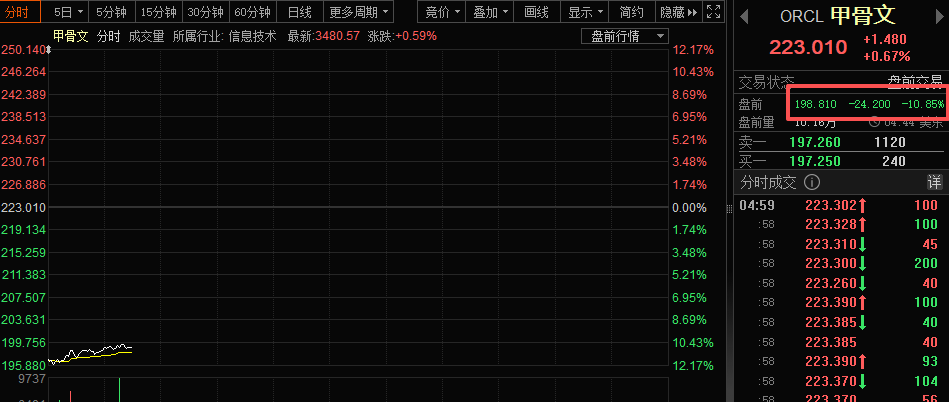
Group 1: Oracle's Performance and Market Reaction - Oracle's stock experienced a pre-market decline of over 10%, with a peak drop of 12% following the release of its Q2 FY2026 earnings report, which showed revenue of $16.06 billion, a 14% year-over-year increase, but below market expectations of $16.21 billion [1][2][3] - The company's cloud business revenue was reported at $7.98 billion, also falling short of the anticipated $8.04 billion, while its free cash flow was negative at $10 billion, raising concerns about its short-term financial health [2][3] - Despite the disappointing results, Jefferies maintained a "buy" rating on Oracle, citing a slightly better-than-expected order backlog of $523 billion, although concerns about AI-related debt financing remain unresolved [3] Group 2: AI Glasses Market Developments - Apple is expected to launch its first lightweight AI glasses, Apple Glass, in 2026, likely during the WWDC, with mass production starting in 2027; these glasses will not have independent computing capabilities and will rely on multiple cameras for photo and video capture [4][5] - The global smart glasses market is projected to see a shipment of 12.8 million units by 2025, representing a 26% year-over-year growth, with China's market expected to reach 2.75 million units, a 107% increase [5] - Various companies, including Alibaba and Li Auto, are entering the AI glasses market, indicating a growing competitive landscape [4][5] Group 3: Positive Outlook for AI Glasses Stocks - A total of 16 AI glasses stocks have seen net purchases exceeding 200 million yuan since Q4 2025, with Jiangbolong leading at 1.162 billion yuan [6][10] - Analysts predict significant profit growth for several companies in the AI glasses sector, with TCL Technology, Haopeng Technology, and Sitwei expected to see net profit growth rates of 259.7%, 176.02%, and 153.63% respectively in 2025 [9][10] - Jiangbolong is recognized as a leading independent storage manufacturer, actively advancing its domestic and international storage industry layout, which is expected to provide substantial growth opportunities [7][10]

头部企业加速布局AI眼镜!消费电子ETF(159732)上涨2.16%
Mei Ri Jing Ji Xin Wen· 2025-10-21 05:15
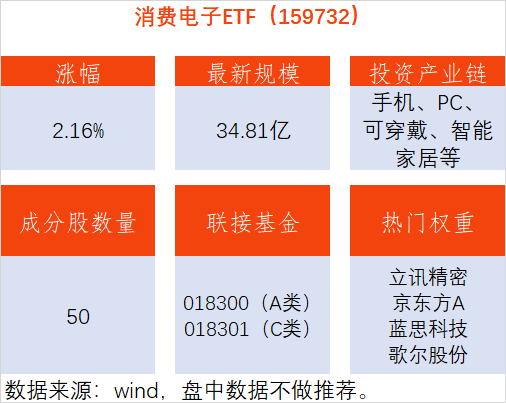
Group 1 - The A-share market saw all three major indices rise collectively, with the Shanghai Composite Index increasing by 0.62% during the session. The energy equipment, precious metals, and heavy machinery sectors led the gains, while coal and forestry sectors experienced declines [1] - The Consumer Electronics ETF (159732) showed significant strength, rising by 2.16%. Key component stocks such as Lianxu Electronics, Visionox, and Baiwei Storage saw increases of 8.32%, 7.11%, and 6.27% respectively, indicating strong performance in the consumer electronics sector [1] Group 2 - Meta launched the monocular full-color AR glasses, Meta Celeste, in September 2025, while Apple is expected to release AI glasses, Apple Glass, in 2026. Domestic manufacturers like Xiaomi, Baidu, and Huawei are also entering the market [3] - According to WellsennXR data, global AI glasses sales are projected to reach 1.52 million units in 2024, 3.5 million units in 2025, 60 million units by 2029, and potentially 1.4 billion units by 2035. This indicates a significant growth trajectory for the AI glasses market [3] - Shanghai Securities noted that AI glasses represent a form of edge AI and are at the beginning of a new consumer electronics cycle. The combination of technology and lifestyle changes, along with decreasing costs and improved ecosystems, is expected to drive industry growth [3] - The Consumer Electronics ETF (159732) tracks the Guozheng Consumer Electronics Index, primarily investing in 50 A-share listed companies involved in the consumer electronics industry, with a focus on electronic manufacturing and optical optoelectronics [3]
政策加持,巨头引领,端侧AI爆发或成中企超车良机
Cai Fu Zai Xian· 2025-10-16 06:33
Core Insights - The article discusses the significant shift of artificial intelligence (AI) from cloud-based solutions to edge computing, driven by the explosion of computing power and increasing privacy concerns. This transition is termed the "downward revolution" in AI, which is expected to create new opportunities in the industry [1][2]. Industry Developments - The Ministry of Commerce and eight other departments in China have issued guidelines to accelerate innovation in AI terminal products, emphasizing the need for collaboration between supply and demand [1][2]. - Major tech companies, including Meta, OpenAI, NVIDIA, Lenovo, and JD.com, are making significant advancements in edge AI, indicating a competitive landscape that is heating up [1][3]. - According to Tianfeng Securities, the combination of policy support and industry leadership is expected to lead to a major cycle of innovation in edge AI products, with 2026 projected to be a pivotal year [1][3]. Market Potential - The demand for edge AI is driven by user needs for real-time processing, data privacy, and personalized experiences. Edge AI reduces reliance on cloud computing resources, thereby enhancing user experience and privacy protection [2][6]. - The Chinese edge AI market is projected to grow from less than 200 billion yuan in 2023 to over 1.9 trillion yuan by 2028, with a compound annual growth rate (CAGR) of 58% [6][7]. Competitive Landscape - Companies are intensifying their efforts in edge AI, with OpenAI planning to launch several AI hardware products in the coming year, including smart speakers and smart glasses [3][6]. - Lenovo is also making strides in edge AI, with its upcoming Moto X70 Air smartphone expected to feature advanced AI capabilities, positioning it as a strong competitor to Apple's products [3][4]. Technological Innovations - The trend towards smaller AI models for edge devices is gaining traction, with companies focusing on practical performance and power efficiency rather than just increasing model parameters [7][8]. - Lenovo has introduced technologies such as model compression and inference acceleration engines to enhance the performance of AI PCs, achieving capabilities comparable to cloud-based models [9][11]. Future Outlook - The integration of edge and cloud AI is seen as crucial for enhancing overall AI performance, with companies like Lenovo developing platforms that facilitate seamless collaboration between devices [11][12]. - The maturation of model miniaturization technology and continuous upgrades in hardware components are expected to lead to a significant explosion in AI terminal products, benefiting domestic manufacturers [14].


科技行业周报:AI应用驱动算力需求高增,中美摩擦推动国产算力提速-20251013
First Shanghai Securities· 2025-10-13 15:29
Investment Rating - The report maintains a strong positive outlook on the AI application-driven demand for computing power, indicating a sustained high growth trajectory [2]. Core Insights - The report emphasizes that the domestic computing power capacity bottleneck has been broken, with expectations for a significant increase in domestic chip production by 2026. The acceleration of commercialization by overseas AI giants like OpenAI is also highlighted, maintaining high demand for computing hardware [2][3]. - The ongoing US-China tensions are not expected to alter the development trends in the AI industry, with domestic computing power making significant strides in capacity and key components [3]. Summary by Sections Domestic Computing Power Industry - The report notes a persistent tight balance in domestic computing power, with critical bottlenecks in advanced process capacity, advanced packaging, large model adaptation, and HBM supply gradually being overcome. Positive news from the industry is expected to catalyze market interest, particularly in the latter half of this year and into next year [3]. - Major Chinese internet companies like ByteDance and Alibaba are experiencing genuine demand for computing power to support their operations, particularly in recommendation and search algorithms, alongside the new demand generated by generative AI applications [3]. Investment Recommendations - Key companies in the domestic computing power hardware supply chain are recommended for attention, including Cambrian (688256), SMIC (0981.HK), and Huahong Semiconductor (1347.HK) [4]. - The report suggests focusing on leading companies in the optical module sector, such as Zhongji Xuchuang (300308) and NewEase (300502), due to the increasing demand for optical modules driven by the needs of companies like Google, Meta, and AWS [5]. AI Edge Hardware Opportunities - The report highlights the launch of AI smart glasses by Meta and the anticipated entry of OpenAI into AI hardware, with Apple also shifting focus towards smart glasses development [6][7]. - Companies involved in edge AI hardware, such as Zhaoyi Innovation (603986) and BYD Electronics (002475), are noted for their potential in the evolving market [7].
