
CMBS/CMBN

Search documents
固定收益专题:低利率环境下ABS投资价值挖掘
GOLDEN SUN SECURITIES· 2026-03-22 08:43
1. Report Industry Investment Rating No information about the industry investment rating is provided in the report. 2. Core Viewpoints of the Report - ABS plays a counter - cyclical complementary role in the investment - financing cycle, serving as an important tool for enterprises to revitalize stock assets and relieve liquidity pressure during credit contraction periods [1][13]. - In the current environment of weak entity financing demand and insufficient credit supply, ABS supply has the basis for expansion. It maintains a clear spread stratification and high - yield varieties have prominent relative advantages, while its low - volatility feature can effectively smooth net value fluctuations [4][71]. 3. Summary by Relevant Catalogs 3.1 China's Asset Securitization Development Process and Market Status - **Investment - financing cycle division**: Credit bonds are pro - cyclical, while ABS is counter - cyclical, being more sensitive to underlying asset supply, regulatory orientation, and specific market cycles [1][13]. - **Regulatory pattern**: A "tripartite confrontation" regulatory pattern has been formed, with enterprise ABS, ABN, and credit ABS having different regulatory institutions, base asset types, and issuance methods [14]. - **Twenty - year evolution**: ABS has gone through stages of exploration, normal issuance, rapid development, and structural adjustment, with the issuance scale reaching 2.31 trillion yuan at the end of 2025 [17]. - **ABS stock market**: The supply of ABS in the whole market is concentrated on core assets, with the top 10 base asset types accounting for 86.4% of the total balance [26]. 3.2 ABS Primary Supply - **Interest rate and duration characteristics**: The primary supply of ABS shows significant interest rate differentiation and is dominated by short - duration products. Credit ABS has the lowest interest rate center and the smallest fluctuation, ABN pricing is highly consistent with the whole - market credit bonds, and enterprise ABS has a relatively high interest rate [30]. - **Spread stratification**: Credit ABS is the market's safety cushion with low spreads, ABN has medium spreads and income elasticity, and enterprise ABS is the main source of spread differentiation [33]. 3.3 ABS Secondary Market and Institutional Behavior - **Liquidity of varieties**: The overall liquidity of ABS is weaker than that of traditional credit bonds, but it is improving marginally. ABN has the best liquidity, followed by enterprise ABS, and credit ABS has the weakest liquidity [2][38]. - **Liquidity differentiation of base assets**: Assets with good credit, stable cash flows, and high standardization have high turnover rates, while bank credit and real - estate assets have low turnover rates [39]. - **Change in holder structure**: The holder structure of ABS is transforming from bank - dominated to diversified participation. In the inter - bank market, large - state - owned banks reduce their holdings while joint - stock banks increase theirs. In the exchange market, non - bank institutions such as insurance, public funds, and trusts are becoming new incremental funds [46][50]. 3.4 Analysis Framework for Various Base Assets - **Real - estate ABS**: It is supported by the dual credit of asset operation cash flow and disposal value. The core evaluation dimensions are the valuation rationality and realization potential of the underlying assets [54]. - **Operating claim ABS**: The cash flow depends on the contract claim income of enterprise operations, and the credit analysis focuses on the credit of the original equity holder and other credit - enhancing entities [59]. - **Bank credit ABS**: It has the attribute of quasi - financial bonds and is an important tool for banks to release capital and optimize statements. The historical performance and distribution characteristics of base assets are important for credit judgment [62]. - **Non - bank claim and other ABS**: It mainly comes from non - bank financial institutions, and the credit analysis needs to focus on the risk - control ability, asset quality, and compliance of the credit subject [66]. 3.5 ABS Investment Strategy - **Duration strategy**: Moderately lengthen the duration and focus on 2 - 3 - year varieties to lock in long - term income and reduce reinvestment risk [77]. - **Liquidity strategy**: Use ABN and credit ABS with good liquidity as the bottom - position assets, and moderately allocate high - yield varieties in the exchange market while controlling the single - variety exposure [77]. - **Portfolio strategy**: Build a diversified portfolio with credit ABS as the safety cushion, REITs for income elasticity, and supply - chain ABN for liquidity [77].
2025年不动产ABS市场分析:发行持续活跃,资产类别多样化,多层次REITs市场稳步构建
Lian He Zi Xin· 2026-01-29 13:12
Investment Rating - The report indicates a stable investment rating for the real estate ABS market in 2025, highlighting a growth pattern in equity products and a steady performance in debt products [2]. Core Insights - The 2025 Chinese real estate ABS market is characterized by a stable growth in debt products and explosive growth in equity products, driven by the need to revitalize existing assets and reduce liabilities [2][8]. - The CMBS/CMBN and REITs continue to dominate the market, with a low issuance rate and an expanding asset matrix [2][8]. - The report emphasizes the importance of regulatory policies in constructing a multi-layered REITs market, enhancing due diligence standards, and improving transparency [4][5][6][7]. Market Issuance Situation - In 2025, CMBS/CMBN and REITs accounted for 9.57% of the total ABS issuance, with a total issuance scale of 217.88 billion, reflecting a 9.06% decrease year-on-year [9][12]. - The number of CMBS/CMBN issuances increased by 43.55% to 89 units, while REITs saw a 21.05% decrease to 60 units [12][11]. - The report notes a structural shift where CMBS/CMBN is favored due to its simpler transaction structure and quicker approval process, aligning with the needs of local government financing [13]. Asset Type Breakdown - The primary asset types in 2025 included infrastructure, office properties, mixed assets, and commercial properties, which together accounted for 84.56% of the issuance [21]. - Infrastructure assets, due to their large scale and stable cash flow, continue to be a significant contributor to the issuance volume [21]. Issuance Rates and Spreads - The average issuance rate for CMBS/CMBN was 2.55%, while for REITs it was slightly lower at 2.46% [25]. - The average issuance spread for CMBS/CMBN was 1.10%, and for REITs, it was 1.01%, indicating a stable risk premium for quality real estate ABS [25]. Actual Financing Entities - Local state-owned enterprises were the primary financing entities, accounting for 67% of the issuance, driven by the need to revitalize existing assets [30]. - The report highlights a significant concentration of issuance in major cities like Beijing, Shanghai, and Guangdong, indicating regional disparities in market activity [28]. Credit Performance - The credit ratings of newly issued products remained highly concentrated at AAAsf, with 97% of the new issuances falling into this category [31]. - The report notes a marginal improvement in overall credit risk, with a decrease in default amounts by 18.3% compared to 2024 [34]. Future Outlook - The report anticipates a continued focus on enhancing the multi-layered market system, with policies aimed at expanding asset boundaries and improving regulatory mechanisms [51]. - The growth of holding-type real estate ABS is expected to lead the market, serving as a key growth point and connecting private equity cultivation with public REITs [52]. - A shift from credit reliance to operational capability is expected, with an increasing participation of private enterprises and a more balanced issuer structure [53].
城楼网|11月融资月报:融创、时代中国境外债重组方案生效
Xin Lang Cai Jing· 2025-12-18 04:18
Financing Overview - In November, the total bond financing in the real estate sector reached 62.04 billion yuan, marking a year-on-year increase of 28.5% [1][2][7] - The financing structure included 26.22 billion yuan from credit bonds (down 1.6% year-on-year, accounting for 42.3%), 6.42 billion yuan from overseas bonds (10.3%), and 29.4 billion yuan from ABS (up 36% year-on-year, accounting for 47.4%) [2][8] - From January to November 2025, total bond financing for real estate companies was 550.28 billion yuan, a 10.5% increase year-on-year [2][8] Credit Bond Issuance - Credit bond issuance saw a slight year-on-year decline, primarily from state-owned enterprises, with major issuers including China Merchants Shekou and Poly Developments, each issuing over 3 billion yuan [3][9] - The average issuance term for credit bonds was 3.56 years, with a focus on 1-3 year and over 3-year bonds [3][9] ABS Issuance - ABS issuance totaled 29.4 billion yuan, showing significant growth, with class REITs being the largest category at 51.7% of the total [4][10] - Recent successful ABS projects include the "Huatai-Shanghai Zhongjian Plaza" and "CITIC Securities-Yuexiu Commercial" plans, which support the development of operational business models for real estate companies [4][10] Financing Costs - The average bond financing interest rate was 2.66%, a slight year-on-year decrease of 0.07 percentage points, but an increase of 0.1 percentage points from the previous month [5][11] - The average interest rate for credit bonds was 2.23%, down 0.55 percentage points year-on-year, while overseas bonds had an average rate of 2.97% [5][11] Corporate Financing Dynamics - China Merchants Shekou had the highest issuance amount at 5.04 billion yuan, while Suzhou High-tech had the lowest financing cost at 1.73% [6][12] - Key companies such as China Jinmao, China Resources, and Poly Developments reported new financing activities, while Sunac and Times China had their overseas debt restructuring plans approved [6][12]



中指研究院:11月房地产行业债券融资总额为620.4亿元 同比增长28.5%
智通财经网· 2025-12-17 10:59
Core Viewpoint - The real estate industry in China is experiencing a significant increase in bond financing, with a total of 620.4 billion yuan in November 2025, marking a year-on-year growth of 28.5% [1] Financing Overview - From January to November 2025, the total bond financing for real estate companies reached 550.28 billion yuan, reflecting a year-on-year increase of 10.5% [3] - The structure of financing shows that credit bond financing amounted to 320.2 billion yuan, a slight increase of 2.9% year-on-year, accounting for 58.2% of the total [3] - Overseas bond financing surged to 161.5 billion yuan, up 141% year-on-year, representing 2.9% of the total [3] - Asset-backed securities (ABS) financing reached 213.93 billion yuan, with a year-on-year growth of 19%, making up 38.9% of the total [3] Credit Bond Issuance - In November, credit bond issuance saw a slight decline, primarily from state-owned enterprises, with major issuances from companies like China Merchants Shekou and Poly Development exceeding 3 billion yuan [3] - The average issuance term for credit bonds was 3.56 years, with a focus on 1-3 year and over 3-year bonds [3] Overseas Bond Issuance - China Resources Land successfully issued overseas bonds in November, contributing to an increase in overseas bond issuance [3] - On November 13, China Resources Land issued 4.3 billion yuan and 300 million USD in dual-currency green bonds, with a 3-year USD bond at a coupon rate of 4.125% and a 5-year yuan bond at 2.40% [3] ABS Market Dynamics - The ABS issuance scale reached 294 billion yuan, showing significant growth, with REITs being the largest category at 51.7% [4] - Other categories included CMBS/CMBN at 24.5%, supply chain ABS at 12.7%, and affordable housing ABS at 11.1% [4] Financing Costs - The average bond financing rate was 2.66%, a slight year-on-year decrease of 0.07 percentage points, but a 0.1 percentage point increase compared to the previous month [6] - The average rate for credit bonds was 2.23%, down 0.55 percentage points year-on-year, while overseas bonds had an average rate of 2.97%, decreasing by 0.33 percentage points month-on-month [6] Notable Company Activities - China Merchants Shekou had the highest issuance amount in November at 50.4 billion yuan, while Suzhou High-tech had the lowest financing cost at 1.73% [6]





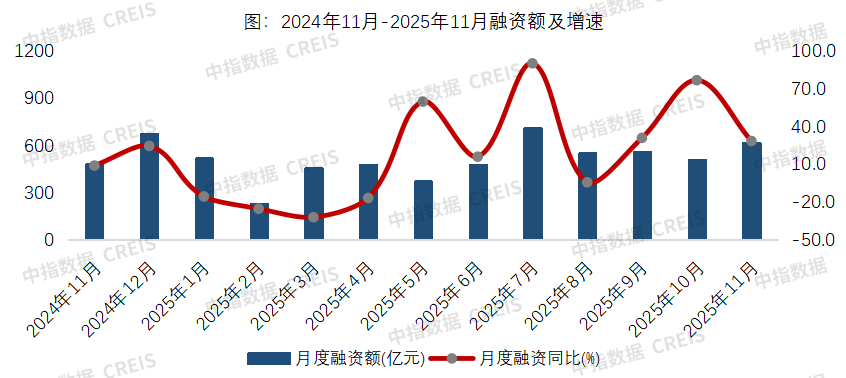
10月房企债券融资规模同比增长超七成
Zheng Quan Shi Bao Wang· 2025-11-06 06:45
Core Insights - The total bond financing in the real estate sector for October reached 51.24 billion yuan, marking a year-on-year increase of 76.9% [1] - The average bond financing interest rate in October was 2.56%, a decrease of 0.42 percentage points year-on-year and 0.13 percentage points month-on-month [2] Financing Structure - Among the total bond financing, credit bonds accounted for 32.7 billion yuan, up 50.7% year-on-year, representing 63.8% of the total [1] - Asset-backed securities (ABS) financing reached 15.7 billion yuan, showing a significant year-on-year growth of 115.8%, making up 30.6% of the total [1][2] - Overseas bond financing was 2.85 billion yuan, accounting for 5.6% of the total [1] Key Issuers and Trends - Major issuers included state-owned enterprises such as China Merchants Shekou, China Overseas, and Poly Developments, each issuing over 3 billion yuan [1] - Private enterprises like Binjiang and Excellence successfully issued credit bonds totaling approximately 1.24 billion yuan [1] - The financing costs varied, with Suzhou High-tech having the lowest cost at 1.84% [3] Year-to-Date Performance - From January to October, total bond financing for real estate companies reached 488.24 billion yuan, a year-on-year increase of 8.6% [3] - Credit bond financing for the same period was 293.98 billion yuan, a slight increase of 3.3%, representing 60.2% of the total [3] - ABS financing for the year-to-date was 184.53 billion yuan, up 16.7% year-on-year, accounting for 37.8% of the total [3]
年底融资潮起,房企备战土储与销售“关键一役”
Bei Ke Cai Jing· 2025-10-23 13:55
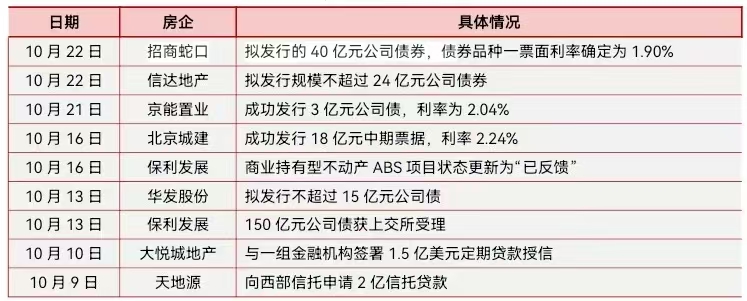
Core Viewpoint - The real estate industry is accelerating financing through various channels such as credit bonds, overseas bonds, and asset securitization to address year-end debt maturity pressures and prepare for future development amid increased supply of quality land parcels [1][3][10]. Financing Trends - In September, the total bond financing in the real estate sector reached 561 billion yuan, marking a year-on-year increase of 31%, with credit bond financing alone amounting to 322 billion yuan, a significant year-on-year growth of 89.5% [3][9]. - The average issuance term for credit bonds in September was 3.65 years, indicating a trend towards longer financing terms, which helps optimize debt structure and alleviate short-term repayment pressures [7]. Company Financing Activities - Several companies are actively issuing bonds, including China Merchants Shekou with a planned issuance of 40 billion yuan at a coupon rate of 1.90%, and China Vanke with a bond issuance of up to 24 billion yuan [6][8]. - Notable issuances include Beijing Urban Construction Group's successful issuance of 18 billion yuan in medium-term notes and Poly Developments' 150 billion yuan bond application accepted by the Shanghai Stock Exchange [6][8]. Challenges in Sales and Cash Flow - Despite the positive financing trends, real estate companies face significant challenges in sales, with a reported 8.4% year-on-year decline in funds received by real estate developers from January to September, particularly in deposits and pre-sales [9][10]. - The ongoing sluggish sales market continues to exert pressure on the overall cash flow of real estate companies, making it crucial for them to balance external financing with internal cash generation [10]. Debt Restructuring Progress - Some distressed real estate companies have made substantial progress in debt restructuring, with over 75% of creditors approving restructuring plans for companies like Longfor Group and Sunac China [8].


年底融资潮起 房企备战土储与销售“关键一役”
Xin Jing Bao· 2025-10-23 13:54
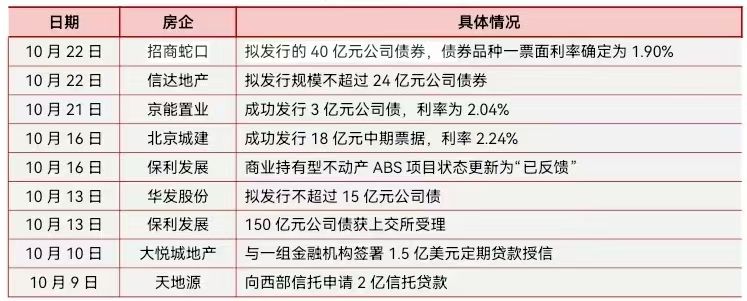
Core Viewpoint - The real estate industry is experiencing a surge in financing activities as companies seek to address year-end debt pressures and prepare for future developments, despite facing challenges in sales recovery and cash flow [1][9]. Financing Activities - In September, the total bond financing in the real estate sector reached 561 billion yuan, marking a 31% year-on-year increase, with credit bonds accounting for 322 billion yuan, a significant 89.5% increase year-on-year [2][9]. - Major companies such as China Resources Land and China Merchants Shekou have issued bonds exceeding 20 billion yuan, with China Resources Land leading at 50 billion yuan [3][9]. - The trend of financing is shifting towards longer maturities, with the average issuance term for credit bonds in September reaching 3.65 years, which helps alleviate short-term repayment pressures [7]. Sales and Cash Flow Challenges - Despite the uptick in financing, real estate companies are facing significant pressure on sales receipts, with total funds available to developers declining by 8.4% year-on-year in the first nine months, particularly in deposits and pre-sales [9]. - The ongoing sluggish sales market continues to strain the overall cash flow of real estate companies, making it crucial for them to balance external financing with internal revenue generation [9]. Debt Restructuring and Market Innovations - Some distressed companies have made progress in debt restructuring, with over 75% of creditors approving restructuring plans for firms like Longfor Group and Sunac China [8]. - The ABS market has seen structural innovations, with REITs becoming the largest ABS product category, accounting for 37.2% of the issuance [8].
前8月房企债券融资总额为3808.9亿元 同比微增0.8%
Zheng Quan Shi Bao Wang· 2025-09-25 08:36
Core Insights - The total bond financing in the real estate sector for August was 55.31 billion, a year-on-year decrease of 4.3% [1] - The average bond financing interest rate in August was 2.51%, showing a decline both year-on-year and month-on-month [3] - From January to August, the total bond financing for real estate companies reached 380.89 billion, a slight year-on-year increase of 0.8% [2] Financing Structure - In August, credit bond financing amounted to 30.78 billion, down 18.4% year-on-year, accounting for 55.6% of total financing; ABS financing was 24.53 billion, up 22.0% year-on-year, making up 44.4% [1][2] - For the first eight months, credit bond financing totaled 229.09 billion, a year-on-year decrease of 6.9%, while ABS financing reached 146.07 billion, a year-on-year increase of 16.8% [2] Notable Issuances - In August, China Overseas Land & Investment issued the highest amount of bonds at 5.3 billion, while Suzhou High-tech Zone had the lowest financing cost at 1.66% [4] - Several private and mixed-ownership enterprises successfully issued credit bonds totaling approximately 2.2 billion, with longer maturities of over three years [1][4] Debt Restructuring - Over 20 distressed real estate companies have received approval for debt restructuring, with a total debt resolution scale exceeding 1.2 trillion RMB [4] - China Evergrande officially delisted on August 25, and China Communications Real Estate completed a significant asset restructuring [4]
2025年CMBS、CMBN和类REITS存续期研究:发行活跃,资产类别多样化,多层次REITS市场稳步构建
Lian He Zi Xin· 2025-09-15 13:17
Policy and Market Overview - In 2025, the issuance of CMBS/CMBN and REITs is driven by the need to revitalize existing assets and reduce liabilities, supported by policies promoting a multi-tiered REITs market[4] - The issuance market remains robust with a total of 76 transactions from January to July 2025, reflecting a year-on-year increase of 35.71%[7] - The total issuance scale reached 1026.75 billion CNY, up 21.36% year-on-year, indicating strong financing demand[7] Issuance and Performance Metrics - The proportion of CMBS/CMBN and REITs in the ABS market was 8.95%, showing a slight year-on-year decline[7] - The average issuance rates for AAAsf and AA+sf rated securities were 2.44% and 2.66%, respectively, down 36bps and 95bps from the previous year[19] - The average issuance rate for AAAsf rated REITs was 2.40%, slightly lower than the 2.48% for CMBS/CMBN, maintaining a consistent spread of 8bps compared to the previous year[20] Asset and Investor Insights - Local state-owned enterprises accounted for nearly half of the actual issuers, with city investment enterprises primarily issuing CMBS/CMBN products[23] - The diversity of underlying assets has increased, with significant contributions from shopping malls, parks, and energy assets, each accounting for over 15% of issuance[17] - The number of projects with specific identifiers increased significantly, with 22 projects identified, including 11 related to green initiatives[9] Future Outlook - The low interest rate environment is expected to persist, with a continued trend of narrowing spreads anticipated in the second half of 2025[34] - The market for holding-type real estate ABS is expected to expand, with nearly 20 projects currently in the review stage for issuance[35] - The competition in the office and industrial park sectors is intensifying, with high vacancy rates projected to continue due to limited demand[36]
7月份房企债券融资同比增长超九成 民营房企信用债融资回暖
Zheng Quan Ri Bao Wang· 2025-08-08 03:40
Group 1 - In July 2025, the total bond financing for real estate companies reached 71.39 billion yuan, a year-on-year increase of 90.3%, indicating a continuous growth trend [1] - The issuance of credit bonds by private real estate companies showed signs of recovery, with some companies achieving their first bond issuance of the year, and the issuance period being extended [1][2] - The financing structure revealed that credit bond financing amounted to 45.65 billion yuan, a year-on-year increase of 104.8%, accounting for 64.0% of all types of bond financing [1] Group 2 - Notably, in July, private or mixed-ownership real estate companies saw a recovery in credit bond financing, with companies like Greentown China and New City Holdings successfully issuing a total of 3.01 billion yuan in credit bonds [2] - The average issuance term for credit bonds was 3.79 years, with a focus on long-term bonds of 1-3 years and over 3 years, which helps improve the debt structure of companies [2] - The total issuance of asset-backed securities (ABS) in July was 25.74 billion yuan, a year-on-year increase of 90.0%, with commercial mortgage-backed securities (CMBS) accounting for the highest proportion at 41.5% [2] Group 3 - The average financing interest rate for real estate company bonds in July was 2.54%, a decrease of 0.24 percentage points year-on-year and 0.51 percentage points month-on-month [3] - Among the companies, five had an average credit bond interest rate below 2%, with China Merchants Shekou Industrial Zone Holdings Co., Ltd. having the lowest financing cost at 1.70% [3] - The overall bond financing data for July released positive signals, indicating an improvement in the financing environment, although further support for the credit recovery of quality private enterprises is still needed [3]