
Dojo 3超级计算机

Search documents
特斯拉AI6芯片,曝光
半导体芯闻· 2026-03-23 10:24
Core Insights - Tesla is optimistic about its chip tape-out timeline, indicating efforts to rapidly enhance its silicon chip manufacturing capabilities [1][3] - CEO Elon Musk is looking forward to the future of the AI6 autonomous driving chip, which is still two generations away from official release, but is already part of the company's ambitious AI hardware roadmap [1][3] - The AI6 chip aims to significantly improve Tesla's autonomous driving technology, humanoid robots, and data center operations [1][3] Group 1 - The AI5 chip has made progress, with Musk stating its design is "on track" and "nearly complete," describing it as a "critical" project requiring his personal involvement [3] - The performance of AI5 is comparable to Nvidia's Hopper level in a single system-on-chip (SoC) configuration and Blackwell level in a dual configuration, but with lower cost and power consumption [3] - AI5 is optimized for edge computing for Optimus robots and Robotaxi vehicles, while also capable of handling data center training tasks [3] Group 2 - The company plans to shorten future chip development cycles to nine months, enabling rapid iterations for AI7, AI8, and higher technologies [4] - Samsung is expected to produce the AI6 chip under a multi-billion dollar agreement, while AI5 will be jointly produced by TSMC and Samsung [4] - These chips will be central to Tesla's full self-driving system, enhancing safety and performance, while also providing efficient reasoning capabilities for expanding data centers [4] Group 3 - The advancement of the AI5 project has led Musk to restart the Dojo 3 supercomputer project, with long-term plans for internal production through the Terafab factory [4] - Tesla aims to accelerate chip development using AI tools to reduce reliance on third-party GPUs and provide high-performance, energy-efficient solutions tailored for its ecosystem [4] - The success of AI6 could mark a significant step for Tesla towards leadership in fully autonomous driving and robotics, although the timeline remains dependent on actual production circumstances [4]


大芯片,再度崛起?
智通财经网· 2026-01-25 06:24
Core Insights - In early 2025, significant developments in the AI chip sector were reported, including Elon Musk's confirmation of Tesla's (TSLA.US) revival of the Dojo 3 supercomputer project, aiming to become the largest AI chip manufacturer globally, and Cerebras Systems' multi-year procurement agreement with OpenAI worth over $10 billion, promising 750 megawatts of computing power by 2028 [1][2]. Group 1: AI Chip Evolution - The evolution of AI chips is characterized by two distinct designs: Cerebras' wafer-scale integration and Tesla's Dojo, which represents a hybrid approach between single-chip and GPU clusters [3]. - The divergence stems from different solutions to the "memory wall" and "interconnect bottleneck" challenges, with traditional GPU architectures facing limitations in memory bandwidth compared to computational power [3][4]. Group 2: Cerebras' Innovations - Cerebras' WSE-3 chip features 40 trillion transistors, 900,000 AI cores, and 44GB of on-chip SRAM, achieving a bandwidth of 214 Pb/s, significantly outperforming NVIDIA's H100 [4]. - The design addresses yield issues associated with large wafers by minimizing the size of each AI core and employing redundancy to maintain performance despite defects [4]. Group 3: Tesla's Strategic Shift - Tesla's Dojo project faced setbacks but was revived with a new focus on "space AI computing," moving away from its original goal of competing with NVIDIA's GPU clusters [7][8]. - The AI5 chip, designed with a 3nm process, is expected to be produced by the end of 2026, aiming for performance comparable to NVIDIA's Hopper architecture [8]. Group 4: Market Dynamics and Competition - The AI chip market is becoming increasingly crowded, with competitors like AMD and NVIDIA rapidly advancing their offerings, which poses challenges for alternative architectures like wafer-scale systems [16][19]. - Cerebras aims to differentiate itself by focusing on low-latency inference systems, capitalizing on the growing demand for real-time AI applications [16][14]. Group 5: Strategic Partnerships - Cerebras' partnership with OpenAI, involving a $10 billion commitment for computing power, highlights the increasing importance of low-latency inference capabilities in the AI landscape [11][12]. - The collaboration reflects a broader trend of established tech companies integrating promising AI chip startups into their ecosystems, which may reshape the competitive landscape [20][21].

大芯片,再度崛起?
半导体行业观察· 2026-01-25 03:52
Core Insights - The article discusses significant developments in the AI chip sector, highlighting Tesla's revival of the Dojo 3 supercomputer project and Cerebras Systems' multi-billion dollar agreement with OpenAI for AI computing power [1][10]. Group 1: AI Chip Developments - Tesla's Dojo 3 project aims to position the company as a leading AI chip manufacturer, with a focus on "space artificial intelligence computing" rather than traditional training models [6][8]. - Cerebras Systems has secured a contract with OpenAI worth over $10 billion, promising to deliver 750 megawatts of computing power by 2028, emphasizing the growing demand for low-latency inference capabilities [10][11]. Group 2: Chip Architecture and Performance - The distinction between two types of large chips is made: Cerebras' wafer-scale integration and Tesla's wafer-scale system, each addressing the "memory wall" and "interconnect bottleneck" challenges differently [2][4]. - Cerebras' WSE-3 chip boasts 40 trillion transistors and 900,000 AI cores, achieving a memory bandwidth of 21 PB/s, significantly outperforming NVIDIA's H100 [3][11]. Group 3: Strategic Shifts - Tesla's shift in strategy reflects a recalibration of resources, moving away from competing directly with NVIDIA's GPU clusters to focusing on specialized applications in space computing [7][8]. - Cerebras' approach to positioning itself as a provider of dedicated inference machines allows it to capitalize on the emerging demand for low-latency processing, differentiating itself from traditional training platforms [15][19]. Group 4: Market Dynamics and Competition - The AI chip market is becoming increasingly crowded, with competitors like AMD and NVIDIA rapidly advancing their offerings, which poses challenges for alternative architectures like those from Cerebras and Tesla [15][19]. - The collaboration between OpenAI and Cerebras is seen as a strategic move to secure a foothold in the burgeoning inference market, which is expected to dominate AI computing needs in the future [10][19]. Group 5: Future Outlook - The advancements in packaging technology, such as TSMC's CoWoS, are expected to blur the lines between large and small chip architectures, potentially reshaping the competitive landscape [16][19]. - The article concludes that both Tesla and Cerebras are not merely trying to replicate NVIDIA's success but are instead seeking to find value in niches overlooked by general solutions, indicating a long-term battle for survival and innovation in the AI chip market [20].
慕了!内存芯片巨头人均发64万年终奖;特斯拉将重启Dojo 3超级计算机项目;2025胡润中国人工智能企业50强出炉!6300亿「寒王」登顶
雷峰网· 2026-01-20 00:40
Group 1 - SK Hynix announced a record year-end bonus of 1.36 billion KRW (approximately 640,000 RMB) per employee, attributed to a new performance bonus plan linked to the company's profits [4][5] - The new bonus plan allows employees to receive up to 50% of their bonuses in company stock, with additional cash rewards for holding the stock for a year [4][5] - The company expects a significant increase in bonuses due to a new agreement that ties bonuses to 10% of the previous year's operating profit, with an estimated total operating profit of 45 trillion KRW for the year [5] Group 2 - HuRun Research Institute released a list of the top 50 AI companies in China, with Cambricon leading at a valuation of 630 billion RMB, followed by Moore Threads and MuXi [7][8] - Cambricon has seen a revenue increase of 4,300% year-on-year, driven by its focus on AI core processor chips and partnerships with leading AI model companies [7][8] - The top five companies in the list include Cambricon, Moore Threads, MuXi, iFlytek, and Horizon Robotics, showcasing the rapid growth and innovation in the AI sector [9] Group 3 - Li Auto's AI glasses sold out in just three hours, with demand exceeding supply, indicating strong market interest [10] - The glasses, priced from 1,999 RMB, are designed to integrate with Li Auto's ecosystem and feature advanced technology such as a 12MP camera and AI capabilities [10] - The product's success highlights the growing trend of smart wearable devices in the automotive industry [10] Group 4 - Porsche reported a 10% decline in global sales for 2025, with a 26.28% drop in the Chinese market, reflecting challenges in the luxury car segment [12] - The company is focusing on maintaining a healthy supply-demand relationship and stable value system amid market pressures [12] - Porsche's stock fell by 4.34% following the sales report, indicating investor concern over the company's performance [12] Group 5 - Moonshot AI, an AI startup backed by Alibaba, achieved a valuation of 48 billion USD (approximately 330 billion RMB) in its latest funding round, reflecting strong market demand for AI companies [14][15] - The company has raised significant capital in a short period, indicating robust investor interest in the AI sector [14][15] - The rapid increase in valuation highlights the competitive landscape for AI startups in China [14][15] Group 6 - Xiaomi's second-generation self-developed chip, the Xuanjie O2, is expected to utilize TSMC's 3nm process and expand its application to tablets, cars, and computers [17][18] - The company aims to enhance its self-developed chip capabilities across various product lines, indicating a strategic shift towards in-house technology [17][18] - The Xuanjie O1 chip, released earlier, has already demonstrated high performance, positioning Xiaomi competitively in the semiconductor market [18] Group 7 - Northvolt announced a projected net loss of 4.35 to 4.65 billion RMB for 2025, primarily due to ongoing investments in product development and market expansion [32] - Despite the losses, the company expects a significant increase in sales volume, indicating a long-term growth strategy [32] - The strategic investments are aimed at enhancing the company's market position in the rapidly evolving electric vehicle sector [32]

全球大公司要闻 | 苹果去年四季度iPhone出货量登顶中国市场
Wind万得· 2026-01-19 23:00
Group 1 - OpenAI's annual recurring revenue (ARR) is expected to exceed $20 billion by 2025, with a computing power scale of 1.9GW, achieving a tenfold revenue growth and 9.5 times increase in computing power within three years [2] - Micron Technology is acquiring the P5 wafer fab from Powerchip Semiconductor for $1.8 billion, expected to complete in Q2 2026, which will enhance Micron's position in the global DRAM market amid increasing demand from AI infrastructure [2] - Tesla's Neuralink has made advancements in brain-machine interface technology, allowing upgrades without surgery, and plans to restart the Dojo 3 supercomputer project, with a new affordable Model 3/Y targeting the Chinese market [3] Group 2 - Apple is set to regain the top position in the Chinese smartphone market with a 28% year-on-year increase in iPhone shipments by Q4 2025, and is developing the iPhone 18 Pro series with advanced features [3] - Baiwei Storage expects a net profit of 850 million to 1 billion yuan in 2025, representing a year-on-year growth of 427.19% to 520.22% [4] - China Duty Free Group plans to acquire DFS's travel retail business in Greater China for up to $395 million, strengthening its market position [6] Group 3 - Pfizer's CEO indicated that the company may raise drug prices abroad due to a pricing agreement with former President Trump, which could lead to a halt in new drug supplies to Europe if price increases are rejected [9] - Toyota aims for over 1.78 million vehicle sales in China by 2025, collaborating with Fujitsu to simplify automotive ECU design using quantum-inspired technology [11] - LVMH's DFS Group is selling its Greater China retail business to China Duty Free Group for up to $395 million, indicating significant market movements in the luxury retail sector [13]

马斯克,重大宣布!
证券时报· 2026-01-19 13:50
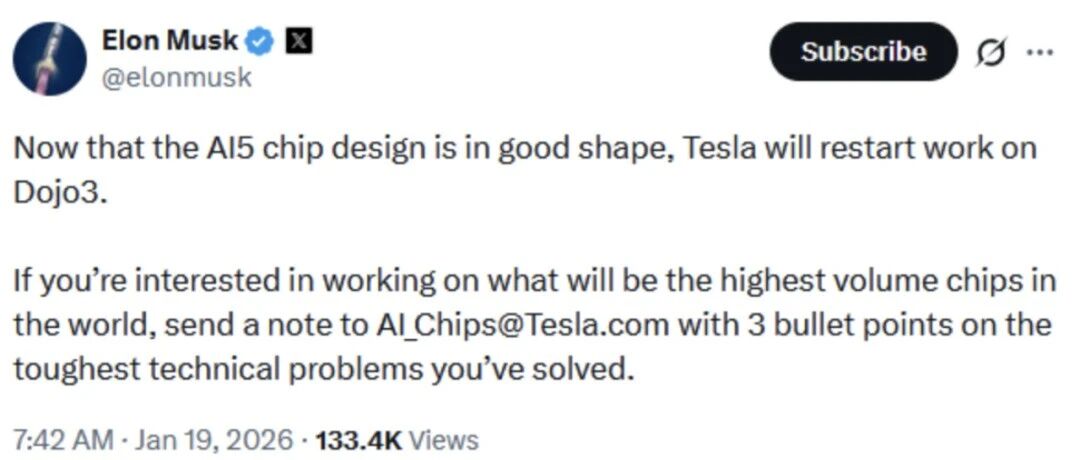
Core Viewpoint - Tesla is restarting the development of its Dojo 3 supercomputer project following the completion of the AI5 chip design, which is deemed crucial for the company's future AI capabilities [1][2]. Group 1: AI5 Chip Development - Elon Musk emphasized the importance of the AI5 chip, stating that it will be a powerful chip with performance comparable to Nvidia's Hopper level for a single SoC and approaching Blackwell level for a dual-chip configuration, while being significantly cheaper and more energy-efficient [2]. - The AI5 chip is expected to be the best inference chip for models with fewer than 250 billion parameters, boasting the lowest cost and the best performance-to-power ratio to date [2]. - The decision to focus on a single chip architecture rather than developing two different designs is seen as a strategic move to concentrate talent and resources on creating a superior product [2]. Group 2: Dojo Project Status - Reports indicate that Tesla previously disbanded its internal Dojo supercomputer team, which was responsible for building a high-performance computing platform for training autonomous driving systems and AI models, highlighting challenges in the company's self-developed chip technology [3]. - Approximately 20 core members of the Dojo team have joined a new AI startup, Density AI, founded by former Dojo head Ganesh Venkataramanan, while remaining Tesla employees have been reassigned to other data centers or computing projects [3]. - The Dojo project was initially mentioned by Musk in 2019, aiming to reduce reliance on external suppliers by developing proprietary chips and systems for enhanced computational power [3]. Group 3: Financial Implications - Morgan Stanley estimated that full deployment of the Dojo system could potentially enhance Tesla's valuation by billions of dollars [4].

刚刚,马斯克重大宣布!
是说芯语· 2026-01-19 08:02
Core Viewpoint - Tesla is making significant advancements in its AI capabilities by restarting the Dojo supercomputer project, driven by the completion of its self-developed AI5 chip, which is crucial for its autonomous driving and robotics initiatives [2][3]. Group 1: Dojo Project and AI5 Chip - The Dojo project, initially proposed by Elon Musk in 2019, aims to create Tesla's own computing foundation to support its Full Self-Driving (FSD) system and AI models, reducing reliance on external chips [3]. - The AI5 chip boasts impressive performance, with a single SoC performance comparable to NVIDIA's Hopper level and a dual-chip configuration nearing Blackwell level, while being more cost-effective and energy-efficient [3][4]. - The AI5 chip's operational performance ranges between 2000 to 2500 TOPS, approximately five times that of the current HW4 chip, enabling more complex FSD algorithms and potentially serving as the "brain" for Tesla's robots [5]. Group 2: Production and Future Developments - Sample production and small-scale deployment of the AI5 chip are set to advance in 2026, with mass production expected to be completed by 2027, involving partnerships with Samsung and TSMC for manufacturing [5][6]. - Tesla has already initiated early development of the AI6 chip, which is planned for release in 2028, featuring a modular design that integrates deeply with the Dojo supercomputer [6]. Group 3: Software and Business Model Changes - Starting February 14, 2026, Tesla will transition its FSD from a one-time purchase model to a monthly subscription model, marking a significant shift in its software business strategy [7]. - This change aims to lower the usage barrier and increase adoption rates while establishing a stable revenue stream from software, supporting the rollout of new features like fully autonomous driving and Robotaxi testing [7]. - Analysts estimate that the full deployment of Dojo could enhance Tesla's valuation by up to $500 billion, highlighting the potential impact on its future business ventures, including robotics and shared mobility [7].
特斯拉将重启Dojo 3超级计算机项目,AI人工智能ETF(512930)备受关注
Xin Lang Cai Jing· 2026-01-19 02:19
Group 1 - The core viewpoint of the news is the strategic return of Tesla in the AI computing power sector with the restart of the Dojo 3 supercomputer project, following the completion of the AI5 chip design [1] - As of January 19, 2026, the CSI Artificial Intelligence Theme Index (930713) has seen a slight increase of 0.13%, with notable gains from component stocks such as Aobo Zhongguang (up 5.19%) and Beijing Junzheng (up 3.36%) [1] - The AI Artificial Intelligence ETF (512930) is experiencing a state of market indecision, with the latest price at 2.4 yuan [1] Group 2 - Citic Securities' research report highlights a high certainty in the development of computing power by 2026, with supernode technology reaching a pivotal opportunity, and an optimistic outlook on domestic computing chip and system-level manufacturers [2] - The CSI Artificial Intelligence Theme Index includes 50 listed companies that provide foundational resources, technology, and application support for artificial intelligence, reflecting the overall performance of AI-related securities [2] - As of December 31, 2025, the top ten weighted stocks in the CSI Artificial Intelligence Theme Index account for 58.08% of the index, including companies like Zhongji Xuchuang and New Yisheng [2]