
Groq芯片

Search documents
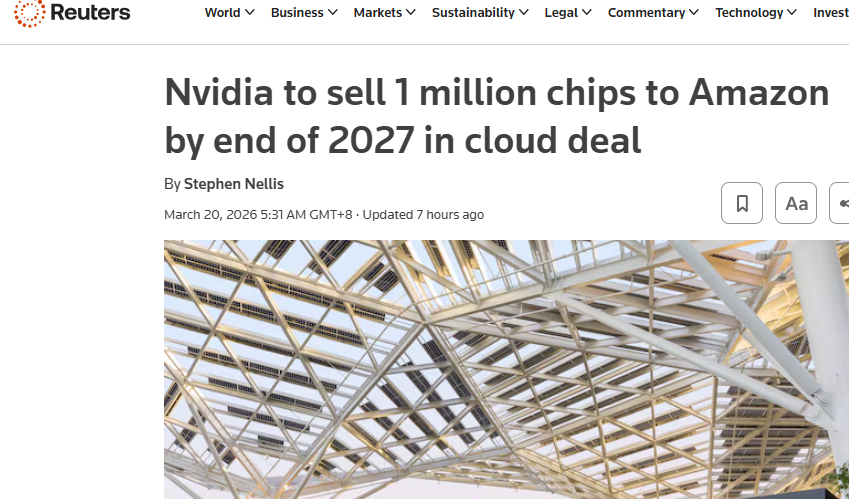
英伟达计划到2027年向亚马逊AWS交付100万颗AI芯片
Huan Qiu Wang· 2026-03-20 06:38
Core Insights - Nvidia has entered into a significant chip procurement agreement with Amazon Web Services (AWS), committing to supply 1 million GPUs and various AI-related chips by the end of 2027, with deliveries starting this year [1][4] Group 1: Partnership Details - The collaboration includes not only 1 million GPUs but also Spectrum network chips and the newly launched Groq chips, focusing on optimizing AI inference performance and enhancing AI response and execution efficiency [4] - AWS will utilize a combination of seven Nvidia chips, aligning with Nvidia CEO Jensen Huang's timeline for a $1 trillion market opportunity related to the Blackwell and Rubin series chips, indicating strong confidence in long-term growth in AI cloud computing [4] Group 2: Market Impact - This partnership marks a significant breakthrough for Nvidia as its networking products will enter AWS data centers, which have traditionally relied on in-house developed networking equipment, highlighting Nvidia's advancement in high-end cloud data center infrastructure [4]


重返中国 AI 芯片市场:英伟达 H200 重启供货,Groq 芯片补齐推理版图
Jing Ji Ri Bao· 2026-03-18 23:04
Group 1 - Nvidia's CEO Jensen Huang announced the restart and acceleration of H200 production for the Chinese market, indicating a strategic move to increase market share in China [1] - The resumption of H200 production follows the acquisition of export licenses from Chinese clients, marking progress in Nvidia's re-entry into the Chinese market after previous production halts due to regulatory constraints [1] - Several Chinese companies have reportedly received approval to purchase H200 orders, although final confirmation from Beijing remains unclear [1] Group 2 - Nvidia is preparing to launch a Groq chip version for the Chinese market, designed for flexibility and integration with other systems, expected to be available as early as May [2] - The upcoming Vera Rubin GPU will be used for model training in overseas data centers, while the Groq chip will handle inference operations, with both products deployed separately to comply with export control regulations [2]
重磅,英伟达将推中国版Groq芯片
半导体行业观察· 2026-03-17 23:39
Core Viewpoint - Nvidia is preparing to launch a Groq AI chip for the Chinese market, following its acquisition of Groq for $17 billion last year, and has restarted production of its H200 chip after obtaining necessary export licenses and orders from Chinese customers [1] Group 1: Nvidia's Strategy and Product Development - Nvidia plans to utilize Groq's chips for AI inference, which involves answering questions and executing tasks, and aims to combine the upcoming Vera Rubin chip with Groq chips [1] - The company is integrating LPU and LPX into its Rubin platform to optimize decoding, indicating a shift in focus from the Rubin CPX project [4] - Nvidia's acquisition of Groq was driven by the need for low-latency inference capabilities, as the demand for AI supercomputers grows [3][12] Group 2: Competitive Landscape - Despite Nvidia's dominance in AI training, it faces intense competition in the inference market from Chinese AI giants like Baidu, which have developed their own inference chips [1] - The Groq chips are not downgraded versions but are designed to be compatible with other systems, with expectations for their market launch in May [1] Group 3: Technical Specifications and Performance - The performance comparison indicates that the R200 GPU can achieve a theoretical peak performance 42 times that of the LP30 chip under certain conditions, highlighting the complexity and cost associated with GPU technology [7] - The integration of Groq's LP30 into Nvidia's systems is expected to enhance performance for high-end customers, as more LP30 chips are added for inference tasks [10] - The performance metrics suggest that Nvidia's systems will provide significant improvements in AI processing capabilities, with a potential 13.3 times increase in performance with fewer GPUs [14][15]

黄仁勋抛出万亿美元收入预期
第一财经· 2026-03-17 01:21
Core Viewpoint - The article discusses the key announcements and developments presented by NVIDIA's CEO Jensen Huang at the GTC conference, highlighting the company's advancements in AI infrastructure, new chip platforms, and the potential revenue growth from AI-related products and services [3][10]. Group 1: New Chip Platforms - NVIDIA introduced the Rubin chip platform, which includes the Vera CPU, Rubin GPU, and several other components, aimed at enhancing AI and reinforcement learning capabilities [5][6]. - The Groq 3 LPU was showcased for the first time, with production set to ramp up in the second half of the year, indicating a strong focus on AI processing [6]. - The Rubin platform now consists of seven chips and five racks, designed to form an AI supercomputer that significantly boosts inference throughput and efficiency [6][8]. Group 2: Revenue Projections - Huang projected that revenue from AI chips, specifically from the Blackwell and Rubin platforms, could reach $1 trillion between 2025 and 2027, a significant increase from previous estimates [10]. - The customer base for NVIDIA has expanded to include major players like Alibaba and ByteDance, with 60% of revenue coming from large cloud service providers and 40% from diverse AI applications [10]. Group 3: Business Strategy and Ecosystem - Huang emphasized NVIDIA's commitment to collaborative design and vertical integration, positioning the company as a key player in the AI ecosystem [12]. - The company is involved in various sectors, including autonomous driving, financial services, healthcare, and telecommunications, showcasing its broad market reach [12]. Group 4: AI Impact and Innovations - Huang noted that the AI landscape has evolved dramatically over the past three years, with significant increases in computational demands and investment in AI startups [13][14]. - NVIDIA announced new partnerships in the automotive sector, including collaborations with BYD and Nissan, to develop Level 4 autonomous vehicles [14]. Group 5: New Products and Software - The GTC conference featured the introduction of several new products, including the Vera Rubin space module, which offers 25 times the AI computing power for space-based inference compared to previous models [14]. - NVIDIA also launched new software frameworks and open-source models aimed at enhancing the capabilities of intelligent robots and autonomous vehicles [15].

黄仁勋GTC演讲全文:推理时代到来,2027营收至少万亿美元,龙虾就是新操作系统
华尔街见闻· 2026-03-16 23:55
Core Insights - The article discusses NVIDIA's transformation from a "chip company" to an "AI infrastructure and factory company," emphasizing the concept of "Token Factory Economics" as a driving force for future growth [2][5][13]. Group 1: Market Demand and Growth Projections - NVIDIA's CEO Huang Renxun projected a significant increase in AI computing demand, estimating at least $1 trillion by 2027, up from a previous estimate of $500 billion [6][65]. - The company anticipates that actual computing demand will exceed this projection, indicating a robust growth trajectory for AI infrastructure [10][11]. Group 2: AI Infrastructure and Token Production - Huang highlighted that modern data centers will evolve into "Token factories," focusing on the efficiency of token production as a key operational metric [74]. - The future pricing structure for tokens will include various tiers, with costs ranging from free to $150 per million tokens, reflecting the value of throughput and speed [16][75]. Group 3: Technological Advancements - The introduction of the Vera Rubin system, which achieved a 350-fold increase in token generation speed, showcases NVIDIA's commitment to cutting-edge technology [20][81]. - The integration of Groq technology aims to enhance inference performance, with a focus on optimizing the processing pipeline for AI workloads [77][79]. Group 4: Software and Ecosystem Development - The emergence of OpenClaw as a pivotal open-source project signifies a shift towards "Agent-as-a-Service" (AaaS), transforming how software companies operate [26][91]. - NVIDIA's collaboration with various enterprises to develop AI models and platforms indicates a strategic move to solidify its position in the AI ecosystem [96]. Group 5: Industry Impact and Future Outlook - The article emphasizes that the AI industry is experiencing unprecedented growth, with venture capital investments reaching $150 billion, marking a historic high [57]. - The anticipated shift towards AI-native companies will redefine industries, similar to past technological revolutions [58].

英伟达CEO黄仁勋:Groq 芯片由三星代工生产。
Xin Lang Cai Jing· 2026-03-16 20:35
Group 1 - The core point of the article is that NVIDIA's CEO Jensen Huang announced that Groq chips are being manufactured by Samsung [1] Group 2 - The collaboration between NVIDIA and Samsung highlights the ongoing trend of partnerships in the semiconductor industry [1]
英伟达CEO黄仁勋:基于 Groq 芯片的系统将于下半年推出。
Xin Lang Cai Jing· 2026-03-16 20:35
Core Viewpoint - NVIDIA CEO Jensen Huang announced that systems based on Groq chips will be launched in the second half of the year [1] Group 1 - The introduction of Groq chip-based systems is expected to enhance NVIDIA's product offerings in the competitive semiconductor market [1] - This move indicates NVIDIA's commitment to expanding its hardware capabilities and addressing growing demands in AI and machine learning applications [1]
独家丨直指2000 Tokens/s,北大系「流式推理芯片」公司完成数千万元融资
雷峰网· 2026-03-09 00:35
Group 1 - The core viewpoint of the article emphasizes that Hanxu Technology focuses solely on ultra-fast streaming inference chips, distinguishing itself from GPU-based solutions by prioritizing speed over general-purpose training [2][3] - Hanxu Technology has completed several million yuan in financing, with investors including Qigao Capital and Saiyi Industrial Fund, and Source Capital serving as the exclusive financial advisor for this round [2] - The company's first chip sample has shown "very ideal" testing results, achieving a remarkable bandwidth of 100 GB/s/mm², which is crucial for AI inference performance [2][3] Group 2 - Hanxu Technology's next-generation chip is already in the tape-out phase, targeting an impressive performance of over 2000 Tokens/s, significantly surpassing the current mainstream dialogue model inference speed of approximately 30-50 Tokens/s [2][3] - The company is recognized as one of the few teams in China that is genuinely following the Groq direction in the inference chip market, with its technology being closely aligned with Groq's high-bandwidth streaming processing chips [3] - Founded in August 2023, Hanxu Technology originates from the Beijing University Magnetic Center, with a core team capable of integrating physics, materials, devices, heterogeneous integration, chip design, and algorithms [3]

NPU,异军突起
半导体芯闻· 2026-01-20 10:05
Group 1 - The core viewpoint of the article highlights the rise of NPU-based companies in the semiconductor industry, particularly in the AI sector, as they secure significant deals with industry leader NVIDIA, indicating a shift in market dynamics [1] - The global AI fabless market is evolving through technological competition and mergers, with key players including Groq, SambaNova Systems, Cerebras, Tenstorrent, and Korean companies Rebellions and FuriosaAI [1] - NVIDIA's acquisition of Groq's core technology rights for $20 billion (approximately 29 trillion KRW) is noted as the largest deal in NVIDIA's history, significantly boosting Groq's valuation to around $7 billion, nearly tripling its worth [1] Group 2 - Cerebras has signed a $10 billion (approximately 14 trillion KRW) computing power supply contract with OpenAI and is in talks to raise $1 billion in new investments [2] - The NPU industry is expanding its business scope from chip supply to server and data center infrastructure, with a focus on the Middle East's demand for "autonomous AI" to reduce reliance on US and Chinese technology [2] - Rebellions is targeting the Saudi data center market with its REBEL-Quad product, which is said to perform comparably to NVIDIA's flagship GPU [2] Group 3 - Rebellions' CEO expressed concerns about the competitive landscape, noting that countries like the US and China are building AI infrastructure using non-NVIDIA products for supply chain diversification [3] - The CEO highlighted that Saudi Arabia purchased Groq chips worth 750 billion KRW last year, while the UAE bought Cerebras chips worth 1.5 trillion KRW, contrasting with Rebellions' government revenue of only 7 billion KRW [3] - Rebellions plans to begin mass production of REBEL-Quad in the first half of the year, while FuriosaAI aims to supply up to 20,000 RNGD units by the end of the year [3]

200亿美元买下Groq,英伟达图啥?
Hua Er Jie Jian Wen· 2025-12-25 02:33
Core Insights - Nvidia has agreed to pay approximately $20 billion for a technology license from the startup Groq, aiming to strengthen its dominance in AI inference computing while navigating increasing antitrust scrutiny [1][2] - The deal involves a non-exclusive technology license and the hiring of Groq's core team, reflecting a strategic move to enhance Nvidia's chip design capabilities for AI applications [1][3] Group 1: Strategic Intent - The transaction is designed to integrate Groq's low-latency processors into Nvidia's AI factory architecture, expanding its platform capabilities for a broader range of AI inference and real-time workloads [1][3] - Nvidia's CEO emphasized the need to address the high costs and size of existing chips for AI applications, indicating a strategic shift towards more efficient inference chips [1][3] Group 2: Market Dynamics - Nvidia's acquisition of Groq's intellectual property is driven by the competitive landscape in the AI inference market, where Groq claims its chips outperform Nvidia's in specific AI tasks [3][6] - Despite Groq's challenges in competing with Nvidia, the upcoming generations of Groq's products may pose a potential threat, prompting Nvidia's proactive acquisition [3][6] Group 3: Transaction Structure - The deal's structure allows Groq's founders and key personnel to join Nvidia while retaining Groq's existing cloud business, a strategy commonly used by tech giants to avoid regulatory scrutiny [4][5] - Nvidia's approach mirrors past strategies employed by companies like Microsoft and Amazon, focusing on technology licensing and talent acquisition without formal company buyouts [4][5] Group 4: Financial Strategy - Nvidia is leveraging its substantial cash reserves, which amount to $60 billion, to solidify its market position and pursue significant technology acquisitions [7] - The $20 billion deal with Groq surpasses Nvidia's previous largest acquisition, indicating a willingness to invest heavily in cutting-edge technology to mitigate potential threats [7]