Oakley Meta眼镜

Search documents
Meta重磅新品即将亮相,AI+AR眼镜产业链蓄势待发
HTSC· 2025-08-27 10:07
Investment Rating - The report maintains a "Buy" rating for key companies in the AI+AR glasses industry, including GoerTek, Crystal Optoelectronics, Sunny Optical Technology, and OmniVision Technologies [5][8][25]. Core Insights - The upcoming Meta Connect conference is expected to showcase multiple new smart glasses and a new metaverse software, indicating a significant shift in the AI+AR glasses market [2][9]. - The report anticipates a turning point for AR products, with a surge in new product launches from major companies like Meta, Apple, Xiaomi, ByteDance, and Alibaba from the second half of 2025 to 2027, marking a "year of mass production" for the industry [3][19]. - The report emphasizes the importance of waveguide technology as a critical component for the next phase of AR glasses, which will enhance display quality, module weight, and cost [3][22]. Summary by Sections Upcoming Product Launches - Meta is expected to release the Celeste smart glasses, featuring an Lcos+ full-color waveguide display, with a starting price of $800, significantly lower than previous expectations [2][10]. - The new Ray-Ban Meta 3 is anticipated to include prescription and pilot styles, while a new sports-oriented Oakley smart glasses is also expected [10][14]. Industry Trends - The report highlights the growing competition in the AI+AR glasses market, with various companies launching products aimed at different consumer segments, including fashion, sports, and high-end markets [10][13]. - The report suggests that the release of new products by leading companies will likely boost sales expectations for 2025-2026, providing potential catalysts for their core supply chains [4][22]. Investment Opportunities - The report recommends focusing on two main lines of investment: the potential sales boost from Meta's new product launches and the upcoming turning point for AR glasses, particularly in optical display segments [4][22]. - Key companies to watch include GoerTek, Crystal Optoelectronics, Sunny Optical Technology, and OmniVision Technologies, with specific recommendations for their respective segments [8][25].


上半年全球智能眼镜发货量增长110%,Meta占据超70%份额
Hua Er Jie Jian Wen· 2025-08-17 03:58
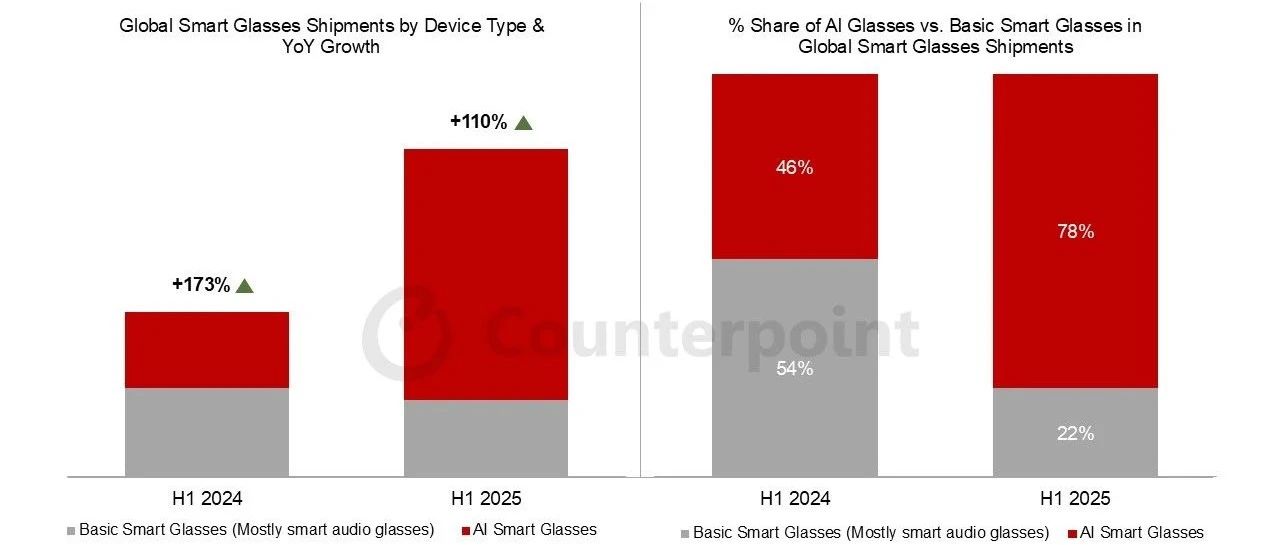
Core Insights - The global smart glasses market is experiencing explosive growth driven by strong demand for AI-enabled features, with Meta holding a dominant position through its collaboration with Ray-Ban [1][2] - Counterpoint's data indicates a year-on-year shipment increase of 110% for smart glasses in the first half of 2025, with Meta's market share rising to 73% [1][2] - The integration of AI functionalities has become mainstream, with AI-enabled glasses' shipment share increasing from 46% to 78% year-on-year [1] Group 1: Meta's Dominance - Meta's Ray-Ban AI glasses saw a shipment increase of over 200% in the first half of 2025, maintaining its industry leadership despite new entrants [2] - The partnership with Luxottica has been crucial for Meta, enhancing production capacity and leveraging a vast retail network for sales [2] - Meta has expanded its product line with the launch of Oakley Meta glasses, which have received positive market feedback [2] Group 2: New Entrants and Market Dynamics - New players like Xiaomi have emerged, with its AI glasses ranking fourth globally and third in the AI glasses category despite only a week of sales in the first half of 2025 [3] - The market is expected to continue growing, with major companies like Meta and Alibaba planning to release new products in the second half of the year [3] - Qualcomm's introduction of the upgraded AR 1+ Gen 1 chip is expected to enhance the development of thinner and longer-lasting glasses [3] Group 3: Future Trends and Innovations - Companies are exploring payment solutions based on smart glasses to reduce reliance on smartphones in shopping scenarios [3] - Apple is also actively developing its first AI glasses, indicating a competitive landscape [3] - The ongoing expansion of the smart glasses market is expected to benefit the entire ecosystem, including hardware manufacturers and chip suppliers [3]
上半年全球智能眼镜出货量同比增长110% Meta市占率超七成
Zheng Quan Shi Bao Wang· 2025-08-14 07:22
Group 1 - The global smart glasses market saw a 110% year-on-year increase in shipments in the first half of 2025, with AI smart glasses accounting for 78% of total shipments [1] - Meta's market share in the global smart glasses market rose to 73% in the first half of 2025, driven by strong demand and production capacity expansion from its main partner Luxottica [1] - The AI smart glasses segment experienced a year-on-year growth of over 250%, significantly outpacing the overall market growth, largely due to the strong demand for Ray-Ban Meta smart glasses [1] Group 2 - The competition in the AI glasses market is intensifying, with companies like Huawei, Amazon, and Xiaomi experiencing declines in the smart audio glasses segment [2] - New products from Chinese companies, such as Xiaomi AI glasses and Alibaba's Quark AI glasses, are exploring payment solutions to reduce reliance on smartphones in outdoor shopping and dining scenarios [2] - Counterpoint has raised its market forecasts for smart glasses in 2025 and 2026, expecting a compound annual growth rate of over 60% from 2024 to 2029, benefiting all ecosystem participants [2]
2025年上半年全球智能眼镜出货量同比激增110%,其中Meta占据了70%以上的市场份额
Counterpoint Research· 2025-08-14 01:03
Core Insights - The global smart glasses market experienced a significant year-on-year growth of 110% in the first half of 2025, driven by strong demand for Ray-Ban Meta smart glasses and the entry of new brands like Xiaomi and RayNeo [4][8][12]. - AI smart glasses accounted for 78% of total shipments in the first half of 2025, up from 46% in the first half of 2024, with a year-on-year growth rate exceeding 250% in the AI glasses segment [4][8]. Market Performance - The global smart glasses market saw a 110% increase in shipments in the first half of 2025, largely due to the strong demand for Ray-Ban Meta smart glasses and the introduction of new players like Xiaomi and RayNeo [4][8]. - Meta's market share in the global smart glasses market rose to 73% in the first half of 2025, attributed to robust demand and production capacity expansion by its key manufacturing partner, Luxottica [8][12]. Competitive Landscape - Ray-Ban Meta AI glasses saw a year-on-year shipment increase of over 200%, reflecting strong market demand and Luxottica's enhanced production capabilities [8][12]. - Other active AI smart glasses manufacturers in the first half of 2025 included Xiaomi, RayNeo, Kopin Solos, and Thunderobot, with Xiaomi's AI glasses becoming the fourth best-selling model globally despite being on the market for only about a week [12][16]. Future Outlook - More new AI smart glasses are expected to enter the market in the second half of 2025, including products from Meta and Alibaba, which are anticipated to further drive market growth [16][17]. - Counterpoint has raised its market forecasts for smart glasses for 2025 and 2026, expecting a compound annual growth rate of over 60% from 2024 to 2029, benefiting all ecosystem participants [17].

Meta电话会:AI显著提升用户活跃度,明年资本支出继续“狂飙”,人才算力两手抓,配备AI眼镜是趋势
硬AI· 2025-07-31 07:00
Core Viewpoint - Meta's AI technology has significantly enhanced advertising economic benefits and improved user engagement and content quality, becoming a major growth engine for the overall business. Zuckerberg stated that Meta is now equipped to achieve "super intelligence," with substantial capital expenditure growth expected in 2026 [1][2][3]. Financial Performance - In Q2, Meta reported revenue of $47.52 billion, exceeding analyst expectations of $44.83 billion, with advertising revenue of $46.5 billion also surpassing forecasts. The Reality Labs division incurred a loss of $4.5 billion, which was better than market expectations. The company raised its 2025 capital expenditure lower limit from $64 billion to $66 billion, leading to a 10% increase in stock price post-announcement [2][3][4]. - The operating profit margin for the quarter was 43%, with a net income of $18.3 billion, translating to earnings per share of $7.14. Total expenses for the quarter were $27.1 billion, a 12% year-over-year increase [24][25]. AI Monetization and User Engagement - AI has become the core driver of Meta's current business growth, with a significant efficiency boost in the advertising system. The new AI-driven advertising recommendation model improved ad conversion rates by approximately 5% on Instagram and 3% on Facebook. The use of generative AI creative tools has also expanded, particularly among small advertisers with limited budgets [3][4][21]. - User engagement metrics improved, with Facebook's user time increasing by 5% and Instagram's by 6%. Video engagement saw a year-over-year increase of over 20% [4][28]. Investment in AI and Infrastructure - Meta plans to continue investing heavily in computing power and talent resources, establishing the "Meta Super Intelligence Lab" to develop next-generation models. The company is building multiple gigawatt-level computing clusters to provide "personal super intelligence" for billions of users [3][6][12]. - Capital expenditures for 2025 are projected to be between $66 billion and $72 billion, with expectations for significant growth in 2026 as well. The CFO emphasized that infrastructure costs will be the primary driver of expense growth in 2026, including depreciation and operational costs [5][6][38]. Talent Acquisition and Team Structure - The company is focusing on building a "small but elite" team of top talent in AI, with a particular emphasis on recruiting industry-leading experts. The structure of the team is designed to facilitate cutting-edge research in super intelligence [9][10][11]. - Employee compensation is expected to be the second-largest driver of expense growth in 2026, primarily due to investments in technical talent [11][36]. Future Outlook and Strategic Focus - Meta's future strategy includes enhancing the freshness of original content and improving the recommendation system to better match user interests. The company aims to leverage AI advancements to further improve user engagement and monetization efficiency [4][28][49]. - The company is optimistic about the long-term potential of AI technologies and their ability to reshape its systems and operations, with a focus on self-improvement capabilities in AI [42][48].

AI眼镜多重要?扎克伯格:没有它,你连认知都会落后
Sou Hu Cai Jing· 2025-07-31 02:12
Core Viewpoint - Meta CEO Mark Zuckerberg emphasized the importance of AI glasses as the primary means for users to interact with AI in the future, suggesting that those without AI glasses will be at a disadvantage [2]. Group 1: AI Glasses Development - Zuckerberg believes that glasses will become the ideal medium for AI, allowing AI to see and hear what users do throughout the day and communicate with them [2]. - The addition of display features to these glasses will unlock more value, whether through broader holographic views like Meta's next-generation Orion AR glasses or smaller display screens in everyday AI glasses [2]. - The sales revenue of the Ray-Ban Meta glasses has more than doubled year-on-year, indicating strong market demand for such wearable devices [2]. Group 2: Future of Consumer AI Devices - Zuckerberg acknowledged that future consumer AI devices may not necessarily take the form of glasses, citing OpenAI's acquisition of Jonathan Ive's company to create new consumer devices for AI interaction [3]. - Other startups are exploring various forms of AI devices, including AI pins and pendant devices, but glasses currently seem the most reasonable due to user familiarity and social acceptance [3]. - Despite the potential for other forms of devices, Zuckerberg remains confident that glasses will become mainstream, serving as an ideal medium for merging the real and digital worlds, with AI accelerating this process [3].

Meta业绩超预期、指引强劲,上调全年资本支出下限,盘后大涨10%
美股IPO· 2025-07-30 23:54
Core Insights - Meta's Q2 revenue reached $47.52 billion, significantly exceeding market expectations, with earnings per share at $7.14, also above forecasts [1][4][5] - Strong advertising revenue and lower-than-expected losses in Reality Labs contributed to a projected Q3 revenue of $47.5 to $50.5 billion, higher than analyst estimates [1][3][5] - The company raised its 2025 capital expenditure lower limit from $64 billion to $66 billion, indicating confidence in its advertising business to support aggressive AI investments [1][7][8] Financial Performance - Revenue: Q2 revenue was $47.52 billion, surpassing analyst expectations of $44.83 billion [4] - Earnings per Share: Q2 EPS was $7.14, significantly higher than the expected $5.89 [5] - Advertising Revenue: Q2 advertising revenue was $46.5 billion, exceeding the forecast of $44.07 billion [5] - Reality Labs Losses: Q2 losses for Reality Labs were $4.5 billion, better than the anticipated $4.8 billion loss [5] Business Outlook - Revenue Guidance: Meta expects Q3 revenue to be between $47.5 billion and $50.5 billion, with a midpoint above analyst estimates of $46.2 billion [5] - Capital Expenditure: Projected 2025 capital expenditures are now estimated to be between $66 billion and $72 billion [7][8] AI Investment Strategy - Increased Spending: Meta plans to further increase capital expenditures next year, driven by investments in talent, infrastructure, data centers, and energy to compete in the evolving AI landscape [7][8] - Infrastructure Costs: The primary driver of spending growth will be infrastructure costs, including accelerated depreciation and increased operational costs [8] - Talent Acquisition: Meta is aggressively recruiting top AI researchers with substantial compensation packages, including offers reaching up to $1 billion [11][12] AI Development Challenges - Internal Challenges: The development of advanced AI faces challenges such as employee turnover and frequent organizational restructuring [9] - Competitive Landscape: Competitors are also increasing spending to capture market share as AI usage becomes more prevalent among consumers and businesses [12][13] Product Development - Smart Glasses: Meta is actively entering the smart glasses market, launching products like Ray-Ban Meta and Oakley Meta glasses, as part of its "personal superintelligence" strategy [14] - Reality Labs Losses: Reality Labs has incurred cumulative losses nearing $70 billion since late 2020, with Q1 losses reported at $4.2 billion [14][15]
盘后大涨12%!MetaQ2业绩超预期、指引强劲,上调全年资本支出下限
Hua Er Jie Jian Wen· 2025-07-30 23:46
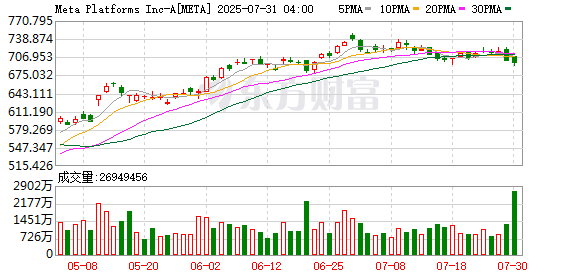
Core Insights - Meta Platforms reported strong Q2 earnings, exceeding revenue expectations and providing robust guidance for Q3, leading to a post-market stock surge of 12% [1][2] - The company continues to invest heavily in AI, supported by its stable advertising revenue, indicating confidence in future growth [4][8] Financial Performance - Q2 Revenue: $47.516 billion, surpassing analyst expectations of $44.83 billion [1] - Q2 Earnings Per Share: $7.14, significantly above the expected $5.89 [1] - Family of Apps Revenue: $47.15 billion, exceeding market expectations of $44.403 billion [1] - Reality Labs Revenue: $370 million, slightly below the market expectation of $383 million [1] - Daily Active Users (DAUs): 3.48 billion, a 6% year-over-year increase [1] Guidance and Capital Expenditure - Q3 Revenue Guidance: Expected between $47 billion and $50.5 billion, with the midpoint above analyst estimates of $46.2 billion [2] - 2025 Capital Expenditure Guidance: Expected to be between $66 billion and $72 billion, up from a previous lower estimate of $64 billion [2][4] Investment in AI - Meta is increasing capital expenditures primarily for infrastructure, talent acquisition, and operational costs related to AI [5][6] - The company is restructuring its AI division into "Meta Superintelligence Labs" to enhance its AI capabilities [8] - Significant recruitment efforts are underway, with offers reaching up to $1 billion for top AI talent [8][9] Market Position and Competition - Meta's competitors, including Alphabet, are also increasing their capital expenditures to capture market share in the AI space [9][10] - The AI competition is characterized by rapid advancements and significant capital investment, likened to past technology races [10] Product Development - Meta is actively developing smart glasses and other AI-related products as part of its "personal superintelligence" strategy [10][11] - The company has reported a significant increase in sales for its Ray-Ban Meta smart glasses, with a threefold increase expected by mid-2025 [11]
Meta卷进人工智能“中心”
美股研究社· 2025-07-11 10:51
Core Viewpoint - Meta is heavily investing in artificial intelligence, including a $14.3 billion investment in Scale AI, to build a "superintelligent" team aimed at becoming a leading personalized AI assistant by 2025 [1][4][22] Investment and Financial Performance - Meta's core AI efforts have enhanced the profitability of its application series, justifying its spending plans as operating and free cash flow continue to expand [2][12] - The company has raised its annual capital expenditure guidance from $62.5 billion to $68 billion, which is expected to account for 36.4% of total revenue by FY2025 [12][22] - Despite losses in the Reality Labs division, Meta's overall operating income remains strong, with a family of apps operating income of $21.03 billion and an operating margin of 41% [9][10] Talent Acquisition and Competition - Meta is actively recruiting AI talent from competitors, having hired at least 15 individuals from OpenAI, Google, and Apple, indicating a fierce talent war in Silicon Valley [6][7] - The cost of this talent acquisition is substantial, estimated at $20 billion, which includes the investment in Scale AI and high salaries for new hires [7][22] Future Projections - Analysts have begun to revise revenue and earnings forecasts upward, with expectations of continued mid-to-low double-digit revenue growth, reaching $238.6 billion by FY2027 [18][23] - The consensus earnings per share is projected to grow to $32.76 by FY2027, with a forward PE ratio calculated at 28.57 [20][23] Market Sentiment and Stock Valuation - Meta's stock is currently above its five-year average expected PE ratio but has room to grow, potentially reaching a target price of $832, reflecting a 14% increase from current levels [22][23] - Investor confidence is bolstered by Meta's strong financial discipline, with free cash flow and operating cash continuing to grow despite increased capital expenditures [16][22]

看完雷军发布会,高盛上调小米、宁德时代目标价,预言“当下的AI眼镜就是2017年的TWS耳机”
硬AI· 2025-06-28 13:24
Group 1: Core Insights - Goldman Sachs indicates that the pre-sale of the YU7 has significantly exceeded market expectations, solidifying Xiaomi's leadership position in the high-end automotive market [1][4] - The AI glasses launched by Xiaomi are expected to open new avenues in the ecosystem, potentially replicating the explosive growth trajectory of TWS headphones [1][6] Group 2: YU7 Performance - The YU7 electric SUV, launched on June 26, achieved a record order volume of 289,000 units within the first hour, far surpassing the initial target of 150,000 orders within 24 hours [8][9] - The pricing of the YU7 models is competitive, with the standard, Pro, and Max versions priced at 253,500 RMB, 279,900 RMB, and 329,900 RMB respectively, aligning closely with market expectations [9][10] - The YU7 features a 96.3 kWh battery with a CLTC range of 835 km, making it the longest-range model among pure electric SUVs with battery packs under 100 kWh [9][10] - Goldman Sachs has adjusted the projected delivery volumes for Xiaomi's electric vehicles for 2025-2027 upwards by 1-6%, anticipating deliveries of 411,000, 800,000, and 1,174,000 units respectively [10] Group 3: AI Glasses Market Potential - Xiaomi's AI glasses are expected to capture 10% of the Chinese smart glasses market, projected to reach 2.9 million units by 2025 [6][12] - The AI glasses are positioned as next-generation portable AI terminals, with a competitive price starting at 1,999 RMB and features including a 12MP camera and real-time translation capabilities [12][13] - The Chinese AI/AR glasses market is forecasted to grow at a compound annual growth rate (CAGR) of 56%, from 479,000 units in 2024 to 6.962 million units by 2030 [13] Group 4: Benefits to CATL - The success of the YU7 is expected to directly benefit CATL, as it becomes a major supplier of high-end batteries for Xiaomi [6][14] - CATL's penetration rate for its high-margin Kirin battery is anticipated to rebound in the second half of 2025, following the launch of models like the YU7 [15][16] - CATL's unit profit is projected to increase from 152 RMB/kWh in 2025 to 169 RMB/kWh by 2030, driven by improved product structure [17]