Quest 3S

Search documents
Meta确认将部分投资“从元宇宙转向AI眼镜”
Sou Hu Cai Jing· 2025-12-06 14:28
Core Viewpoint - Meta has confirmed a shift in investment strategy, reallocating funds from its metaverse division, Reality Labs, to focus on AI glasses and wearable devices, amidst ongoing financial losses in the metaverse sector [1][3]. Group 1: Budget Adjustments - Meta's Reality Labs is facing a budget cut of up to 30%, primarily affecting VR and Horizon Worlds operations [3]. - The official statement from Meta indicates that the decision is driven by strong momentum in the AI glasses and wearable devices market, with no broader adjustment plans currently in place [3]. - The budget cuts are expected to impact funding for third-party studios developing content for Horizon Worlds, with potential layoffs as part of the adjustment [3]. Group 2: Financial Performance - Reality Labs has accumulated losses exceeding $60 billion since 2020, prompting the need for a strategic shift [3]. - Despite a record high quarterly revenue in Q4 2024 due to the launch of Quest 3S, sales of Quest devices saw a year-on-year decline in the first two quarters of 2025, with a temporary rebound attributed to retailers stocking up for the holiday season [4]. - Meta's investment in creator competitions for Horizon Worlds has not yielded significant results, as the platform struggles to compete with cross-platform giants like Roblox and Fortnite [4]. Group 3: Success in Smart Glasses - Sales of Meta's smart glasses have surged, with 2 million units sold as of February 2024, and a reported increase of over two times year-on-year by July 2025 [4][5]. - The company plans to increase annual production capacity for smart glasses to 10 million units by the end of 2026, with this target now expected to be met ahead of schedule due to strong sales contributions [5]. - The success in the smart glasses market, contrasted with stagnation in VR and metaverse platforms, is likely influencing Meta's decision to redirect funds to solidify its leadership position before competitors like Apple and Google enter the space [5].



美国科技行业 - 2025 年第三季度大盘股机构持仓:英伟达仍是机构持仓比例最低的大型科技股-US Technology-Large-Cap Institutional Ownership 3Q25 NVDA Remains The Most Under-Owned Mega-Cap Tech Stock
2025-11-20 02:17
Summary of Key Points from the Conference Call Industry Overview - **Industry**: US Technology, specifically focusing on large-cap tech stocks - **Key Findings**: Mega-cap tech stocks are currently the most under-owned in over 16 years, with a widening gap compared to the S&P 500 Core Insights - **Under-Ownership of Mega-Cap Tech Stocks**: - The gap in institutional ownership for mega-cap tech stocks compared to the S&P 500 increased to -148 basis points (bps) at the end of Q3 2025, up from -140 bps at the end of Q2 2025 [2][12] - Nvidia (NVDA) is identified as the most under-owned large-cap tech stock, followed by Apple (AAPL), Microsoft (MSFT), Amazon (AMZN), and Broadcom (AVGO) [1][2] - **Specific Stock Analysis**: - **Nvidia (NVDA)**: - Institutional ownership decreased by 20 bps quarter-over-quarter (QoQ), ending at -2.61% [9] - **Apple (AAPL)**: - Institutional ownership increased by 36 bps QoQ to 4.45%, while S&P 500 weighting rose by 90 bps, resulting in a widening gap of 53 bps to -2.19% [15] - The iPhone 17 cycle is expected to benefit from a longer replacement cycle and upgrades, with a price target of $305 [15] - **Microsoft (MSFT)**: - Institutional ownership increased by ~40 bps QoQ to 5.1%, but remains ~200 bps below its S&P 500 weighting of 7.1% [16] - The company is positioned well for growth beyond GenAI, with a focus on accelerating revenue growth and margin expansion [16] - **Amazon (AMZN)**: - Remains under-owned with a weighting approximately 144 bps below the S&P 500 [17] - AWS revenue growth is expected to accelerate, with a price target of $315 [17] - **Meta (META)**: - Under-owned with a weighting about 40 bps below the S&P 500, with a price target of $820 [19] - **Alphabet (GOOGL)**: - Under-owned with a price target of $330, driven by GenAI innovation and cloud business growth [17][19] Additional Insights - **Institutional Ownership Trends**: - The average active ownership for large-cap tech stocks is significantly lower than their S&P 500 weightings, indicating potential for future stock performance improvements [12] - The analysis suggests a statistically significant relationship between low active ownership and future stock performance, indicating potential upward price movement for under-owned stocks [12] - **Market Dynamics**: - The report highlights the importance of understanding the dynamics of institutional ownership as it relates to stock performance, particularly in the context of mega-cap tech stocks [12] - **Risks and Considerations**: - Rising commodity input costs may pressure margins for companies like Apple, but manageable due to better supply chain leverage [15] - Concerns regarding the broader return on investment for Nvidia's AI spending, despite strong demand indicators [25] Conclusion - The current landscape for mega-cap tech stocks presents a unique investment opportunity due to their under-ownership status, particularly for stocks like Nvidia, Apple, and Microsoft. The analysis indicates potential for upward price movement as institutional ownership adjusts to reflect their market performance.


Q3’25国内消费级XR市场销量环比增长17%,AR表现亮眼
CINNO Research· 2025-11-12 23:32
Market Overview - In Q3 2025, the sales volume of China's consumer-grade AR/VR glasses reached 169,000 units, with a quarter-on-quarter growth of 17% and a year-on-year growth of 57% [2][5] - The growth is primarily driven by the continuous launch of new AR devices, optimization of upstream supply chain costs, and deep integration of AI technology [2][5] Sales Performance - The overall XR market in China reached 169,000 units in Q3 2025, with consumer-grade AR devices being the main growth driver, achieving sales of 130,000 units, a year-on-year increase of 109% [5] - Consumer-grade VR device sales were 40,000 units, with a quarter-on-quarter growth of 8%, supported by Meta's low-price strategy [5] Technological Innovations - Continuous breakthroughs in display and optical technologies are leading the transformation in the AR/VR industry [6] Brand Performance - The AR brand Thunderbird continues to lead the market, while Rokid's new products have emerged strongly, with VR market competition intensifying and leading brands narrowing the gap [7] Investment and Financing Trends - In Q3 2025, there were 33 financing deals in the AR/VR industry globally, totaling approximately 5.5 billion yuan, with 18 deals occurring in China [8] - Upstream hardware and terminal manufacturers are becoming the focus of capital investment, with companies like JBD and Yanshan Technology actively investing in Micro LED display technology [8] - The integration of AI with hardware and software ecosystems is a significant trend, indicating capital's keen insight into the future of AR/VR technology [8] Market Dynamics - Fast LCD screens have captured 91% of the low-end VR market, with BOE holding a 43% market share [8] - Micro OLED technology faces challenges but remains a strong contender in the high-end market, with a 73% share in AR devices [8] - The Pancake optical solution maintains a leading position with a 49% market share, despite a slight contraction [8] Key Product Launches - Thunderbird launched AIR 4 and AIR 4 PRO, introducing HDR display technology and AI 3D video capabilities, significantly enhancing visual experience [8] - Rokid's new product launch has propelled it to the second position in sales, marking a significant highlight for the quarter [8] - Meta's Quest 3S has seen increased sales due to its low-price strategy, further narrowing the gap with the leading brand in the VR market [8]

Meta一次性税费致季度盈利暴跌83%,预计明年资本支出大增,盘后重挫超8%
硬AI· 2025-10-30 06:20
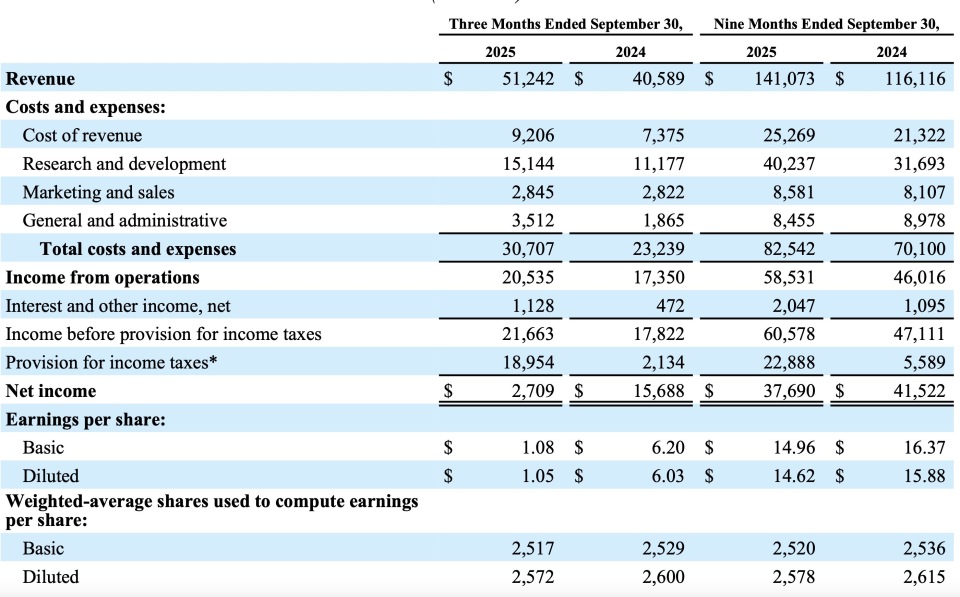
Core Viewpoint - Meta's third-quarter net profit plummeted by 83% year-on-year, primarily due to a one-time non-cash tax expense of $15.93 billion resulting from the U.S. tax reform, which significantly impacted earnings per share (EPS) and overall financial performance [2][4][3]. Financial Performance - Revenue for Q3 reached $51.24 billion, a 26% year-on-year increase, but net profit fell from $15.69 billion to $2.71 billion, marking an 83% decline [4][8]. - The effective tax rate surged from 12% in the previous year to 87% due to the one-time tax expense [4]. - EPS was reported at $1.05, significantly below market expectations of $6.68, primarily due to the tax impact [4][8]. - Free cash flow stood at $10.6 billion, with cash reserves amounting to $44.5 billion [8]. Business Progress - Daily active users reached 3.54 billion, reflecting an 8% year-on-year growth, while ad impressions grew by 14% and average ad prices increased by 10% [11][8]. - Despite strong performance in the core advertising business, potential regulatory changes in the EU pose a significant threat to future revenue [12][13]. Strategic Adjustments - Meta is significantly increasing its capital expenditures, with projections for 2026 potentially exceeding $80-85 billion, driven by infrastructure investments and AI talent costs [17][21]. - Total expenses are expected to grow at a rate that will outpace revenue growth, raising concerns about profit margins [16][20]. Future Outlook - The Reality Labs division is expected to see a decline in revenue for Q4, raising questions about its profitability trajectory [19][20]. - The Q4 revenue guidance of $56-59 billion aligns with market expectations, but ongoing cost pressures may continue to impact profit margins [20][21]. - Despite a robust cash position and stock buybacks, investor sentiment remains cautious regarding the long-term returns of Meta's AI investments, as reflected in the post-earnings stock drop of over 8% [21][9].

受“大漂亮法案”影响,Meta第三季度净利润27.09亿美元,同比大跌83%
3 6 Ke· 2025-10-30 02:40
Core Insights - Meta's Q3 2025 revenue reached $51.24 billion, a 26% increase from $40.59 billion in Q3 2024, while net income fell to $2.71 billion, down 83% from $15.69 billion in the same period last year due to a one-time tax expense related to the "Big Beautiful Law" [1][2][5] Financial Performance - Q3 2025 operating income was $20.54 billion, up 18% from $17.35 billion in Q3 2024, with an operating margin of 40%, down from 43% year-over-year [1][2] - Total costs and expenses for Q3 2025 were $30.71 billion, a 32% increase from $23.24 billion in Q3 2024, with significant increases in research and development costs [5][6] - Meta's effective tax rate for Q3 2025 was 87%, compared to 12% in the same quarter last year, reflecting a substantial increase in tax provisions [5][6] User Engagement and Advertising - The average daily active users (DAU) across Meta's family of services reached 3.54 billion in September 2025, an 8% increase year-over-year [3] - The number of ad impressions increased by 14% year-over-year, while the average price per ad rose by 10% [3] Future Outlook - Meta expects Q4 2025 revenue to be between $56 billion and $59 billion, with a positive impact of approximately 1% from foreign exchange factors [7] - The company anticipates total expenses for 2025 to be between $116 billion and $118 billion, reflecting a year-over-year increase of 22% to 24% [7] - Capital expenditures for 2025 are projected to be between $70 billion and $72 billion, up from previous guidance [7] Strategic Initiatives - Meta plans to expand its infrastructure capabilities to meet increasing computational demands, which will lead to higher capital expenditures in 2026 [8] - The company is focusing on hiring AI talent and expanding in key technology areas to drive future growth [8] Regulatory Environment - Meta is engaged in discussions with the European Commission regarding the "Less Personalized Ads" initiative, which may negatively impact European revenues [9] - Ongoing legal challenges related to youth users in the U.S. are expected to be heard in 2026, potentially leading to significant financial implications [9] Executive Commentary - CEO Mark Zuckerberg highlighted strong business performance and community engagement, expressing optimism about future opportunities, particularly in AI and smart glasses [10]
盘后重挫超8%!Meta三季度业绩不及预期,一次性税费致季度盈利暴跌83%,预计明年资本支出大增
美股IPO· 2025-10-29 22:58
Core Viewpoint - Meta's third-quarter net profit plummeted by 83% year-on-year, primarily due to a one-time non-cash tax expense of $15.93 billion resulting from the U.S. tax reform, which raised the effective tax rate to 87% from 12% in the same period last year [1][3][5] Financial Performance - Revenue for the third quarter reached $51.24 billion, a 26% year-on-year increase, while net profit fell from $15.69 billion to $2.71 billion [3][5] - Earnings per share (EPS) was reported at $1.05, significantly below market expectations of $6.68, but adjusted EPS, excluding the tax impact, was $7.25, exceeding expectations [5] - Operating profit margin decreased from 43% to 40%, with total costs rising by 32% year-on-year [5][13] - Free cash flow stood at $10.6 billion, with cash reserves of $44.5 billion [5][15] Business Progress - Daily active users reached 3.54 billion, an 8% year-on-year growth, with ad impressions increasing by 14% and average ad prices rising by 10% [4][10] - Q4 revenue guidance is set between $56 billion and $59 billion, aligning with market expectations [6][14] Strategic Adjustments - Significant capital expenditures are anticipated, with projections for 2026 potentially exceeding $80-85 billion, driven by infrastructure investments and AI talent costs [12][13] - The CFO indicated that the growth in capital expenditures for 2026 will significantly surpass that of 2025, which was already projected at $70-72 billion [13] Future Outlook - Concerns arise regarding the Reality Labs division, which is expected to see a decline in hardware revenue in Q4 due to last year's product launches and preemptive stocking by retailers [14] - Despite a solid financial position, the key issue lies in whether investors are willing to support an unclear return cycle for AI investments, as indicated by the post-earnings drop of over 8% [15]

Meta电话会:资本支出主要投向AI基础设施,Meta AI将推出付费高级版和广告功能
Hua Er Jie Jian Wen· 2025-05-01 10:54
Core Insights - Meta significantly raised its capital expenditure guidance, with CEO Mark Zuckerberg committing to an AI strategy that promises high returns [1][4][5] Financial Performance - Meta reported Q1 revenue of $42.2 billion, a 16% year-over-year increase, surpassing Wall Street's expectation of $41.3 billion [1][8] - Advertising revenue reached $41.4 billion, also up 16%, with e-commerce being the largest contributor to growth [8] - Reality Labs revenue was $412 million, down 6%, primarily due to declining Quest sales [8] - Operating margin stood at 41%, with free cash flow of $10.3 billion [8] - Q2 revenue guidance is set between $42.5 billion and $45.5 billion, with a favorable currency impact of about 1% [8] - Full-year expense guidance has been lowered to $113 billion to $118 billion [8] Capital Expenditure and AI Strategy - Annual capital expenditure guidance has been raised from $60-65 billion to $64-72 billion, primarily directed towards AI development [4][5] - The increase in capital expenditure is aimed at building world-class infrastructure to enhance AI technology and services [4][5][15] - Meta AI will introduce a paid premium version and advertising features to create new revenue streams [4][5] User Engagement and AI Development - Daily active users across Meta's applications exceed 3.4 billion, indicating strong community growth [3] - AI has improved ad targeting, with new tools in testing increasing click-through rates by 5% [3] - User engagement on Facebook, Instagram, and Threads has increased, with respective time spent growing by 7%, 6%, and 35% [3] - Threads has surpassed 300 million monthly active users [3] Regulatory and Market Challenges - Increased regulatory pressure in Europe could lead to fines of up to 20% of annual revenue due to potential violations of the Digital Markets Act [4][32] - Uncertainty in Q2 earnings guidance is influenced by macroeconomic conditions and their impact on various business segments [4][15] AI Product Development - Meta AI currently has nearly 1 billion users, with plans to expand its independent application in the U.S. [5][10] - The Llama 4 model is designed for low-latency voice interactions, with a focus on personalized experiences [7][9] - AI coding agents are expected to complete a significant portion of AI development work by mid to late next year [4][21] Business Communication and Future Outlook - WhatsApp has over 3 billion monthly active users, leveraging AI customer service agents to lower usage barriers in developed countries [5] - The company is optimistic about the long-term returns from its substantial investments in AI and infrastructure [5][36]
TikTok劫,Meta爽,老扎AI野心膨胀!
海豚投研· 2025-05-01 01:44
Core Viewpoint - Meta's Q1 2025 earnings report indicates a resilient performance amidst a challenging advertising environment, with revenue guidance for Q2 2025 set between $42.5 billion and $45.5 billion, reflecting a growth rate of 11% to 16% [5][6][21]. Advertising Performance - Meta's Q1 revenue reached $42.3 billion, a 16% year-over-year increase, primarily driven by its advertising business, which constitutes 98% of total revenue [21][23]. - The average advertising price increased by 10% in Q1, with North America showing a notable acceleration to 14% [28][30]. - The ban on TikTok likely contributed to Meta's revenue exceeding expectations, as advertisers shifted budgets to Meta platforms [34][36]. Capital Expenditure and AI Focus - Meta raised its full-year capital expenditure guidance to a range of $64 billion to $72 billion, up from a previous estimate of $60 billion to $65 billion, indicating a strong commitment to AI investments [9][44]. - The company is focusing on AI development, with the recent launch of Llama 4 and Meta AI, which leverage extensive social data to enhance user experience [9][11]. Operational Efficiency - Meta's operating expenses increased by only 9.4% year-over-year, below revenue growth, suggesting improved short-term profitability [11][40]. - The company has lowered its full-year operating expense guidance by $1 billion, now projected between $113 billion and $118 billion, indicating a strategic move towards efficiency [11][40]. VR Business Outlook - The VR segment, particularly Reality Labs, reported a revenue decline of 6% in Q1, reflecting seasonal demand fluctuations post-holiday sales [36][50]. - The ongoing losses in the VR segment highlight the need for further optimization and potential new product innovations to drive profitability [36][50]. Cash Flow and Shareholder Returns - As of the end of Q1, Meta held $70.2 billion in cash and short-term investments, with a net cash position of $41.4 billion after accounting for long-term debt [12]. - The company generated $10.3 billion in free cash flow, with plans for significant shareholder returns through buybacks and dividends, projecting a total return of approximately 4% for 2025 [12][12].
【太平洋科技-每日观点&资讯】(2025-04-25)
远峰电子· 2025-04-24 12:50
①主板领涨,西陇科学(+10.00%)/武汉凡谷(+5.10%)/盛路通信(+4.87%)/立昂微(+4.75%)/大晟 文化(+4.46%)/ ②创业板领涨,海联讯(+9.36%)/新晨科技(+8.35%)/飞天诚信(+7.33%)/③科创板领涨,莱尔科 技(+6.07%)/世华科技(+5.56%)/新点软件(+3.31%)/ 国内新闻 ①全球半导体观察,台积电在全球技术论坛北美场次中/揭示其下一世代先进 逻辑制程技术A14的状况/台积电表示/A14制程技术体现了台积电在其领先 业界的N2制程上的重大进展/此技术旨在通过提供更快的运算和更好的能源 效率来推动人工智能(AI)转型/其亦有望透过增进装置端AI功能(on- board AI capabilities)来强化智慧型手机功能/使其更加智慧/A14制程技 术计划于2028年开始生产/截至目前开发进展顺利/良率表现优于预期进度/ ②爱集微,和辉光电正式向香港联交所递交主板上市申请/中金公司担任独家 保荐人/该公司此前已于2021年5月登陆上交所科创板/截至2025年4月23日 A股市值约292亿元/此次赴港IPO旨在拓展国际融资渠道/优化资本结构/为 技 ...

【太平洋科技-每日观点&资讯】(2025-04-25)
远峰电子· 2025-04-24 12:50
Market Performance - The main board led the gains with notable increases in stocks such as Xilong Science (+10.00%), Wuhan Fanggu (+5.10%), and Shenglu Communication (+4.87%) [1] - The ChiNext board saw significant rises with Hai Lian Xun (+9.36%) and Xin Chen Technology (+8.35%) leading the way [1] - The Sci-Tech Innovation board was led by Lier Technology (+6.07%) and Shihua Technology (+5.56%) [1] Domestic News - TSMC revealed advancements in its next-generation A14 logic process technology, aimed at enhancing AI capabilities and energy efficiency, with production planned to start in 2028 [1] - Hehui Optoelectronics submitted its main board listing application to the Hong Kong Stock Exchange, aiming to optimize capital structure and support R&D and capacity expansion [1] - SKF, a global leader in bearing technology, is driving its strategy with a focus on "smart + clean" technologies in the context of the automotive industry's shift towards electrification and intelligence [1] - The China Information and Communication Technology Group held its first member representative conference in Wuhan [1] Company Announcements - Yingqu Technology reported Q1 2025 revenue of 859 million yuan, a year-on-year increase of 12.45%, with net profit rising by 37.81% to 77 million yuan [3] - O-film Technology's Q1 2025 revenue was 4.882 billion yuan, a 5.07% increase, but it reported a net loss of 59 million yuan, a significant decrease of 470.51% [3] - Hengyin Technology achieved Q1 2025 revenue of 94 million yuan, up 1.27%, with net profit increasing by 125.24% to 5 million yuan [3] - Langwei Co. reported Q1 2025 revenue of 250 million yuan, a 21.43% increase, with net profit rising by 110.43% to 20 million yuan [3] Overseas News - Meta launched a revamped version of Quest 3S, priced at $270 for the 128GB version and $360 for the 256GB version, with a 30-day return policy and one-year warranty [4] - Google announced its annual I/O developer conference agenda, which includes sessions on Android XR application development [4] - BESI reported an increase in orders in Q1 due to more AI-related data center applications being ordered by Asian foundries [4] - Nokia's Q1 profits fell short of market expectations, with U.S. tariffs expected to impact Q2 profits, posing challenges to achieving this year's performance targets [4]