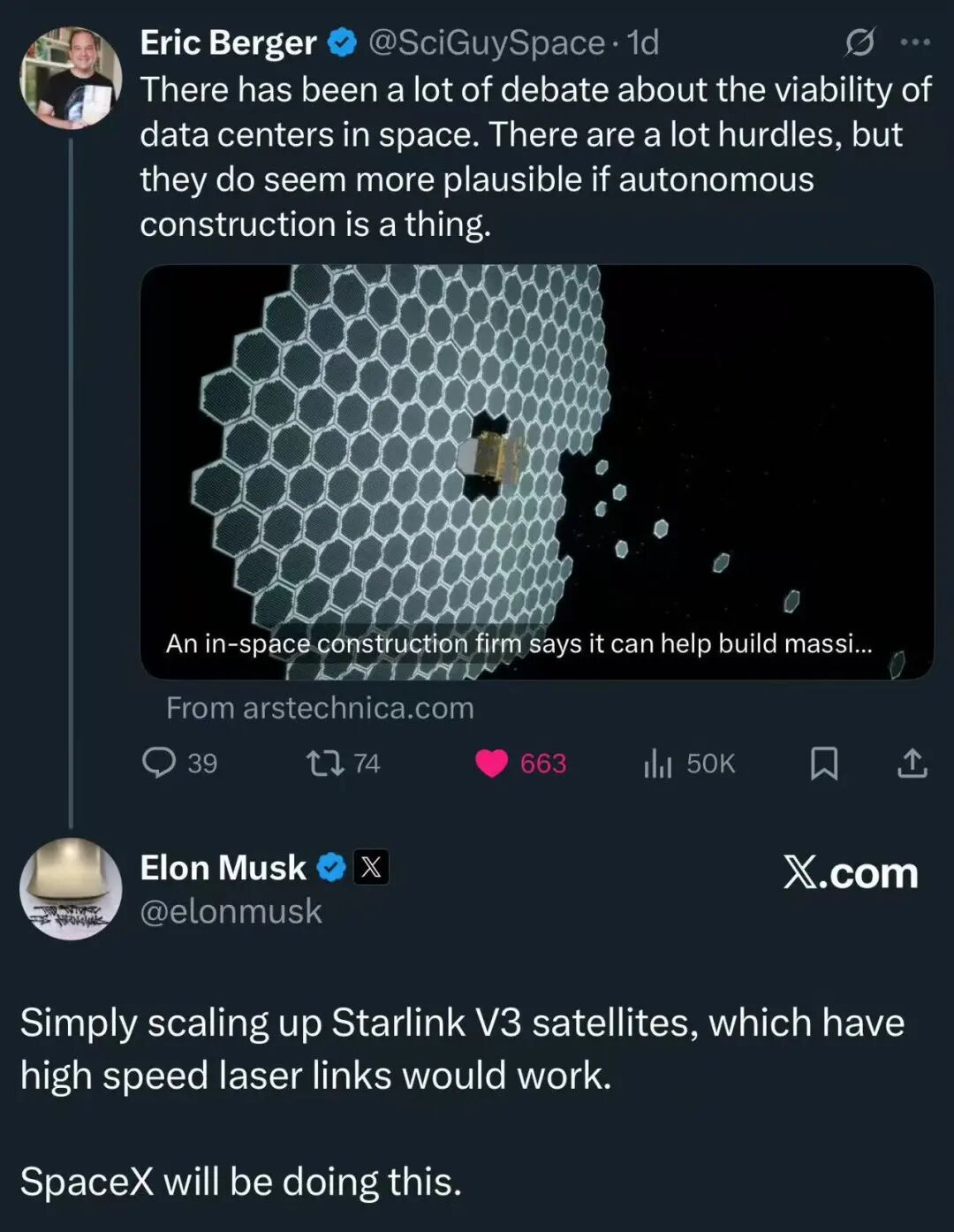
Starlink V3卫星

Search documents
商用航天奠定太空算力基础-太空光伏迎来重要发展机遇
2026-01-04 15:35
Summary of Key Points from the Conference Call Industry Overview - The conference call focused on the commercial aerospace sector, particularly the opportunities in space photovoltaics, which are expected to see significant development due to advancements in technology and cost reductions in satellite launches [3][4]. Core Insights and Arguments - **Investment Opportunities**: The commercial aerospace sector, especially space photovoltaics, presents substantial investment opportunities. The foundation of space computing has been established through reusable rockets and mass satellite manufacturing technologies, significantly lowering launch and satellite costs [3]. - **Cost Reduction**: Companies like SpaceX and China's Zhuque-3 are driving down the cost of launching individual satellites, enhancing the economic feasibility of space computing. It is anticipated that 100 GW of space data centers could be added annually over the next 4-5 years [3][4]. - **Global Initiatives**: - SpaceX plans to integrate communication and computing through its Starlink V3 satellites. - China aims to expand its "Starry Plan" satellite count to 2,800 by 2030, supporting the development of a global integrated computing network [3][4]. - **Technological Advancements**: The commercialization of space photovoltaics is accelerating due to technological iterations and cost optimizations. Silicon solar cells are currently more cost-effective than gallium arsenide cells, with prices around 50 RMB per watt for silicon and 70 RMB per watt for perovskite tandem cells [4]. - **Market Demand**: The AIGC market is increasing demand for stable and reliable power solutions in space. The projected construction of 100 GW of data centers annually indicates a trillion-level market potential for photovoltaic development [4]. Companies with Strategic Layouts - Several companies are making forward-looking investments in the commercial aerospace and space photovoltaic sectors: - **Junda Co., Ltd.**: Engaged in strategic partnerships to advance perovskite technology for space applications [5][6]. - **Dongfang Risheng**: Has delivered small batches of HJT cells, suitable for space environments [8]. - **Tuorui New Energy**: Signed supply contracts with satellite companies, establishing a clear foundation in satellite battery supply [8]. - **Mianyang Intelligent**: Laid out HJT production lines with promising lab efficiency [8]. - Other companies like Jin Feng Technology and Shuangliang Energy are also involved in the industry chain through various means [8]. Emerging Trends in New Energy - **Focus Areas**: In the new energy sector, AIDC power and solid-state batteries are highlighted as key investment areas. The 800V DC architecture is expected to be a significant variable by 2026, with solid-state transformers and high-power PSUs being critical components [9]. - **Storage Market Growth**: By December 2025, Inner Mongolia's energy storage grid connection is projected to reach 10.7 GW, totaling 45 GWh. The global energy storage capacity is expected to exceed 400 GW in 2026, with a year-on-year growth rate exceeding 50% [11]. Conclusion - The commercial aerospace and space photovoltaic sectors are poised for significant growth driven by technological advancements and strategic investments. Companies that are proactively positioning themselves in these areas are likely to benefit from the expanding market opportunities.
券商晨会精华 | 关注智能驾驶产业链
智通财经网· 2025-12-30 01:00
Group 1: Space Computing Industry - The space computing industry is accelerating its development, aiming to create an integrated computing architecture that utilizes solar energy and ultra-low temperature environments to significantly reduce latency and data transmission volume [2] - Upstream, SpaceX's Starlink V3 satellites have improved performance, and their reusable technology continues to lower costs. China's rocket recovery attempts, although unsuccessful, are crucial for technological exploration [2] - In the midstream operations, Starlink relies on phased array, dynamic scheduling, and laser link core technologies, having formed a large-scale commercial constellation that has been validated in practical applications [2] Group 2: Intelligent Driving Industry - The intelligent driving industry is expected to see significant growth, with Tesla leading a transformation in physical AI by 2026. The business model is shifting from hardware sales to software subscriptions and mobility operations [3] - Within 2-3 years, breakthroughs in L3 conditional and L4 autonomous driving technologies are anticipated, with the Robotaxi business model expected to become viable, concentrating the industry value chain towards intelligent driving solution providers and mobility platforms [3] - Companies with integrated hardware and software solutions, as well as those producing autonomous components like lidar and drive-by-wire systems, are likely to see a revaluation of their technological attributes [3] Group 3: Chinese Securities Industry - The growth of the Chinese securities industry is benefiting from economic development and capital market reforms, with leading domestic brokerages expected to accelerate their progress towards becoming world-class investment banks during the 14th Five-Year Plan [4] - These brokerages are anticipated to enhance their business scale, professional capabilities, and profitability, further highlighting their long-term investment value [4]


计算机行业周报:太空算力新基建:太阳翼-20251228
HUAXI Securities· 2025-12-28 08:01
Investment Rating - Industry Rating: Recommended [5] Core Insights - The flexible solar wing technology is crucial for large-scale satellite constellation construction, significantly reducing weight by 20%-40% and storage volume by over 60%, while expanding the deployment area by up to 1.5 times [2][12][24] - The space computing industry chain is experiencing rapid growth, with a projected compound annual growth rate of approximately 9% from 2024 to 2029, potentially exceeding $780 billion by 2029 [3][40] - The Chinese satellite internet constellation, with a planned deployment of approximately 13,000 satellites, aims to provide low-latency communication and high-resolution Earth observation services [2][21] Summary by Sections Flexible Solar Wings Supporting Large-Scale Constellation Construction - The successful launch of 17 low-orbit satellites by the Long March 8 rocket marks a significant milestone for China's satellite internet initiative, achieving a 100% success rate at the Hainan launch site [2][20] - The GW constellation, designed to operate in both high and low orbits, aims to enhance coverage efficiency and mitigate orbital competition, with a focus on low-latency communication [12][21] - China's advancements in flexible solar wings, including the world's first fully flexible solar wing satellite, demonstrate the country's leadership in this technology [2][14][31] Growth of the Space Computing Industry Chain - The space computing industry encompasses upstream satellite manufacturing, midstream operations, and downstream data services, creating a comprehensive ecosystem [3][15] - SpaceX's Starlink V3 satellites represent a significant leap in performance, enhancing global service capabilities and reducing costs through reusable technology [3][41][42] - The GW constellation is a national strategic initiative, with plans to deploy approximately 13,000 low-orbit satellites by 2035, enhancing China's competitive edge in the global space internet landscape [21][51] Investment Recommendations - Beneficiary companies in the rocket sector include Aerospace Power, Superjet, Western Materials, and others [4][19] - Companies involved in space computing include Shunhao Co., Junda Co., and others [7][19] - Satellite-related companies include Xicet Testing, Tianyin Electromechanical, and others [7][19]
一夜走红的“太空数据中心”
Hua Er Jie Jian Wen· 2025-12-17 03:28
Core Insights - The concept of space data centers is transitioning from science fiction to reality, driven by the surge in demand for artificial intelligence and the structural limitations faced by terrestrial data centers [1] - SpaceX has confirmed its IPO plans for next year, aiming for a valuation of $1.5 trillion, with strong support from Elon Musk for deploying data centers in space [1] - Major investment banks like Morgan Stanley and Deutsche Bank are beginning to assess the feasibility of space data centers, focusing on engineering challenges rather than physical limitations [1][2] Technological Advantages - Space data centers offer significant advantages in energy, cooling, latency, and scalability, with solar panels in optimal orbits capable of generating 6-8 times more energy than terrestrial counterparts [3] - Cooling systems in space can eliminate the need for traditional water-cooling methods, which account for 40% of energy consumption in ground data centers [3] - Laser link transmission speeds in vacuum are over 40% faster than terrestrial fiber optics, enabling real-time processing of data in orbit [3] Cost and Engineering Challenges - Despite theoretical advantages, space data centers face high launch costs, with the reusable Falcon 9 rocket priced at approximately $70 million, leading to a cost of about $1,500 per kilogram [4] - Effective thermal management in space is complex, requiring innovative designs for passive heat dissipation due to the vacuum environment [4] - Radiation threats can accelerate chip aging, necessitating the use of "space-grade" hardware, which increases costs [4] Market Opportunities - Deutsche Bank predicts that if technology validation is successful, the scale of satellite constellations could reach hundreds to thousands by the 2030s, creating new market opportunities for launch and satellite manufacturing companies [2][7] - Companies like Planet Labs, Rocket Lab, and Intuitive Machines are positioned to benefit from the space data center concept, with existing partnerships and capabilities in satellite production and launch services [7][8] Private Sector Developments - Startups like Starcloud have secured over $20 million in seed funding, while Axiom Space plans to launch its first two orbital data center nodes by the end of 2025, having raised over $700 million [8] - Lonestar Data Holdings is developing lunar and space data center infrastructure, with its "Freedom" payload successfully landing on the moon via SpaceX [8]
商业航天司“官宣”,火箭高频发射或进入常态化阶段
Xuan Gu Bao· 2025-11-30 23:31
Group 1 - The establishment of a dedicated regulatory body for commercial space in China marks a significant step in the development of the commercial space industry, with over 600 companies currently operating in the sector [1] - The "Action Plan for Promoting High-Quality and Safe Development of Commercial Space (2025-2027)" outlines four core objectives, including support for low-cost technologies, integration of civil and commercial standards, establishment of a national fund, and the creation of a comprehensive safety regulatory system [1] Group 2 - According to招商证券, the commercial space sector is expected to enter a phase of high-frequency launches starting in 2026 following the clarification of the policy framework [2] - The European Space Agency has approved its highest budget ever, totaling approximately €22.1 billion for the years 2026 to 2028, focusing on key scientific, exploratory, and technological projects, as well as increased investment in Earth observation, navigation, and telecommunications [2] Group 3 - Major companies are actively pursuing advancements in space computing, with Starcloud launching the Starcloud-1 satellite equipped with NVIDIA H100 GPU and plans for future satellite launches and a space data center [3] - Google has announced the Suncatcher project, aiming to launch satellites equipped with the latest Trillium TPU by 2027, forming an AI computing cluster of 81 satellites [3] - Elon Musk indicated that expanding the Starlink V3 satellite scale could enable the construction of large data centers in space, with ambitious deployment goals for data centers on the Moon [3] Group 4 - The space industry supply chain is categorized into three core segments: upstream (rocket launches, satellite manufacturing), midstream (constellation networking, in-orbit control), and downstream (emergency communication and diverse application scenarios) [3] - Key companies in the upstream and midstream sectors include Yunnan Zhenye (germanium substrates), Kaipuyun and Aerospace Electronics (laser communication), and various rocket manufacturers [3]
把数据中心建在太空,无需冷却也不缺能源,马斯克重大宣布:我们能做到!中国企业也传来好消息
Mei Ri Jing Ji Xin Wen· 2025-11-09 11:44
Core Insights - Elon Musk announced that the advent of Starship paves the way for large-scale deployment of solar-powered AI satellites, which he believes is the only path to achieve 1 terawatt (1TW) of AI computing power annually [1] - The energy supply shortage is a critical bottleneck for AI data center construction, with FTI Consulting predicting that energy demand for data centers in the U.S. will nearly double by 2027 [4] - Companies are increasingly considering building data centers in space due to the limitations of terrestrial power supply [4] Group 1: Space Data Centers - StarCloud successfully launched a satellite equipped with NVIDIA H100 chips and Google Gemini models, which will provide 100 times the GPU computing power of previous space computing facilities [4] - StarCloud plans to construct a 5-gigawatt orbital data center with large solar and cooling battery panels, measuring approximately 4 kilometers in width and length [4] - The space data center will not require water for cooling and will not depend on batteries or backup power, potentially offering unlimited low-cost renewable energy [4] Group 2: Google’s Initiatives - Google is exploring the idea of equipping its Tensor Processing Units (TPUs) on satellites with solar panels that can generate power almost continuously, with an efficiency eight times that of similar panels on Earth [5] - This initiative, named "Project Suncatcher," aims to establish the first space data center, with plans to launch prototype satellites by 2027 in collaboration with Planet [5] Group 3: Industry Trends - The U.S. has launched over 10,000 satellites, with significant implications for the ongoing conflict in Ukraine, prompting expectations for accelerated launch schedules in China [6] - The commercial aerospace sector is anticipated to experience significant growth in the coming years, with strong performance observed in the A-share commercial aerospace sector recently [6]



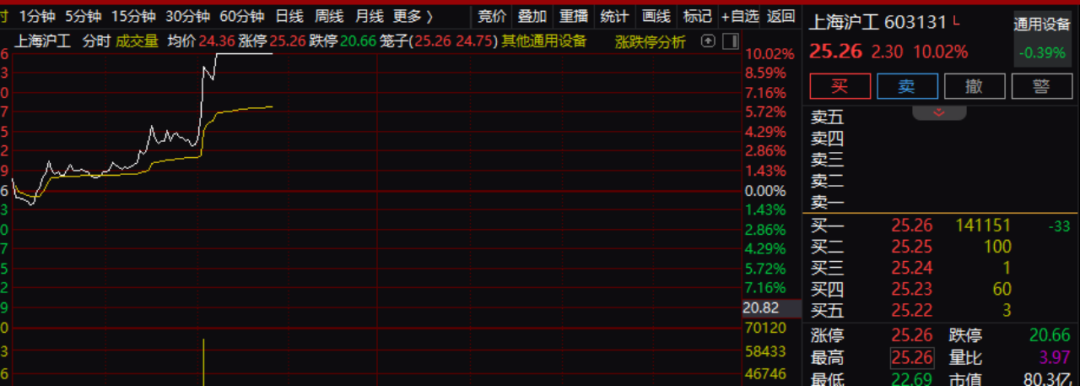
突然,直线涨停!三大利好,重磅驱动!
Zheng Quan Shi Bao Wang· 2025-11-07 04:39
Core Viewpoint - The commercial aerospace sector in China is experiencing a significant surge, driven by recent technological advancements, supportive government policies, and competitive dynamics in the global market [1][4][5]. Group 1: Market Dynamics - The A-share commercial aerospace sector saw a sharp rise, with companies like Shanghai Huguang hitting the daily limit and others like Aerospace Zhizhuang and Shanghai Hanxun also experiencing gains [1][2]. - Analysts attribute this sudden market movement to three main factors: successful tests of reusable rockets, supportive government plans, and international developments in satellite technology [1][4]. Group 2: Technological Advancements - Star River Dynamics successfully completed the ground testing of the Zhishen-1 reusable liquid rocket's first-stage propulsion system, marking a significant milestone towards its maiden flight [4]. - The Zhishen-1 is designed for at least 25 reuses and targets the large satellite launch market, indicating a shift towards more sustainable space operations [4]. Group 3: Government Policies - The 14th Five-Year Plan emphasizes the construction of a "strong aerospace nation," highlighting the importance of commercial aerospace alongside other sectors [1][4]. - Future government reports are expected to further promote the development of commercial aerospace and related industries as new growth engines for the economy [4][5]. Group 4: Global Competition - The global commercial aerospace landscape is intensifying, with the U.S. leading in technological innovation and market presence, while China is rapidly catching up [5][6]. - The competition for satellite orbits and frequency resources is becoming critical, with countries recognizing the strategic value of low Earth orbit and satellite communication systems [6]. Group 5: Market Potential - The global commercial aerospace market is projected to reach $480.3 billion by 2024, accounting for 78% of the global aerospace economy [5]. - China's commercial aerospace market is expected to grow from 324.4 billion yuan in 2017 to 713.3 billion yuan by 2024, reflecting a compound annual growth rate of 11.9% [5].
突然,直线涨停!三大利好,重磅驱动!
券商中国· 2025-11-07 04:36
Core Viewpoint - The commercial aerospace sector in China is experiencing a significant surge, driven by recent developments in reusable rocket technology, supportive government policies, and competitive dynamics in the global market [1][2][4]. Group 1: Recent Developments - Beijing's Xinghe Power Aerospace successfully completed the ground testing of the first stage power system for the reusable liquid rocket, Zhishen-1, marking the completion of all major ground tests and preparing for its maiden flight [2][5]. - The successful static ignition test of the reusable rocket Zhuque-3 has also been completed, indicating readiness for its first launch [5]. - The commercial aerospace concept has gained momentum, with several companies like Shanghai Huguang and others experiencing significant stock price increases [1][4]. Group 2: Policy Support - The 14th Five-Year Plan emphasizes the construction of a manufacturing powerhouse, quality powerhouse, aerospace powerhouse, and other strong nations, highlighting the importance of commercial aerospace [2][6]. - The 2024 Government Work Report aims to actively develop commercial aerospace and low-altitude economy as new growth engines, further reinforcing the policy framework for the sector [6]. Group 3: Global Competition - Elon Musk announced plans to expand SpaceX's Starlink V3 satellite scale and establish data centers in space to address the growing demand for computing power in the AI era, indicating a rising interest in space-based computing resources [2][6]. - The U.S. has launched over 10,000 satellites, significantly impacting global communications, and China is expected to accelerate its launch schedule in the coming years [4][9]. Group 4: Market Potential - The global commercial aerospace market is projected to reach $480.3 billion by 2024, accounting for 78% of the global aerospace economy [9]. - China's commercial aerospace market is expected to grow from 324.44 billion yuan in 2017 to 713.32 billion yuan by 2024, with a compound annual growth rate of 11.9% [9]. - The competition for satellite orbits and frequency resources is intensifying, with countries recognizing the strategic value of low Earth orbit and frequency resources [9]. Group 5: Future Outlook - By the end of 2025, China is anticipated to witness a series of maiden flights for various reusable rockets, including those from China Aerospace Science and Technology Corporation and other private companies [10].


谷歌、英伟达开始将算力运上太空
Di Yi Cai Jing· 2025-11-07 00:36
Core Insights - The construction of data centers in space is becoming a viable solution for addressing the energy supply constraints faced by terrestrial data centers, with predictions indicating that energy demand for U.S. data centers will nearly double by 2027 [1][3] Group 1: Industry Trends - Major tech companies, including Google and SpaceX, are exploring the feasibility of building scalable machine learning computing systems in space, with Google's "Suncatcher" initiative leading the charge [3][5] - SpaceX plans to expand its Starlink V3 satellite capabilities to facilitate the construction of data centers in space, while Jeff Bezos anticipates that within the next 10 to 20 years, humans will be able to build gigawatt-scale data centers in space [3][4] Group 2: Technological Advancements - Starcloud is set to launch a satellite equipped with NVIDIA H100 GPUs, marking the first instance of advanced data center GPUs being deployed in space, with the satellite expected to provide 100 times the GPU computing power of previous space computing facilities [4] - The potential for unlimited low-cost renewable energy in space is highlighted as a significant advantage, with Starcloud's data center projected to save 10 times the carbon dioxide emissions compared to terrestrial data centers [4][5] Group 3: Future Projections - Industry experts predict that within the next decade, space could emerge as a primary location for new data centers, with the cost of building these facilities expected to decrease significantly [6][7] - Historical data suggests that by the mid-2030s, launch costs could drop below $200 per kilogram, making the operational costs of space data centers comparable to those of ground-based facilities [6][7]


Elon Musk:扩大Starlink V3规模,进军太空算力
3 6 Ke· 2025-11-04 01:05
Core Viewpoint - Elon Musk announced that SpaceX will expand the scale of Starlink V3 satellites and begin constructing data centers in space to address the growing demand for computing power in the AI era [1][3]. Group 1: Space-Based Computing - The interest in space-based computing is rapidly increasing due to the significant growth in computing power demand driven by artificial intelligence [3]. - SpaceX's current Starlink V2 mini-satellites have a maximum downlink capacity of approximately 100 Gbps, while the V3 satellites are expected to increase this capacity tenfold to 1 Tbps [3][5]. Group 2: Unique Value of Space-Based Data Centers - Space-based data centers are modular computing infrastructures deployed in orbit, designed to process massive amounts of data directly in space, overcoming physical expansion limitations faced by ground-based data centers [5][7]. - By utilizing efficient solar arrays, space-based data centers can generate power from solar energy, achieving five times the power generation per unit area compared to ground facilities [5][12]. Group 3: Advantages Over Traditional Data Centers - Space-based data centers exhibit disruptive advantages in technology architecture, cost structure, deployment mode, energy efficiency, and scalability compared to traditional ground data centers [10][12]. - The total cost for operating a 40 MW cluster in space for ten years is estimated at approximately $8.2 million, significantly lower than the $167 million cost for a similar ground-based operation [12][13]. Group 4: Technical Challenges - Key technical challenges for space-based computing include radiation resistance and hardware reliability, heat dissipation system design, stable energy supply, communication bottlenecks, and launch costs [14][15][20]. - Solutions being explored include using military-grade equipment to withstand radiation, innovative cooling systems, and large solar arrays for energy generation [15][17]. Group 5: Major Players in Space-Based Computing - Major players in the space-based computing sector include startups like Starcloud, Axiom Space, and Lonestar, as well as tech giants like NVIDIA, Amazon, and Microsoft [21][22]. - Starcloud aims to launch the first AI satellite equipped with NVIDIA H100 chips, targeting the construction of a gigawatt-level orbital data center [21]. Group 6: Industry Chain Overview - The upstream of the space-based computing industry chain involves satellite manufacturers and launch service providers, including companies like Maxar, Thales Alenia, and SpaceX [23]. - The midstream includes companies providing space-hardened computing hardware and high-speed communication technologies, while the downstream focuses on applications that convert technological advantages into productivity [24].