iShares Silver Trust(SLV)

Search documents
四连跌停后仍有37%的溢价!白银LOF暴跌拷问产品设计逻辑
Mei Ri Jing Ji Xin Wen· 2026-02-06 00:53
Core Viewpoint - The significant drop of over 30% in the net value of Guotou Ruijin Silver LOF raises critical questions about the underlying design logic of the product, highlighting the challenges in implementing hedging strategies to mitigate losses [1][4]. Group 1: Product Design and Investor Expectations - Investors are suggesting that the fund company should temporarily break conventional rules to use derivatives for hedging, but industry insiders indicate that this is difficult due to product positioning, risk matching, and operational feasibility [1][5]. - The fund's design aims to track silver prices closely, with strict guidelines limiting the use of derivatives to maintain its passive tracking nature, which would be compromised by introducing hedging strategies [6][7]. Group 2: Risk and Suitability of Investors - The introduction of hedging strategies could misalign with the risk tolerance of current investors, as these strategies may introduce new risks that could exacerbate losses [7]. - The fund's current scale and risk profile are aligned with its existing investors, and any changes to the investment strategy could lead to a mismatch in risk tolerance [7]. Group 3: Operational Feasibility and Market Comparisons - Achieving perfect hedging through derivatives for a single asset like silver is unrealistic, and even similar products in overseas markets face challenges [8]. - The closest comparable product in the U.S. market, PowerShares DB Silver Fund, has faced significant issues, including a complete liquidation due to market volatility [8]. Group 4: International Product Insights - Internationally, physical silver ETFs and other investment vehicles are more prevalent, with physical silver ETFs offering a more viable model for addressing high entry barriers and storage costs in the domestic market [10][11]. - The design of physical silver ETFs could provide a framework that aligns with regulatory requirements and investor risk preferences, potentially filling gaps in the domestic silver investment landscape [11]. Group 5: Future Considerations and Industry Reflection - The recent valuation event of Guotou Ruijin Silver LOF has prompted a reevaluation of product designs within the public fund industry, emphasizing the need for improved risk management standards [17]. - The industry may need to adapt its product design philosophy and risk control measures in response to extreme market conditions, as current frameworks may not adequately address unforeseen market volatility [17].

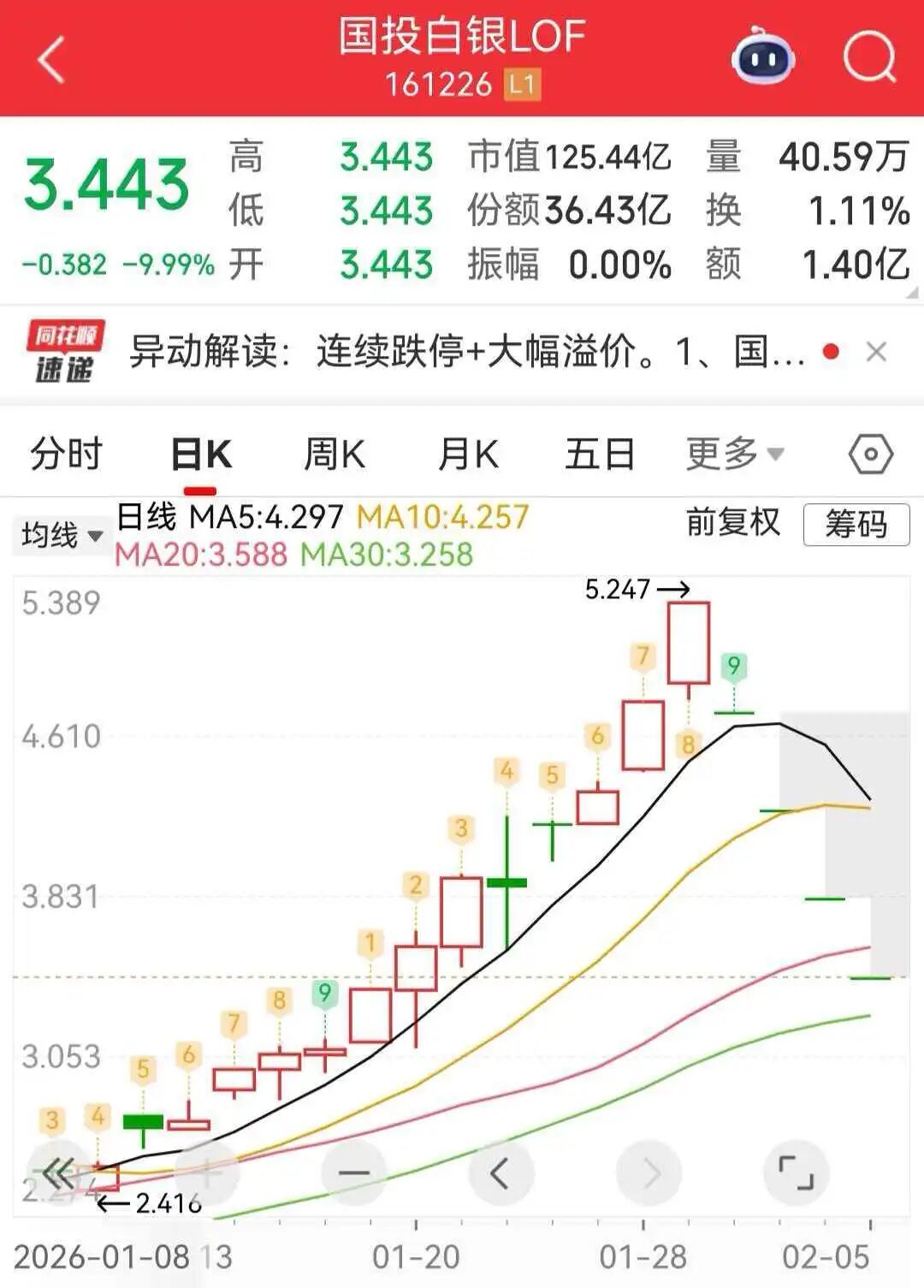
四连跌停后仍有37%的溢价!白银LOF暴跌拷问产品设计逻辑 再次面临极端行情能否扛住压力?
Mei Ri Jing Ji Xin Wen· 2026-02-06 00:45
Core Viewpoint - The significant drop of over 30% in the net value of Guotou Ruijin Silver LOF raises questions about the underlying design logic of the product, prompting investors to seek temporary measures to mitigate losses through derivative hedging, which faces substantial barriers in terms of product positioning, risk matching, and practical implementation [2][4][5]. Group 1: Product Design and Intent - The primary intent of the Guotou Ruijin Silver LOF is to track silver price movements, utilizing futures contracts due to their liquidity, while the physical silver market lacks sufficient depth for large capital movements [6]. - The product is designed to maintain a tracking deviation of no more than 0.5% daily and an annual tracking error of no more than 7%, indicating its nature as a passive tracking tool rather than an actively managed product [6]. Group 2: Investor Suitability and Risk - Introducing hedging mechanisms could misalign the product's risk profile with the existing investors' risk tolerance, as the current holders are matched to a medium-high risk level [7]. - The complexity of hedging strategies may introduce new risks, potentially exacerbating losses if the hedging fails, which could lead to a mismatch between the product's risk and the investors' capacity to bear it [7]. Group 3: Practical Implementation Challenges - Achieving perfect hedging through derivatives for a single asset like silver is unrealistic, and even similar products in overseas markets face challenges, such as the PowerShares DB Silver Fund, which has been affected by futures roll costs and market volatility [8]. - The historical limitations of product design mean that the current framework cannot adequately address extreme market conditions, highlighting the unpredictability of market behavior [9]. Group 4: International Product Comparisons - Internationally, the main silver investment products include physical silver ETFs, silver futures, and silver mining ETFs, with physical silver ETFs being particularly relevant for the Chinese market due to their ability to address high entry barriers and storage costs [11]. - The design of physical silver ETFs, which combines physical backing with share issuance, could provide a model for domestic products, enhancing tracking accuracy and reducing costs [11]. Group 5: Future Product Development - The potential transition of Guotou Ruijin Silver LOF to a QDII-FOF model faces fundamental challenges, particularly regarding the underlying assets, as investing in futures would not fundamentally improve the current model [14]. - The inability to launch a silver ETF in China due to tax implications on physical silver investments presents a significant barrier to developing more effective investment products [14].
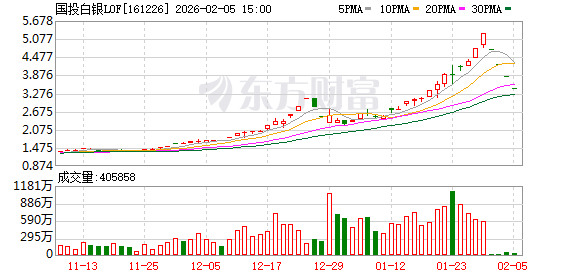
四连跌停后仍有37%的溢价!白银LOF暴跌拷问产品设计逻辑,再次面临极端行情能否扛住压力?
Mei Ri Jing Ji Xin Wen· 2026-02-06 00:38
Core Viewpoint - The significant drop of over 30% in the net value of Guotou Ruijin Silver LOF has raised questions about the underlying design logic of the product, prompting investors to suggest temporary measures such as using derivatives for hedging to mitigate losses, which industry insiders deem difficult due to product positioning, risk matching, and operational feasibility [1][2]. Group 1: Product Design and Intent - The primary intent of the Guotou Ruijin Silver LOF is to track silver price movements, utilizing futures contracts due to their liquidity, while the spot market lacks sufficient depth for large transactions [3]. - The product is designed to maintain a tracking deviation of no more than 0.5% daily and an annual tracking error of no more than 7%, indicating its nature as a passive tracking tool rather than an actively managed product [3]. Group 2: Investor Suitability and Risk - Introducing hedging mechanisms could misalign the risk profile of the fund with the existing investors' risk tolerance, as the current fund holders are matched to a medium-high risk level [4]. - The complexity of hedging strategies may introduce new risks, potentially exacerbating losses rather than mitigating them, which raises concerns about the appropriateness of such strategies for current investors [4]. Group 3: Operational Feasibility and Market Comparison - Achieving perfect hedging through derivatives for a single asset like silver is unrealistic, and even in international markets, similar products that effectively manage such risks are scarce [5]. - The closest international counterpart, the PowerShares DB Silver Fund, faced challenges due to futures contract roll costs and market volatility, leading to its liquidation in March 2023 [5]. Group 4: Alternative Investment Structures - Internationally, physical silver ETFs and silver mining ETFs are more prevalent, with physical silver ETFs offering a more accessible investment structure that could address high entry barriers and storage costs in the domestic market [8]. - The design of physical silver ETFs, which combines physical backing with share issuance, could enhance tracking accuracy and reduce costs, making it suitable for domestic investors [8]. Group 5: Future Considerations for Product Design - The current situation highlights the historical limitations of product design, which did not anticipate extreme market conditions, suggesting a need for a thorough review of product categories and risk management standards in the industry [14]. - Future product designs may need to adapt based on lessons learned from this incident, potentially leading to changes in risk control measures and investment strategies [14].

刚入场就遭重击!“散户大军”涌入金银市场,却撞上历史性暴跌
Hua Er Jie Jian Wen· 2026-02-02 13:03
Core Viewpoint - The recent surge in trading of metal and mining stocks has abruptly halted due to a significant sell-off triggered by a rebound in the US dollar, highlighting the volatility that can arise from speculative retail investor participation [1][2]. Group 1: Market Dynamics - Retail investors injected approximately $171 million into the iShares Silver Trust (SLV) on Thursday, marking the largest single-day net inflow for this group [1]. - Following the nomination of a hawkish candidate for the Federal Reserve chair, the dollar strengthened, leading to a sharp decline in precious metal prices, with gold dropping 9% and silver plummeting over 20% on the same day [2][6]. - The iShares Silver Trust experienced its largest drop since its inception in 2006, while the NYSE Arca Gold Miners Index faced its worst decline since 2008 [2]. Group 2: Retail Investor Behavior - The increasing participation of retail investors, characterized by a pursuit of short-term gains and erratic positions, raises concerns about further market volatility [6]. - The SLV fund became the second most actively traded asset on Interactive Brokers, with its trading activity doubling compared to the previous week [6]. - Retail investors have shown a strong interest in the metal and mining sector, with eight new stocks from this sector added to Jefferies LLC's basket of popular retail stocks [7]. Group 3: Institutional Investor Perspective - Despite the downturn in precious metals, some institutional investors view the sell-off in industrial metals as a buying opportunity, citing potential catalysts such as AI infrastructure development and government fiscal expansion [8]. - Barclays noted that the Bloomberg Industrial Metals Index has risen approximately 30% from recent lows, but this is still below the average 170% increase seen in metal rebound cycles since the 1990s [8]. - The current market dislocation presents a unique opportunity for value-seeking investors, particularly in industrial metal stocks compared to the crowded precious metal sector [8].

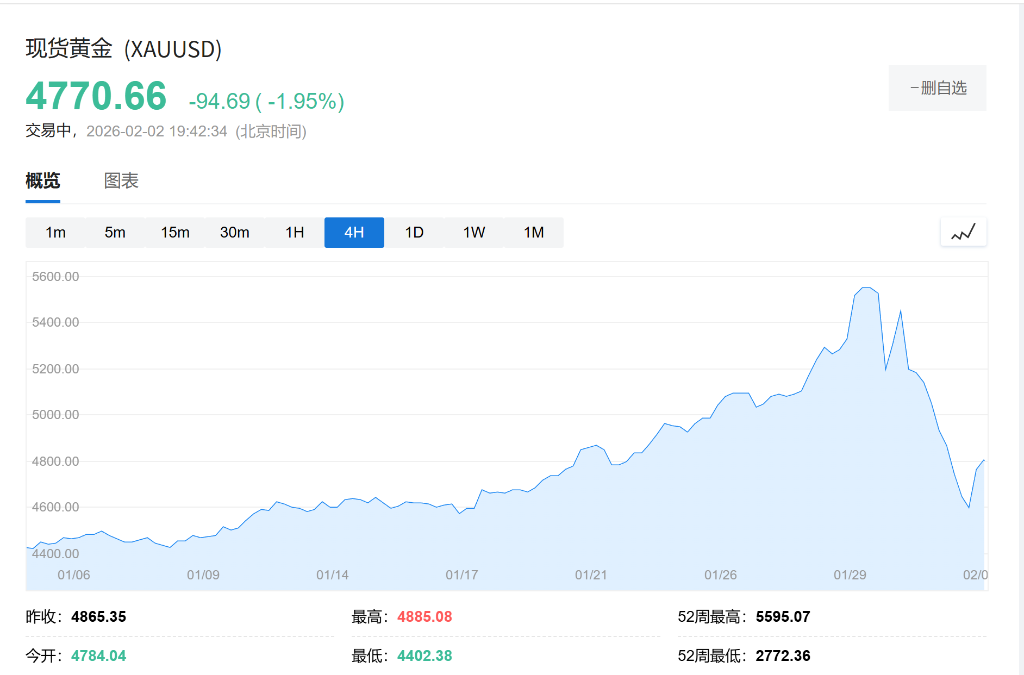
黄金破5000美元后,交易员还在疯狂买入看涨期权?
Jin Shi Shu Ju· 2026-01-27 01:36
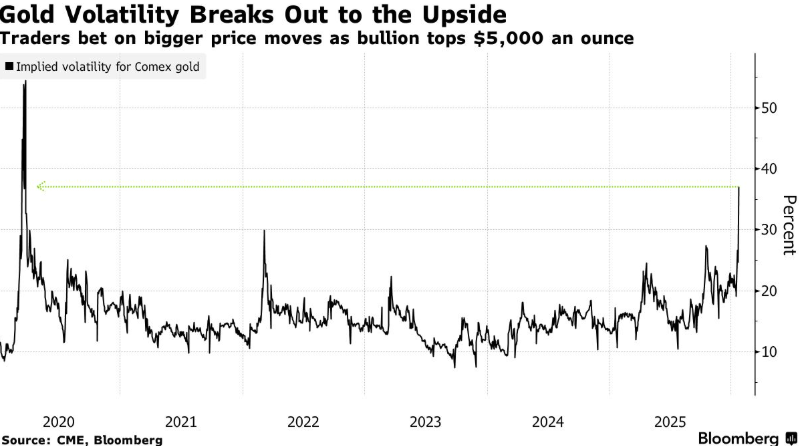
Group 1 - Gold prices have surged above $5,000 per ounce for the first time, prompting strong market reactions and bets from options traders that the upward trend will continue [1] - The increase in gold prices is attributed to a "currency devaluation trade," where investors are shifting from sovereign bonds and currencies to hard assets like gold and silver [1] - The volatility of gold futures on the New York Commodity Exchange (Comex) has reached its highest level since the peak of the pandemic in March 2020, with the SPDR Gold Shares ETF also experiencing significant volatility [1] Group 2 - A large number of bullish spread strategies have emerged in the options market, with significant trades in Comex gold futures, including nearly 5,000 contracts for a $5,500/$5,600 call spread [4] - As gold prices approach key strike levels, traders are rolling their positions upward, which may lead to a "gamma squeeze" driven by market makers needing to buy more futures contracts to balance their risk exposure [4] - Investors are also heavily buying call spread contracts for SPDR Gold Shares, with notable purchases of approximately 70,000 contracts for a $590/$595 call spread and 37,000 contracts for a $510/$515 call spread [7] Group 3 - The volatility and skew of call options in the silver market have also increased significantly, with over 35,000 contracts traded for a $125 call option expiring in May for the iShares Silver Trust [7] - The Comex silver futures market has seen trades of a 200-contract eagle spread for April with strike prices of $110, $120, $130, and $140 [7]
全球最大规模白银ETF或将创五年来最差单日表现
Ge Long Hui A P P· 2025-12-30 00:00
Core Viewpoint - The iShares Silver Trust (SLV), the world's largest silver ETF, is experiencing a significant decline, approaching its largest single-day drop since 2020, despite a year-to-date increase of over 140% [1] Group 1: Market Performance - SLV's intraday drop is nearly 9%, bringing prices back to levels seen before the Christmas holiday [1] - Year-to-date, SLV has accumulated an increase of over 140% [1] Group 2: Demand Dynamics - SLV has increased its holdings by nearly 67 million ounces of silver to meet the surge in demand this year [1] - Analysts note that this increase, while substantial, represents only a small portion of the total global silver demand for the year [1] - The main drivers of overall demand growth are strong demand from solar panel manufacturers and increased imports in India, where precious metals are more popular among savers compared to the U.S. [1]
一盎司白银罕见贵过一桶油!商品市场的“新霸主”来了?
华尔街见闻· 2025-12-29 10:24
Group 1: Silver Price Surge - The price of silver has surpassed $74 per ounce, exceeding the price of crude oil for the first time in 45 years, driven by strong demand and structural supply constraints [1][2] - Silver's price increase is attributed to both investment demand and industrial applications, particularly in clean energy sectors like solar panels and electric vehicles [2][7] - The current silver market is characterized by a significant supply constraint, as global pure silver deposits are nearly depleted, leading to silver being produced as a byproduct of mining other metals [11] Group 2: Industrial Demand and Investment Behavior - The industrial demand for silver is robust, with the solar industry consuming nearly 30% of the global annual silver production, highlighting a structural demand gap [8] - Investment behavior is shifting, with some investors turning to silver as a more affordable alternative to gold, especially as gold prices rise above $4,500 per ounce [9] - The ETF market reflects this trend, with iShares Silver Trust showing a significant price advantage over SPDR Gold ETF, attracting funds into the silver sector [10] Group 3: Oil Market Challenges - The global oil market is facing a supply surplus and structural demand transformation, with international oil prices having dropped 21% since 2025, reaching low levels post-pandemic recovery [3][14] - Analysts predict that unless major oil-producing countries coordinate substantial production cuts, the oversupply situation in the global oil market will worsen [14] - Geopolitical stability could further exacerbate supply-demand imbalances by releasing more oil production capacity [15]
风头盖过黄金!白银一年内涨近100%,创45年新高,全球最大白银ETF疯狂扫货,下周行情如何?
雪球· 2025-12-06 07:20
Group 1 - The core viewpoint of the article highlights the significant surge in silver prices, with silver's increase exceeding 100% this year, far outpacing gold's 60% rise [2][10] - The recent inflow of funds into silver ETFs has reached its highest level since July, driven by expectations of an interest rate cut by the Federal Reserve, which has supported the recent price surge [3][8] - Silver reached a historical high of $59.33 per ounce, marking a 45-year peak, with both spot and futures markets experiencing substantial activity [6][10] Group 2 - The article discusses the "short squeeze" phenomenon in the silver market, indicating that the recent price increase is not solely based on fundamental factors but also on market dynamics and speculative trading [12][14] - The initial trigger for the silver price surge was concerns over potential tariffs, leading to a rush to transport silver from London to the U.S., which created a supply crunch in the market [13][14] - The industrial demand for silver has been rising, with over half of silver consumption now coming from industrial applications, while mining production has not kept pace with demand [15][20] Group 3 - Analysts predict that silver prices could rise to $62 per ounce in the next three months due to the ongoing interest rate cuts and the tight supply situation in various markets [22] - Historical patterns indicate that silver has previously faced significant corrections after reaching similar price levels, suggesting potential volatility ahead [23] - The article notes that China is the largest industrial consumer of silver, and the current supply-demand dynamics in the solar and electronics sectors are critical to understanding future price movements [24]