Ren Min Wang

Search documents
内陆县跑出跨境电商加速度
Ren Min Wang· 2026-01-22 22:38
本报记者 杨颜菲 线下档口提供实物展示、打样定制等服务,线上云仓整合供应链资源实现快速发货……"线下档口+线 上云仓"模式,使体验和交易无缝衔接,改变传统跨境采购选货难、成本高、周期长的痛点。这一模式 吸引了众多海内外优质采购商,2025年1—10月累计接待采购商162批次,线上交易额突破26亿元,同比 增长75%。 订单越来越多,作为内陆县域,如何破解跨境物流难题? "以前货物到欧美要14天,现在3—5天就能送达,物流成本降了30%以上。"铅山诚越贸易有限公司负责 人张敏指着实时物流跟踪系统介绍。铅山县构建水陆空铁多式联运体系,引进10余家国际物流企业,布 局"海外仓+分拨中心"全球物流网络,实现本地备货、本地发货的高效配送模式。同时,推动海关监管 模式升级,实现县域跨境电商B2B出口"一键通关",联合物流企业开发智能调度系统,优化运输路线与 仓储管理。2025年1—10月,铅山跨境快递发件量突破4500万件。 在铅山数字电商产业园内,170余家跨境电商企业有序运营。这座47万平方米的产业空间集生产、物 流、办公、生活服务于一体,提供零门槛入驻、一站式成长服务,形成上下游配套、产学研协同的产业 社区。 "前 ...
数读中国 数读2025 | 五个关键字,看2025年“三农”发展新图景
Ren Min Wang· 2026-01-22 07:33
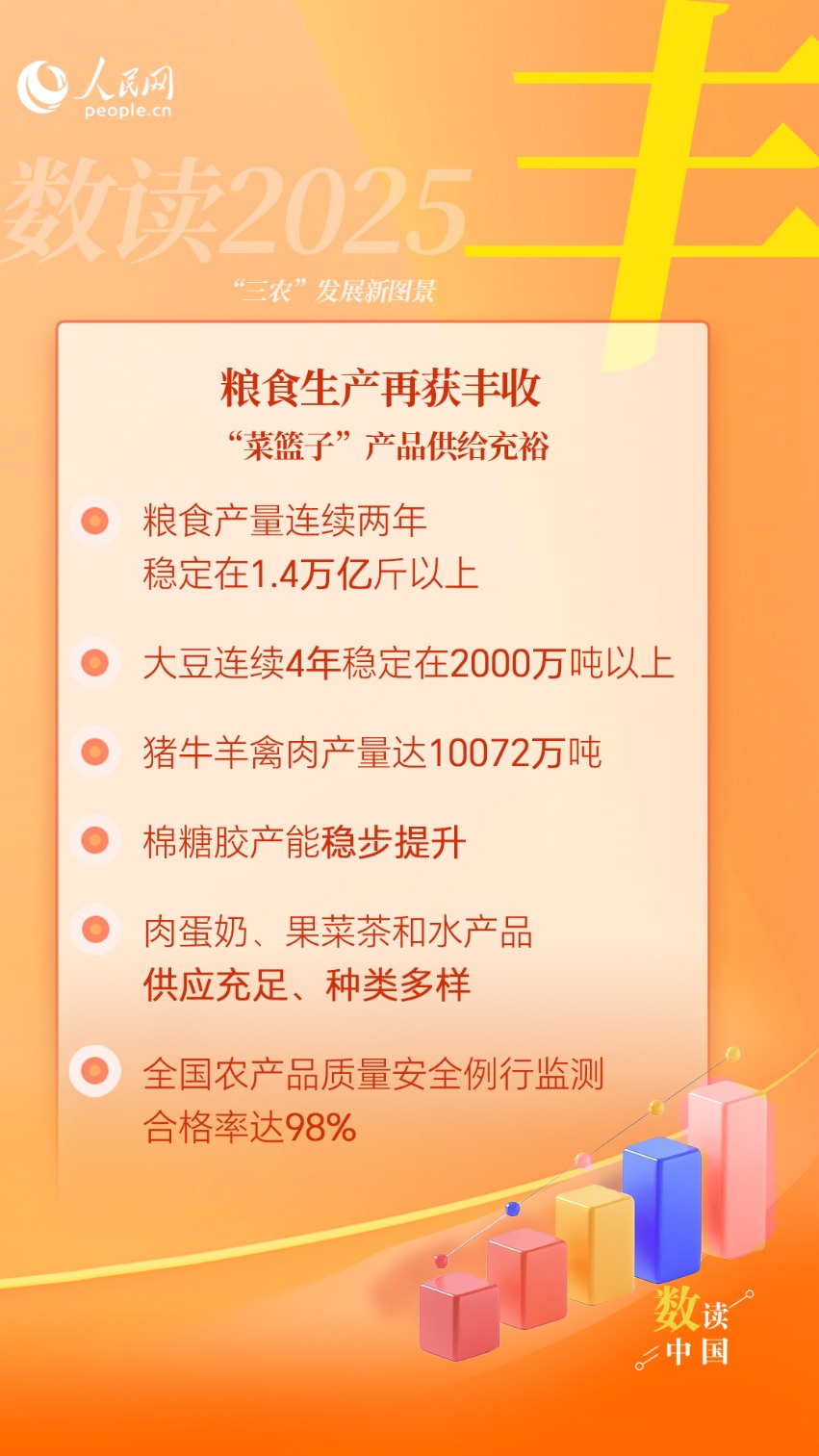
Group 1 - The core viewpoint emphasizes that the agricultural and rural development in China has maintained a steady and positive momentum, achieving all targets for the year and the "14th Five-Year Plan" [1] Group 2 - The achievements in poverty alleviation are being consolidated, with over 7 million monitoring subjects identified and supported to eliminate poverty risks by the end of 2025 [3] - The levels of education, basic healthcare, housing safety, and drinking water safety for the poverty alleviated population continue to improve [3] - The number of rural laborers engaged in winter employment and planting has reached 32 million [3] Group 3 - The support for the construction and upgrading of high-standard farmland has reached 7.568 million acres, contributing to the continuous improvement of agricultural modernization [5] - The contribution rate of agricultural technology progress exceeds 64% [5] - The area of self-bred crop varieties accounts for over 95%, with a comprehensive mechanization rate of 76.7% in crop farming [6] Group 4 - The number of agricultural drones has surpassed 300,000, with an annual operational area exceeding 46 million acres [6] - The resource utilization level of livestock manure and crop straw is steadily improving [6] Group 5 - The construction of livable and workable beautiful villages is being advanced, with continuous improvement in the well-being of the population [7] - The added value of the national scale agricultural and sideline food processing industry increased by 5.6% compared to the previous year [8] - The per capita disposable income of rural residents has increased by 6% in real terms compared to the previous year [8] - The coverage rate of sanitary toilets in rural areas has reached approximately 77%, and the construction of a civilized rural culture is progressing steadily [8]

数读中国春运@你,这些铁路暖心新政请收好
Ren Min Wang· 2026-01-22 07:28
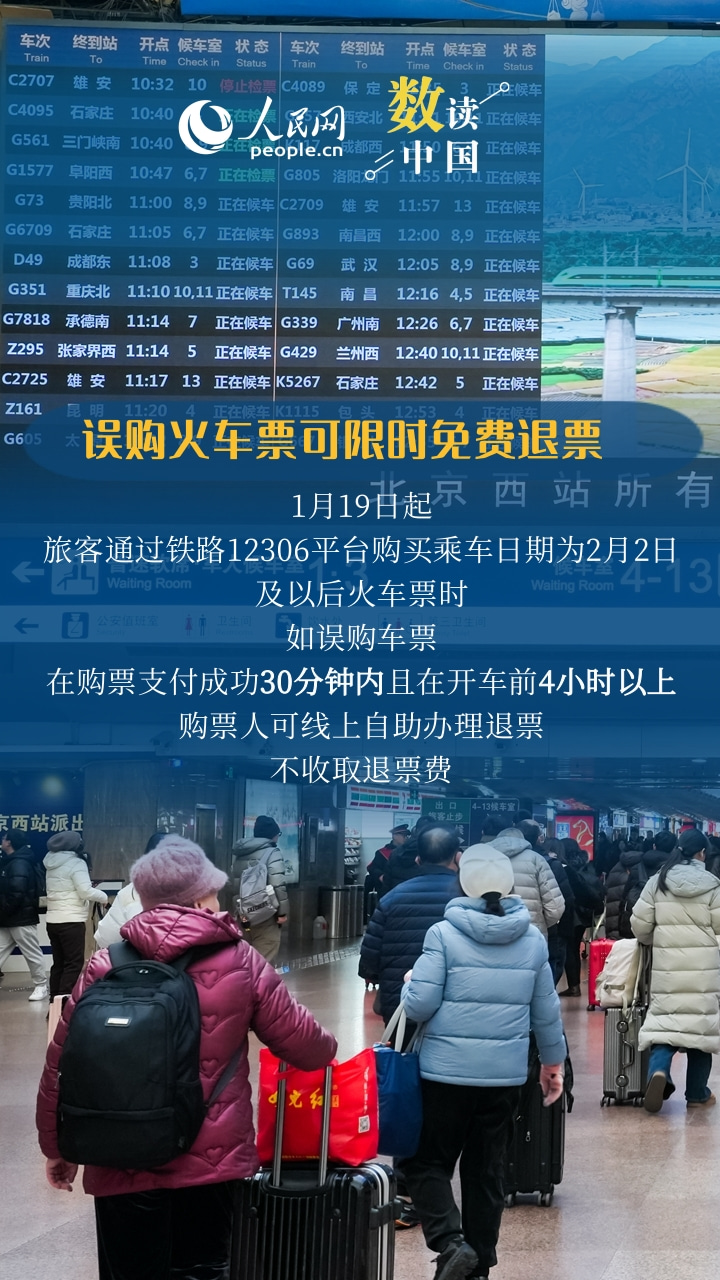
Group 1 - The railway department has introduced a series of new policies to cater to diverse travel needs for the 2026 Spring Festival, including free refunds for mistakenly purchased tickets, a new telephone ticket purchasing service for seniors aged 60 and above, and additional student discount tickets for 2026 graduates [1][5][8] - Passengers who mistakenly purchase tickets can now self-process refunds online without any fees within 30 minutes of payment and more than 4 hours before departure [2] - The new policies aim to enhance convenience and accessibility for various passenger groups, including students and elderly travelers [1][5][8] Group 2 - The railway department has expanded the "quiet carriage" service to include more train types, increasing the total number of trains offering this service to over 8,000 [12] - A new "light travel" service will be available from January 15, allowing passengers to travel without carrying their luggage at 111 stations across several cities [14] - A "snow gear convenience" service will be trialed in certain northeastern stations, allowing passengers to carry snow gear on specific trains [15]
让全球市场看到中国家纺业的创新实力
Ren Min Wang· 2026-01-22 03:03
丝加工等环节与国际伙伴开展合作。"我们在做强做精传统丝绸产业的同时,更加注重以创新驱动升 级,以合作共促共赢。"太湖雪销售经理曹玲说。 展会期间举办的中国家纺行业推介会吸引了德国、法国、意大利、美国等国家和地区的100多家企 业代表参加。中国家用纺织品行业协会及相关机构介绍了中国家纺市场的最新趋势、新兴渠道与创新技 术。"我们与中国企业合作多年,亲眼见证了他们的快速发展。"家居采购商米勒告诉记者,"除了价格 和交付能力,我们现在更关注产品的设计逻辑与环保标准。目前,欧中企业已在智能制造、绿色环保等 领域展开合作,相信未来双方的协作将更加深入。" 本届展会,中国企业参展面积近2万平方米,展品覆盖墙饰、地毯、装饰面料、睡眠系统等全产业 链。抗菌防螨的智能被芯、博物馆联名的国风床品、纯植物生态面料等产品兼具设计感与科技感。记者 在现场看到,多家中国企业展位前客流不断,常同时迎来三四批客户:有的客商仔细触摸面料、品鉴质 感,有的专注拍摄产品细节,还有的在展位上摊开资料,现场讨论合作方案。工作人员拿着笔记本,密 密麻麻地记着客户需求。不少欧洲采购商对记者表示,中国家纺企业不仅制造能力处于世界领先地位, 而且近年来坚持创 ...
澳大利亚社交媒体禁令实施月余 逾470万个账户停用
Ren Min Wang· 2026-01-22 02:28
Core Viewpoint - The Australian government has implemented a social media ban for minors under 16, resulting in over 4.7 million accounts being disabled, deleted, or restricted since December 10. The public response is mixed, with some supporting the measures while others find ways to circumvent the ban [1]. Group 1 - The Australian government has reported that more than 4.7 million accounts related to minors have been disabled, deleted, or restricted since the implementation of the social media ban [1]. - The ban applies to 10 social media platforms, including Facebook, Instagram, TikTok, and YouTube, with a maximum fine of AUD 49.5 million for non-compliance by social media companies [1]. - The Australian Prime Minister and Communications Minister have acknowledged the initial positive impact of the ban, emphasizing the importance of taking action to drive change [1]. Group 2 - The eSafety regulator will continue to monitor compliance across social media platforms to ensure the enforcement of the new regulations [2].
推进二维码互联互通 银联以“支付互联”赋能“全球协同”
Ren Min Wang· 2026-01-22 01:34
Core Insights - China UnionPay is actively participating in the World Economic Forum, showcasing its role as a global payment service provider and emphasizing its new "four-party model" for building a collaborative global payment network [1] Group 1: Market Trends and Innovations - The demand for efficient, convenient, and secure cross-border payment services is increasing due to the rise in global cross-border trade and tourism [1] - QR code payment systems are becoming a mainstream payment method globally, driven by low costs and ease of promotion, with significant adoption in Southeast Asia, Brazil, and Turkey [2] - The "top-down standardization and bottom-up application" approach in various countries aligns with UnionPay's strategy of "technical adaptation + rule collaboration" [2] Group 2: Cross-Border Payment Cooperation - UnionPay is innovating with a dual-track mechanism of government-to-government (G2G) and network-to-network (N2N) cooperation to enhance cross-border payment connectivity [3] - The G2G model is being implemented in countries like Indonesia and Vietnam, while the N2N model is being utilized in Singapore and South Korea to quickly respond to market needs [3] Group 3: Expansion and Performance - UnionPay has established or is advancing QR code interoperability in approximately 50 countries, creating a broad and efficient cross-border payment network [4] - By 2025, UnionPay aims to launch QR code interoperability in seven overseas markets, with projected increases in QR code transaction volumes of 124% and 100% for domestic and foreign users, respectively [4] Group 4: Future Strategies - UnionPay plans to strengthen its global acceptance network to facilitate both outbound and inbound exchanges, focusing on regions like Southeast Asia, Central Asia, the Middle East, Africa, and Latin America [5] - The company aims to construct a new "four-party model" for cross-border payments, integrating quality resources across the payment industry to build an open and collaborative global payment ecosystem [6]
“贴地飞行”前的模拟驾驶
Ren Min Wang· 2026-01-22 01:06
l g EOAS设备 佐森实训工装 2 1946 19 of the la 12 May 国际 7 a sam 123 博 ● . . 18 y. L A 13 4 8 · C . 17 f H B M M H T P .. and . dia 9 9 .. it . .. TIP HERE y 6 如何年 出版 2026-01-15 08:27:10 00:31 日期:出版 2026-01-15 07:31:36 00:3 . Fr 100 1 125 1 200 la la lo A 0 1 5 8 # S 高 ......... 11 HI == C O 0 o m Im III IIII and The British illi L 00% 00 67 B 4 est r ...

韩国经济处于结构转型关键阶段(经济透视)
Ren Min Wang· 2026-01-21 22:38
Core Viewpoint - The International Monetary Fund and the Organisation for Economic Co-operation and Development predict that South Korea's economy is expected to achieve moderate recovery by 2026, driven by a rebound in semiconductor and high-end manufacturing exports, with a focus on emerging sectors like artificial intelligence, advanced semiconductors, and green technology [1] Group 1: Economic Transition - South Korea is undergoing a structural transformation, moving beyond traditional industries such as automotive, telecommunications, and shipbuilding, which are now in a mature phase, to high-value sectors like AI, advanced semiconductors, biomedicine, and future mobility [1] - The government is implementing a combination of policies, including tax incentives, regulatory easing, and enhanced R&D support, to systematically promote the development of emerging industries [1] Group 2: Digital and Green Transformation - Digitalization and green transformation are identified as two core pillars of South Korea's economic strategy, with a focus on addressing global climate challenges and enhancing technological competitiveness [2] - The government is collaborating with enterprises to build large AI data centers and promote the integration of AI technology into manufacturing and services, aiming for revolutionary improvements in productivity and cost structures [2] - In the digital transformation aspect, South Korea is leveraging its advanced ICT infrastructure and a mature public-private collaboration mechanism, exemplified by the "K-Cloud" project, which aims to promote domestic cloud platforms [3] - For green transformation, South Korea is constructing a "hydrogen economy ecosystem," focusing on hydrogen production, storage, transportation, and applications, including the promotion of hydrogen fuel cell vehicles and the development of low-cost clean hydrogen production technologies [3] Group 3: Regional Cooperation - Strengthening regional cooperation is crucial, as China and South Korea are significant trade partners with deeply integrated supply chains, with China being South Korea's largest trading partner for 21 consecutive years [4] - The future of South Korea-China economic relations is expected to focus on "manufacturing innovation" and "service collaboration," promoting policy communication and industrial alignment for mutual benefits [4]
智能除冰显身手
Ren Min Wang· 2026-01-21 22:32
Core Insights - The article highlights the impact of recent low-temperature, rain, and snow conditions on various regions in China, particularly in the southern areas where temperatures have dropped sharply, leading to increased demand for heating electricity [4] - The use of advanced technologies such as ice removal robots, snow-clearing robots, infrared temperature sensors, and various drones has been emphasized to ensure efficient and precise power supply maintenance during these adverse weather conditions [4] Group 1 - The low-temperature and icy weather has caused significant challenges for power supply stability, with some transmission lines experiencing ice accumulation [4] - The deployment of intelligent equipment, including ice removal robots and drones, is crucial for maintaining electricity supply and ensuring safety during extreme weather events [4] - The article indicates a surge in heating electricity demand due to the severe weather conditions affecting a large part of the country [4]

人工智能产业亮点纷呈(权威发布)
Ren Min Wang· 2026-01-21 22:32
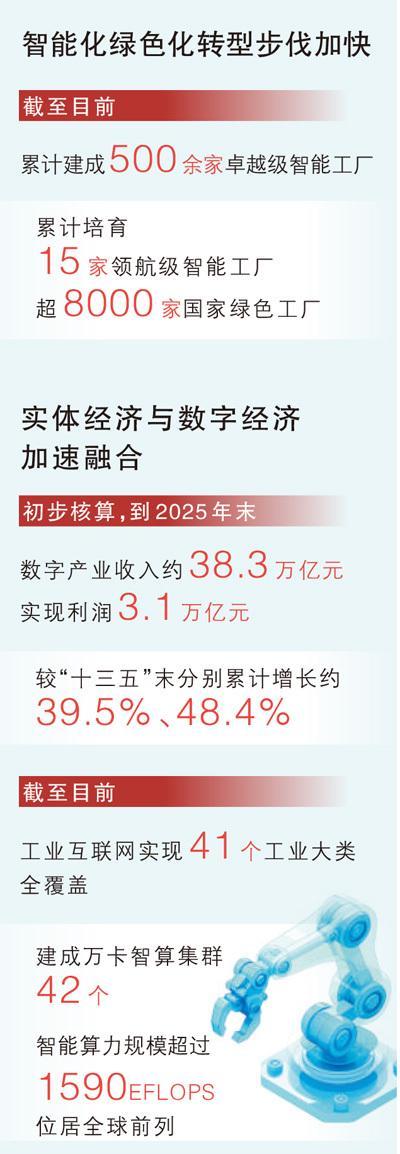
Group 1: Industrial Transformation and Growth - As of now, over 500 exemplary smart factories have been established, with 15 leading smart factories cultivated and more than 8,000 national green factories built [1] - By the end of 2025, the digital industry revenue is expected to reach approximately 38.3 trillion yuan, with profits of 3.1 trillion yuan, representing cumulative growth of about 39.5% and 48.4% compared to the end of the 13th Five-Year Plan [6] - The industrial internet has achieved full coverage across 41 industrial categories, with the establishment of 42 smart computing clusters [1] Group 2: High-Quality Development and Innovation - By 2025, the added value of large-scale industrial enterprises is projected to grow by 5.9% year-on-year, with the manufacturing sector's contribution to GDP remaining stable [2] - New production capabilities are leading to high-quality development, with significant advancements in materials and technologies such as perovskite materials, permanent magnet materials, and power batteries [2] - The production efficiency of leading factories has improved by an average of 29%, and the defect rate of products has decreased by 47% [4] Group 3: Market Expansion and Consumer Goods - The consumer goods industry is expected to see a 3.7% year-on-year increase in added value by 2025, accounting for 26.1% of total industrial output [8] - A series of promotional activities have been organized to enhance the supply of quality products, including the release of 35 bio-manufacturing products and 1,321 innovative textile products [8][9] - The strategy to enhance brand development is being implemented, with the selection of 93 national consumer brands and 43 regional brands to stimulate domestic consumption [8]