2 1 Shi Ji Jing Ji Bao Dao

Search documents
精进电动:2025年净利润同比扭亏
2 1 Shi Ji Jing Ji Bao Dao· 2026-02-27 10:42
Group 1 - The core viewpoint of the article highlights that Jingjin Electric has reported significant growth in its 2025 annual performance, with a revenue of 2.726 billion yuan, representing a year-on-year increase of 108.93% [1] - The company achieved a net profit attributable to shareholders of 162 million yuan, marking a turnaround from losses in the previous year [1] - Basic earnings per share reached 0.27 yuan, reflecting a year-on-year growth of 136.49% [1]

*ST建艺:深圳市建艺装饰集团股份有限公司收到行政监管措施决定书
2 1 Shi Ji Jing Ji Bao Dao· 2026-02-27 10:39
Core Viewpoint - Shenzhen Jianyi Decoration Group Co., Ltd. received a regulatory decision from the Shenzhen Securities Regulatory Bureau, which includes corrective measures and warnings for several executives due to internal control deficiencies and improper disclosures [1] Group 1: Regulatory Actions - The company is required to submit a written rectification report within 30 days of receiving the decision [1] - Regulatory measures include a warning letter issued to the chairman, general manager, vice chairman, and other key executives [1] Group 2: Identified Issues - Internal control deficiencies related to contract management were highlighted [1] - Certain board meeting records from 2023 to 2025 were found to be non-compliant [1] - Financial assistance provided from 2017 to 2020 was not timely reviewed and disclosed [1] - Inaccurate information disclosure regarding the equity donation from Guangdong Jianyi Stone Co., Ltd. in December 2024 was noted [1] Group 3: Required Improvements - The company must enhance its understanding of securities laws and regulations [1] - There is a need to improve corporate governance and internal control systems [1] - The company is expected to enhance the standardization of information disclosure and financial management [1]
长源东谷:股票交易异常波动
2 1 Shi Ji Jing Ji Bao Dao· 2026-02-27 10:39
Core Viewpoint - The stock of Changyuan Donggu experienced a significant price fluctuation, with a cumulative increase of 21.02% over two consecutive trading days, which is classified as an abnormal trading situation according to Shanghai Stock Exchange regulations [1] Company Operations - As of the date of the announcement, the company's production and operations are normal, with no significant changes in market environment or industry policies [1] - There have been no substantial fluctuations in production costs or sales conditions [1] Disclosure and Major Events - The company, its controlling shareholder, and actual controller have confirmed that there are no undisclosed major matters that could impact stock trading, including but not limited to major asset restructuring, share issuance, significant transactions, business restructuring, share buybacks, equity incentives, bankruptcy reorganization, major business collaborations, or introduction of strategic investors [1] - No media reports, market rumors, or trending concepts have been identified that could significantly affect the company's stock price [1] Insider Trading - During the period of abnormal stock price fluctuation, the controlling shareholder, actual controller, and company executives did not engage in buying or selling the company's stock [1]

华媒控股:选举项辉为董事长
2 1 Shi Ji Jing Ji Bao Dao· 2026-02-27 10:38
Core Viewpoint - The company announced the election of Xiang Hui as the chairman of the board, effective immediately upon the resolution's approval, lasting until the end of the current board's term [1] Group 1 - The company held its 15th meeting of the 11th board of directors on February 27, 2026 [1] - The agenda included the election of the chairman and the executive director responsible for company affairs [1]

兴蓉环境:2025年净利润同比增长0.41%
2 1 Shi Ji Jing Ji Bao Dao· 2026-02-27 10:38
南财智讯2月27日电,兴蓉环境发布2025年度业绩快报,报告期内公司实现营业收入90.68亿元,同比增 长0.21%;归属于上市公司股东的净利润20.04亿元,同比增长0.41%;基本每股收益0.67元,同比持 平。 ...

开普云终止收购高端存储厂商,AI转型一波三折
2 1 Shi Ji Jing Ji Bao Dao· 2026-02-27 10:37
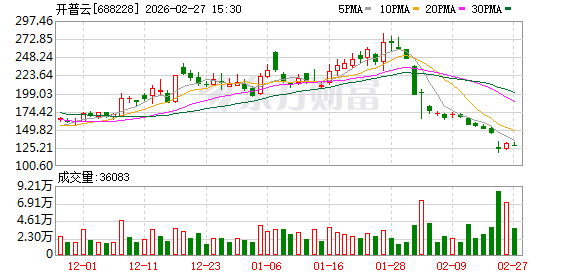
Core Viewpoint - The acquisition of Nanning Taike by Kaipu Cloud has been terminated due to valuation disagreements and changes in market conditions, impacting the company's stock performance and future AI transformation plans [2][4][12]. Group 1: Acquisition Details - Kaipu Cloud announced the termination of its acquisition of 100% equity in Nanning Taike from Shenzhen Jintek, a leading company in storage products [2]. - The acquisition was initially expected to enhance Kaipu Cloud's capabilities in AI infrastructure by integrating high-performance storage solutions [4][12]. - The deal was structured to involve a cash purchase of 70% equity followed by a share issuance for the remaining 30% [10]. Group 2: Financial Impact - Following the announcement, Kaipu Cloud's stock price dropped by 14.57% over three trading days and has seen a cumulative decline of 47.71% since February [3]. - In 2024, Jintek's total revenue from storage assets was reported at 2.366 billion, nearly four times that of Kaipu Cloud's revenue of 618 million [5]. - Jintek's net profit for 2024 was 136 million, approximately ten times higher than Kaipu Cloud's net profit of 15.39 million [5]. Group 3: Market Context - The storage industry is currently experiencing a "super cycle" driven by explosive demand for AI computing power and tight supply of storage chips [4]. - Jintek ranks fourth globally in SSD module revenue and is a key supplier for major companies like Lenovo and Haier [4]. Group 4: Future Strategy - Despite the acquisition failure, Kaipu Cloud plans to continue focusing on its AI business transformation and has initiated a share buyback program to stabilize its stock price [2][12]. - The company aims to deepen its core technology development and explore new strategic projects in the AI industry [12][13]. - Kaipu Cloud has established a new subsidiary, Kaipu Cloud Intelligent Storage (Shenzhen) Co., Ltd., to expand its presence in the storage hardware sector [12].


汇通控股:465.66万股限售股3月5日解禁
2 1 Shi Ji Jing Ji Bao Dao· 2026-02-27 10:35
Group 1 - The company announced the listing of 4.6566 million restricted shares for public circulation, which represents 3.69% of the total share capital [1] - The lock-up period for these shares is set for 12 months from the date of the company's initial public offering and listing [1] - The shares will become tradable on March 5, 2026 [1]
华兰疫苗:拟使用不超10.00亿元部分闲置募集资金进行现金管理
2 1 Shi Ji Jing Ji Bao Dao· 2026-02-27 10:34
Core Viewpoint - The company has approved the use of idle raised funds for cash management, ensuring it does not affect the progress of investment projects or normal operations [1] Group 1: Cash Management Approval - The company will continue to use up to RMB 1 billion of idle raised funds for cash management [1] - The investment products will include high safety, good liquidity, and principal-protected options such as structured deposits and large certificates of deposit, with a maturity not exceeding 12 months [1] - The cash management will be effective for 12 months from the date of board approval, and the funds can be rolled over within the approved limit [1]

佰仁医疗:2025年净利润同比增长36.81%
2 1 Shi Ji Jing Ji Bao Dao· 2026-02-27 10:34
Group 1 - The core viewpoint of the article highlights that Baijun Medical reported a significant increase in its financial performance for the fiscal year 2025, with a revenue of 630 million yuan, representing a year-on-year growth of 25.60% [1] - The net profit attributable to shareholders of the listed company reached 200 million yuan, showing a year-on-year increase of 36.81% [1] - The basic earnings per share (EPS) was reported at 1.46 yuan, which is a year-on-year growth of 36.45% [1]

38万亿险资调仓:固收打底但增配放缓 股票占比创近年新高
2 1 Shi Ji Jing Ji Bao Dao· 2026-02-27 10:34
Core Insights - The insurance asset allocation is transitioning from a dominance of fixed income to a more diversified structure, incorporating equities and alternative investments, supported by a steady growth in premium income on the liability side [1] Group 1: Asset Allocation Trends - As of the end of Q4 2025, the total balance of insurance funds reached 38 trillion yuan, marking a 15.7% increase from the beginning of the year, the highest annual growth rate since 2021 [1] - Life insurance companies remain the primary contributors, with a fund balance of 34.66 trillion yuan, up 15.73% year-on-year, accounting for approximately 90.1% of the total industry scale [1] - Property insurance companies had a fund balance of 2.42 trillion yuan, increasing by 8.78%, representing about 6.27% of the total [1] Group 2: Fixed Income and Bond Investments - Long-term bonds continue to be a crucial component of insurance companies' investment strategies, with a combined bond investment balance of approximately 18.7 trillion yuan, making up 48.6% of the total fund balance, a slight increase of 0.7 percentage points from the beginning of the year [2] - The average yield of 10-year government bonds in 2025 decreased by about 40 basis points compared to 2024, leading to a slowdown in the pace of long-term bond allocation by insurance companies [2] - The proportion of bank deposits decreased to about 7.6%, down approximately 0.8 percentage points from the beginning of the year, while non-standard assets also saw a decline [2] Group 3: Equity Investments - Equity assets have become the main focus of reallocation, with the combined proportion of stocks, funds, and long-term equity investments reaching approximately 23.0%, an increase of 2.6 percentage points from the beginning of the year, totaling an increase of 1.97 trillion yuan [5] - The stock allocation balance reached about 3.73 trillion yuan, with a net increase of 1.31 trillion yuan over the year, accounting for 9.68% of the total fund balance, the highest level since Q2 2022 [5] - The balance of securities investment funds was 1.97 trillion yuan, with a net increase of 289.9 billion yuan, representing 5.3% of the total fund balance, showing a slight increase [5] Group 4: Future Outlook - In 2026, insurance funds are expected to continue increasing their allocation to equity assets, driven by policy support and liability-side factors, becoming a significant incremental force in the market [7] - A survey indicated that most insurance institutions are optimistic about domestic investment assets, particularly stocks and securities investment funds, with a tendency to slightly increase stock investments [8] - The focus on A-shares is expected to remain strong, with institutions favoring sectors such as electronics, non-ferrous metals, and pharmaceuticals [9]