
Ren Min Ri Bao

Search documents
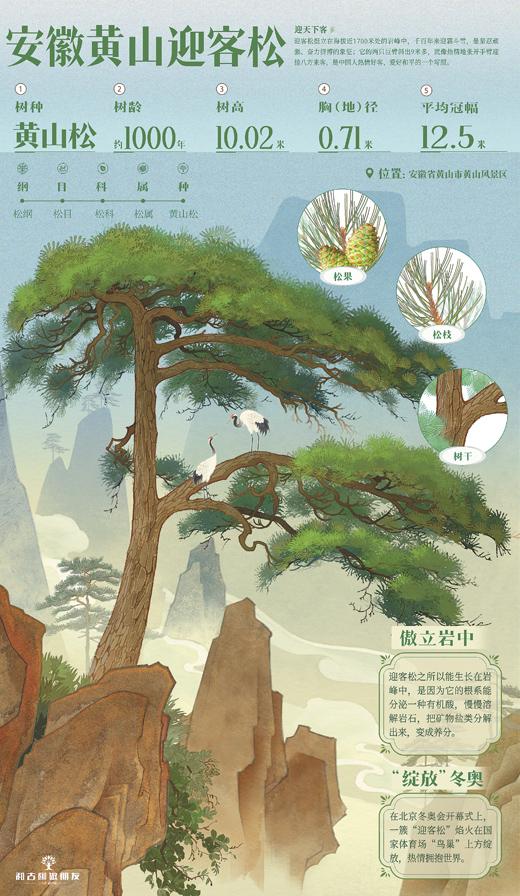
千年迎客松 广迎八方客(和古树做朋友)
Ren Min Ri Bao· 2026-01-22 23:42
松科松属乔木,我国特有树种。喜光,喜凉润、空气相对湿度较大的高山气候,耐瘠薄,在土层深厚、 排水良好的酸性土及向阳山坡生长良好。 近些年,科技力量的加入,让迎客松的保护工作更加精准。黄山风景区管理委员会园林局高级工程师吴 贻军介绍,景区与高校合作,经过多轮设计、研制、测试,研发出"树木双向双刚度弹性支撑"技术,让 迎客松手臂枝能够在风雨中摇摆自如,促进手臂枝受应力刺激而产生自增强、自适应行为;又可通过调 节限幅装置,根据风力雪载大小限制摆动幅度,避免迎客松手臂枝因变形过大而被损伤。 2020年,吴贻军主导"迎客松3D数字化建模"项目,完成了对迎客松主体的三维扫描、近景摄影和建 模,迎客松周边环境三维扫描等工作内容。"这为迎客松留存了详细的数字化档案,为监测与展示等保 护利用工作提供了数据基础。"吴贻军说。 树皮深灰褐色,裂成不规则鳞状厚块片或薄片;枝平展,老树树冠平顶;花期4—5月,球果次年10月成 熟。 黄山松 清晨,阳光洒向天都峰顶,安徽黄山风景区迎来新的一天。 玉屏楼前,薄雾如轻纱般缓缓散去,一棵造型奇绝的黄山松在晨曦中显露真容——一侧枝丫如臂般舒展 伸出,针叶在晨光中泛着苍翠光泽,仿佛正以饱满的热情迎 ...

各地多措并举优化消费环境 让消费者舒心购无忧购
Ren Min Ri Bao· 2026-01-22 23:24
核心阅读 商场环境如何保持新鲜感,实体店购物后退换是否方便,预订服务、预付费用会不会有"坑"……消费环 境优劣,关乎消费体验。优化消费环境可以提振消费信心、激发经济活力,对推动经济高质量发展、保 障高品质生活具有重要意义。各地对此积极探索,努力提升消费便利度、舒适度、满意度。 中央经济工作会议指出,"深入实施提振消费专项行动""扩大优质商品和服务供给"。目前,各级市场监 管部门牵头推进的优化消费环境三年行动正在实施,着力解决突出问题,营造放心消费环境。 如何提升供给质量、维护市场秩序、提高维权效能,记者在各地进行了探访。 江苏南京—— 艺术+商业,消费场景"上新" 冬日的江苏南京,一场大雪为城市街巷平添韵味。德基广场的一处展厅,却是春意正浓——色彩在画布 上铺陈,花朵在笔触间盛放。在法国印象派画家克劳德·莫奈的油画《盆中花》前,顾客董源正看得投 入,欣赏着繁花盛放的生机勃勃。 不久前,彭先生在位于四川泸州的重庆百货商场购买了一件衬衣。没几天到了重庆,他逛街时又看到了 同品牌的衬衣。"泸州的店里没有这个款式,这个更好看,只可惜我已经买了。"彭先生很遗憾。 "只要您的衣服不影响二次销售,我们可以在15天之内无理由 ...
农业农村部:今年常态化精准帮扶“缺什么、补什么”
Ren Min Ri Bao· 2026-01-22 23:24
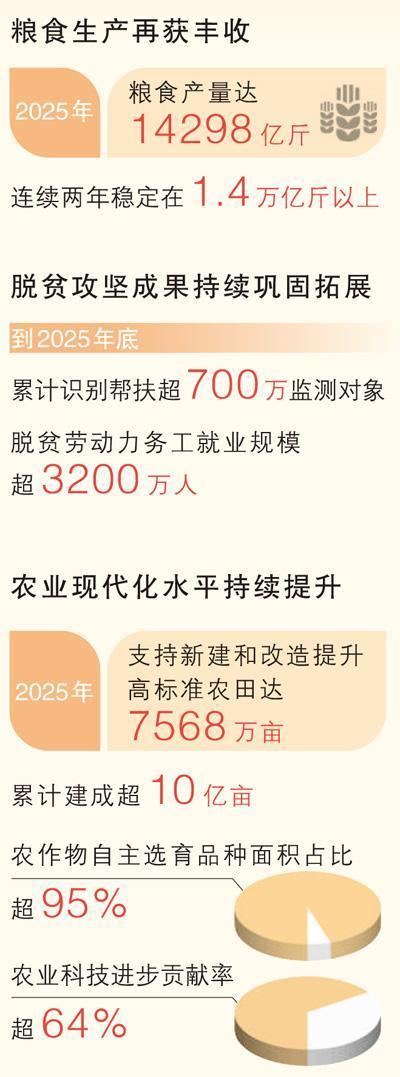
数据来源:农业农村部 制图:蔡华伟 1月22日,国务院新闻办举行新闻发布会,邀请农业农村部有关负责同志,介绍加快农业农村现代化, 扎实推进乡村全面振兴有关情况。 农业农村部副部长张兴旺在会上表示,过去这一年,各级农业农村部门学习运用"千万工程"经验,扎实 有力推进乡村全面振兴和农业强国建设重点工作,农业农村发展保持稳中有进、稳中向好势头,全年 和"十四五"各项目标任务顺利完成,为推动经济社会高质量发展提供基础支撑。 春节期间蔬菜产品供应有充分保障 2025年我国粮食生产再获丰收,"菜篮子"产品供给充裕。 原标题:脱贫人口务工就业规模连续5年稳定在3000万人以上 今年常态化精准帮扶"缺什么、补什么"(权威发布) 产量增加,深入实施新一轮千亿斤粮食产能提升行动,粮食生产连续两年稳定在1.4万亿斤以上;大豆 油料扩种成果持续巩固,产量连续4年稳定在2000万吨以上;猪牛羊禽肉产量达10072万吨、同比增长 4.2%。 质量更优,全国农产品质量安全例行监测合格率达98%,化肥农药利用率进一步提高,畜禽粪污综合利 用率超过80%,绿色食品、有机产品、名特优新农产品、地理标志农产品总数超过了8.8万个,农业发 展全面绿 ...
历史的现场 生动的课堂
Ren Min Ri Bao· 2026-01-22 23:20
Core Viewpoint - Shanxi Province is innovatively integrating red resources and traditional Chinese culture into ideological and political education, breaking classroom boundaries and enhancing the appeal and effectiveness of these courses through new media [1][2][12] Group 1: Innovative Teaching Approaches - A special ideological and political class was conducted at the school history museum in Taiyuan, allowing students from different grades to engage in mutual questioning and collective thinking [2] - The "walking ideological and political class" is part of Shanxi's "New Era Talent Cultivation Project" and aims to promote integrated reforms in ideological education across all educational levels [2][11] - Shanxi Province has developed 67 "Great Ideological and Political Class" practical teaching bases, supporting collaboration between schools and museums to enhance course quality [5] Group 2: Curriculum Development - The curriculum incorporates three thematic colors: red for patriotism, green for ecological civilization, and blue for industrial technology, creating a diverse ideological education framework [8][9] - Teachers are encouraged to design courses that connect students with local resources, such as tea picking, to foster a deeper understanding of new development concepts [9] - The province is building a resource library for "What is Shanxi" ideological courses, integrating moral education elements from various subjects [9] Group 3: Community Engagement and Practical Experience - Students participate in community service and historical reenactments, enhancing their understanding of national history and fostering a sense of patriotism [11][12] - The "walking ideological class" includes activities like hiking to historical sites, singing revolutionary songs, and paying tribute to martyrs, which are designed to instill a sense of national pride [11] - Schools are forming partnerships with local communities to create a platform for students to engage in moral education through service and storytelling [11][12]
如何促进思政课堂和社会课堂有效融合(政策问答·回应关切)
Ren Min Ri Bao· 2026-01-22 23:16
Core Viewpoint - The integration of ideological and political education (思政课) with real-life social contexts is emphasized, aiming to enhance the effectiveness and relevance of the curriculum [1][2]. Group 1: Integration of Ideological Education - The "14th Five-Year Plan" suggests promoting effective integration between ideological education in classrooms and social contexts [1]. - The Ministry of Education and ten other departments have issued a plan to fully mobilize social resources for practical teaching in ideological education [2]. - Over 600 universities have implemented practical credit requirements for ideological courses, with pilot reform areas expanding to ten regions [2]. Group 2: Practical Teaching Innovations - The Ministry of Education has organized nationwide "Ideological Big Classes" to create benchmark courses that combine theory and practice [3]. - A significant outreach effort has been made, with over 1.5 billion students and teachers participating in themed classes, achieving a total online viewership of 485 million [3]. Group 3: Regional Characteristics and Resources - Various regions are developing unique brands for ideological education, such as "The Great Ideological Class on the Central Axis" in Beijing and "The Taste of Truth" in Zhejiang [4]. - The establishment of over 550 national-level practical teaching bases has been initiated, with a focus on immersive and interactive teaching methods [4]. - Future reforms will prioritize practical teaching, aiming to enhance the digital resources and engagement methods for ideological education [4].
中方愿同各方一道继续推动全球绿色低碳转型
Ren Min Ri Bao· 2026-01-22 23:15
新华社北京1月22日电(记者董雪、袁睿)针对美国领导人在瑞士达沃斯发表关于中国风力发电机的言 论,外交部发言人郭嘉昆22日在例行记者会上答问时表示,作为负责任发展中大国,中方愿同各方一 道,继续推动全球绿色低碳转型,共同建设清洁美丽的世界。 郭嘉昆说,中国构建了全球最完备的碳减排政策体系和最大的可再生能源体系,并积极分享绿色发展成 果。中国风电装机规模已连续15年稳居世界第一,截至2025年11月底,中国风电装机容量超过6亿千 瓦。"十四五"时期中国出口的风电和光伏产品累计为其他国家减少碳排放约41亿吨。 "中国在应对气候变化、推动全球可再生能源发展应用方面所作努力有目共睹。"郭嘉昆说,作为负责任 发展中大国,中方愿同各方一道,继续推动全球绿色低碳转型,共同建设清洁美丽的世界。 有记者问:美国总统特朗普21日在达沃斯称,中国生产了大量风力发电机,但他在中国找不到任何风电 场,并称中国一直在向"愚蠢的"人出售风力发电机。外交部对此有何评论? ...
今年首批936亿元超长期特别国债支持设备更新资金已经下达
Ren Min Ri Bao· 2026-01-22 23:08
本报北京1月22日电 (记者刘志强)今年以来,国家发展改革委会同各有关方面优化实施"两新"政策, 在前期扎实开展设备更新项目谋划储备的基础上,抓紧组织项目申报,严格做好审核把关,加快推动设 备更新政策落地见效。近日,2026年第一批936亿元超长期特别国债支持设备更新资金已经下达,支持 工业、能源电力、教育、医疗、粮油加工、海关查验、住宅老旧电梯、节能降碳环保、回收循环利用等 领域约4500个项目,带动总投资超过4600亿元;同时,采取直接向地方下达资金的方式,继续支持老旧 营运货车报废更新、新能源城市公交车更新、老旧农机报废更新。 (文章来源:人民日报) 下一步,国家发展改革委将会同各有关方面,持续做好统筹协调和跟踪调度,加强设备更新项目和资金 全链条管理,扎实推进项目建设,加快提升资金使用效率,进一步发挥"两新"政策效能。 ...
从5个百分点看绿水青山就是金山银山(读数·年度数据深一度)
Ren Min Ri Bao· 2026-01-22 22:30
Core Insights - The Yangtze River Economic Belt has achieved significant ecological and economic improvements over the past decade, with the proportion of good water quality rising from 67% to 96.5% and regional GDP more than doubling, increasing its share of the national economy from 42.2% to 47.3% [1][2] Group 1: Ecological Improvements - The Yangtze River Economic Belt has implemented 17 integrated ecological protection and restoration projects, establishing over 17,000 ecological environment control units to safeguard development foundations [3] - The transformation of the relationship between people and mountains has led to enhanced ecological advantages, which are now translating into development advantages for local communities [3] Group 2: Economic Transformation - The economic vitality of the Yangtze River Economic Belt has been bolstered by the transition of nearly 10,000 chemical enterprises along the river, with the establishment of 24 national carbon peak pilot cities and parks, and 14 zero-carbon parks [4] - The region has cultivated 41 national-level advanced manufacturing clusters and 30 strategic emerging industry clusters, accounting for 51% and 45% of the national totals, respectively [5] Group 3: Innovation and Development - The Yangtze River Economic Belt is becoming a hub for technological innovation, with the presence of major scientific facilities and research units attracting over 3,000 researchers, contributing to future industry development [4][5] - The shift in development philosophy is driving changes in economic structure and quality, aiming for a harmonious coexistence between humans and nature, which is essential for sustainable growth in the region [5]
为实现“十五五”良好开局提供有力金融支撑——访中国人民银行党委书记、行长潘功胜(权威访谈·开局“十五五”)
Ren Min Ri Bao· 2026-01-22 22:30
Group 1 - The core viewpoint emphasizes the implementation of a more proactive macro policy to achieve qualitative and effective economic improvement and reasonable quantitative growth, ensuring social harmony and stability, and striving for a good start to the "14th Five-Year Plan" [1] - The Central Economic Work Conference proposed to continue implementing a moderately loose monetary policy, with the People's Bank of China (PBOC) planning to support stable growth and high-quality development through various monetary policies in 2024 and 2025 [2][3] Group 2 - In terms of total policy, the PBOC aims to maintain ample liquidity and ensure that the growth of social financing and money supply aligns with economic growth and price level expectations, indicating room for further cuts in reserve requirement ratios and interest rates [3] - Structural policies will focus on optimizing the design and management of structural monetary policy tools, with a recent reduction of 0.25 percentage points in the interest rates of various structural monetary policy tools [3][4] Group 3 - The PBOC plans to construct a scientific and robust monetary policy system and a comprehensive macro-prudential management system to support high-quality financial development and the construction of a financial power [4][5] - Key initiatives include optimizing the monetary policy target system, improving the market-oriented interest rate formation mechanism, and enhancing the macro-prudential management toolbox [5] Group 4 - The PBOC will enhance financial services for high-quality economic development by increasing support for expanding domestic demand, technological innovation, and small and micro enterprises [6][7] - Specific measures include a dedicated 500 billion yuan for consumer and elderly care loans and an increase in the quota for technological innovation loans to 1.2 trillion yuan [6][7] Group 5 - The PBOC will strengthen collaboration among financial departments and other industry regulators, improve the service capabilities of financial institutions, and ensure coordination between monetary and fiscal policies [8][9] - In terms of global financial governance, the PBOC will promote financial sector reforms, enhance the internationalization of the yuan, and actively participate in international financial cooperation [10][11]
从各地“新年第一会”看高质量发展(评论员观察)
Ren Min Ri Bao· 2026-01-22 22:13
"十五五"开局之年,不少地方打破惯例,将往年春节后的"新春第一会",提前为元旦刚过的"新年第一 会"。 上海致力"深化体系":连续第九年出台优化营商环境行动方案,对"内卷式"竞争、"职业闭店人"等新问 题作出细化规定,着力打造更加稳定、透明、可预期的制度环境。 辽宁侧重"提振信心":相关会议提出打造"营商环境最佳口碑省",以"不留余地"的决心倒逼改革落地; 省委领导主动添加企业家微信,直言"有什么问题直接给我反映",积极构建亲清统一的新型政商关系, 展示优化营商环境的诚意。 "十五五"蓝图擘画,明确了未来五年"任务书",但具体落实的"路线图"需要各地从实际出发去探索,决 不能刻舟求剑、拿一个模子去套。有什么问题就解决什么问题,一把钥匙开一把锁,才能取得实实在在 的成绩,实现没有水分的发展。 这不仅是工作日程的前移,更是工作节奏的主动提速,传递出"时不我待、只争朝夕"的精神状态、"开 好局、起好步"的坚强信心。 纵览各地"新年第一会",高质量发展为主线,实体经济、民生福祉等被置于突出位置。同时,在议题设 置和政策部署上,也根据本地特点谋划发展路径。从各地"新年第一会"看新一年的高质量发展,大局 观、方向感、执行 ...