Nan Fang Du Shi Bao

Search documents
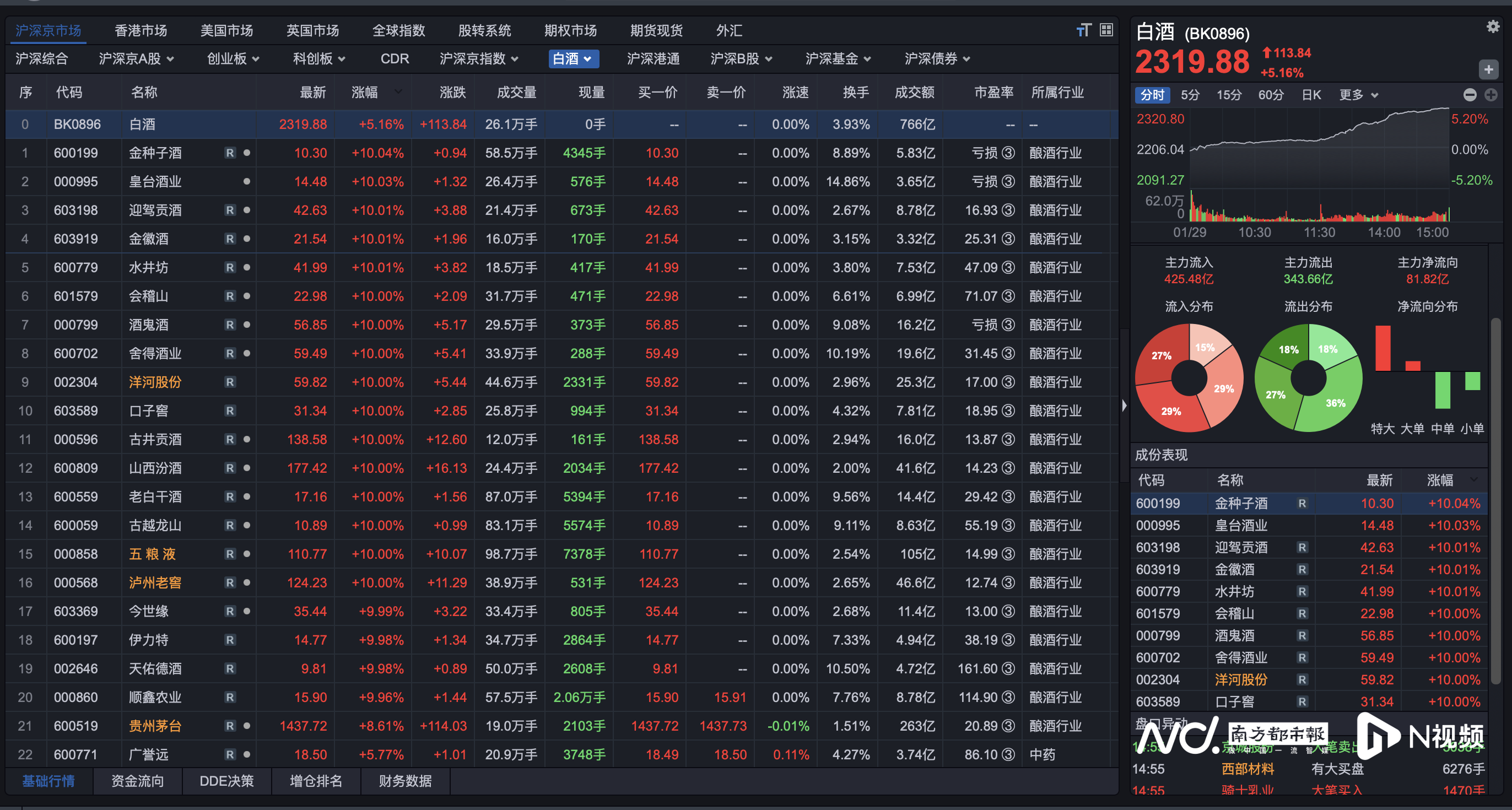
贵州茅台罕见暴涨!白酒股大面积涨停!“拐点”真的来了?
Nan Fang Du Shi Bao· 2026-01-29 08:57
| 沪深京市场 | | 香港市场 | 美国市场 | 英国市场 | 全球指数 | | 股转系统 | 期权市场 | | --- | --- | --- | --- | --- | --- | --- | --- | --- | | 沪深综合 | | 沪深京A股 ▼ | 创业板 ▼ | 科创板 ▼ | CDR | 沪深京指数 ▼ | | 白酒 ▼ | | 序 | 代码 | 名称 | | 最新 | 涨幅 > | 涨跌 | 成交量 | 现量 | | 0 | BK0896 | 白酒 | | 2319.88 | +5.16% | +113.84 | 26.1万手 | 03 | | 1 | 600199 | 金种子酒 | R ● | 10.30 | +10.04% | +0.94 | 58.5万手 | 4345手 | | 2 | 000995 | 三圆织与新 | ● | 14.48 | +10.03% | +1.32 | 26.4万手 | 576手 | | 3 | 603198 | 迎驾贡酒 | R . | 42.63 | +10.01% | +3.88 | 21.4万手 | 673手 | | 4 | 603919 | 金徽 ...




商务部:家政服务机构可享免征增值税等优惠政策延期至明年底
Nan Fang Du Shi Bao· 2026-01-29 08:52
何咏前介绍,家政等社区家庭服务业事关"一老一小"和民生福祉,与老百姓生活息息相关,党中央、国务院高度 重视家政服务业发展。2019年,财政部、商务部等六部门印发《关于养老、托育、家政等社区家庭服务业税费优 惠政策的公告》,为社区提供家政服务的机构,按照规定可享受免征增值税、契税、房产税、城镇土地使用税、 不动产登记费、耕地开垦费、土地复垦费、土地闲置费、城市基础设施配套费、防空地下室易地建设费,企业所 得税应纳税所得额减按90%计入收入总额等优惠。该政策的实施,有效降低了税费负担,促进了家政服务业发 展,受到了社会各界好评。 何咏前表示,2025年,商务部、财政部、国家税务总局等部门充分考虑家政服务业在促消费、稳就业、惠民生中 的重要作用,并结合行业实际反映,推动继续将上述5税6费优惠政策延期至2027年底。 何咏前说,下一步,商务部将继续配合相关部门,落实落细税费优惠政策,做好政策宣传解读,让更多含金量高 的支持政策惠及更广大的家政企业,加快推动家政服务业高质量发展。 南都讯 记者杨文君发自北京 1月29日下午,商务部召开例行新闻发布会,新闻发言人何咏前就近日六部门联合印 发的《关于延续实施养老、托育、家政 ...

融资20亿!强脑科技传赴港上市,杭州六小龙已有四家冲上市
Nan Fang Du Shi Bao· 2026-01-29 08:46
Core Viewpoint - Zhejiang Qiangnao Technology Co., Ltd. has reportedly submitted a confidential IPO application to the Hong Kong Stock Exchange, with CICC and UBS as joint sponsors, indicating a significant move towards public listing in the rapidly growing brain-computer interface (BCI) sector [1][3]. Company Overview - Founded in February 2015, Qiangnao Technology focuses on the development of non-invasive brain-computer interface technology, with products spanning smart bionics, health, and education [1]. - The company has launched several products, including a smart bionic hand, a brain-machine intelligent sleep device, and an attention training system [1]. Financing History - Qiangnao Technology completed a significant financing round in early January, raising approximately 2 billion RMB, marking it as the second-largest financing in the BCI field globally, after Neuralink [3]. - Since its inception, the company has completed six rounds of financing, including a notable $400 million Series A round in 2019 [3][4]. - The latest financing rounds include a $30 million Pre-B round and a $20 million Series B round in 2025 [4]. Market Trends - The BCI sector is experiencing rapid growth, with 26 financing events in 2025 totaling 1.778 billion RMB, a significant increase from 2024 [5]. - The global BCI market is projected to grow from approximately $2.6 billion in 2024 to $2.9 billion in 2025, with a further increase to $3.3 billion by 2026 [5]. - In China, the BCI market is expected to reach 3.8 billion RMB in 2025, up from 3.2 billion RMB in 2024 [5]. Policy Support - The Chinese government is actively promoting the BCI industry, with policies aimed at fostering innovation and establishing industry clusters by 2027 and 2030 [7]. - The national strategy includes BCI as a key area for economic growth, alongside other advanced technologies [7]. Industry Outlook - Analysts predict that the BCI industry is on the verge of significant growth, driven by commercial advancements and policy support [8]. - The transition from laboratory research to commercialization is expected to accelerate, particularly with the anticipated production scale-up by Neuralink [8].

芬兰总理访华,中芬双方达成哪些经贸成果?商务部回应
Nan Fang Du Shi Bao· 2026-01-29 08:45
Core Insights - The recent visit of Finnish Prime Minister Orpo to China resulted in significant economic cooperation outcomes between China and Finland [3] - A memorandum of understanding was signed to enhance the work of the China-Finland Innovation Enterprises Cooperation Committee, indicating a commitment to collaborative innovation [3] - Over 50 companies from both countries engaged in discussions on cooperation in innovation, green technology, and digital sectors, leading to multiple commercial agreements in various industries [3] Economic Cooperation - The visit included the sixth meeting of the China-Finland Innovation Enterprises Cooperation Committee, highlighting the focus on innovation and collaboration [3] - Finnish companies expressed optimism about China's economic development and market potential, indicating a willingness to invest long-term in China [3] Future Initiatives - The Ministry of Commerce plans to work with Finland to implement the important consensus reached by the leaders of both countries [3] - There will be efforts to enhance policy communication in economic and trade matters and support Finnish companies in exporting quality products and services to China [3]
黄金市场:金币金条光芒盖过金饰 以旧换新缓解购买力不足
Nan Fang Du Shi Bao· 2026-01-29 08:24
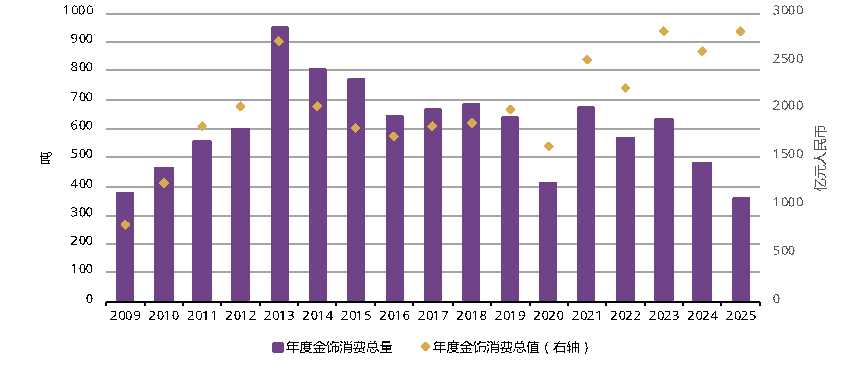
金饰克价上涨限制消费者购买力 金饰方面,2025年全年金饰需求总量达360吨,同比减少25%。不过,从消费金额维度来看,四季度中国消费者金饰支出 达778亿元人民币(约合110亿美元),同比增长19%;全年累计支出2814亿元人民币(约合394亿美元),同比增幅为 8%。 1月29日,世界黄金协会更新关于中国黄金市场的观察报告。2025年四季度,中国市场黄金投资与消费需求(含金饰、金 条、金币、黄金ETF及工业用金)总量达274吨,年同比增长18%,较三季度大幅攀升60%,同时创下历年四季度第二亮眼 表现,仅次于2016年同期。 2025年全年,中国黄金市场需求总量达1003吨,同比增长6%,为2021年以来最高水平。按金额计,全年需求更是创下历 史新高,总额达7960亿元人民币(约合1110亿美元),同比激增53%。值得注意的是,年内强劲的黄金投资需求抵消了金 饰板块的疲软态势。 值得关注的是,全年金饰"以旧换新"业务(消费者将旧首饰折算后补足差价及额外工费换购新首饰)持续火爆,有效缓解 了消费者购买力不足的问题。世界黄金协会认为,这一趋势是中国消费者对金饰兴趣持续高涨以及市场流动性不断提升的 积极信号。 ...
奢侈品消费复苏是假象?LVMH去年收入下降5%,股价跳水
Nan Fang Du Shi Bao· 2026-01-29 08:24
Core Viewpoint - LVMH's financial performance for the fiscal year ending December 31, 2025, continues to be impacted by the industry's cyclical downturn, with total revenue declining by 5% to €80.8 billion, operating profit down 9% to €17.755 billion, and net profit down 13% to €10.878 billion, primarily due to poor performance in the fashion and leather goods segment [2][5] Group 1: Financial Performance - In Q4 2025, LVMH's revenue decreased by 5.1% year-on-year to €22.72 billion, although organic revenue grew by 1%, marking the second consecutive quarter of growth after two quarters of decline [4] - The fashion and leather goods segment saw organic sales decline by 3% in Q4, a worsening from the 2% decline in Q3, while the perfume and cosmetics segment fell by 1% [4] - The watch and jewelry segment, along with premium retail businesses like DFS and Sephora, performed well with organic revenue growth of 8% and 7% respectively in Q4, exceeding market expectations [4] Group 2: Segment Performance - For the full year 2025, the fashion and leather goods segment revenue fell by 8% to €37.77 billion, while the watch and jewelry segment saw a slight decline of 1% to €10.486 billion [5] - The perfume and cosmetics segment revenue decreased by 3% to €8.174 billion, and the wine and spirits segment revenue dropped by 9% to €5.358 billion [5] Group 3: Market Insights - The Asian market, particularly China, showed signs of improvement in the second half of 2025, with organic revenue growth of 1% in Q4, contrary to previous expectations of a decline [9] - The Japanese market experienced a 13% decline in organic revenue for the year, while the European market fell by 1%, and the U.S. market remained flat compared to the previous year [9] Group 4: Strategic Moves - LVMH's CEO Bernard Arnault announced the acquisition of additional shares in Loro Piana for approximately €1 billion, increasing the group's stake from 85% to 94%, with the family retaining 6% [7] - The company is focusing on maintaining product quality and scarcity while controlling the pace of expansion, as Loro Piana has shown rapid growth [7] Group 5: Industry Challenges - The luxury goods sector is facing challenges due to rising living costs, geopolitical uncertainties, and weakened consumer confidence, which are suppressing global luxury spending [11] - The previous strategy of frequent price increases in the luxury sector is showing adverse effects, leading to consumer dissatisfaction and a potential shift in focus towards demand recovery and value reconstruction in 2026 [12]

金价再创新高!多家银行调整积存金业务,消费者如何“上车”
Nan Fang Du Shi Bao· 2026-01-29 07:44
Core Viewpoint - The recent surge in spot gold prices, surpassing $5,500 per ounce, has prompted banks to adjust their gold accumulation business, including changes in interest rates and minimum investment amounts [2][6]. Group 1: Gold Price Movement - As of January 29, 2026, spot gold prices reached a peak of $5,598.75 per ounce, marking a significant increase of nearly 30% since the beginning of the year [6]. - The price of gold has consistently broken through key levels, including $5,000, $5,100, $5,200, $5,300, and $5,400 in a short span [6]. Group 2: Bank Adjustments - Ningbo Bank announced a reduction in its gold accumulation product interest rates, with the current rates set at 0% for demand deposits and 0.3% for one-month and three-month fixed deposits [3]. - Ping An Bank also adjusted its gold accumulation business rates, with demand deposit rates now at 0.01% and fixed deposit rates for three months, six months, and one year set at 0.2%, 0.4%, and 0.8% respectively [4]. - Several banks, including Agricultural Bank and Industrial and Commercial Bank, have implemented new requirements for personal clients to undergo risk assessment before participating in gold accumulation transactions [5]. Group 3: Investment Advice - Experts advise that gold should not be viewed as a speculative tool for quick wealth but rather as a means to hedge against extreme risks and stabilize overall asset portfolios [2][9]. - New investors are encouraged to adopt a disciplined approach, such as regular fixed investments, to mitigate the psychological pitfalls of market volatility [9].

券商、运营商密集跨界卖保险,消费者选择困难症来了?
Nan Fang Du Shi Bao· 2026-01-29 06:33
Core Viewpoint - The insurance industry is experiencing an innovative trend of "cross-industry collaboration," with various sectors such as securities firms and telecommunications companies entering the insurance market, leading to a multi-channel integration of insurance sales [2][5][10]. Group 1: Cross-Industry Participation - Major securities firms have launched "insurance sections" in their official apps, with one leading firm offering 18 insurance products, including 13 dividend-type products [3]. - China Mobile has begun selling insurance products in its offline stores, integrating insurance sales with telecommunications services [3][10]. - Other capital players, such as Yuexiu Group and Midea Group, are also making significant investments in the insurance sector through acquisitions [3][5]. Group 2: Market Dynamics and Consumer Behavior - The entry of cross-industry players is reshaping traditional insurance sales channels, which have historically relied on individual agents, bank insurance, and brokerage channels [6][7]. - The insurance market is witnessing a shift, with the bank insurance channel surpassing individual insurance channels in new premium scale for the first time in 14 years, while individual channels have seen a 16.6% decline [6]. - Consumers are finding it easier to purchase insurance but are increasingly concerned about making the right choices, as the integration of insurance into daily life may lead to oversimplified decision-making [11][12]. Group 3: Implications for Traditional Channels - The emergence of cross-industry channels is expected to challenge traditional agents and brokers, particularly in the distribution of standardized insurance products [7][10]. - Experts suggest that while cross-industry platforms may dominate simple insurance products, the value of professional agents will become more pronounced in complex risk management and long-term service [7][13]. - The market may evolve into a structure where cross-industry channels focus on lower-end products for younger demographics, while traditional channels cater to high-net-worth clients with complex needs [7][10]. Group 4: Regulatory and Strategic Considerations - The regulatory environment is evolving to support the expansion of insurance sales by securities firms, with new guidelines set to take effect in February 2026 [9]. - The push for cross-industry collaboration is driven by the need for traditional firms to diversify revenue streams amid declining income, with insurance sales seen as a key strategy for wealth management [9][10]. - The integration of insurance into telecommunications and financial services is viewed as a strategic move to create new growth avenues in a saturated market [10][13].

青岛银行去年盈利51.88亿元,利润增速达营收增速近三倍
Nan Fang Du Shi Bao· 2026-01-29 06:27
规模增长方面,截至2025年末,青岛银行资产总额8149.60亿元,比上年末增长18.12%,客户贷款总额 3970.08亿元,比上年末增长16.53%;客户存款总额5028.99亿元,比上年末增长16.41%。 1月28日,青岛银行发布2025年度业绩快报。数据显示,2025年,该行归属于母公司股东的净利润51.88 亿元,同比增长21.66%;营业收入145.73亿元,同比增长7.97%;加权平均净资产收益率12.68%,比上 年提高1.17个百分点。 据中国人民银行统计,2025年末金融机构人民币各项贷款余额同比增长6.4%。有业内分析指出,在银 行业普遍面临息差收窄、资产荒与风险暴露多重压力的当下,青岛银行超过16%的信贷增速远超行业平 均水平,显示出该行在资产获取端的强劲动能,同时也意味着在许多同业选择"缩表"或"慢扩表"以规避 风险的周期里,青岛银行选择了相对激进的规模扩张策略。 值得关注的是,青岛银行利润增速与营收增速呈现显著"剪刀差",21.66%的净利润增速接近7.97%的营 收增速的三倍,这种盈利增长与营收增长的差异化表现,在近期披露财报的上市银行中并不多见。 资产质量方面,截至2025年 ...

多股涨停!地产股集体冲高,房企告别“三道红线”监管
Nan Fang Du Shi Bao· 2026-01-29 06:25
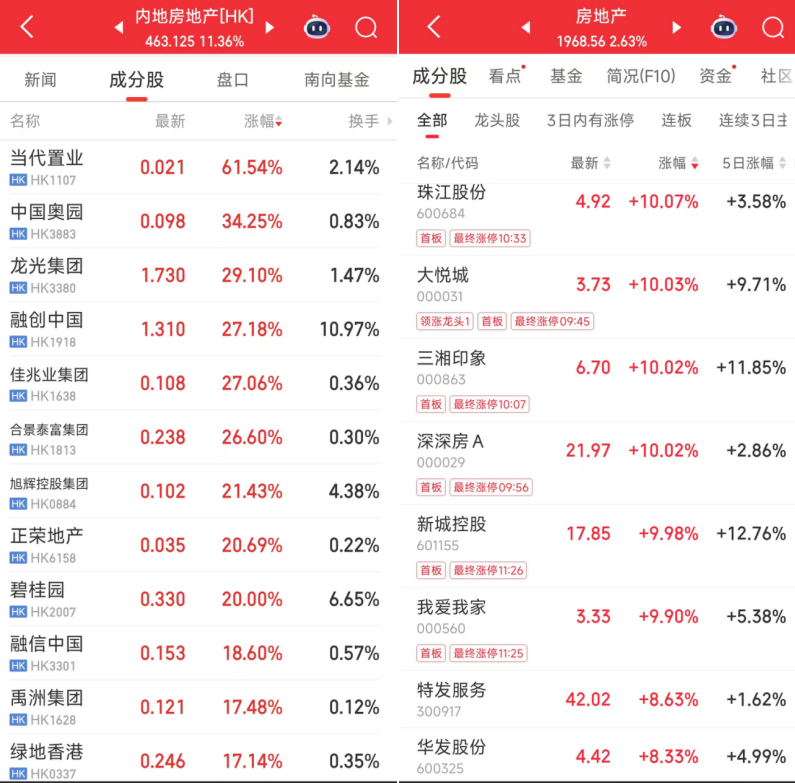
Core Viewpoint - The real estate sector is experiencing a significant rebound in stock prices, with many companies seeing substantial gains, indicating a potential recovery in the market [1][2]. Group 1: Stock Performance - A-share real estate companies such as Zhujiang Holdings, Dayuecheng, Sanxiang Impression, and Shen Shen Fang A have risen over 10% [1]. - In the Hong Kong market, Contemporary Land has surged over 61%, while China Aoyuan and Longguang Group have increased by over 34% and 25%, respectively [1][2]. Group 2: Regulatory Changes - Reports indicate that some real estate companies are no longer required to report the "three red lines" indicators to regulatory authorities, which were previously mandatory since mid-2020 [2][3]. - The "three red lines" policy aimed to control leverage and prevent financial risks in real estate, with key metrics including asset-liability ratios and net debt ratios [3]. Group 3: Market Dynamics - The current market environment has led to a decline in funding for real estate companies, with a four-year average decrease of 17.5% in funds received, surpassing the 15.7% decline in new housing sales [4]. - The shift in the market has resulted in a focus on low-leverage, high-quality asset management by leading real estate firms, moving away from previous high-leverage expansion models [4][5]. Group 4: Future Financing Models - A new financing model is emerging, characterized by the "lead bank system," where a designated bank or syndicate oversees project financing, ensuring that funds are allocated appropriately [6]. - As of December 2025, 21 distressed real estate companies have undergone debt restructuring, with a total debt relief of approximately 1.2 trillion yuan, easing short-term repayment pressures [6].