
Xin Hua Cai Jing

Search documents
海峡股份1月19日开售琼州海峡春运往返船票
Xin Hua Cai Jing· 2026-01-15 12:33
Core Viewpoint - The company is launching an early ticket purchasing service for the Spring Festival travel season through its "Ferry Manager" app and mini-program, aimed at alleviating ticket purchasing difficulties for travelers [1]. Group 1: Ticket Purchasing Service - The "Ferry Manager" app and mini-program will start selling round-trip tickets between Haikou and Xuwen on January 19, providing a 30-day advance purchase period for outbound tickets from January 19 to February 12 [1]. - The pre-sale period for inbound tickets from Xuwen to Haikou is set at 15 days, allowing purchases from January 19 for travel between January 20 and February 3 [1]. - The ticketing service covers multiple self-operated routes, enabling travelers to select suitable routes and schedules based on their travel plans [1]. Group 2: Additional Services - The "Ferry Manager" app also offers various travel services, including schedule inquiries, port information, and weather forecasts, to help travelers prepare comprehensively for their journeys [2].

马士基:将恢复MECL服务的苏伊士运河航线
Xin Hua Cai Jing· 2026-01-15 12:17
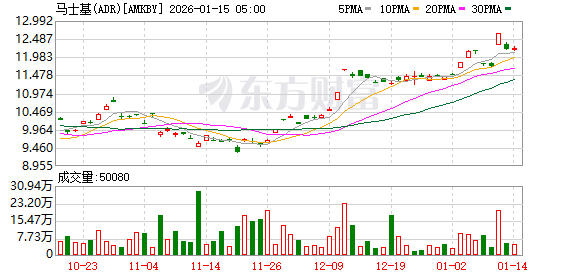
马士基表示将继续密切关注中东地区的安全局势,MECL服务的任何调整都将取决于红海地区的持续稳 定以及该地区冲突是否升级。若安全局势恶化,公司已制定应急预案。 声明发布后,马士基股票应声大跌7.5%,有望创下2025年4月以来的最大单日跌幅。 (文章来源:新华财经) 新华财经北京1月15日电马士基1月15日发布声明称,随着红海海域稳定性改善,公司将恢复MECL服务 的苏伊士运河航线,从而在确保安全的前提下提高运输效率。 ...

铝价再创新高 预焙阳极龙头索通发展乘势向上
Xin Hua Cai Jing· 2026-01-15 11:14
Group 1: Aluminum Price Trends - Since December 2025, domestic aluminum prices have entered a strong upward trend, reaching a historical high of 24,690 yuan/ton by January 14, 2026, driven by recovering downstream demand and supply contraction [1] - The current market conditions have established a "difficult to decline" scenario for aluminum prices, indicating a new cycle for the aluminum industry and injecting strong growth momentum into upstream aluminum consumables [2] - The demand for aluminum has been significantly boosted by the global energy transition, particularly in sectors like electric vehicles and power grid construction, with a revised forecast for China's electrolytic aluminum consumption growth rate increasing from 1.0% to 2.6% for 2025 [3] Group 2: Company Overview - Suotong Development - Suotong Development, a leading company in the prebaked anode industry, is expected to benefit from the rising aluminum prices due to its scale, technology, and customer advantages [2] - The company has been deeply involved in the prebaked anode sector for over 20 years and is positioned to meet the increasing demand from downstream electrolytic aluminum enterprises as they accelerate investment [4] - Suotong Development aims to achieve a production capacity of 5 million tons, with a projected signed capacity of over 4.8 million tons by 2025, and is actively pursuing international expansion through joint ventures [5] Group 3: Market Dynamics and Future Outlook - The supply-demand imbalance in the electrolytic aluminum industry is expected to tighten further, with a projected supply gap of approximately 210,000 tons in 2026, indicating continued upward momentum for aluminum prices [5] - The rising aluminum prices are anticipated to open a new cycle for the aluminum industry chain, positively impacting the prebaked anode sector's market conditions [5] - Suotong Development is well-positioned to leverage its comprehensive advantages to capture the benefits of rising prices in the downstream electrolytic aluminum market, advancing towards a new phase of high-quality global development [5]

山西华阳集团51部主运皮带进入地面集控时代
Xin Hua Cai Jing· 2026-01-15 10:42
Core Insights - Shanxi Huayang Group has completed the construction of a centralized control and underground inspection system for 51 main belt conveyors across its first and second mines and Xinjing Company by the end of 2025, significantly enhancing the intelligent management and safety capabilities of the transportation system [2] - The implementation of this system has led to a reduction of 116 personnel, resulting in annual labor cost savings of 17.4 million yuan, calculated at 150,000 yuan per person per year [2] Group 1 - The traditional model of "multiple personnel on one belt" for long-distance conveyors has been replaced by a more efficient system, reducing labor costs and improving operational efficiency while addressing safety concerns in harsh underground environments [2] - Since 2024, the company has prioritized the intelligent transformation of main transportation belts, focusing on "mechanization replacing manpower, automation reducing manpower, and intelligence achieving unmanned operations" [2] - The centralized control system allows for real-time data collection and remote monitoring of the entire main transportation system, enhancing operational efficiency and safety [2][4] Group 2 - The effectiveness of the intelligent upgrade is evident in the centralized control room of Huayang Group's second mine, where operations have become significantly more efficient, reducing the time to start the entire transportation system from 6 minutes to just 1-2 minutes [3] - The centralized control platform can accurately start and stop each device while collecting critical parameters such as belt speed, current, voltage, and coal level, providing essential data for production scheduling and preventive maintenance [3] - The reduction of underground positions has led to more efficient operations and a shift from experience-driven to data-driven equipment management, supporting the intelligent development of coal mines [4]

李斌勾勒蔚来2026:全业务链“AI化”,未来三年锚定年增40%
Xin Hua Cai Jing· 2026-01-15 10:29
据了解,蔚来AI战略主要围绕两个方向展开:一是智能驾驶,将持续进行全栈自研,通过年内规划的 三次大版本更新,目标重回行业第一梯队。公司已在算力投入上给予专项支持。 二是AI全业务链落地,将AI应用从研发制造延伸至供应链、销售、财务、人力等所有环节,构建公司 级AI能力体系。李斌强调,蔚来全员需主动拥抱AI,通过每个环节的效率提升,实现公司整体竞争力 的倍增。 李斌表示,目前蔚来在中国市场份额仍不足2%,成长空间巨大。全员需摒弃松懈心态,保持"创业公 司"的奋斗精神,以应对未来的诸多不确定性。 新华财经上海1月15日电1月14日下午,蔚来汽车召开内部会议,蔚来创始人、董事长兼CEO李斌首次发 表2026年内部讲话,公布了公司年度战略目标,核心聚焦于实现稳健增长、全面深化AI技术应用,以 及持续夯实组织体系能力。 李斌表示,回顾2025年,下半年在乐道L90、全新ES8等车型的带动下,蔚来实现销量回升,第四季度 凭借较高毛利车型的放量,有望实现单季盈利,标志着公司进入新的发展周期。 谈及2026年核心目标,李斌表示销量要实现40%-50%的稳健增长,对应销量目标约为45.6万至48.9万 辆,同时要在接下来3-5 ...

抢滩智能时代,长三角开年上演“智造”竞速赛
Xin Hua Cai Jing· 2026-01-15 09:38
Core Viewpoint - The Yangtze River Delta region is accelerating its development in artificial intelligence (AI) through a series of high-profile policies and action plans, emphasizing the strategic importance of the AI industry and its role in driving regional economic growth [1] Group 1: Strategic Integration of AI - By 2026, Shanghai, Jiangsu, Zhejiang, and Anhui will integrate AI into their core development frameworks, establishing a comprehensive strategy for AI across the Yangtze River Delta [2] - Anhui has launched the "Action Plan for the Development of the Intelligent Robot Industry (2025-2027)," aiming to cultivate over 10 leading domestic enterprises and achieve a total industry revenue of 100 billion by 2027 [2] - Zhejiang's "Spark Plan" focuses on upgrading AI alongside other industries, with a clear emphasis on developing AI computing, smartphones, and wearable devices [2] Group 2: Specific Action Plans - Shanghai's "Three-Year Action Plan for Supporting Advanced Manufacturing Transformation (2026-2028)" aims for full coverage of intelligent applications in large enterprises by 2027 and smart factory coverage by 2028, with a target robot density of 600 units per 10,000 people [3] - Jiangsu's "AI+" Action Plan sets a three-step goal to achieve widespread integration of AI by 2027, with a target of over 90% application rate by 2030 and an AI industry scale exceeding 1 trillion [3] Group 3: Regional Strengths and Differentiation - The Yangtze River Delta holds about one-third of the national AI-related resources, with significant advantages in innovation and application scenarios, making it well-positioned for large-scale AI development [4] - Shanghai's strategy focuses on a dual approach of "hardware + services," leveraging its strong service industry to create a production-oriented service ecosystem for AI [5] - Jiangsu aims to enhance its manufacturing sector by deeply integrating AI into the entire industrial chain, exemplified by initiatives in cities like Wuxi [6] Group 4: Collaborative Ecosystem and Challenges - The future competitive advantage of the Yangtze River Delta in AI lies in building an efficient, collaborative, and resilient regional ecosystem that optimizes the flow of technology, data, capital, and talent [9] - There is a risk of homogenization as many local governments invest heavily in AI computing centers without sustainable market demand, which could lead to inefficiencies [8] - Smaller cities are encouraged to find niche opportunities within the AI sector, focusing on collaborative efforts with larger cities to avoid redundant investments and foster innovation [8]
因债券募集资金买理财、违规转借 伊川财源投资被上交所通报批评
Xin Hua Cai Jing· 2026-01-15 09:36
二、未按约定用途使用募集资金。据募集说明书约定,24伊川01募集资金应当用于偿还到期公司债券本 金。2024年4月17日,发行人将募集资金用于购买银行理财产品,涉及金额合计1.99亿元,占该债券发 行金额的99.50%,后于2024年4月19日赎回相关理财产品。2024年4月19日至4月22日,发行人将募集资 金用于偿还其他有息债务,涉及金额合计0.905亿元,占该债券发行金额的45.25%。 三、未如实、准确披露募集资金使用情况。发行人在2024年8月至2025年4月期间披露的2024年中报、 2024年年报中,未如实、准确披露24伊川01募集资金使用情况。 鉴于上述违规事实和情节,经上交所纪律处分委员会审核通过,对伊川财源实业投资有限责任公司及时 任董事长、信息披露事务负责人闫新乐,时任总经理王迅彪,时任财务负责人张建辉予以通报批评。 新华财经北京1月15日电上交所15日公告称,对伊川财源实业投资有限责任公司(简称伊川财源投资) 及时任董事长闫新乐,时任总经理王迅彪,时任财务负责人张建辉予以通报批评。 经查明,伊川财源投资在债券募集资金使用、信息披露方面,有关责任人在职责履行方面,存在违规行 为。 一、违 ...
达美航空2025年运营收入再创历史新高 2026年盈利预计增长20%
Xin Hua Cai Jing· 2026-01-15 09:34
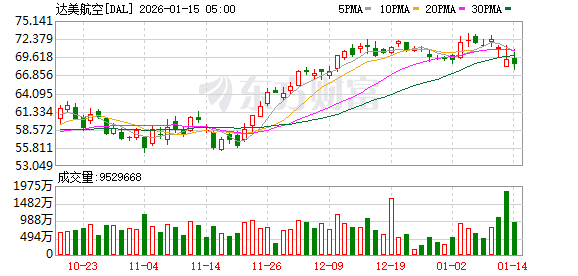
Core Viewpoint - Delta Air Lines reported strong financial performance for 2025, with adjusted operating revenue of $58.3 billion and a pre-tax profit of $5 billion, indicating resilience in a challenging environment [2] Financial Performance - Adjusted operating revenue for 2025 reached $58.3 billion, with an operating profit of $5.8 billion and a pre-tax profit of $5 billion, resulting in a pre-tax profit margin of 8.5% [2] - The company achieved record free cash flow of $4.6 billion, demonstrating strong financial health [2] Future Outlook - Delta anticipates a strong start to 2026, driven by consumer and corporate demand, with expected profit margin improvements and a year-over-year profit increase of 20% [2] - The company expects first-quarter revenue growth of 5%-7% in 2026, outpacing capacity growth by several percentage points [2] Revenue Composition - Delta's adjusted operating revenue for the year set a historical record, with unit revenue maintaining nearly 115% of the industry average [2] - High profit margins and diversified revenue streams contributed to high single-digit growth compared to 2024, accounting for 60% of total revenue [2]

【环球财经】中印尼合作电池材料项目在印尼投产
Xin Hua Cai Jing· 2026-01-15 09:23
Core Insights - The establishment of the PT ABEB battery precursor materials factory in Indonesia is a significant step towards the country's mineral resource downstream development and new energy industry growth [1][2] Group 1: Project Overview - PT ABEB is a joint venture between Zhongwei Co. and Jhonlin Group, focusing on the production of nickel-based ternary precursor materials for lithium battery cathodes, serving electric vehicles and energy storage systems [1] - The factory is planned to have an annual production capacity of 20,000 tons of ternary precursor materials, which are crucial intermediate materials in the lithium battery supply chain [2] Group 2: Economic and Strategic Impact - The project is expected to create approximately 1,000 jobs upon full production, contributing to local employment [1] - The Indonesian Defense Minister highlighted that the development of domestic processing industries through downstream resource utilization will enhance resource value and strengthen local industrial capabilities, supporting strategic sectors including the defense industry [1]
汽车出口破百万辆,安徽成中部首个外贸万亿省
Xin Hua Cai Jing· 2026-01-15 09:07
Core Insights - Anhui Province's total import and export value reached 1,013.56 billion yuan in 2025, marking a year-on-year increase of 17.3%, making it the 9th province in China to surpass the trillion yuan mark in foreign trade [1] - The province's foreign trade has shown a "stepwise progression" during the 14th Five-Year Plan period, with a significant increase from 545.15 billion yuan at the end of the 13th Five-Year Plan to over a trillion yuan in 2025 [1] - In December 2025, Anhui achieved a monthly import and export value of 111.84 billion yuan, a record high with a year-on-year growth of 35.9% [1] Trade Structure and Growth Drivers - The growth triangle of "strategic positioning - advanced manufacturing - open environment" has driven Anhui's foreign trade from traditional product exports to high-value technology exports [2] - High-tech product exports reached 159.82 billion yuan in 2025, growing by 16.6% year-on-year, while self-branded exports totaled 348.32 billion yuan, up 13.2% [2] - Exports of "new three items" including electric vehicles, lithium-ion batteries, and photovoltaic products reached 101.83 billion yuan, a 110% increase, accounting for 14.9% of the province's total exports [2] - Anhui's automobile exports (including chassis) reached 1.228 million units, a year-on-year increase of 28.7%, making it the first province in China to export over one million vehicles annually [2] Active Trade Entities and Market Diversification - In 2025, Anhui had 14,890 trading entities, an increase of 1,591 from 2024, with 120 enterprises having import and export values exceeding 1 billion yuan [3] - Private enterprises accounted for 5,191.5 billion yuan of the total foreign trade, a 15.8% increase, representing 51.2% of the province's total [3] - Anhui's trade with 189 countries and regions showed positive growth, with ASEAN as the largest trading partner, totaling 141.5 billion yuan, a 38.3% increase [3] - Trade with the EU reached 139.43 billion yuan, up 21.6%, while trade with Belt and Road countries totaled 550.33 billion yuan, an 18% increase, representing over 50% of the province's foreign trade [3] Supportive Environment and Initiatives - Anhui's robust industrial foundation, active enterprises, and diversified market layout are key to its foreign trade resilience [4] - The province is enhancing its open environment through initiatives like the "Hui Dong Global" campaign, optimizing port business environments, and establishing international trade cooperation alliances [4]