Xin Hua Cai Jing

Search documents
债市日报:1月15日
Xin Hua Cai Jing· 2026-01-15 09:04
Core Viewpoint - The bond market showed slight strengthening with most interbank bond yields declining by around 1 basis point, while the central bank's net injection was 169.4 billion yuan, leading to a general decrease in funding rates. The market is expected to remain volatile in the short term, with a continued need for a loose monetary environment into 2026, and potential for flexible use of interest rate cuts and reserve requirement ratio reductions [1][6]. Market Performance - The closing prices for government bond futures showed an increase for most contracts, with the 10-year main contract rising by 0.11% to 108.035. The yields for various government bonds also decreased, with the 10-year government bond yield down by 0.95 basis points to 1.8475% [2]. - The China Convertible Bond Index rose by 0.20% to 516.90 points, with a trading volume of 90.616 billion yuan. Notable gainers included Jin 05 Convertible Bond and Guo Wei Convertible Bond, which increased by 20.00% and 15.15%, respectively [2]. International Bond Market - In North America, U.S. Treasury yields fell across the board, with the 10-year yield down by 4.33 basis points to 4.132%. Similar downward trends were observed in the Asian and Eurozone markets, with Japanese and European bond yields also declining [3][4]. Primary Market - The China Development Bank's 3-year and 7-year financial bonds had winning yields of 1.6675% and 1.9086%, respectively, with bid-to-cover ratios of 3.03 and 4.11. The Export-Import Bank's financial bonds had winning yields of 1.4387% and 1.7481%, with bid-to-cover ratios of 2.63 and 6.39 [5]. Funding Conditions - The central bank conducted a 179.3 billion yuan reverse repurchase operation at a fixed rate of 1.40%, resulting in a net injection of 169.4 billion yuan for the day. Additionally, a 900 billion yuan 6-month buyout reverse repurchase operation was carried out, marking the fifth consecutive month of increased operations [6]. - The Shibor rates for various tenors showed a collective decline, with the overnight rate down by 1.6 basis points to 1.374% [6]. Institutional Perspectives - Institutions highlighted the necessity of loose monetary policy to address the structural issues in the economy, emphasizing the need for counter-cyclical tools to facilitate asset balance sheet recovery. The central bank's actions are seen as supportive of government bond issuance and encouraging financial institutions to increase credit supply [8].
长图|地方未来产业发展方略全景对比分析
Xin Hua Cai Jing· 2026-01-15 09:03
Core Insights - China is at a critical stage for future industry development, with the "14th Five-Year Plan" emphasizing the exploration of diverse technological routes, typical application scenarios, and feasible business models to promote quantum technology, biomanufacturing, and embodied intelligence as new economic growth points [1] Group 1: Future Industry Development Strategies - Local leaders have significantly increased their focus on future industries, with over 700 relevant event information monitored, covering more than 1,700 companies [1] - The development strategies for future industries are becoming clearer, focusing on future manufacturing and future information as core drivers, integrating key technologies like large models and embodied intelligence [1] - Future materials, future energy, and future space are identified as important supports, accelerating breakthroughs in key technologies and practical applications [1] Group 2: Key Future Industries - Future manufacturing emphasizes a dual-drive approach of "technology sourcing + pilot testing" to solidify the foundation of new productive forces [4] - Future information aims to strengthen computing power and expand AI applications, creating a "AI + connectivity + computing power" ecosystem [4] - Future health focuses on the integration of medical and engineering fields, exploring new industrial paths that combine cutting-edge technologies with clinical applications [4] Group 3: Strategic Framework for Future Industries - The strategy highlights localized layouts to solidify the strategic foundation of resource-driven future industries [5] - It advocates for a gradual approach to implement long-term strategies for future industries [5] - The framework emphasizes the importance of innovation services to support disruptive technology sourcing and the creation of an innovative ecosystem [5]


ESG:截至1月14日当周 新加坡燃料油库存上涨至两周高点2547.3万桶
Xin Hua Cai Jing· 2026-01-15 08:08
新加坡企业发展局(ESG)数据显示,截至1月14日当周,新加坡燃料油库存上涨6.5万桶至两周高点 2547.3万桶。 (文章来源:新华财经) ...
2025年“最忙碌”工程机械揭晓!汽车起重机连续12个月稳居榜首
Xin Hua Cai Jing· 2026-01-15 07:21
Group 1 - The "Excavator Index" developed by SANY Heavy Industry based on the Root Internet Industrial Internet platform indicates a clear concentration of advantages among leading equipment categories, with truck cranes maintaining the highest operational activity for 12 consecutive months in 2025 [1] - Truck cranes are widely used in heavy infrastructure, energy projects, and large factory construction, reflecting the sustainability and intensity of major project construction [1] - Excavators and concrete mixers form the second tier, corresponding to core construction activities such as earthworks and concrete pouring, indicating steady progress in residential construction, municipal pipeline projects, and industrial park support [1] Group 2 - The operational rate of port equipment has increased for six consecutive months since July 2025, with provinces like Ningxia, Zhejiang, Shaanxi, and Guizhou leading the nation [1] - The data reflects the enhanced effectiveness of inland provinces in utilizing "dry ports" and the China-Europe Railway Express, while coastal ports benefit from route densification and smart upgrades, improving container and bulk cargo turnover efficiency [1] - The continuous growth in port equipment operational rates indicates the resilience of integrated domestic and foreign trade development, highlighting the role of ports as logistics hubs [1] Group 3 - Among specific equipment categories, the operational rates of stackers, truck cranes, rotary drilling rigs, concrete mixers, trailer pumps, and pump trucks have all seen year-on-year growth, indicating a more refined structure of infrastructure and industrial investment [2] - The increase in stacker operational rates reflects strong demand in e-commerce logistics and port freight, while the rise in concrete mixers, trailer pumps, and pump trucks indicates an accelerated construction pace for concrete pouring projects [2] - Overall, the growth in operational rates across different types of equipment demonstrates a broad coverage of investment-driven activities, showing steady improvement from large-scale infrastructure to detailed supporting projects [2] Group 4 - According to the "Excavator Index," the national construction machinery operational rate for 2025 is projected at 44.89%, with 18 provinces exceeding 50% [2] - The central region has maintained the highest construction machinery operational rate for seven consecutive months [2]

【新华500】新华500指数(989001)15日涨0.14%
Xin Hua Cai Jing· 2026-01-15 07:19
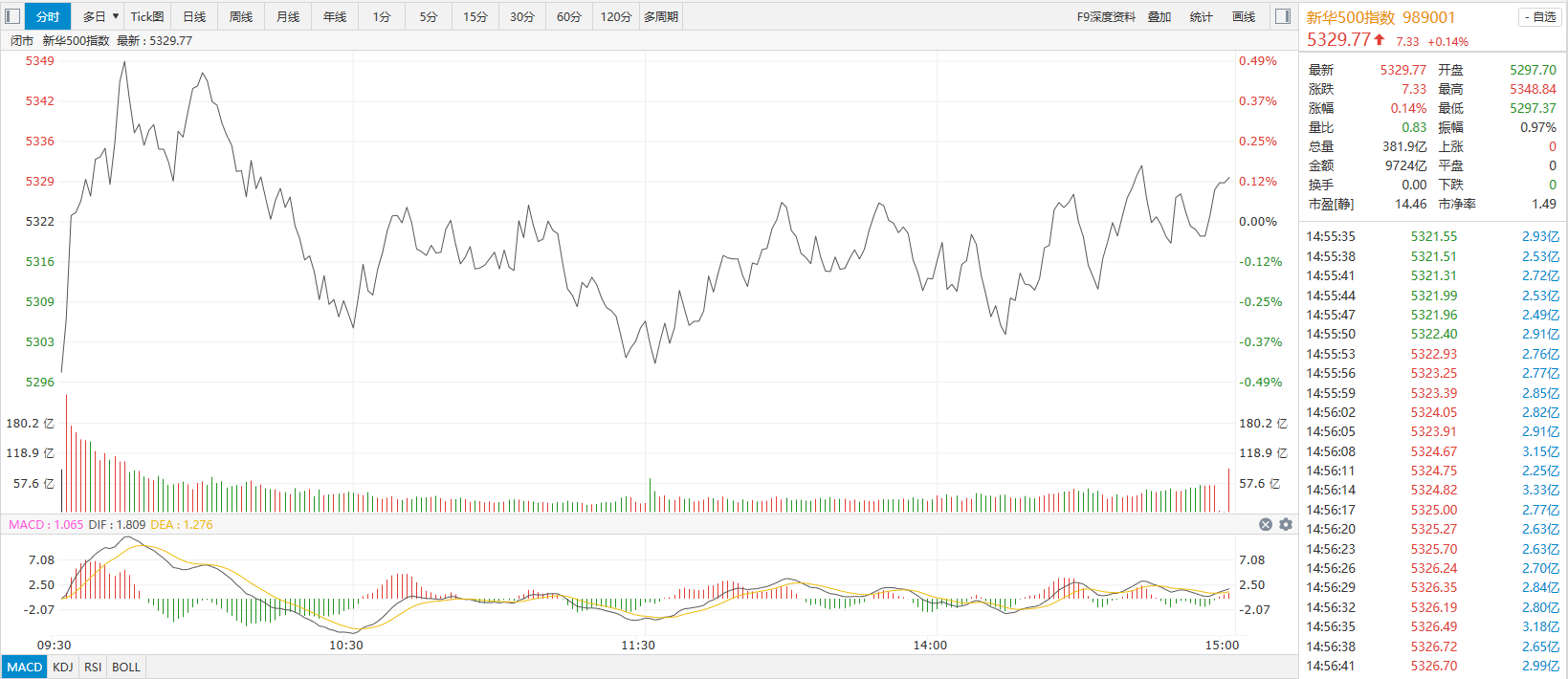
Core Viewpoint - The Xinhua 500 Index (989001) closed at 5329.77 points on January 15, reflecting a slight increase of 0.14% [1]. Market Performance - The Xinhua 500 Index opened lower on the morning of January 15 but quickly rebounded, experiencing fluctuations throughout the day. It reached a high of 5348.84 points and a low of 5297.37 points before closing with a small gain [3]. - The total trading volume for constituent stocks was reported at 972.4 billion yuan, showing a significant decrease compared to the previous trading day [3]. Constituent Stocks - Notable gainers among the constituent stocks included Shiji Information, Unisoc, Huanshu Electronics, and Tongce Medical, which saw the highest increases [3]. - Conversely, the stocks that experienced the largest declines included Goldwind Technology, China Satellite, China Satcom, and Hualin Securities [3].
【金融街发布】人民银行:2025年人民币贷款增加16.27万亿元 社会融资规模存量同比增长8.3%
Xin Hua Cai Jing· 2026-01-15 07:15
Core Insights - The People's Bank of China reported that by the end of 2025, the total social financing scale reached 442.12 trillion yuan, marking an 8.3% year-on-year increase [1][2] Group 1: Social Financing Scale - The total social financing scale increased by 35.6 trillion yuan in 2025, which is 3.34 trillion yuan more than the previous year [4] - The balance of RMB loans to the real economy was 268.4 trillion yuan, reflecting a 6.3% year-on-year growth [2] - The balance of foreign currency loans to the real economy, converted to RMB, was 1.05 trillion yuan, showing an 18% decline [2] Group 2: Loan and Deposit Statistics - By the end of December, the balance of RMB loans was 271.91 trillion yuan, with a year-on-year growth of 6.4% [7] - The total increase in RMB loans for the year was 16.27 trillion yuan, with household loans increasing by 4.42 trillion yuan [7] - The total balance of deposits in RMB and foreign currencies was 336.14 trillion yuan, with a year-on-year increase of 9% [6] Group 3: Monetary Supply - The balance of broad money (M2) was 340.29 trillion yuan, reflecting an 8.5% year-on-year increase [5] - The balance of narrow money (M1) was 115.51 trillion yuan, with a year-on-year growth of 3.8% [5] - The cash in circulation (M0) reached 14.13 trillion yuan, marking a 10.2% year-on-year increase [5] Group 4: Foreign Exchange and Cross-Border Transactions - The foreign exchange reserves stood at 3.36 trillion USD by the end of December [9] - The total amount of cross-border RMB settlements under the current account was 17.86 trillion yuan in 2025 [9]

中国经济观测点丨2025年12月新注册经营主体数小幅增加 融资规模进一步缩小
Xin Hua Cai Jing· 2026-01-15 06:55
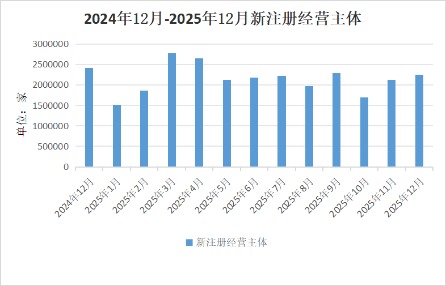
Group 1 - In December 2025, a total of 2.2429 million new business entities were registered nationwide, an increase of 113,900 from the previous month, but a year-on-year decrease of 7.07% [1] - Guangdong province continued to lead in new business registrations with 262,227 entities, representing a year-on-year growth of 15.59% and accounting for 11.69% of the national total [3] - The top ten provinces for new business registrations in December accounted for 61.43% of the total nationwide [3] Group 2 - Hainan province experienced the highest growth rate in new business registrations at 45.58%, with several provinces showing positive growth compared to the previous month [5] - The retail industry had the highest number of new registrations in December, totaling 222,100, with a year-on-year growth of 9.4%, while the software and information technology services sector saw the fastest growth at 34.73% [7] - In December, there were 808 financing events in China, with a total financing scale of 53.421 billion yuan, a decrease of 12.25 billion yuan from the previous month [9] Group 3 - The information technology sector led in financing events with 367 occurrences, followed by the manufacturing sector with 221 events [9] - Jiangsu province had the highest number of financing events at 132, while Guangdong province ranked second with 122 events [11]
1月14日中国汽、柴油批发价格分别为7351、6198元/吨
Xin Hua Cai Jing· 2026-01-15 06:32
Core Viewpoint - On January 14, 2023, China's wholesale prices for gasoline and diesel both increased, with the average wholesale price for 92 gasoline at 7351 yuan per ton, up 10 yuan from the previous day, and diesel at 6198 yuan per ton, up 5 yuan from the previous day [1] Market Overview - The international crude oil futures prices surged on January 13, leading to a positive change in the average price of a basket of crude oil, providing strong support for the market [1] - As the month progresses, operating units are maintaining a relaxed approach with preferential pricing, resulting in a weak trend for gasoline and diesel prices [1] Regional Price Changes - Gasoline wholesale prices increased in regions including Jiangxi, Beijing, Fujian, Shaanxi, Hebei, Tianjin, Inner Mongolia, Shanghai, Hubei, and Jiangsu, while prices decreased in Heilongjiang, Jilin, Liaoning, Sichuan, and Zhejiang [1] - Diesel wholesale prices rose in Inner Mongolia, Shandong, Jiangsu, Shanghai, Beijing, Tianjin, Hebei, Henan, Hubei, and Guangxi, but fell in Heilongjiang, Jilin, Liaoning, Gansu, Ningxia, Chongqing, Zhejiang, and Shanxi [1] - In Shandong, local refineries saw an increase in gasoline prices and a significant rise in diesel prices [1] Data Source - The wholesale price data is published by the China Economic Information Agency and the China Petroleum Economic and Technological Research Institute's "Energy Big Data Laboratory," reflecting the overall situation of China's gasoline and diesel wholesale market [1]
开始测试AI购物功能 千问App全面接入淘宝、闪购等阿里生态业务
Xin Hua Cai Jing· 2026-01-15 06:29
Core Insights - The Qianwen App has integrated with Alibaba's ecosystem, enabling AI shopping functionalities such as ordering food, purchasing items, and booking flights, marking it as the first AI assistant capable of handling complex real-life tasks [1][2] - The app will launch over 400 AI service features, leveraging the "Qwen strongest model" and Alibaba's extensive ecosystem to enhance user experience [1] - The app's AI capabilities include personalized shopping recommendations based on user needs and Alibaba's vast product database, allowing users to complete the entire shopping process with a single command [2] Group 1 - The Qianwen App's AI can now assist users in making informed purchasing decisions by providing tailored product suggestions and utilizing Alibaba's transaction and service data for accuracy [2] - The app has integrated with Alipay's government services, offering 50 public services such as visa applications and household registration, streamlining the process for users [2] - The "Task Assistant" feature is currently in testing, designed to handle complex tasks across various scenarios, including report writing and application development, and will be available for free after testing [2]

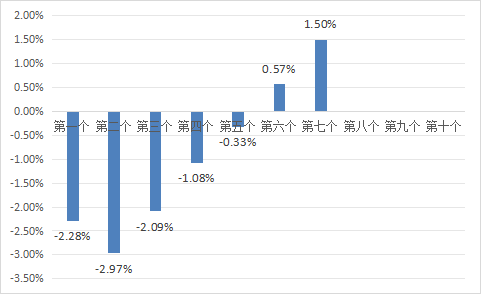
1月14日一揽子原油平均价格变化率为1.50%
Xin Hua Cai Jing· 2026-01-15 06:28
Group 1 - The average price change rate of a basket of crude oil was reported at 1.50% on January 14 [1] - Domestic gasoline and diesel prices are adjusted based on international crude oil price changes every 10 working days, with the adjustment effective at 24:00 on the announcement date [3] - The adjustment window for this pricing cycle will open at 24:00 on January 20, marking the seventh working day of the current pricing cycle [4]