
Xin Hua Cai Jing

Search documents
伊朗总统下令启动谈判,美国总统特使赴中东
Xin Hua Cai Jing· 2026-02-02 23:53
Group 1 - Iran's President Pezeshkian has ordered the initiation of nuclear negotiations with the United States, with high-level talks expected to occur in the coming days [1] - U.S. Special Envoy Wittekopf is scheduled to arrive in Israel on March 3, and is expected to meet with Israeli Prime Minister Netanyahu [1] - Iranian Foreign Minister Alaghezi is likely to participate in discussions with Wittekopf in Istanbul on March 6 regarding a potential nuclear agreement [1] Group 2 - Iranian military officials have stated that Iran is fully prepared to respond to any military provocations against its sovereignty and territorial integrity [2] - Iran's Supreme Leader Khamenei warned that any U.S. provocation could lead to a regional war, emphasizing the resolve of the Iranian people to retaliate [2] - U.S. President Trump commented on Khamenei's statements, indicating that the U.S. military is positioned nearby, ready to respond if no agreement is reached [2] Group 3 - Jordan's Foreign Minister Safadi stated that Jordan will not serve as a base for any military actions against Iran, echoing similar statements from Saudi Arabia and the UAE [3]
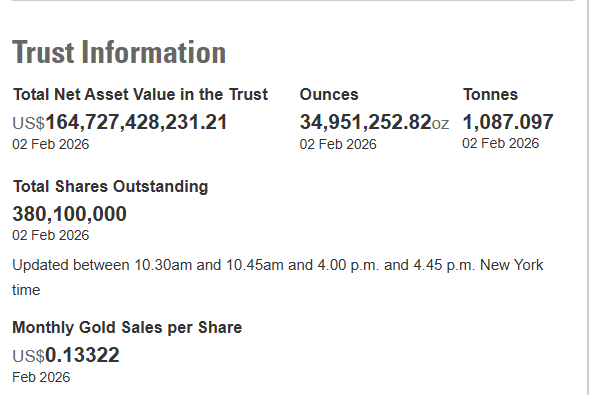
截至2月2日 全球最大的黄金ETF——SPDR Gold Trust的黄金持仓量为1,087.10吨 与前一交易日持平
Xin Hua Cai Jing· 2026-02-02 23:12
Group 1 - The global largest gold ETF, SPDR Gold Trust, has a gold holding of 1,087.10 tons as of February 2, remaining unchanged from the previous trading day [1]

中电联:预计2026年全社会用电量同比增长5%-6%
Xin Hua Cai Jing· 2026-02-02 15:12
Core Insights - The China Electricity Council released a report predicting a 5%-6% year-on-year growth in national electricity consumption by 2026 [1] - By the end of 2026, installed solar power capacity is expected to surpass coal power capacity for the first time, with wind and solar combined accounting for half of the total installed capacity [1] Group 1: Electricity Supply Forecast - The report anticipates that over 400 million kilowatts of new power generation capacity will be added in 2026, with over 300 million kilowatts coming from renewable energy sources [1] - The total installed power generation capacity is projected to reach approximately 4.3 billion kilowatts by the end of 2026, with non-fossil energy sources accounting for 2.7 billion kilowatts, representing about 63% of the total capacity [1] - The share of coal power in total installed capacity is expected to decrease to around 31% by 2026 [1] Group 2: Electricity Supply and Demand Balance - The report indicates that the overall electricity supply and demand will be balanced in 2026, although there may be tight supply during peak periods in certain regions [2] - During summer, regions such as Southwest, Central China, and East China may experience tighter supply-demand balance, while winter will see a generally balanced situation across the country [2] - In case of extreme weather or tight primary energy supply, localized supply-demand imbalances can be addressed through inter-provincial and inter-regional cooperation [2]
地产经纬丨“量”在“价”先?上海二手房成交节前“反季”活跃
Xin Hua Cai Jing· 2026-02-02 15:09
Core Viewpoint - The Shanghai second-hand housing market is experiencing an unexpected surge in activity during the traditional off-peak season, driven by improved price-performance ratios and a shift in buyer sentiment towards lower-priced properties [1][3][5]. Group 1: Market Activity - From November 2025 to January 2026, the Shanghai second-hand housing market recorded nearly 23,000 transactions per month, totaling close to 70,000 homes sold in three months, breaking the traditional seasonal slowdown [2][3]. - The transaction volume in January 2026 increased significantly compared to the previous years, with a year-on-year growth of 39.4% compared to January 2024 and 23.4% compared to January 2025 [2]. Group 2: Price Dynamics - The average price of second-hand residential properties in Shanghai in January 2026 was 55,265 yuan per square meter, reflecting a month-on-month decline of 1.22% and a year-on-year decline of 7.61%, indicating a return to more reasonable price levels [3][4]. - Properties priced below 3 million yuan accounted for over 70% of transactions, with nearly half of the sales in January 2026 being below 2 million yuan [2][4]. Group 3: Investment Sentiment - The rental yield for certain older properties has increased, making them attractive for both living and investment purposes, with some areas showing yields as high as 3.0%, surpassing bank deposit rates [4][6]. - The current market is showing signs of a "bottoming" phase, with a significant reduction in the number of listings, indicating a shift in seller and buyer expectations [4][5]. Group 4: Future Outlook - There is a growing belief that the market may transition from "price-driven volume" to "stable volume and price," with conditions for price stabilization gradually being met [5][6]. - The real estate policy is shifting towards stabilizing expectations and shortening adjustment periods, with potential demand release expected in March 2026 as new quality land parcels are introduced [6].
欧元区1月制造业活动连续第三个月收缩 德法制造业表现分化
Xin Hua Cai Jing· 2026-02-02 15:07
德国1月制造业PMI终值则从上月的47.0升至49.1,也略高于初值48.7,创下三个月高位,但仍低于50荣 枯线。就业水平继续下滑,反映企业正在进行重组且职位空缺未能填补。制造商对来年前景持乐观态 度,预期指数升至七个月高点。 意大利与西班牙1月制造业PMI分别为48.1和49.2,均处于萎缩状态,但意大利的下行势头略有缓和。 总体而言,欧元区制造业复苏步伐缓慢且不平衡,德国等核心经济体的持续疲软抵消了法国的增长,对 区域经济动能构成拖累。短期内,制造业强劲复苏的可能性较低。展望未来十二个月,企业对扩大生产 的态度较上月略显乐观。 (文章来源:新华财经) 新华财经北京2月2日电受新订单持续疲软拖累,欧元区1月制造业活动连续第三个月处于收缩区间。 欧元区1月制造业PMI终值升至49.5,虽高于2025年12月的48.8,但仍连续第三个月处于50荣枯线下方, 表明行业持续萎缩。汉堡商业银行首席经济学家Cyrus de la Rubia表示:"制造业确实出现了一些进展, 但速度缓慢。"作为整体指数的关键组成部分,制造业产出指数1月从2025年12月的48.9回升至50.5,重 新站上50荣枯线,显示产出温和增长。 ...
基础设施高效服务一二级债市运行 北金所1月集中簿记系统支持发债超8700亿元
Xin Hua Cai Jing· 2026-02-02 15:06
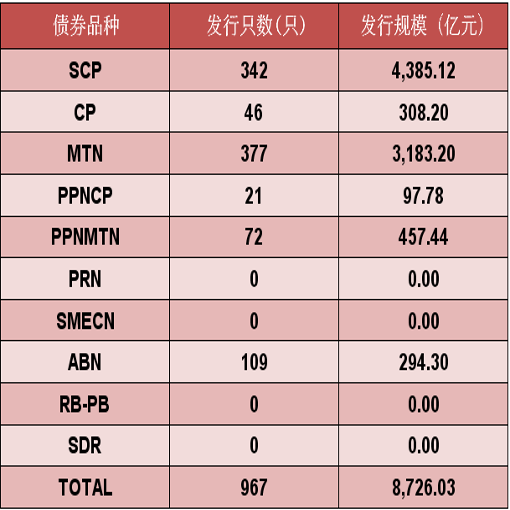
Core Viewpoint - The Beijing Financial Assets Exchange (北金所) has maintained a stable issuance scale in its centralized bookkeeping and filing system in January 2026, with an active bond trading environment indicating continued institutional interest in standardized bond issuance and trading platforms [1]. Issuance Data - In January 2026, the centralized bookkeeping system completed 967 issuances, totaling 8,726.03 billion yuan, providing a smooth channel for corporate debt financing at the beginning of the year [1][2]. - Breakdown of issuance by bond type includes: - SCP: 342 issuances, 4,385.12 billion yuan - CP: 46 issuances, 308.20 billion yuan - MTN: 377 issuances, 3,183.20 billion yuan - PPNCP: 21 issuances, 97.78 billion yuan - PPNMTN: 72 issuances, 457.44 billion yuan - ABN: 109 issuances, 294.30 billion yuan [2]. Trading Activity - In January, there were 21 trading days, with a total of 3,922 quotes made in the bond trading system, averaging about 187 quotes per day, showing an increase compared to December 2025 [3]. - The average yield levels for bonds in January showed a slight decrease compared to December, with specific bonds having notable yields, such as: - Medium-term notes with a buy yield of 1.58% and a sell yield of 2.11% - Short-term financing bonds with a buy yield of 1.31% and a sell yield of 2.22% [4]. Transaction Summary - In January 2026, a total of 15 bond transactions were completed, with cumulative transactions since November 2014 reaching 1,027, totaling 341.36 billion yuan [5]. - The breakdown of transactions includes: - 731 purchases and 296 sales by non-financial institutional qualified investors - 932 different bonds traded, including 15 short-term financing bonds and 569 medium-term notes [5]. - The data reflects a stable willingness among institutions to engage in bond issuance and trading through standardized platforms, with particular interest in certain types of credit assets [5].
货币市场日报:2月2日
Xin Hua Cai Jing· 2026-02-02 15:06
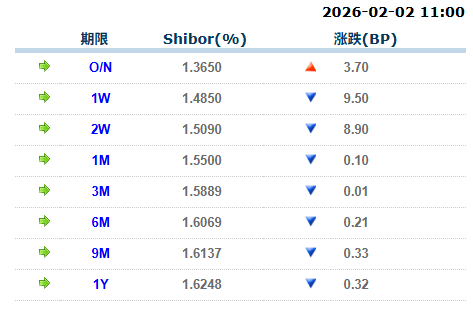
Core Viewpoint - The People's Bank of China conducted a 750 billion yuan reverse repurchase operation with a rate of 1.40%, resulting in a net withdrawal of 755 billion yuan from the market due to the maturity of 1,505 billion yuan in reverse repos on the same day [1]. Group 1: Market Rates - The overnight Shanghai Interbank Offered Rate (Shibor) increased by 3.70 basis points to 1.3650% [2][3]. - The 7-day Shibor decreased by 9.50 basis points to 1.4850%, while the 14-day Shibor fell by 8.90 basis points to 1.5090% [2][3]. - In the interbank pledged repo market, the weighted average rate for DR001 rose by 3.7 basis points to 1.3642%, while DR007 dropped below 1.5% [5]. Group 2: Trading Activity - The overall funding situation on February 2 was balanced, with overnight rates for certificates of deposit trading between 1.53% and 1.55% [9]. - The trading sentiment in the secondary market for certificates of deposit was positive, with the 1-month national bank stock closing around 1.55%, up approximately 5 basis points from the previous day [10].
关注地方两会丨 “人员不好招”与“工作不好找”怪圈何解?姜雪峰委员建言从教育改革着手
Xin Hua Cai Jing· 2026-02-02 15:05
Core Viewpoint - The mismatch between job supply and demand is a result of industrial transformation, technological revolution, and generational change, necessitating policy collaboration to align talent supply with demand [1][2]. Group 1: Causes of Mismatch - The current global landscape is undergoing profound adjustments, with a new wave of technological revolution accelerating industrial upgrades, leading to the disappearance of traditional jobs and the emergence of new demands [2]. - The arrival of the artificial intelligence era is significantly reshaping operational logic across industries, requiring a redefinition of traditional roles and the emergence of new positions, while the talent supply system has not fully adapted to this rapid change [2]. - The employment perspectives of the "Z generation" (born between 1995 and 2009) have shifted significantly, influenced by their upbringing in the digital age, leading to changes in job selection criteria and societal recognition [3]. Group 2: Solutions for Mismatch - Addressing the employment mismatch requires fundamental reforms in the education system, enhancing practical course offerings, and adopting a problem-oriented educational model to improve students' comprehensive abilities [4]. - The establishment of a dual mentorship system involving both academic and industry experts is crucial for aligning education with industry needs, fostering a blend of academic and practical skills in students [4]. - Implementing a full-process internship certification system and creating policies that connect academic training with industry development are essential for bridging the gap between education and employment [5]. Group 3: Building a Stable Employment Ecosystem - Youth employment requires not only alignment from employers but also supportive social policies, such as increasing the supply of affordable rental housing to alleviate concerns for young professionals [6]. - Enhancing the evaluation system for youth innovation and entrepreneurship, along with establishing recognition mechanisms, can encourage more young individuals to engage in industrial innovation [6]. - A collaborative effort involving educational reform, industry engagement, and policy support is necessary to transform structural employment challenges into opportunities for high-quality development [7].
【环球财经】澳大利亚1月制造业PMI升至52.3点
Xin Hua Cai Jing· 2026-02-02 15:00
Core Insights - The S&P Global Australia Manufacturing PMI increased from 51.6 in December to 52.3 in January 2026, indicating continued expansion in the Australian manufacturing sector for the third consecutive month [1][2] - The index above 50 signifies growth, while below 50 indicates contraction, reflecting a positive trend in manufacturing activity [1] Group 1: Manufacturing Performance - The January report highlights a robust growth in new orders, particularly driven by a recovery in overseas demand, which accelerated factory output [1][2] - Increased production demand and optimistic sentiment regarding future output led to a rise in both procurement activities and employment in January [1][2] Group 2: Cost and Pricing Dynamics - Average input costs faced by the Australian manufacturing sector saw the fastest increase in nine months due to supply constraints and rising raw material costs, prompting companies to raise selling prices [1][2] - Despite the increase in input costs and selling prices, both remained below their historical averages [1] Group 3: Business Sentiment - Overall business sentiment in the Australian manufacturing sector improved, with confidence reaching its highest level in nearly four years, driven by expectations of economic growth and sales boosts over the next year [2] - The PMI data indicates a significant improvement in operational conditions, with factory output growth aligning with long-term trends and notable increases in employment and procurement activities [2]

安永报告:改革与开放双轮驱动 中国金融体系迈向高质量发展新阶段
Xin Hua Cai Jing· 2026-02-02 12:03
Core Insights - The report by Ernst & Young highlights significant achievements in China's financial reform and opening-up by 2025, injecting new vitality into global economic growth and financial market prosperity [1][2]. Group 1: Financial Reform and Opening-up - By 2025, China's financial reform and opening-up have entered a new phase characterized by systematic deepening and accelerated institutional opening [1][2]. - The focus has shifted from "factor openness" to "institutional openness," emphasizing rules, systems, and infrastructure development [2]. - The capital market has seen steady progress in institutional dual-directional opening, with Hong Kong's new stock financing ranking first globally in 2025 [2]. Group 2: Market Dynamics and Foreign Investment - The pace of opening in banking, insurance, securities, and asset management has accelerated, with foreign financial institutions experiencing growth in asset scale and business revenue [3]. - The number of foreign institutions operating in China has reached new highs, fostering a complementary and competitive relationship with domestic institutions [3]. - The development environment in China remains vibrant and stable, enhancing the attractiveness and inclusiveness of the capital market [3]. Group 3: Asset Management Industry - As of Q3 2025, China's asset management industry reached approximately 179.33 trillion yuan, with foreign public funds increasing their investments and product offerings [4]. - The industry is evolving under regulatory norms and open policies, entering a phase of high-quality development [4]. - The combination of global experience from foreign institutions with local market insights is expected to further stimulate innovation within the industry [4].