Guan Cha Zhe Wang

Search documents
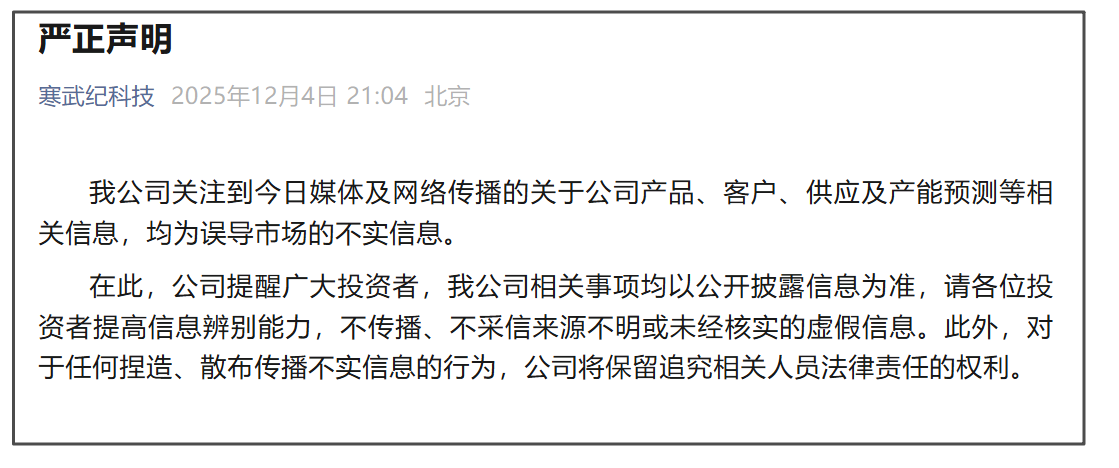
寒武纪:网传公司产品、客户、供应及产能预测等相关信息不实
Guan Cha Zhe Wang· 2025-12-04 14:52
Core Viewpoint - The company issued a statement addressing misleading information circulating in the media and online regarding its products, customers, supply, and capacity forecasts [1] Group 1 - The company emphasizes that all relevant matters should be based on publicly disclosed information [1] - Investors are urged to enhance their ability to discern information and to refrain from spreading or believing unverified or false information from unknown sources [1] - The company reserves the right to pursue legal action against individuals who fabricate or disseminate false information [1]


北约闭门会上,美国又炮轰欧盟:别再“霸凌”美国军工企业
Guan Cha Zhe Wang· 2025-12-04 14:51
Group 1 - The core issue is the growing rift between the US and the EU regarding defense cooperation, with the US accusing the EU of "bullying" American defense companies and attempting to exclude them from the European rearmament plans [1][8] - US Deputy Secretary of State Christopher Landau emphasized the need for Europe to convert defense spending commitments into actual capabilities and warned against protectionist policies that could weaken collective defense [3][10] - The EU is pushing for defense autonomy, with plans like the "Rearm Europe" initiative, which includes a €150 billion loan program aimed at purchasing products from European manufacturers [4][11] Group 2 - European countries face challenges in achieving defense autonomy, with leaders expressing concerns over increased military spending impacting public debt [5][12] - A significant reliance on US arms persists, with 64% of weapons for NATO European members being imported from the US between 2020 and 2024, up from 52% in the previous period [13] - Recent funding announcements by Germany and Poland to support NATO's procurement of US weapons for Ukraine highlight the ongoing dependence on American military support [6][13]

再度上诉!宗馥莉继续要求香港法院撤销18亿美元离岸信托保全令
Guan Cha Zhe Wang· 2025-12-04 13:40
对于这一裁决宗馥莉表示不服,并在判决后的进行上诉。今年9月26日,香港高等法院驳回了宗馥莉要求撤销资产保全令的上诉,维持原判。但显然宗馥莉 选择再度上诉。 据了解,香港上诉法庭为香港高等法院中的一个部分,地位仅次于香港终审法院。 上述媒体还披露了宗馥莉的律师上诉的五项理由,其中包括认为宗继昌、宗婕莉、宗继盛(Jacky, Jessie and Jerry Zong)三人对汇丰银行账户中18亿美元资 产缺乏强有力的所有权主张;不存在资产流失的风险;以及早前裁决的法官,未能明确原告在汇丰账户中拥有何种权益。 观察者网查阅到,据香港高等法院披露信息,双方的诉讼费评定的聆讯,将在12月23日上午举行,诉讼各方包括宗馥莉、JIAN HAO VENTURES LIMITED (建浩创投有限公司),以及宗氏另外三名子女。 | 高等法院 | | | | --- | --- | --- | | 時間 (未來聆訊) | | 性質 | | 2025年12月23日 | 上午 | 訟費評定提訊 | | 23/12/2025 | 10:30am | Taxation Call Over Hearing | (文/孙梅欣 编辑/吕栋) 娃 ...

Soul六年亏了11亿,只为“让天下没有孤独的人”?
Guan Cha Zhe Wang· 2025-12-04 10:36
Core Viewpoint - Soul, a social app aimed at alleviating loneliness among young people, is facing significant challenges as it attempts to go public for the fourth time, highlighting a shift from a "metaverse" narrative to an "AI + immersive social" focus amid ongoing user growth and financial losses [1][4]. Company Overview - Founded in 2015 in Shanghai, Soul differentiates itself from traditional social platforms by allowing users to create virtual identities (Avatars) and express themselves without revealing their real identities [3]. - The company employs a "soul test" during registration to match users with similar interests, fostering a unique social environment [3]. Financial Performance - Soul has reported continuous losses over six years, totaling over 3 billion yuan, despite increasing revenues from 71 million yuan in 2019 to 2.211 billion yuan in 2024 [8]. - The average monthly revenue per paying user reached 104.4 yuan, ranking first among AI + immersive social platforms in China [3][5]. - Revenue from emotional value services accounted for 90.8% of total income for the eight months ending August 31, 2025 [3]. User Metrics - Soul's monthly active users peaked at 31.6 million in 2021 but have since declined to 26.2 million by 2024 [7]. - The company has experienced fluctuating growth rates, with revenue growth slowing down significantly in recent years [8]. Strategic Shifts - Soul's narrative has shifted from focusing on the "metaverse" to emphasizing "AI," with the term "AI" appearing 210 times in the latest prospectus, compared to 23 mentions of "metaverse" in the previous one [4]. - The introduction of technologies like 3D Avatars and the Soul X model has expanded its social ecosystem, creating various interactive scenarios [4]. IPO Attempts - Soul has made four attempts to go public, initially targeting the U.S. market before shifting to Hong Kong, with the latest submission occurring in November 2025 [13][17]. - The company faced legal challenges and competitive pressures that have complicated its IPO journey, including a lawsuit from competitor Uki [15][16].

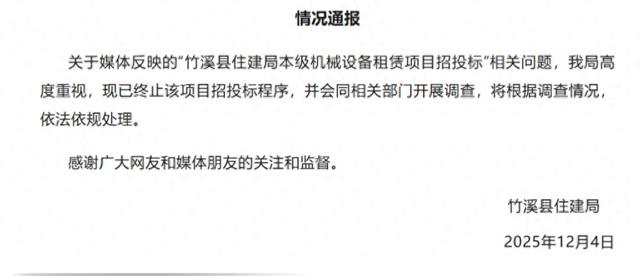
湖北竹溪通报“政府采购评审名单照搬百度人名大全”:已终止招投标程序
Guan Cha Zhe Wang· 2025-12-04 10:30
Core Viewpoint - The bidding process for the mechanical equipment leasing project by the Housing and Urban-Rural Development Bureau of Zhuxi County has been terminated due to significant errors in the evaluation process, which raised public concerns about the integrity of the procurement process [1][3][7]. Group 1: Project Overview - The project involved the leasing of mechanical equipment, with a total bid amount of 31.88 million yuan [5][8]. - The winning supplier for the project is Zhuxi Chuangtuo Labor Service Co., Ltd., located in the industrial park of Zhuxi County [5][8]. - The procurement was managed by Hubei Runyu Tendering Agency Co., Ltd. [8]. Group 2: Evaluation and Concerns - The evaluation committee for the bidding included five members, whose names coincidentally matched the first five names from a publicly available list, leading to public skepticism [3][6]. - A representative from the Zhuxi County Housing Bureau acknowledged that the errors were due to significant mistakes made by the entrusted agency during the information upload process, indicating a lack of oversight [7][8]. Group 3: Investigation and Response - An investigation has been initiated to address the issues raised, with a joint investigation team formed to handle the matter [1][7]. - The bureau's representative stated that the errors were a major oversight in their operations and regulatory processes [7].
“减肥神药”司美格鲁肽疑致失明,排队仿制的中国药企还好吗?
Guan Cha Zhe Wang· 2025-12-04 10:27
【文/王力 编辑/周远方】 近日,全球减肥药市场迎来剧变时刻。年销售额超254亿美元的诺和诺德旗下司美格鲁肽系列产品,因 视力损害副作用陷入舆论危机。今年六月,欧洲药品管理局正式确认该药可能引发非动脉炎性前部缺血 性视神经病变(NAION),导致患者突发性失明。 丹麦患者赔偿协会披露的43起索赔案件中,已有4名患者获赔近90万元人民币,将这场安全性争议推向 风口浪尖。作为占据诺和诺德71%营收的核心产品,司美格鲁肽在全球市场依然保持24%的增速,但其 中国市场增长已放缓至8%。 更严峻的是,随着2026年专利到期临近,中国多家药企围绕该药展开仿制药竞赛,礼来的双靶点竞品替 尔泊肽也凭借更优减重效果快速抢占高端市场。在安全性质疑与专利悬崖的双重夹击下,这款曾被视 为"减肥神药"的重磅产品能否守住全球药王地位,成为医药投资界最受关注的命题。 失明赔偿案引爆全球警示,监管收紧威胁千亿市值 据丹麦患者赔偿协会公布的数据显示,43名使用该药的患者因患有NAION申请赔偿。这种视神经病变 被医学界列为仅次于青光眼的失明第二大原因,尽管发病率被定义为"极罕见"——每万人约1例,但在 全球超5000万使用者的庞大基数下,潜在 ...

AI之后,特朗普政府开始关注机器人
Guan Cha Zhe Wang· 2025-12-04 10:21
近日,政治新闻网站Politico的一份报道显示,特朗普政府在推动美国人工智能创新后,正将注意力转 向机器人技术领域。 该报道援引接近政府的消息人士称,美国商务部长霍华德・勒特尼克已多次与机器人行业领袖会面,特 朗普政府正"全力投入"推动美国机器人技术的发展。 (右为霍华德・勒特尼克) 美国商务部发言人表示:"我们致力于机器人技术和先进制造,因为它们是将关键生产带回美国的核 心。" 视频中,这台机器人灵活地扭动身体,随着音乐节奏翩翩起舞,动作流畅自然。 本文系观察者网独家稿件,未经授权,不得转载。 目前,美国的机器人技术发展显著落后于全球其他国家,尤其是中国。 国际机器人联合会2024年9月发布的报告显示,中国工厂已部署近200万台工业机器人,而美国的这一指 标数量仅为中国的四分之一。 2025年11月中旬,标准机器人公司(Standard Bots)首席执行官埃文・比尔德在国会联合经济委员会作 证时表示,美国亟需一项国家机器人战略,以全面改善本国机器人技术与制造业发展现状。 据悉,特斯拉CEO埃隆·马斯克在近期的股东会上,将"擎天柱"描述为一台"印钞机"。他还表示,机器 人将让全球经济增长10倍甚至100倍 ...


四川小城的逆袭!在蔬菜地里,种下“理想生活”
Guan Cha Zhe Wang· 2025-12-04 09:47
Core Insights - The article highlights the innovative approaches taken by Pengzhou, Sichuan, to connect agricultural production with consumer markets, enhancing visibility and recognition of the industry while avoiding the "industry without a scene" dilemma [1] Group 1: Agricultural Development - Pengzhou is recognized as a representative region for "regional vegetables" in China, with a vegetable planting area of 820,000 acres and an annual output of approximately 2.35 million tons [3] - The annual China-Sichuan (Pengzhou) Vegetable Expo serves as a significant platform for showcasing the achievements of Sichuan's vegetable industry and facilitating external cooperation [3] Group 2: Event Transformation - The Vegetable Expo is transitioning from an industry-focused exhibition to a regional festival that integrates industry value, citizen participation, and cultural experiences [3][4] - The event features various activities such as vegetable-themed weddings, workshops, and music festivals, creating a vibrant atmosphere that engages the community [1][4] Group 3: Cross-Industry Collaboration - The integration of "vegetable+" collaborations with brands like NIO and local agricultural trading centers aims to expand the fashionable boundaries of "vegetable lifestyle" [4] - The local government, industry associations, and leading enterprises collaborate to provide professional resources and execute the event, enhancing the overall experience for participants [3][4] Group 4: Long-term Vision - The "Vegetable Aroma Super Ideal Village" project aims to deeply integrate the vegetable industry with cultural tourism, creating tangible experiences over a ten-year phased operation [5] - Future developments will include interactive experiences such as vegetable garden adoption and educational programs for children, promoting a sustainable "vegetable lifestyle" [5]

让豆包手机“自动驾驶”靠谱吗?
Guan Cha Zhe Wang· 2025-12-04 09:05
Core Viewpoint - ZTE Corporation's stock has declined nearly 1% after the initial excitement surrounding the launch of its "Doubao Assistant" smartphone, which sold out quickly and saw a price premium on second-hand platforms [1][4]. Group 1: Product Launch and Market Reaction - ZTE announced the limited release of the nubia M153 smartphone featuring the "Doubao Assistant" technology, priced at 3499 yuan, which led to a stock price surge and rapid sell-out [1][4]. - The "Doubao Assistant" is designed to enhance user interaction with smartphones by enabling multi-modal question answering and automatic price comparison across e-commerce platforms [1][4]. Group 2: Technology Comparison - The "Doubao Assistant" differs from traditional voice assistants by integrating deeply with the system, allowing for cross-application automation, akin to a "self-driving" mode for smartphones [4][5]. - Other major manufacturers like Honor and Vivo have also been exploring similar AI capabilities, indicating a competitive landscape in the smartphone AI assistant market [4][5]. Group 3: Privacy and Security Concerns - There are concerns regarding user data security and privacy, as the "Doubao Assistant" requires extensive permissions to function effectively, including reading user screens and accessing personal data [7][8]. - Doubao has stated that the assistant does not store user data on the cloud and requires user consent to access sensitive information, aiming to alleviate privacy concerns [8][10]. Group 4: Industry Dynamics and Challenges - The competition among smartphone manufacturers, AI model developers, and traditional app providers is intensifying, with a focus on controlling data access and user interactions [11][13]. - The current state of the "Doubao Assistant" is described as a "technical preview," indicating that it is still in the exploratory phase and not yet ready for mainstream consumer use [13][14].


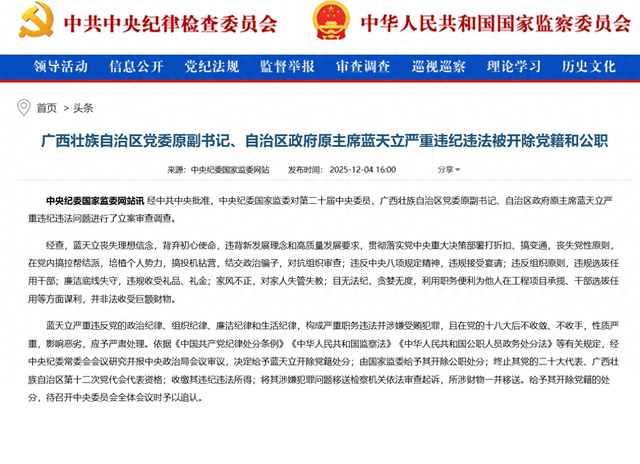
广西壮族自治区原主席蓝天立被开除党籍和公职
Guan Cha Zhe Wang· 2025-12-04 08:49
中央纪委国家监委网站12月4日消息,经中共中央批准,中央纪委国家监委对第二十届中央委员,广西 壮族自治区党委原副书记、自治区政府原主席蓝天立严重违纪违法问题进行了立案审查调查。 经查,蓝天立丧失理想信念,背弃初心使命,违背新发展理念和高质量发展要求,贯彻落实党中央重大 决策部署打折扣、搞变通,丧失党性原则,在党内搞拉帮结派,培植个人势力,搞投机钻营,结交政治 骗子,对抗组织审查;违反中央八项规定精神,违规接受宴请;违反组织原则,违规选拔任用干部;廉 洁底线失守,违规收受礼品、礼金;家风不正,对家人失管失教;目无法纪,贪婪无度,利用职务便利 为他人在工程项目承揽、干部选拔任用等方面谋利,并非法收受巨额财物。 蓝天立严重违反党的政治纪律、组织纪律、廉洁纪律和生活纪律,构成严重职务违法并涉嫌受贿犯罪, 且在党的十八大后不收敛、不收手,性质严重,影响恶劣,应予严肃处理。依据《中国共产党纪律处分 条例》《中华人民共和国监察法》《中华人民共和国公职人员政务处分法》等有关规定,经中央纪委常 委会会议研究并报中央政治局会议审议,决定给予蓝天立开除党籍处分;由国家监委给予其开除公职处 分;终止其党的二十大代表、广西壮族自治区第 ...