
Guo Ji Jin Rong Bao

Search documents
掌舵不足半年 康佳总裁曹士平离任
Guo Ji Jin Rong Bao· 2026-01-19 13:52
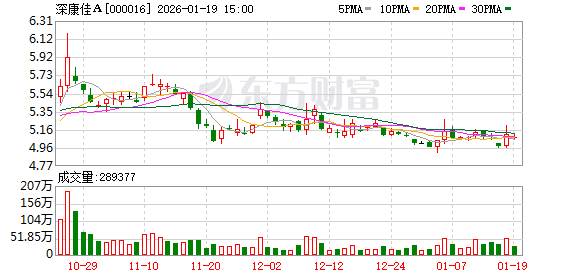
Management Changes - Konka Group's president, Cao Shiping, submitted his resignation due to work arrangements, effective January 16, and will continue to work within the company [2] - Vice President Yang Bo also submitted his resignation three days prior, with Dong Gang from China Resources Group appointed as his successor [2] - The frequent personnel changes are attributed to the accelerated entry of executives from China Resources [2] Shareholding and Control - In late July 2025, Konka Group officially transitioned to being controlled by China Resources after the transfer of 198 million B-shares from Overseas Chinese Town Group [3] - Wu Jianjun, with a background in China Resources, was appointed as the new chairman and legal representative of Konka [3] - The current board consists of five non-independent directors, four of whom have experience with China Resources-related enterprises [3] Financial Performance - Konka Group has seen a significant decline in revenue, dropping from over 55 billion yuan at its peak to less than 20 billion yuan, with three consecutive years of net losses totaling nearly 7 billion yuan from 2022 to 2024 [4] - The company anticipates another year of losses for 2025, marking four consecutive years of negative net profit [5] - For the first three quarters of 2025, Konka reported revenue of 7.679 billion yuan, a year-on-year decrease of 5.43%, and a net loss of 982 million yuan, an increase in loss of 38.89% compared to the previous year [5]


完成近25亿元融资后 天兵科技冲刺IPO
Guo Ji Jin Rong Bao· 2026-01-19 13:44
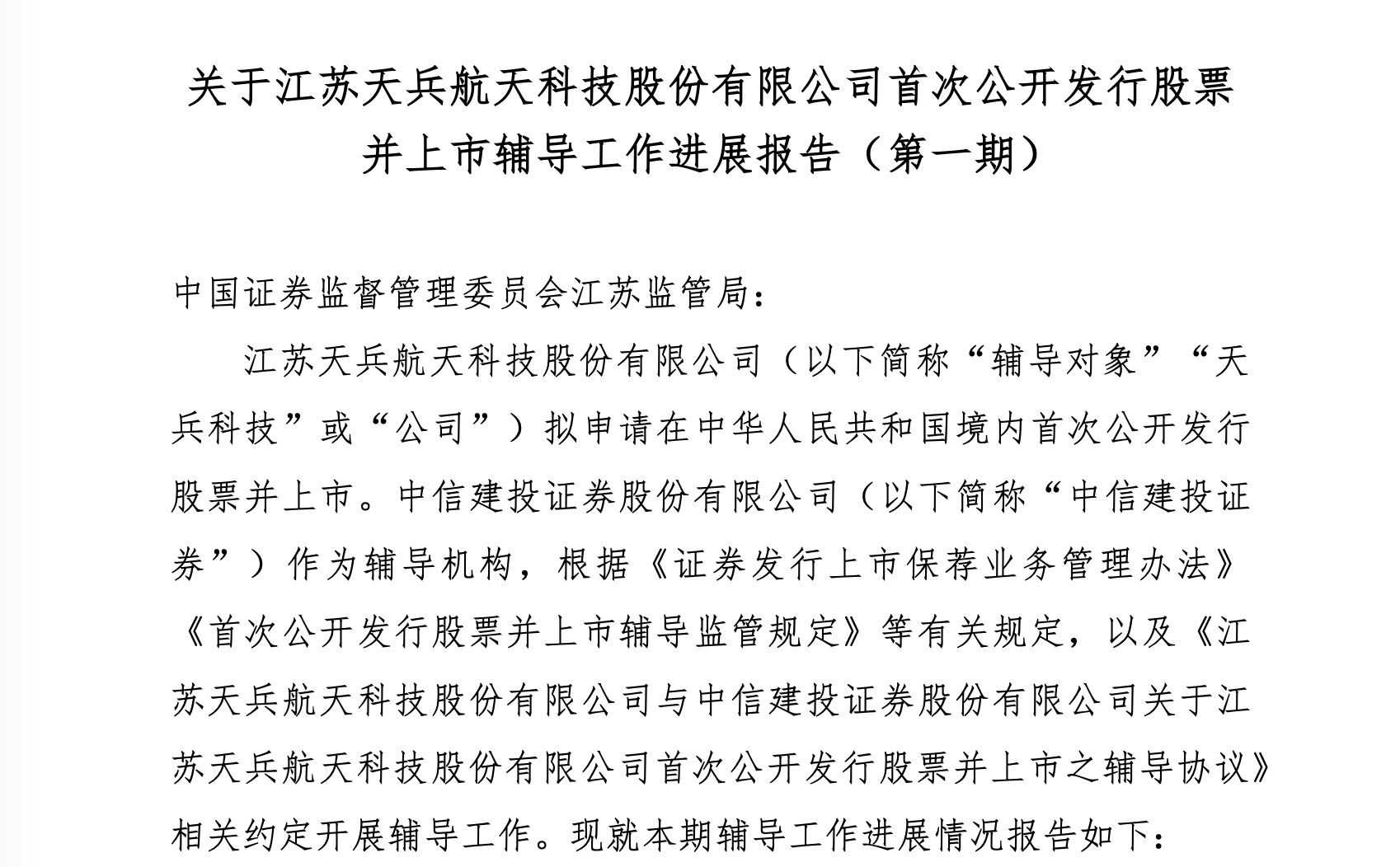
近期,江苏天兵航天科技股份有限公司(下称"天兵科技")公示了首次公开发行股票并上市辅导工作进展报告(第一期)。公告显示,中信建投证券股份有 限公司(下称"中信建投")为天兵科技本次辅导机构,同时参与本期辅导工作的其他证券服务机构还包括容诚会计师事务所(特殊普通合伙)和北京市中伦 律师事务所。 辅导备案报告显示,天兵科技注册在张家港经济技术开发区,注册资本为3.91亿元;控股股东为康永来,直接持股比例为23.49%。 | 辅 导 对象 | 江苏天兵航天科技股份有限公司 | | | --- | --- | --- | | 成立日期 | 2019年4月11日 | | | 注册资本 | 39,140.6162 万元 法定代表人 | 康永来 | | 注册地址 | 张家港经济技术开发区国泰北路 9号金通大厦 602 室 | | | 控股股东及 持 股 比 例 | 控股股东为康永来,直接持股比例为 23.49% | | | 行业分类 | 在其他交易场 C37 铁路、船舶、航空航天 所(申请)挂牌 | 无 | | | 和其他运输设备制造业 或上市的情况 | | | 谷 注 | 不存在近3年内提交首次公开发行股票/存托凭证并上 ...
掌舵不足半年,康佳总裁曹士平离任
Guo Ji Jin Rong Bao· 2026-01-19 13:41
Management Changes - The recent resignation of President Cao Shiping and Vice President Yang Bo indicates a significant shift in management at Konka Group, with a focus on integrating executives from China Resources [1][2] - The board will expedite the process of appointing a new president and board members following these resignations [1] Ownership Transition - In late July 2025, Konka Group officially transitioned to being controlled by China Resources after the completion of a share transfer involving 198 million B-shares [2] - The new chairman, Wu Jianjun, has a background in China Resources, reflecting the increasing influence of this group within Konka's leadership [2] Financial Performance - Konka Group has experienced a significant decline in revenue, dropping from over 55 billion yuan at its peak to less than 20 billion yuan, with a cumulative net loss of nearly 7 billion yuan over the past three years [3] - The company anticipates continued losses, projecting a negative net profit for the fiscal year 2025, marking the fourth consecutive year of losses [3] - For the first three quarters of 2025, Konka reported revenues of 7.679 billion yuan, a year-on-year decrease of 5.43%, and a net loss of 982 million yuan, an increase in loss of 38.89% compared to the previous year [3]
刚因“电芯”遭23亿天价索赔,欣旺达又卷入沃尔沃全球召回风波
Guo Ji Jin Rong Bao· 2026-01-19 13:00
Core Viewpoint - The recent recall of Volvo's electric vehicle EX30 due to battery safety issues has raised concerns about the responsibility of the battery supplier, A123, and has compounded existing sales pressures on Volvo [2][3][5]. Group 1: Volvo's Recall and Sales Performance - Volvo has initiated a global recall of its EX30 electric model due to high-voltage battery overheating risks, affecting markets including the US, Canada, South Africa, and Australia [2]. - In the UK, 10,440 units of the EX30 are confirmed to be affected, covering models from 2024 to 2026 [2]. - Volvo's global sales in 2024 are projected at 763,400 units, an 8% increase year-on-year, but sales in China, its largest market, have dropped to 156,400 units, the lowest in five years [4]. Group 2: Financial Impact and Battery Supplier Issues - In Q3 2023, Volvo's global sales fell to 160,500 units, a 7% year-on-year decline, with revenues of 86.4 billion Swedish Krona, down 6% [5]. - The recall has sparked controversy over battery supply responsibilities, with reports indicating that the problematic battery cells were produced by a joint venture involving A123 [5][6]. - A123's chairman stated that the battery packs were supplied through a different factory, distancing the company from direct responsibility for the issues [5]. Group 3: A123's Challenges and Market Position - A123 is facing significant challenges, including a recent lawsuit from Zeekr over battery quality issues, which has intensified scrutiny on the company's reliability [6][9]. - The company has seen a reduction in orders from key clients like Li Auto and Xiaomi, with the number of models supported by A123 for Li Auto dropping from 10 to 3 [9]. - A123's aggressive pricing strategy has led to declining profit margins, with a gross margin of only 9.77% in H1 2025, significantly lower than competitors [10]. Group 4: Financial Health and Future Outlook - A123 reported a loss of 1.87 billion Yuan in 2024, with cumulative losses exceeding 4.5 billion Yuan from 2023 to H1 2025 [10]. - The company's debt levels have risen sharply, with a debt-to-asset ratio of 67.62% and total liabilities reaching 67.9 billion Yuan [10]. - Concerns about ongoing litigation and financial losses may hinder A123's plans for an IPO in Hong Kong, which was anticipated for 2026 [10].

境内债展期方案还在“拉锯”,万科又被执行10.9亿元
Guo Ji Jin Rong Bao· 2026-01-19 12:55
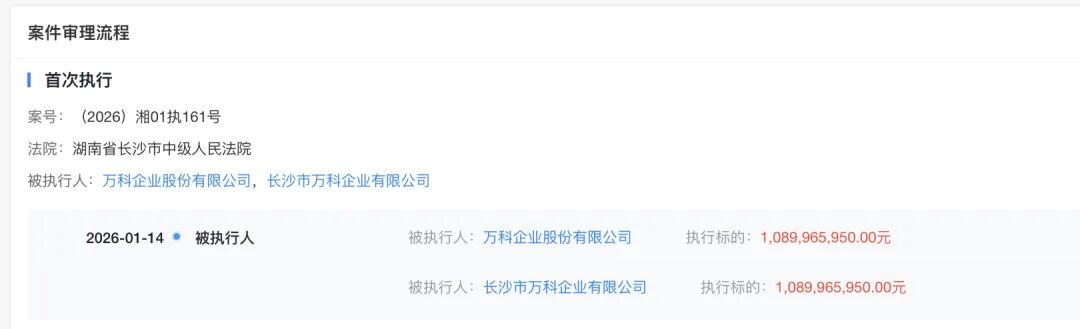
Core Viewpoint - Vanke Enterprises Co., Ltd. is facing significant financial distress, highlighted by recent legal actions and ongoing debt restructuring efforts [1][4][9] Group 1: Legal and Financial Issues - Vanke Enterprises has recently been subject to an execution order involving approximately 1.09 billion yuan, marking its first execution event since a bond extension incident [1][2] - The company has a history of legal challenges, including 14 instances of equity freezes totaling approximately 2.758 billion yuan, primarily occurring in 2025 [2][3] - The last execution event prior to this was in May 2023, involving a minimal amount of 3393 yuan [2] Group 2: Debt Restructuring Efforts - Since November 2025, Vanke has been attempting to extend two domestic debts totaling 5.7 billion yuan, facing multiple rejections from creditors [4] - A recent bondholder meeting agenda outlines proposals for extending the repayment of the "22 Vanke MTN004" bond by 12 months, with a new maturity date set for December 15, 2026 [5][6] - The company has proposed collateral measures involving receivables from three project companies to secure the unpaid principal and interest during the extension period [6][8] Group 3: Bondholder Meeting Proposals - The bondholder meeting for "22 Vanke MTN004" is scheduled for January 21, 2026, with voting deadlines set for January 26 and 27 for different proposals [8] - Proposed arrangements include fixed payments of 100,000 yuan to bondholders who agree to certain proposals, with specific percentages of principal due by January 28, 2026 [7][8] - Similar proposals are outlined for "22 Vanke MTN005," indicating a consistent approach to managing debt obligations [8]

从长三角一体化,看上海“十五五”规划建议
Guo Ji Jin Rong Bao· 2026-01-19 12:39
Core Viewpoint - The Shanghai Municipal Party Committee has released a proposal for the 15th Five-Year Plan, aiming to transform Shanghai into a world-class socialist modern international metropolis by 2035, with a focus on high-quality development and regional integration in the Yangtze River Delta [1]. Group 1: Five Centers Upgrade - Shanghai aims to upgrade its "Five Centers" by 2035, achieving international leading levels in key development indicators, including doubling per capita GDP from 2020 levels [2]. - During the 14th Five-Year Plan, Shanghai's GDP surpassed 5 trillion yuan, becoming the first city in China to achieve this milestone and ranking among the top five global cities [2]. - The upgrade of the "Five Centers" will enhance resource allocation for the Yangtze River Delta, transitioning from single-function enhancement to system integration [2][3]. Group 2: Implementation Paths - The proposal outlines three implementation paths: leveraging financial support for innovation, creating regulatory innovations, and fostering new productive forces to reshape industrial chains [3]. - Shanghai's economic growth is projected to remain reasonable and synchronized with national trends, with a steady increase in total factor productivity [3]. Group 3: Key Industries - The three leading industries—integrated circuits, biomedicine, and artificial intelligence—will further solidify their positions, focusing on overall breakthroughs in the industrial chain [4]. - The artificial intelligence sector is expected to grow significantly, with projected revenues exceeding 550 billion yuan by 2025, reflecting a growth rate of over 30% [4]. Group 4: Institutional Innovation - High-level openness is a core advantage for Shanghai, with institutional innovations aimed at enhancing regional development dynamics [6]. - The proposal emphasizes the role of the Pudong New Area and Lingang New Area in driving institutional innovation and creating replicable models for the Yangtze River Delta [6][7]. Group 5: Collaborative Development - The proposal aims to establish a "power community" in the Yangtze River Delta, focusing on collaborative technological innovation, ecological protection, and spatial optimization [10]. - Specific paths for collaboration include deepening the integration of innovation chains and enhancing cooperation in key technology areas [11]. Group 6: Environmental and Spatial Optimization - The proposal highlights the importance of ecological protection and spatial layout optimization to enhance collaborative capacity in the Yangtze River Delta [12]. - Shanghai will promote the construction of a metropolitan area with a multi-node structure, facilitating coordinated development with surrounding regions [12]. Group 7: Social Welfare and Integration - The proposal emphasizes the sharing of public services across the Yangtze River Delta, enhancing the quality of life for residents in education, healthcare, and other areas [13]. - Shanghai's successful experiences in community services will be extended to the Yangtze River Delta, ensuring that high-quality development benefits a broader population [13].
天箭科技:预计2025年净利润同比下降1,657.73%~1,196.06%
Guo Ji Jin Rong Bao· 2026-01-19 12:08
Core Viewpoint - The company Tianjian Technology expects a significant decline in net profit for the fiscal year 2025, projecting a loss between 2.498 billion to 176 million yuan, representing a year-on-year decrease of 1,657.73% to 1,196.06% [1] Group 1 - The primary reason for the decline in revenue and net profit attributable to shareholders, excluding non-recurring gains and losses, is the adjustment in the price difference between the company's provisional pricing and the approved pricing [1]

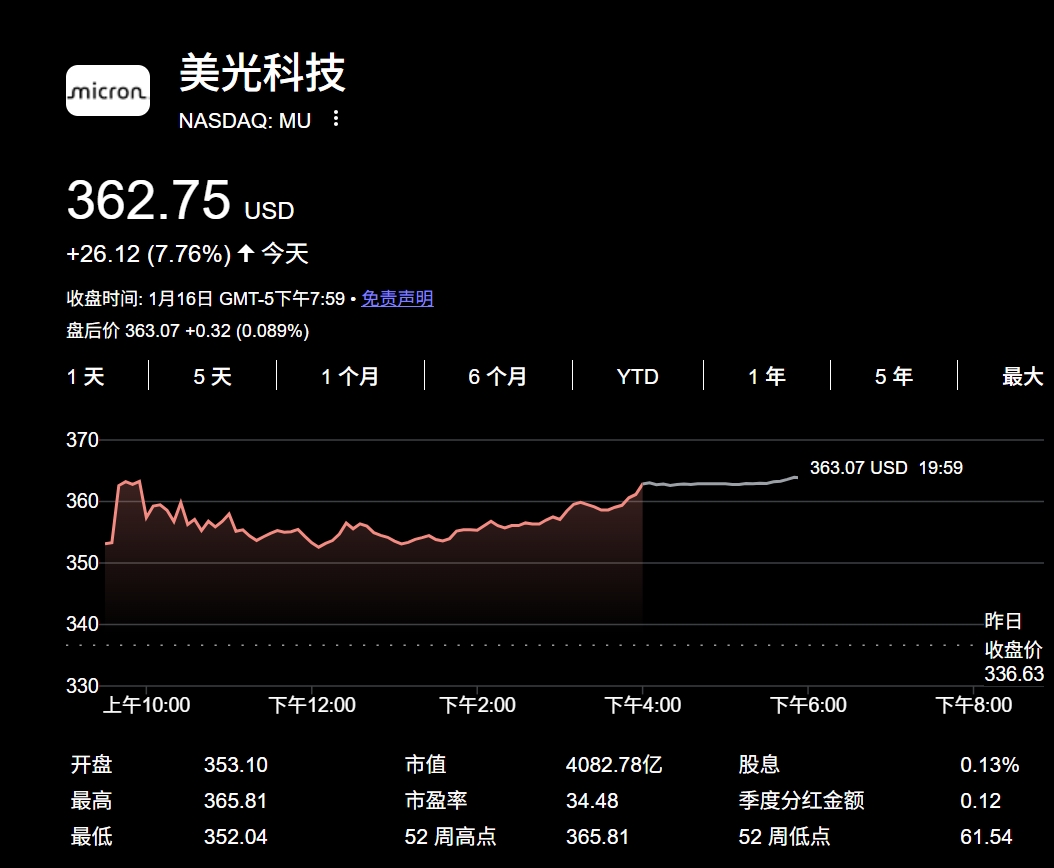
美光股价暴涨背后
Guo Ji Jin Rong Bao· 2026-01-19 11:23
Core Viewpoint - Micron Technology's stock price surged over 7% to a record high of $362.75, with a market capitalization reaching $408 billion, driven by strong demand for AI-related memory products [1][4]. Group 1: Stock Performance - On January 16, Micron's stock closed at $362.75, marking a 7.76% increase from the previous day [2]. - The stock's after-hours price was $363.07, reflecting a slight increase of 0.089% [2]. - Over the past three months, Micron's stock price has risen by 86%, and it has increased by 245% over the past year [4]. Group 2: Financial Performance - For the fiscal year ending August 28, 2025, Micron reported revenues of $37.38 billion, up from $25.11 billion in the previous fiscal year [5]. - The non-GAAP earnings per share for the fiscal year 2025 were $8.29, a significant increase from $1.30 in the prior year [5]. - Micron is projected to achieve a 99% revenue growth rate in fiscal year 2026, ranking tenth among S&P 500 companies [5]. Group 3: Market Dynamics - The demand for high bandwidth memory (HBM) chips has surged due to the growth of AI applications, leading to a "memory shortage" across the industry [4]. - Micron's products are widely used in hardware that drives AI applications, enhancing its pricing power [4]. - The company has sold out its AI memory chips through 2026 and is expanding production capacity by building a new factory in New York and acquiring a wafer fab in Taiwan for $1.8 billion [4][5]. Group 4: Analyst Insights - Analysts from Mizuho and Morgan Stanley have highlighted the positive market sentiment towards Micron and memory stocks, citing limited memory capacity and strong demand for AI as key factors [6]. - Morgan Stanley has ranked Micron among the top ten global DRAM suppliers, emphasizing the long-term visibility of orders due to rising AI demand [6].

远翔新材:预计2025年净利润同比增长76.27%~107.37%
Guo Ji Jin Rong Bao· 2026-01-19 11:15
Core Viewpoint - The company expects a net profit of 85 million to 100 million yuan for the year 2025, representing a year-on-year growth of 76.27% to 107.37% [1] Group 1: Financial Performance - The anticipated increase in net profit is primarily attributed to ongoing technological innovation and optimization of product structure [1] - The company's production and sales volume are expected to further increase, contributing to the profit growth [1] - A decline in the prices of key raw materials is projected to reduce unit production costs, leading to an increase in product gross margin [1]
永安行:预计2025年年度净利润亏损2亿元到-1.6亿元
Guo Ji Jin Rong Bao· 2026-01-19 11:03
永安行公告,预计2025年年度实现归属于上市公司股东的净利润为-2亿元到-1.6亿元;预计2025年年度 实现归属于上市公司股东的扣除非经常性损益的净利润为-1.8亿元到-1.4亿元。公司对存在减值迹象的 共享出行设备计提了减值准备,部分客户拖延付款造成应收款项未能及时到账,信用减值损失计提增 加,对收购浙江凯博形成的商誉计提减值准备。 ...
