Jin Rong Shi Bao

Search documents
保险业确立数字金融“双轮驱动”新航标
Jin Rong Shi Bao· 2025-12-31 01:54
Core Viewpoint - The implementation plan for high-quality development of digital finance in the banking and insurance sectors emphasizes a dual-driven approach of digital technology and data elements, aiming to enhance the integration of the insurance industry into the real economy and national strategies [1][2]. Group 1: Digital Financial Development Goals - The plan outlines major goals for the insurance industry's digital financial development over the next five years, focusing on significant progress in digital transformation and the enhancement of capabilities driven by digital technology and data elements [2]. - It encourages the exploration of innovative applications of digital technology and data elements, aiming to improve financial service quality in key areas such as technology, green finance, inclusive finance, and elderly care [2]. Group 2: Organizational Structure and Governance - The plan prioritizes establishing a robust governance mechanism for digital finance, requiring insurance institutions to strengthen top-level design and build a digital operation system [3]. - It mandates the formation of leadership groups or committees responsible for digital finance, emphasizing the need for unified metrics that align digitalization with business growth and service quality [3]. Group 3: Risk Management and Service Integration - The plan identifies eight key areas for digital financial empowerment, highlighting the evolution of insurance from post-event compensation to risk reduction and insurance protection [4][5]. - It proposes the development of insurance products that provide risk coverage for technology enterprises, focusing on network security and data asset risks, thereby opening new opportunities for the insurance sector [4]. Group 4: Enhancing Financial Services - The plan calls for the development of personalized digital financial products to improve financial services in healthcare and elderly care, while addressing the digital divide [6]. - It emphasizes the importance of data collaboration between insurance institutions and healthcare providers to enhance consumer experience and compliance with data protection regulations [6]. Group 5: Support for Rural Revitalization - The plan encourages the use of IoT and AI technologies to broaden the scope of agricultural insurance products, enhancing efficiency in loss assessment and reducing moral hazard [6]. - It aims to integrate remote sensing and mobile internet data into agricultural insurance, thereby improving the overall risk management capabilities of the insurance industry [6].
慢病“长战线”上的 民生温度与政策期待
Jin Rong Shi Bao· 2025-12-31 01:54
Group 1 - The article highlights the importance of chronic disease management and the positive impact of recent policy changes on patients, particularly in terms of financial relief and accessibility to medications [1][2] - There is a concerning trend of chronic diseases becoming more prevalent among younger populations, with individuals in their 30s and 40s increasingly affected, indicating a need for early intervention and awareness [1][2] - The article emphasizes the necessity for a comprehensive approach to chronic disease management that includes prevention, diagnosis, treatment, and ongoing support, aligning with the "Health China" strategy that prioritizes prevention [2][3] Group 2 - The article discusses the role of commercial insurance in enhancing the multi-tiered healthcare system, providing personalized health management services, and addressing gaps in coverage for rare and chronic diseases [3] - It mentions the need for continuous development and implementation of policies to ensure effective chronic disease management and support for patients, highlighting the importance of sustained efforts in healthcare reform [2][3] - The sentiments expressed by patients reflect a recognition of the benefits of current policies and a hopeful outlook for future improvements in healthcare support [3]
从“用药愁”到“药无忧” 医保与商保联手破解慢特病保障困局
Jin Rong Shi Bao· 2025-12-31 01:54
Core Insights - The article highlights the significant improvements in the management and reimbursement of chronic diseases in Baoji City, Shaanxi Province, addressing the economic burden on patients and enhancing healthcare accessibility [1][2][3]. Group 1: Patient Experience and Benefits - Baoji City has implemented a chronic disease reimbursement policy that has been in place for 14 years, evolving from offline to online services, significantly reducing the financial burden on patients [1][3]. - Patients like Ma Laifen and Kong Xianyong have reported substantial reductions in their medication costs due to the reimbursement policy, with Kong's out-of-pocket expenses dropping to just a few dozen yuan per month [2][3]. - The policy has improved the quality of life for patients, allowing them to manage their health better and reducing the need for frequent hospital visits [2][3]. Group 2: Government and Insurance Collaboration - The collaboration between the government and insurance companies, such as Renbao Health, has been crucial in developing a comprehensive service model for chronic disease management [3][4]. - The initiative aims to alleviate the pressure on healthcare staff and streamline the reimbursement process for patients, addressing the challenges of manpower shortages in healthcare administration [4][5]. Group 3: Regulatory and Technological Innovations - Baoji City has introduced a "1366" smart regulatory model to enhance the oversight of retail pharmacies, ensuring the safety of healthcare funds and compliance with regulations [6][7]. - The system includes multiple intelligent checkpoints to prevent misuse of chronic disease reimbursement funds, thereby improving the integrity of the healthcare system [7][8]. Group 4: Healthcare Management and Accessibility - The healthcare management system in Baoji has evolved to provide comprehensive services, including home visits and health monitoring for chronic disease patients, enhancing patient engagement and care [10][11]. - The integration of technology in health management has streamlined processes, allowing for quicker approvals and better patient data management [11][12]. Group 5: Future Challenges and Sustainability - As the number of insured patients continues to grow, the policy faces challenges related to service optimization and sustainable development [13][14]. - The company is exploring sustainable service paths through collaboration with various sectors while ensuring the quality of care remains high [15].
以精准供给提升保险保障“含金量”
Jin Rong Shi Bao· 2025-12-31 01:52
Group 1 - The insurance industry in China has made significant strides in high-quality development, addressing gaps in insurance coverage and enhancing supply in weak areas [1] - A platform called "Car Insurance Good to Insure" was established to tackle the high claim rates and data inadequacies in new energy vehicle insurance, providing coverage for over 1.1 million vehicles with a total insured amount of 1.1 trillion yuan [1] - The platform has expanded to include high-risk fuel-operated vehicles, further alleviating insurance difficulties for trucks and taxis [1] Group 2 - The insurance sector is actively aligning with emerging industries, providing customized insurance solutions to mitigate risks associated with technological innovation, with over 10 trillion yuan in risk coverage provided during the 14th Five-Year Plan [2] - The industry has supported 3,600 innovative application projects through insurance, enhancing corporate innovation capabilities [2] Group 3 - The insurance industry has focused on new citizens and the elderly, launching specialized insurance products to meet the needs of gig economy workers and providing essential coverage for accidents and injuries [3] - There has been an expansion of commercial pension products and long-term care insurance for the elderly, addressing the financial pressures faced by the aging population [3] Group 4 - The insurance industry has contributed to rural revitalization by offering diverse insurance products like "anti-poverty insurance" and complete cost insurance for staple grains, providing risk coverage for 800 million farming households [4] - The increase in insurance supply is not just about product quantity but also requires ongoing improvements in service quality, claims efficiency, and risk pricing [4]
险企密集“去监事会” 保险业公司治理变革深化
Jin Rong Shi Bao· 2025-12-31 01:52
Core Viewpoint - The insurance industry is undergoing a significant transformation with the "exit of the supervisory board," as many companies are abolishing this governance structure to enhance efficiency and adapt to new regulatory requirements [2][4]. Group 1: Changes in Governance Structure - As of December 25, 2023, 13 insurance companies, including China Life and China Pacific Insurance, have announced the abolition of their supervisory boards, marking a profound change in the long-standing "three meetings and one layer" governance framework [2][3]. - The trend began with Japan's insurance company in April 2023, which was the first to announce the removal of the supervisory board, followed by state-owned insurance groups [2][3]. - By December 2023, major companies like China Life and New China Life had completed the necessary regulatory approvals to officially abolish their supervisory boards [3][4]. Group 2: Policy and Regulatory Drivers - The reform is driven by the new Company Law effective July 2024, allowing state-owned companies to replace supervisory boards with audit committees, which can enhance governance efficiency [4]. - The China Banking and Insurance Regulatory Commission issued a notice in December 2024, clarifying that financial institutions can establish audit committees to perform the functions of supervisory boards [4]. Group 3: Motivations Behind the Reform - The primary motivations for abolishing supervisory boards include the need to reduce costs, improve efficiency, and address issues of overlapping functions and formalized supervision [4]. - The transition is not seen as a reduction in oversight but rather a restructuring of the supervisory system, with audit committees taking over the responsibilities of the supervisory boards [4]. - The industry anticipates that this reform will enhance compliance and risk management capabilities, contributing to the high-quality development of the insurance sector [4].



2025年: 保险业瞄准风险保障“薄弱环节”精准发力
Jin Rong Shi Bao· 2025-12-31 01:44
破解新能源车"投保难" 今年1月,在常规渠道遇到投保困难的新能源汽车客户,不用再为投保问题担忧。金融监管总局指导中 国保险行业协会和上海保险交易所搭建的"车险好投保"平台上线,新能源车主可通过平台自主选择保险 公司,跳转至对应页面完成投保,保险公司不得拒保。截至10月底,已有37家财险公司接入该平台, 110多万辆车顺利通过平台投保,提供保障1.1万亿元,解决了新能源汽车"投保难"问题,受到社会各界 的广泛好评。 2025年是"十四五"规划的收官之年,保险业积极把握发展机遇,聚焦经济社会发展中风险保障的薄弱环 节,持续深化供给侧结构性改革。特别是在车险、科技保险、普惠保险等重点领域,行业通过产品创 新、服务升级、模式优化等多维度举措,显著提升了风险保障能力。 据乘联分会数据,自今年3月起,新能源汽车在国内乘用车市场零售渗透率已突破50%。经初步测算, 12月,国内狭义乘用车零售总市场规模预计约为230万辆,其中新能源汽车有望达到138万辆左右,渗透 率或首次突破60%。 面对这一快速发展的巨大市场,保险业在风险定价、保障范围、服务模式等多个维度展开积极探索与实 践,持续完善新能源汽车专属保险产品体系。 在风险 ...
中国农业发展银行聚焦服务乡村振兴战略 奋力发挥农村金融体系中的主体和骨干作用
Jin Rong Shi Bao· 2025-12-31 00:49
Core Viewpoint - The Agricultural Development Bank of China (ADBC) is committed to implementing the Party's leadership and policies throughout its operations, focusing on rural revitalization and agricultural modernization during the 14th Five-Year Plan period [1][3][15]. Group 1: Party Leadership and Governance - ADBC emphasizes the integration of Party leadership into strategic planning and policy execution, ensuring adherence to the central authority and promoting a culture of innovation and education within the organization [1][2]. - The bank has established a comprehensive supervision and management system to enhance accountability and prevent corruption, aligning with the central government's directives [2]. Group 2: Rural Revitalization and Agricultural Support - ADBC focuses on four key areas: food security, agricultural modernization, urban-rural integration, and rural ecological civilization, aiming to support national agricultural policies [3][4]. - The bank has provided over 1.5 trillion yuan in loans for grain and oil purchases, accounting for more than 50% of the total national grain procurement [4]. - ADBC has implemented various projects to enhance agricultural productivity, including support for high-standard farmland construction and innovative financing models for grain trade [4][5]. Group 3: Poverty Alleviation and Economic Development - ADBC has invested nearly 2.5 trillion yuan in targeted poverty alleviation efforts, maintaining a strong focus on supporting vulnerable populations and ensuring the sustainability of poverty alleviation outcomes [5]. - The bank has facilitated initiatives that connect urban and rural economies, such as supporting local industries and employment opportunities for relocated populations [5][10]. Group 4: Infrastructure and Urban-Rural Integration - ADBC has launched initiatives to improve rural infrastructure, with over 5 trillion yuan in loans allocated to urban-rural integration projects, significantly increasing investment in rural development [8][10]. - The bank supports major water conservancy projects and rural road upgrades, contributing to the overall enhancement of rural living conditions [8][10]. Group 5: Ecological and Sustainable Development - ADBC is committed to promoting green development, with a 254% increase in green loan balances since the beginning of the 14th Five-Year Plan, focusing on ecological restoration and pollution prevention [9]. - The bank supports various environmental projects, including clean energy initiatives and rural waste management, to foster sustainable rural communities [9]. Group 6: Financial Innovation and Institutional Development - ADBC is enhancing its financial products and governance structures to improve operational efficiency and risk management, aligning with national financial reform goals [13][14]. - The bank has become a major player in the bond market, significantly increasing its asset base and optimizing its liability structure to support agricultural financing [14].
这家股份行宣布由董事长暂代行长→
Jin Rong Shi Bao· 2025-12-30 13:18
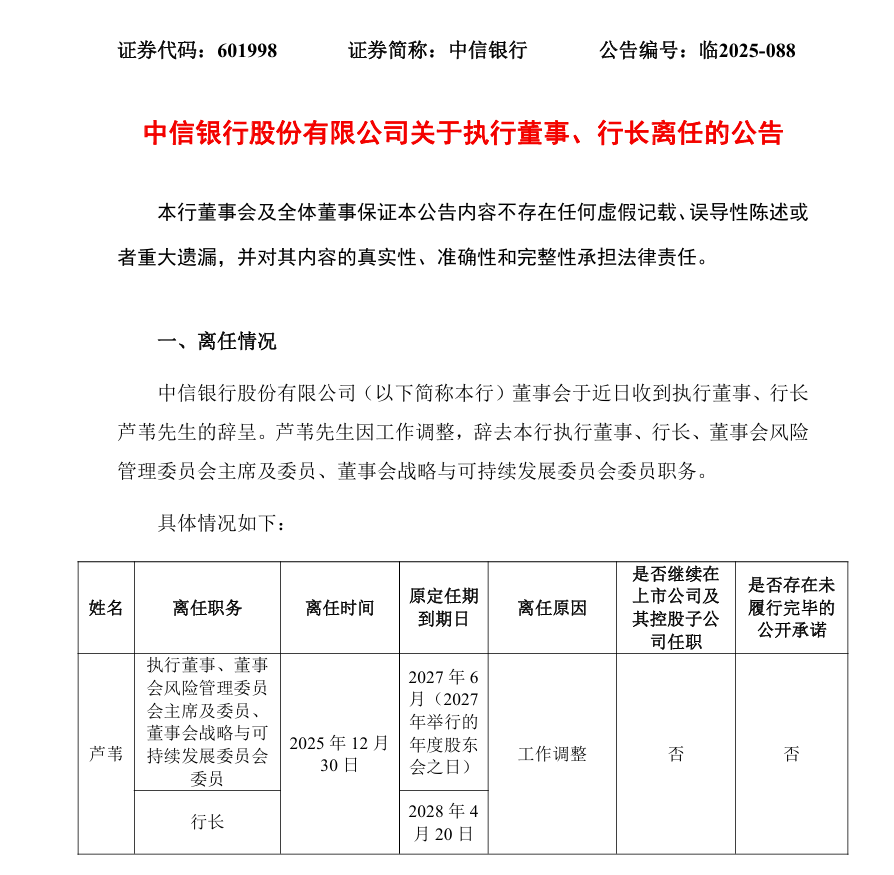
Core Viewpoint - The resignation of Lu Wei, the Executive Director and President of CITIC Bank, is attributed to work adjustments, and he will take on a new role as Vice President of China Post Group and is nominated as the candidate for Executive Director of Postal Savings Bank [3][4]. Group 1: Resignation Details - Lu Wei has submitted his resignation from multiple positions including Executive Director, President, and various committee roles at CITIC Bank due to work adjustments [3]. - His resignation will not result in the board of CITIC Bank falling below the legal number of members, and the bank has ensured proper work handover [5]. Group 2: Background and Achievements - Lu Wei has served at CITIC Bank for 26 years, holding key positions in both domestic and international branches, and became President in April 2025 [4]. - During his tenure, he advanced the bank's "Five Leading" initiatives, strengthened risk compliance, and improved financial management, contributing positively to the bank's service to the real economy and overall competitiveness [4]. Group 3: Financial Performance - As of the end of the third quarter, CITIC Bank reported total assets of 98,981.28 billion, a year-on-year increase of 3.83% [5]. - The bank achieved a net profit attributable to shareholders of 53.39 billion, reflecting a year-on-year growth of 3.02%, with operating income reaching 156.60 billion [5]. - Loan balances in key sectors such as manufacturing, strategic emerging industries, and private economy showed significant growth, with increases of 15.44%, 13.14%, and 6.01% respectively compared to the previous year [5].


官宣!明年,“国补”继续!
Jin Rong Shi Bao· 2025-12-30 12:24
Core Viewpoint - The National Development and Reform Commission and the Ministry of Finance have issued a notice regarding the continuation of large-scale equipment updates and consumer goods replacement policies in 2026, optimizing support scope, subsidy standards, and implementation mechanisms [1] Group 1: Optimization of Support Scope - The support scope for equipment updates will generally continue from 2025, with additions in the livelihood sector for old residential elevators and equipment updates in elderly care institutions, as well as in safety for firefighting and inspection equipment [2] - The policy will continue to implement subsidies for scrapping and replacing automobiles, and for replacing old household appliances, focusing on six categories: refrigerators, washing machines, televisions, air conditioners, computers, and water heaters [2] - The subsidy for digital products will be expanded to include smart products such as smartphones, tablets, smartwatches, smart glasses, and smart home products, including those designed for the elderly [2] Group 2: Optimization of Subsidy Standards - For equipment updates, the subsidy for updating old residential elevators will be adjusted from a fixed amount to a tiered subsidy based on the number of elevator floors [3] - In the scrapping and replacing of old operational trucks, priority will be given to supporting the replacement with electric trucks [3] - The subsidy for household appliances will be adjusted to support products with a 1st-level energy efficiency or water efficiency rating, providing 15% of the product price as a subsidy, with a maximum of 1,500 yuan per item [3] Group 3: Optimization of Implementation Mechanisms - The project application mechanism and review process for equipment updates will be optimized to lower the investment threshold for applications and increase support for small and medium-sized enterprises [4] - The funding allocation method for consumer goods replacement will be optimized, with strict measures against fraudulent claims and illegal practices [4] - The notice emphasizes the need for coordinated efforts among various departments to implement the policies effectively, with local governments required to organize and enhance the effectiveness of the policies [4]
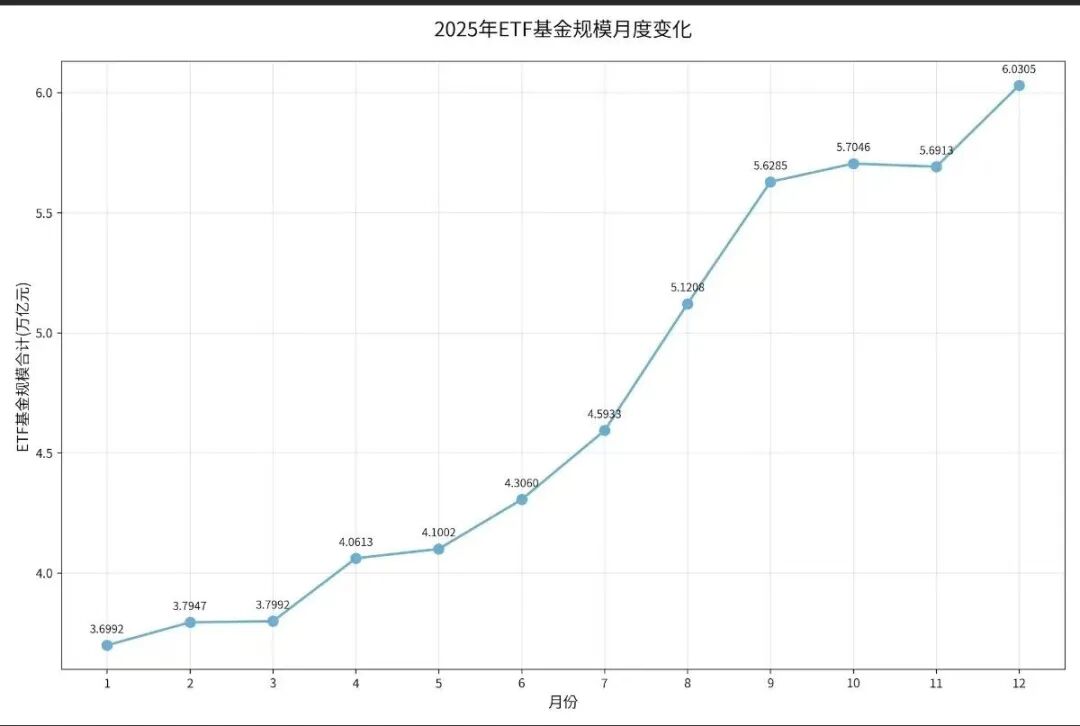
ETF规模突破6万亿元,年内增长超63%
Jin Rong Shi Bao· 2025-12-30 10:53
Group 1 - The total scale of ETFs in China has surpassed 6 trillion yuan, reaching 6.03 trillion yuan, representing a growth of over 63% compared to the beginning of the year [1] - As of December 29, the domestic ETF market reached a total scale of 60,281.10 billion yuan, with stock ETFs being the largest category at 38,500 billion yuan, accounting for 63.8% of the total [3] - The growth in stock ETFs this year exceeded 800 billion yuan, with the CSI A500 ETF being the largest contributor, attracting a net inflow of 960.65 billion yuan in December alone [3] Group 2 - The largest ETF product is the Huatai-PB CSI 300 ETF, with a scale of 4270.67 billion yuan, followed by the E Fund CSI 300 ETF, which exceeds 2100 billion yuan [4] - Long-term funds, represented by insurance and social security funds, have been increasing their positions in A-shares, primarily through ETF tools, focusing on core broad-based and high-dividend assets [4] - The trend of long-term investment is deepening, with insurance funds directly investing in A-shares reaching 3.6 trillion yuan, accounting for 9.7% of the total investment balance [4] Group 3 - The investment community is entering a new era of ETFs, with index investment becoming a mainstream tool in capital markets [5] - Index investment is not merely passive; it can incorporate stock selection logic and asset allocation strategies, especially in a market with structural differentiation [5] - The application of AI technology and the maturation of index investment participants are enhancing the value of factor-based indices, allowing for more refined investment strategies [5] Group 4 - For investors seeking stable returns, a multi-asset and multi-strategy allocation approach is essential for achieving long-term goals [6] - The recommended asset allocation hierarchy follows the logic of "equities > commodities > bonds," with adjustments based on market assessments [6] - The current market offers a variety of low-correlation assets, providing a solid foundation for multi-asset allocation strategies [7]